
Military Insurance Guide: Tricare West, TriWest & More
Military insurance is one of the more misunderstood areas of healthcare contracting and billing. Even experienced administrative teams can struggle to distinguish among TRICARE West, TriWest, TRICARE East, and TRICARE for Life because the names sound similar. However, the administrative processes and reimbursement rules differ significantly.
For medical practices, that confusion creates operational risk.
A clinic may assume it is in-network when it is not. Staff may misunderstand referral requirements. Billing teams may process claims incorrectly because they do not realize they are dealing with a VA Community Care patient instead of a TRICARE patient. In other situations, practices delay credentialing until patients are already scheduled. They only discover afterward that enrollment timelines can take months.
The challenge is that military-related insurance programs are not structured the same way as standard commercial plans. They involve different administrators, eligibility groups, and participation models depending on geography and patient type.
Once practices understand how these programs are separated operationally, the workflows become much easier to manage.
Key Takeaways
- TRICARE and TriWest are separate programs with different authorization and reimbursement workflows.
- Participation status affects both reimbursement handling and patient financial responsibility.
- Credentialing delays can disrupt scheduling, claims submission, and patient access.
- TRICARE for Life requires accurate Medicare coordination and secondary billing workflows.
- Military insurance programs require stronger eligibility verification and referral oversight than many commercial plans.
Table of Contents
Why Military Insurance Creates Operational Confusion
Part of the confusion comes from the fact that multiple organizations are involved in administering care for military members, retirees, and veterans.
TRICARE is the official healthcare program for the Department of Defense. Within that system, regional contractors manage provider networks and claims processing. Private companies like TriWest also coordinate certain services connected to the VA Community Care Network.
To patients, all of this may simply sound like “military insurance.” From an administrative standpoint, these programs function very differently.
A front desk employee may only see the insurance card and assume the process is similar to Medicare or a commercial PPO. The billing team may not immediately recognize that referral rules or authorization requirements differ depending on whether the patient is active duty, retired military, Medicare-eligible, or connected to VA community care.
When these front-office oversight gaps go unchecked, they naturally trigger severe downstream denials across your entire medical practice revenue cycle management and operations.
That is where operational breakdowns and reimbursement confusion often begin.
The issue is rarely that practices are unwilling to learn the system. The issue is that military insurance programs require more upfront verification and clearer workflow separation than many practices expect.
Operational Snapshot
Military insurance complexity stems from administrative variation rather than payer volume. When front-office teams correctly distinguish TRICARE, TriWest, and TRICARE for Life workflows, they are better positioned to prevent denials across the medical practice revenue cycle.
Understanding the Difference Between TRICARE and TriWest
| Program | Main Population | Operational Role |
|---|---|---|
| TRICARE West/East | Active-duty military, retirees, families | Regional military insurance administration |
| TriWest | Veterans using VA Community Care | Coordinates care outside VA facilities |
| TRICARE for Life | Medicare-eligible military beneficiaries | Secondary coverage alongside Medicare |
One of the biggest misunderstandings is assuming TRICARE and TriWest are interchangeable.
Although the names are similar, the administrative structure, patient eligibility rules, and authorization processes are handled differently.
TRICARE is the actual insurance program for active-duty military members, retirees, and their families. It includes multiple plans such as TRICARE Prime, TRICARE Select, and TRICARE for Life.
TriWest is a private company that serves as a regional third-party administrator for the VA Community Care Network (CCN). It does not manage the Department of Defense’s active-duty infrastructure. Instead, it coordinates care outside VA facilities for eligible Veterans under the VA’s strict authorization guidelines.
That distinction matters because referral handling, prior authorizations, reimbursement schedules, and patient eligibility verification processes are entirely distinct. TRICARE utilizes regional commercial clearinghouse Payer IDs such as PGBA or Humana Military. TriWest CCN claims, however, to route through an independent veteran-specific repository.
For example, a practice may schedule a veteran, assuming standard TRICARE Prime referral rules apply, only to later discover that the patient required an approved, trackable VA Community Care referral number issued by TriWest before services were rendered.
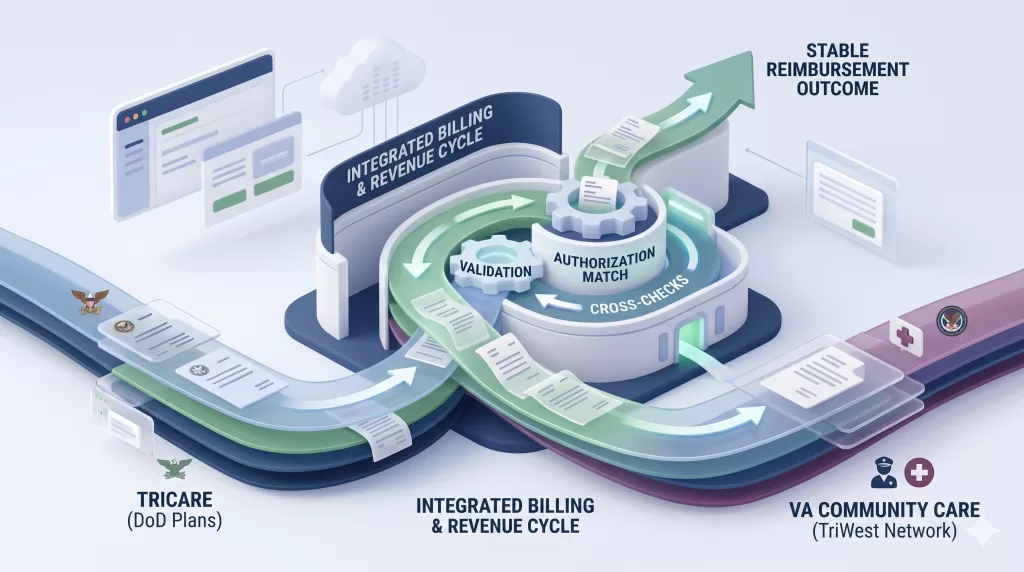
If staff treat those workflows the same way, denials and delays become much more likely.
For practices interested in learning more about provider participation and enrollment requirements, these resources are important starting points:
- TRICARE West provider resources
- Health Net Federal Services provider information
- TriWest Healthcare Alliance provider enrollment information
How TRICARE West and TRICARE East Are Structured
TRICARE is divided into regional administration models.
TRICARE regional administration is handled by contracted organizations that oversee provider networks, claims processing, and regional support functions. Practices should verify current regional contractor information directly through official TRICARE resources because administrative contracts and oversight responsibilities can change over time. The contractor your practice works with depends primarily on geography.
This matters because provider participation, enrollment, and contracting are handled regionally. A practice cannot assume the same process applies nationwide.
In some areas, especially near military bases, there may be greater demand for participating providers. In other regions, practices may find it harder to obtain in-network participation status because the network is already considered adequate.
Understanding Non-Network vs. Non-Participating Status
One area that creates confusion for medical practices is the difference between non-network and non-participating status. These terms sound similar. However, they can affect reimbursement, patient responsibility, and front-office financial conversations.
A non-network participating provider may not be formally in the TRICARE network, but the provider agrees to accept the TRICARE allowable amount. A non-participating provider, however, may be able to bill above the allowable amount. This can increase the patient’s out-of-pocket responsibility.
| Participation Status | Operational Meaning | Practice Impact |
|---|---|---|
| In-network provider | Formally contracted with the TRICARE regional network | Clearer reimbursement terms and network participation status |
| Non-network participating provider | Not formally in-network but agrees to accept the allowable amount | May still allow the practice to serve TRICARE patients while limiting surprise balances |
| Non-participating provider | Does not agree to accept the allowable amount as full payment | May increase patient responsibility and create billing confusion |
Scheduling, eligibility, billing, and patient financial communication teams should clearly understand this distinction.
Many practices incorrectly assume they cannot see TRICARE patients unless they are fully contracted in-network providers. In reality, non-network participating status may still allow the practice to treat patients while receiving the standard allowable reimbursement amount.
The operational issue is that many teams do not clearly verify which participation category applies to their organization.
Operational Snapshot
Participation status influences more than reimbursement rates. It directly affects patient financial responsibility, front-office communication, and the likelihood of billing disputes after services are rendered.
That creates confusion around reimbursement expectations, patient balances, and claims handling.
Practices in the eastern region can review participation information through Humana Military provider resources.
TRICARE East and Humana Military
Like TRICARE West, TRICARE East operates through a regional contractor model and is administered by Humana Military. Which regional contractor a practice works with depends on the practice’s location and the TRICARE region assigned to that area.
This matters because provider enrollment, network participation, claims processes, portal access, and regional guidance are not always identical across contractors. A practice with experience in one TRICARE region should not assume the same steps apply in another region.
For practices near state border areas or organizations operating in multiple states, this can create additional operational complexity. Staff may need to verify whether the patient is tied to the East or West region and which contractor applies. They may also need to determine which portal or support channel to use for eligibility, authorizations, claims, or provider enrollment questions.
Because TRICARE regional contracts and administrative processes can change over time, practices should periodically confirm current regional contractor information before relying on older internal instructions or outdated payer notes.
Compliance Alert
Recent TRICARE T5 regional contract changes shifted multiple states between administrative regions. Practices serving patients across state lines or through telemedicine should periodically verify regional contractor assignments to avoid enrollment, authorization, and claims-routing errors.
Why Credentialing Timelines Matter More Than Practices Expect
Credentialing delays are one of the biggest operational risks when working with military insurance programs.
Many practices begin the enrollment process only after patients are already requesting appointments. By that point, the organization may already be behind operationally, especially if approval for participation is still pending.
This is especially important with TriWest and VA Community Care participation, where enrollment timelines may extend for several months depending on specialty, location, provider type, application completeness, and current network needs.
Delayed reimbursement is part of the problem, but the larger issue is the uncertainty it creates across scheduling, billing, and patient access workflows.
Scheduling teams may not know whether appointments should proceed. Billing departments may not know whether claims can be submitted correctly. Providers may assume participation is active when approvals are still incomplete.
That uncertainty can simultaneously affect scheduling coordination, patient access, authorization handling, claims submission, revenue projections, and front-office communication.
Practices that manage military insurance participation successfully usually approach credentialing proactively rather than reactively. They maintain up-to-date provider documentation year-round and verify application requirements before submission. They also regularly monitor enrollment status, respond quickly to requests for missing information, and assign clear ownership of payer enrollment oversight.
If multiple providers are enrolled simultaneously, centralized tracking systems can also help prevent applications from stalling unnoticed during the review process.
Without that level of structure, participation in military insurance becomes much harder to manage consistently across departments.
Practices reviewing or improving their credentialing workflows may also benefit from this credentialing workflow guide.
The Unique Challenges of TRICARE for Life
TRICARE for Life creates another layer of complexity because Medicare becomes the primary payer.
Most beneficiaries are Medicare-eligible retirees or disabled individuals who qualify for both programs. Operationally, this means practices must understand Medicare billing rules as well as TRICARE secondary processing requirements.
Participation status becomes especially important here because it directly affects patient responsibility.
A non-network participating provider may still accept the allowable reimbursement amount in full. A non-participating provider, however, may bill above the allowable rate. This can leave the patient responsible for additional balances.
For older adults and disabled veterans, those unexpected balances often create patient dissatisfaction, billing confusion, and collection problems.
This is where operational decisions directly affect patient experience.
A practice may technically have the right to bill additional amounts, but if patients do not understand those distinctions in advance, the administrative burden increases significantly after the claims process.
The result is usually more billing calls, more payment disputes, and more pressure on front-office and revenue cycle teams.
Additional information about TRICARE for Life is available through the official TRICARE for Life resource center.
Why Military Insurance Requires Stronger Workflow Discipline
Military insurance programs are manageable, but they require more structure than many practices initially expect.
Eligibility verification, participation status, referral requirements, authorizations, and payer identification all need to be confirmed carefully before services are rendered. Unchecked assumptions can quickly create operational risk.
This is especially true when practices serve multiple military-related patient populations at once. A clinic near both a military base and a VA facility may simultaneously manage TRICARE West patients, VA Community Care referrals through TriWest, Medicare beneficiaries with TRICARE for Life, and commercial plans tied to military families.
Without standardized workflows, those distinctions become difficult for staff to manage consistently.
TRICARE West Contact and Provider Support
Practices should maintain updated payer contact workflows for TRICARE questions, especially when staff need help with claim status, eligibility verification, referrals, authorizations, provider searches, forms, or portal access.
For TRICARE West support, a commonly used customer service phone number is 1-844-866-9378. Many practices use this number for claims, eligibility, referral, authorization, and provider assistance questions.
Because regional administration and contractor responsibilities can change, practices should also confirm current contact options through the official TRICARE West provider portal before relying only on saved internal notes.
This information should be included in front-office and billing reference materials so staff know where to go when a military insurance question cannot be resolved through the normal eligibility or claims workflow.
Staff can also access claims tools, provider searches, forms, and eligibility resources through the TRICARE West online provider portal.
Frequently Asked Questions
What is the difference between TRICARE and TriWest?
TRICARE is the Department of Defense healthcare program for military members, retirees, and families. TriWest is a private administrator involved primarily with VA Community Care coordination.
Why does participation status matter?
Participation status affects reimbursement handling, allowable charges, and patient financial responsibility.
Why are military insurance workflows operationally challenging?
Different programs may use separate authorization rules, enrollment systems, claims workflows, and referral requirements depending on geography and patient type.
Why should practices start credentialing early?
Military insurance enrollment timelines can extend for months, especially for VA Community Care participation and specialty providers.
Final Thoughts on Managing Military Insurance Workflows
Practices that manage military insurance participation successfully usually maintain structured verification workflows, organized credentialing systems, clear referral and authorization procedures, and ongoing staff training.
Operational Snapshot
Military insurance programs can become a stable source of patient growth when workflows are clearly separated. Success depends on disciplined verification, credentialing, authorization management, and reimbursement oversight rather than assumptions.
Practices that rely on assumptions often end up reacting to denials, delayed payments, and patient complaints after problems have already surfaced.
Military insurance programs can absolutely support practice growth and patient access, especially in areas with strong military or veteran populations. However, operational success depends on understanding that these are not interchangeable plans with interchangeable workflows.
Once the structure behind the programs becomes clear, the administrative side becomes much easier to navigate.
For practices located near military communities or VA facilities, understanding these workflows can improve patient access and reduce confusion around reimbursement. It can also create more stable operational processes across scheduling, billing, credentialing, and revenue cycle management.
About the Author
Jennifer Blevens-Smith is the founder and sole consultant driving Integral Clinic Solutions. Armed with deep domain expertise and a commitment to protecting independent medicine, she delivers the personalized, executive-level guidance that healthcare leaders need to build sustainable, high-performing organizations.
Need Help Strengthening Your Medical Practice Operations?
Integral Clinic Solutions provides practical support for medical practices navigating credentialing, contracting, revenue cycle operations, compliance workflows, front-office systems, and practice management challenges.
Explore more operational guidance, compliance insights, and healthcare business resources on the Integral Clinic Solutions blog. New articles and updates are added regularly for practice owners, administrators, and healthcare teams.
Disclaimer: This content is for informational and educational purposes only and does not constitute legal, coding, billing, compliance, financial, or medical advice. Healthcare practices must verify all operational requirements with applicable payers, regulators, and qualified professionals. Read our full Legal & Compliance Disclaimer.