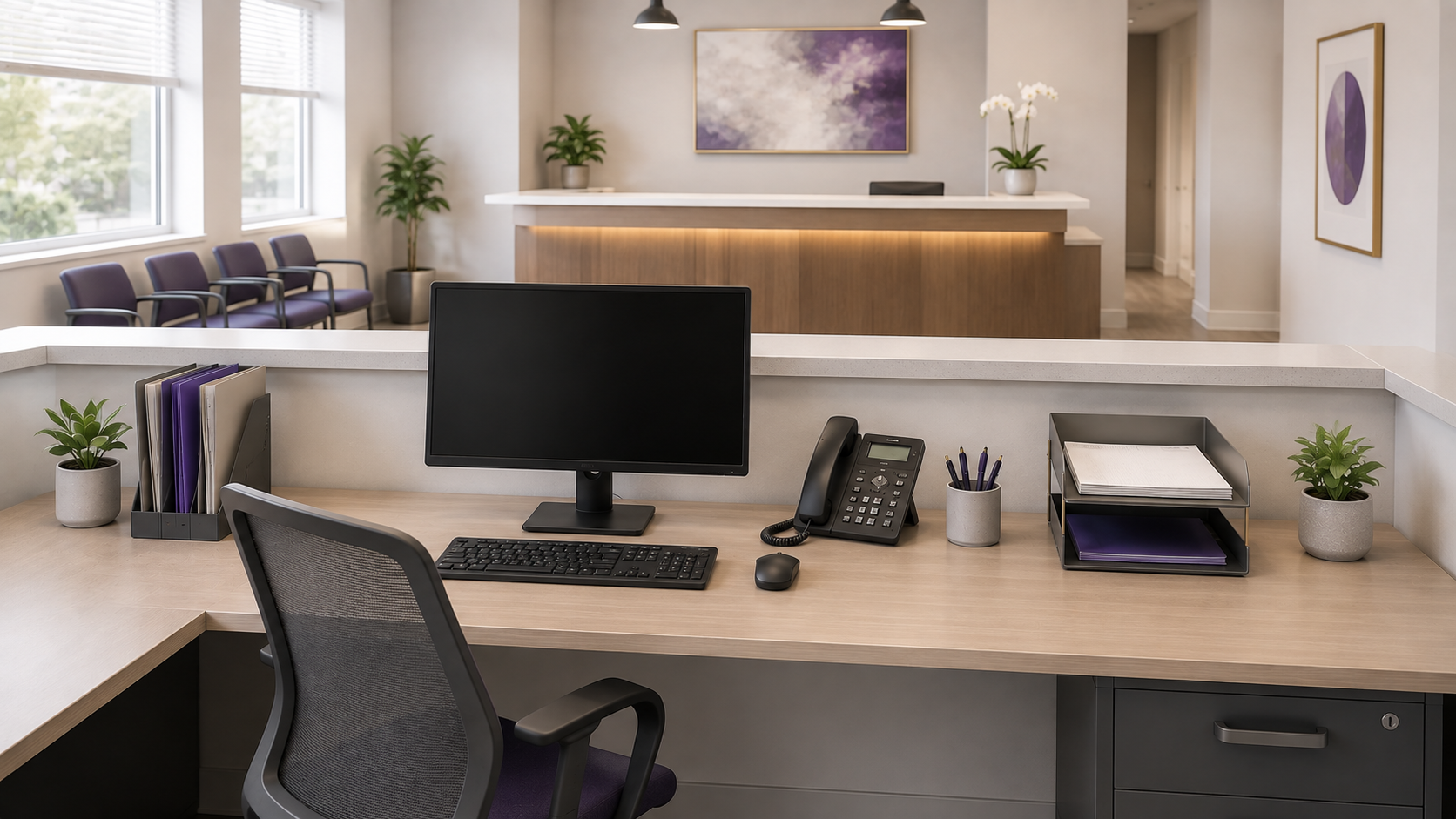
How to Implement a Clean Desk Policy That Employees Can Follow
A clean desk policy in a medical practice is not really about keeping the office tidy. It is about controlling what happens to protected health information when workforce members are working with it, step away from it, or no longer need it.
That distinction matters because PHI is frequently exposed through ordinary activities. A printed schedule sits next to a computer. Handwritten notes accumulate during a busy morning. A workstation remains unlocked while an employee helps a patient. A document containing patient information ends up in recycling instead of a secure disposal container.
None of these situations requires a sophisticated cybersecurity attack. They are simple workflow gaps that can expose patient information to someone who should not have access to it.
A useful clean desk policy creates clear expectations for those everyday situations. It establishes how employees handle paper, workstations, devices, temporary notes, and discarded information throughout the workday—not simply how the office should look when everyone goes home.
Key Takeaways
- A clean desk policy should follow PHI across the practice rather than focus only on the physical desk.
- Paper records, temporary notes, unlocked workstations, portable devices, printers, fax areas, and disposal processes can all create exposure points.
- Clean desk expectations should apply throughout the workday, not only during closing procedures.
- Technical controls and workforce behavior work best together; one should not automatically be treated as a substitute for the other.
- Repeated compliance problems may reveal training needs, workflow defects, equipment-placement problems, or other operational barriers.
- Scenario-based training helps employees understand how clean desk expectations apply to actual PHI-handling situations.
Table of Contents
A Clean Desk Policy Extends Beyond the Desk
The name can be misleading because the policy should apply anywhere employees routinely work with PHI.
Front desks deserve particular attention because they are often open, busy environments. Patients check in and out, family members wait nearby, phones are answered, paperwork changes hands, and staff frequently move between tasks. Information that seems protected from behind the desk may still be visible to patients or visitors.
The objective is not to eliminate every possibility that another person could see a workstation or document. Practices should evaluate their environment and use reasonable safeguards to limit unnecessary or unauthorized viewing of PHI while allowing staff to perform their jobs effectively.
But the same risk exists elsewhere.
Clinical workstations can display open charts. Exam rooms may contain printed documents after a patient leaves. Billing offices may have reports containing patient information. Printers and fax machines can accumulate documents waiting to be retrieved. Staff break areas can become problematic if employees carry paperwork with them while multitasking.
The policy therefore needs to follow the information rather than the furniture.
Operational Snapshot
A location-based review can miss exposure points created as PHI moves between employees and work areas. Mapping where information is created and transferred gives leadership a more useful framework for identifying controls. The same applies to where information is temporarily held and discarded. This framework is more useful than evaluating individual desks in isolation.
HIPAA does not prescribe a specific policy called a “clean desk policy.” Instead, a clean desk policy can be one practical way a medical practice implements appropriate privacy and security safeguards for PHI within its physical and electronic work environment.
| Area | Common Exposure | Expected Control |
|---|---|---|
| Front desk | Forms, schedules, notes visible to patients | Position and secure PHI when not actively in use |
| Workstations | Open EHR sessions | Lock the screen when stepping away |
| Exam or clinical areas | Printed records or temporary notes | Remove or secure documents after use |
| Printers and fax areas | Documents waiting unattended | Retrieve PHI promptly |
| Back offices | Reports and patient paperwork | Use appropriate secure storage |
| Disposal areas | PHI placed in trash or recycling | Use designated secure destruction processes |
Looking at the policy this way makes it easier to identify vulnerabilities that would be missed by simply telling employees to keep their desks clear.
Control PHI Across Physical and Electronic Workspaces
Paper Still Creates Risk in Digital Practices
Even practices that rely heavily on electronic records usually have more paper than they realize.
Patients complete forms. Staff print schedules and reports. Employees write temporary notes while on the phone. Records arrive by fax. Labels, encounter information, and other documents move between employees during the day.
The operational question is what happens to those materials after their immediate purpose has been served.
Documents containing PHI should be protected from inappropriate access or viewing when they are not actively being used. This applies even if an employee expects to use them again later. If they need to be retained, they should be placed in an appropriate location when unattended.
If they are no longer needed, they should enter the practice’s secure destruction process rather than regular trash or recycling. This applies when they can be destroyed according to the practice’s retention and disposal requirements.
Temporary handwritten notes deserve particular attention. Staff may not think of a sticky note containing identifiable patient information as something that requires the same attention as information in the medical record. But PHI can require appropriate safeguards regardless of whether it appears in an EHR, formal document, or temporary handwritten note.
Compliance Alert
Informal does not mean exempt from safeguards. Practices should account for the full lifecycle of temporary PHI. This includes creation, use, storage, and disposal. Notes and working documents can fall outside normal record-management habits while still creating privacy exposure.
An Unlocked Computer Is an Unsecured Workspace
A clean desk policy should also address electronic workspaces.
An employee can remove every piece of paper from a desk and still leave PHI exposed by walking away from an unlocked computer.
This happens easily in medical practices because staff constantly move. A receptionist gets up to help a patient. A medical assistant leaves a workstation to speak with a provider. An employee steps away for lunch and assumes no one will touch the computer.
Practices should establish appropriate workstation-security procedures. These may include requiring employees to lock active screens whenever a workstation containing or providing access to PHI is left unattended.
Where appropriate based on the practice’s systems and risks, automatic locking after a defined period of inactivity can provide an additional safeguard. But it should support rather than replace appropriate employee behavior.
Unique user credentials support access control and accountability. Each workforce member who uses a system that maintains ePHI should have the unique user identification required by the HIPAA Security Rule rather than relying on a shared user ID simply because multiple employees use the same workstation.
Practices should also establish appropriate credential and access-control procedures based on workforce responsibilities and applicable security requirements.
Technical Deep Dive
Workstation protection is strongest when behavioral and technical controls reinforce each other. Manual screen locking addresses brief departures. Inactivity timeouts provide a backstop when staff forget. Individual credentials preserve accountability. These three controls solve different parts of the same access-risk problem.
The physical device may require protection as well. Laptops, tablets, and other portable equipment can create additional exposure because they are easier to remove or misplace than fixed workstations.
Secure Disposal Is Part of the Same Workflow
One of the easiest places to overlook PHI is below the desk rather than on top of it.
Regular garbage and recycling containers should not become holding areas for documents containing PHI that requires secure disposal.
Crumpling a document or placing it underneath other papers does not protect the PHI it contains. If the information remains readable or otherwise accessible after disposal, unauthorized individuals may be able to obtain it. This creates an avoidable privacy risk.
Practices should establish disposal procedures appropriate to the PHI they handle and provide secure disposal options where needed to prevent unauthorized access to information awaiting destruction. Those containers should be conveniently located where employees actually generate paper.
That last point matters operationally. If the secure disposal container is difficult to access while regular recycling is directly beside the workstation, employees are being asked to work against the physical design of their environment. Good policies are easier to follow when the workspace supports the expected behavior.
Operational Snapshot
Compliance friction is often a workspace-design signal. When the secure action takes more time, movement, or effort than the insecure alternative, recurring exceptions should prompt leadership to examine equipment placement and workflow design. Leadership should not rely solely on additional reminders.
Make Clean Desk Compliance Part of Daily Operations
Define What “Clean” Means During the Workday
A common weakness in clean desk policies is focusing exclusively on closing procedures.
End-of-day security is important, but many exposures occur at 10:30 in the morning rather than after the office closes.
Employees need to know what is expected when they leave for lunch, move to another workstation, step into a meeting, or temporarily leave a patient-facing area.
A practical policy should establish a small number of consistent expectations:
- Secure documents containing PHI whenever they are not actively being used.
- Lock computer screens before leaving a workstation unattended.
- Retrieve printed or faxed PHI promptly rather than allowing it to accumulate.
- Place documents requiring destruction into the designated secure disposal process.
- Store portable devices and physical records appropriately when they are not in use.
- Clear work areas at shift changes and the end of the workday so PHI is not left behind.
These behaviors are simple enough to become routine, which is exactly what the practice needs.
Management Has to Reinforce the Policy
Writing a clean desk policy does not create a clean desk practice.
Managers need to observe whether the policy works under actual operating conditions. A walkthrough during a quiet administrative period may show perfect compliance. The more useful observations often happen during lunch coverage, shift changes, high-volume clinic periods, and closing procedures.
Operational Snapshot
A compliance check performed only under ideal conditions can produce false confidence. Leadership gets a more accurate picture by observing PHI-handling practices at operational stress points. These are times when staffing coverage changes and task switching increases. Employees are most likely to reveal where the intended workflow breaks down during these periods.
That is when shortcuts become visible.
The purpose of oversight should not be to catch employees doing something wrong. It should be to determine whether the expected process is actually being followed and, when it is not, understand why.
Repeated problems may indicate a training issue, but they can also expose a poorly designed workflow. If employees constantly leave paperwork unsecured because there is no appropriate storage near the workstation, additional reminders will not solve the underlying problem.
If computers are routinely left unlocked because staff move between stations every few minutes, leadership may need to evaluate both behavior and system configuration.
Accountability matters, but so does understanding what is making compliance difficult.
Operational Snapshot
Repeated exceptions are useful diagnostic data. Before treating recurring noncompliance as an individual performance problem, leadership should determine whether the pattern clusters around a particular workstation, task, shift, or resource constraint. That distinction helps separate coaching needs from process defects.
Train the Policy as a Workflow, Not a Rule
Telling a new employee to “keep your desk clean” leaves too much room for interpretation.
Training should show employees exactly what the policy means in the context of their job.
Front-office staff should understand how to position documents in patient-facing areas and what to do with forms between interactions. Clinical employees should know how temporary notes and printed information are handled in exam areas. Anyone using electronic systems should know when screens must be locked and how portable devices are secured.
Realistic scenarios make these expectations easier to understand.
What should an employee do with a printed patient schedule when leaving for lunch? Where does a handwritten telephone note go after the information has been entered into the appropriate system? What happens to an incorrectly printed patient document? What should staff do when they notice a coworker’s screen has been left unlocked?
Training becomes more useful when employees can answer those questions rather than simply confirm that they have read the policy.
Operational Snapshot
Scenario-based training can double as a policy test. If employees cannot give a consistent answer to a common PHI-handling situation, the problem may be ambiguity in the procedure itself rather than a lack of awareness. This gives management a concrete signal that the workflow needs clarification.
The Goal Is Routine PHI Protection
The strongest clean desk policies are usually the ones employees stop thinking of as a separate compliance exercise. Locking a screen before standing up becomes automatic. Documents move into secure storage or disposal when employees finish with them. Employees retrieve sensitive printouts rather than leaving them at the printer.
Getting to that point requires clear expectations, an environment that supports the expected behavior, appropriate training, and consistent reinforcement from management.
A clean desk policy will never be the entirety of a practice’s HIPAA compliance program, nor should it be treated that way. It addresses a narrower but very practical problem: preventing PHI from being unnecessarily exposed during ordinary work.
That narrow focus is what makes the policy useful. When employees understand exactly how to handle patient information at their workstations, one of the most common sources of preventable privacy exposure becomes much easier to control. The practice also needs to reinforce those expectations consistently.
Clean Desk Policy FAQs for Medical Practices
Does HIPAA require medical practices to have a clean desk policy?
HIPAA does not specifically require a policy called a “clean desk policy.” However, medical practices must implement appropriate safeguards for PHI. A clean desk policy can support those safeguards by establishing expectations for documents, workstations, devices, temporary notes, and other places where PHI may be exposed.
What should a medical practice include in a clean desk policy?
A clean desk policy should address how workforce members secure PHI when it is not actively being used. This may include expectations for paper documents, screen locking, printers and fax areas, portable devices, temporary notes, secure storage, shift changes, and disposal of information.
Should employees lock their computer screens every time they step away?
Practices should establish workstation-security procedures based on their systems, workflows, and risks. Requiring workforce members to lock screens when leaving workstations that contain or provide access to PHI is one practical safeguard. Automatic inactivity locking can provide an additional layer of protection.
Do handwritten notes containing PHI need to be protected?
Yes. PHI can require appropriate safeguards regardless of whether it appears in an EHR, printed report, formal medical record, or temporary handwritten note. Practices should establish procedures for securing temporary notes while they are needed and disposing of them appropriately when they are eligible for destruction.
Can documents containing PHI be placed in regular trash or recycling?
Practices should use disposal methods that reasonably protect PHI from unauthorized access and follow applicable retention and disposal requirements. Documents containing PHI should not be placed in regular trash or recycling when doing so would leave the information readable or otherwise accessible to unauthorized individuals.
How can medical practices improve compliance with a clean desk policy?
Clear expectations, practical training, appropriate workstation design, convenient secure storage and disposal options, and consistent management reinforcement can improve compliance. Practices should also evaluate repeated problems to determine whether they reflect individual training needs or operational barriers that make the expected behavior difficult to follow.
How can medical practices improve compliance with a clean desk policy?
Clear expectations, practical training, appropriate workstation design, convenient secure storage and disposal options, and consistent management reinforcement can improve compliance. Practices should also evaluate repeated problems to determine whether they reflect individual training needs or operational barriers that make the expected behavior difficult to follow.
About the Author
Jennifer Blevens-Smith is the founder and principal consultant of Integral Clinic Solutions. With more than two decades of experience supporting independent medical practices, she helps physicians, practice administrators, and healthcare leaders strengthen credentialing, payer contracting, revenue cycle operations, compliance workflows, and practice management. Her work focuses on translating complex healthcare requirements into practical operational processes. These processes improve consistency, reduce administrative burden, and support long-term practice success.
Need Help Strengthening Your Medical Practice Operations?
Integral Clinic Solutions provides practical support for medical practices navigating credentialing, contracting, revenue cycle operations, compliance workflows, front-office systems, and practice management challenges.
Explore more operational guidance, compliance insights, and healthcare business resources on the Integral Clinic Solutions blog. New articles and updates are added regularly for practice owners, administrators, and healthcare teams.
Disclaimer: This content is for informational and educational purposes only and does not constitute legal, coding, billing, compliance, financial, or medical advice. Healthcare practices must verify all operational requirements with applicable payers, regulators, and qualified professionals. Read our full Legal & Compliance Disclaimer.