CMS Home Health Proposed Rule 2026 and Reimbursement Cuts
Have you seen the headlines about the CMS home health proposed rule 2026 and wondered what it really means for agencies, clinicians, and patients? This isn’t just another regulatory update—it’s shaping up to be one of the largest home healthcare reimbursement cuts in years, with ripple effects across staffing, compensation, and patient access.
But before we get into panic mode, let’s slow down and break this down step by step. This is still a proposed rule, not final. The CMS home health final rule timeline means the actual decision won’t land until Q4 of 2025. That gives agencies time to prepare, model different scenarios, and provide feedback through industry comments (although the comment window closed in late August 2025).
KEY TAKEAWAYS
- CMS proposes a net -6.4% cut to home health payments in 2026.
- Permanent PDGM adjustment of -4.059% will impact base rates.
- Temporary -5% recoupment targets overpayments from 2020–2024.
- QRP and HHVBP measures are being revised—training is essential.
- Agencies must model best/base/worst-case budget scenarios now.
- Compensation, staffing, and visit scheduling will require strategic redesign.
- Final rule drops Q4 2025—prep work needs to start now.

Table of Contents
CMS Home Health Pay Reduction 2026: Core Elements
The proposed rule boils down to three main levers CMS is pulling:
- A permanent -4.059% PDGM behavioral adjustment
- A temporary -5.0% recoupment adjustment
- A routine positive 2.4% payment update
Put those together, and you land at the net -6.4% cut for 2026.
Here’s a quick refresher: the PDGM adjustment 2026 (Patient-Driven Groupings Model) is meant to recalibrate payments based on how providers actually behaved versus how CMS assumed they would behave when PDGM was rolled out. From 2020 to 2024, CMS says agencies got paid more than they would have under the old system. And by law, CMS has to claw that back to maintain budget neutrality.
That’s where the permanent behavioral adjustment comes in. This isn’t a one-year hit—it permanently lowers the 30-day base rate. In contrast, the temporary recoupment adjustment is a one-time clawback designed to recover overpayments from 2020–2024. CMS estimates agencies were overpaid by about $5.3 billion in that window, so they’re starting the repayment clock in 2026.
The 2.4% positive update softens the blow a little, but not much. Once you add everything up, CMS calculates the aggregate home healthcare reimbursement cuts 2026 at $1.135 billion.
Drivers Behind the Home Healthcare Reimbursement Cuts 2026
At first glance, these Medicare home health payment changes 2026 feel harsh. But CMS argues they’re simply following the law. Budget neutrality is a requirement, and according to CMS’s data, agencies collected more than intended under PDGM.
Here’s their logic:
- Payments in 2020–2024 exceeded expectations, so adjustments are required.
- Permanent cuts realign the payment system going forward.
- Temporary recoupments claw back the overpayments of the past.
CMS also notes that PDGM recalibration is an ongoing process. That means case-mix weights, LUPA thresholds, functional impairment categories, and comorbidity groupings will all get updated using 2024 data. In other words, not only will base payments shrink, but the formulas used to calculate them will also shift. Agencies could see changes in revenue per episode depending on the type of patients they serve.
PDGM Adjustment 2026 and Its Long-Term Impact
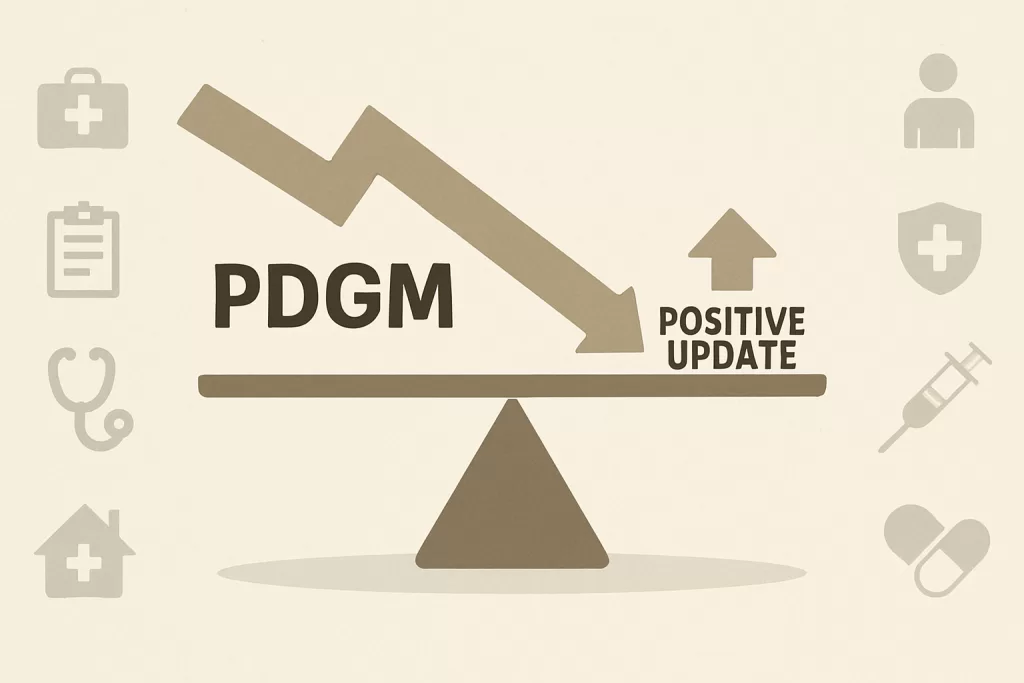
The PDGM behavioral adjustment is one of the most confusing but critical parts of this rule. When CMS first implemented PDGM in 2020, they predicted agencies would change their billing practices in ways that might inflate payments. So CMS applied a “behavioral assumption” cut upfront.
Now, looking back at 2020–2024, CMS says actual billing behavior exceeded those assumptions. That means their initial cut wasn’t big enough. So they’re layering on an additional permanent -4.059% cut starting in 2026.
Think of it this way: if you’re baking bread and you add too much yeast, the dough rises higher than you expected. CMS is saying agencies’ reimbursement “rose” too much, so now they’re flattening it permanently.
And remember, this isn’t just for 2026. This permanent adjustment applies to the base rate moving forward. That’s why agencies should see it not as a one-year problem, but as a structural shift in how home health will be paid in the long run.
The Temporary Recoupment Adjustment CMS 2026
Separate from the permanent cut is the temporary recoupment adjustment CMS 2026. This is CMS’s way of clawing back that estimated $5.3 billion in overpayments from 2020–2024.
For 2026, they’ve proposed a -5% cut to the base payment rate. CMS emphasizes this is temporary—it’s not automatically locked in for 2027. But here’s the catch: CMS has also said they might propose additional temporary adjustments in future years as more data rolls in.
So while 2027 doesn’t automatically repeat the -5% reduction, agencies should plan conservatively. It’s entirely possible CMS could tack on another round of temporary adjustments if they believe the repayment target hasn’t been fully met.
Immediate Implications for Home Health Agencies
The immediate takeaway for agency leaders is this: even though this is a proposed rule, the writing on the wall is clear. CMS is serious about clawing back money and recalibrating payments.
That means home health agency budget planning for 2026 needs to start now. Agencies can’t wait until the CMS home health final rule timeline drops in October or November. Instead, they should be modeling best-case, base-case, and worst-case scenarios now, so they’re ready to pivot when the final decision is published.
Clinician pay models may also need attention. Agencies could consider re-evaluating per-visit versus salaried compensation, optimizing travel rules to avoid LUPAs, or tightening productivity benchmarks. In short, financial pressure will push agencies to rethink operations across the board.
PDGM Recalibration and Revenue Mix in 2026
Every year, CMS updates the guts of the PDGM model, and 2026 won’t be an exception. In fact, recalibration is a big part of this proposed rule. CMS is adjusting case-mix weights, LUPA thresholds, functional impairment levels, and comorbidity groupings based on 2024 data.
What does that mean in plain English? Agencies might find that the types of patients they serve become more or less financially viable, depending on how the weights shift. If your agency leans heavily toward high-comorbidity patients, your revenue per episode could swing differently than an agency that mostly serves lower-acuity patients.
Here’s where it gets tricky: even if your overall payment rate looks steady on paper, shifts in episode revenue mix and LUPA risk can still erode margins. That’s why it’s critical to run internal modeling against the new PDGM weight tables once CMS finalizes them.
| PDGM Element | What’s Changing in 2026 | Impact on Agencies |
|---|---|---|
| Case-mix weights | Updated with 2024 data | Shifts revenue per patient type |
| LUPA thresholds | Recalibrated | Higher risk of partial payments if visits aren’t managed |
| Comorbidity groupings | Refined | Could favor or penalize certain diagnoses |
| Functional levels | Adjusted | Alters revenue tied to patient independence |
LUPA Thresholds and Case-Mix Risk in 2026
If there’s one word that makes home health managers groan, it’s LUPA (Low Utilization Payment Adjustment). Under the Medicare home health payment changes of 2026, CMS is once again recalibrating thresholds for LUPAs.
Agencies will need to pay close attention, as tighter thresholds can result in more partial payments if visits aren’t scheduled strategically. This is where productivity and scheduling rules come into play. Agencies may need to optimize staff travel routes or redesign their triage protocols just to avoid tripping into LUPA territory.
Bottom line: LUPA risk is rising in 2026, and agencies that don’t adjust scheduling will feel the hit on margins.
Face-to-Face Encounter Rule Updates for 2026
One small bright spot in the CMS home health proposed rule 2026 is an update to the face-to-face encounter rule. CMS is broadening practitioner flexibility by aligning with the CARES Act.
What does this mean? More categories of practitioners can now complete the required face-to-face encounter, giving agencies and patients a little more breathing room. For agencies that have struggled with physician availability or practitioner shortages, this is a welcome tweak.
While this may not offset the sting of the CMS home health pay reduction 2026, it does reduce administrative friction and can help agencies streamline compliance.
CMS QRP Changes 2026 and Compliance Updates
Quality reporting is another area seeing adjustments. The CMS QRP changes 2026 include:
- Removal of certain COVID-related vaccine and assessment items
- Updates to the reconsideration pathway
- Revisions to the Home Health Consumer Assessment of Healthcare Providers and Systems (HHCAHPS) survey, rolling out in April 2026
For agencies, this means two things: less paperwork in some areas (good news), but also the need to update staff training and workflows to reflect the survey changes. Even small adjustments to surveys can impact patient perception scores and downstream reimbursement.
Home Health Value-Based Purchasing Updates 2026 (HHVBP)
The Home Health Value-Based Purchasing Updates 2026 are among the more significant policy tweaks. CMS is removing three HHCAHPS-based measures and adding three OASIS-based ADL (Activities of Daily Living) measures along with new claims-based measures.
This reshuffling means agencies will need to revisit their performance strategies. If you’ve been leaning heavily on patient satisfaction measures for HHVBP scoring, you’ll now need to pivot toward OASIS documentation accuracy and functional outcomes.
In practice, this means:
- Training staff on meticulous OASIS data capture
- Reviewing workflows for ADL assessments
- Tracking claims-based metrics more closely
HHVBP isn’t just about compliance—it directly impacts payment adjustments. With the new measures weighted differently, agencies that don’t recalibrate will risk losing reimbursement dollars even before the broader cuts hit.
Why 2026 Policy Updates Matter for Agencies
Some of these updates might feel small compared to the home healthcare reimbursement cuts in 2026, but they add up. An agency that fails to adapt to recalibrated LUPA thresholds or misses a detail in the QRP updates could lose thousands—on top of the permanent and temporary cuts already baked into the rule.
The key is preparation. Agencies that stay on top of these Medicare home health payment changes in 2026, retrain staff, and adapt workflows early will be in better shape come January 1, 2026.
Staffing and Compensation Under Medicare Home Health Payment Changes 2026

By now, we’ve covered the big picture of the home healthcare reimbursement cuts 2026 and the operational tweaks buried in the rule. But here’s where it gets very real: staffing and clinician compensation.
The CMS home health pay reduction 2026 doesn’t just live in agency spreadsheets—it trickles down to how RNs, PTs, OTs, SLPs, and home health aides get paid, how productivity is tracked, and how agencies decide what visits they can afford to schedule.
Let’s walk through how this plays out for frontline staff.
Productivity Pressure Under Medicare Home Health Payment Changes 2026
Agencies live and die by margins, and the Medicare home health payment changes of 2026 squeeze those margins tighter than ever. With lower base rates and higher LUPA risk, many agencies will respond the only way they can: by raising productivity targets.
That could mean more visits per day, stricter scheduling, and heavier reliance on software to optimize travel routes. While this makes sense from a budget standpoint, it often raises concerns about clinician burnout—something the industry has struggled with even before these cuts were implemented.
Agencies that push productivity without balancing clinician workload risk higher turnover, which only compounds staffing challenges. It’s a delicate balancing act.
Visit Mix Adjustments and Scheduling Strategies
The 2026 PDGM adjustment changes how certain patient profiles are reimbursed, which means agencies will need to rethink their visit mix. If one category of patients now pays significantly less, agencies may limit intake in that area, shifting resources toward profiles that preserve contribution margins.
Scheduling will become even more strategic. Agencies may adopt stricter triage protocols to avoid unnecessary visits and redesign intake processes to prioritize patients who align better with revenue under the recalibrated system.
This isn’t about cherry-picking patients; it’s about survival in an environment where CMS is lowering payments across the board.
Clinician Compensation Models Under CMS Pay Reduction 2026
The way agencies pay clinicians is likely to evolve under the CMS Home Health Proposed Rule 2026. Two models dominate the industry:
- Per-visit pay (clinicians earn based on the number of visits they complete)
- Salary pay (clinicians are paid a set wage regardless of visit volume)
Here’s how those models might look under the new reimbursement landscape:
| Pay Model | Pros Under 2026 Cuts | Cons Under 2026 Cuts |
|---|---|---|
| Per-visit pay | Aligns costs with revenue; flexible for agencies | Risk of clinician burnout; income instability if visit mix shifts |
| Salary pay | Stable income for staff; easier recruitment | Harder for agencies to sustain if margins shrink; less flexibility in LUPA-heavy cases |
Some agencies may lean more heavily on per-visit models to hedge against shrinking margins. Others may restructure salaries with built-in productivity expectations. Either way, compensation conversations will be front and center in 2026.
Travel Optimization for 2026 Home Health Operations
One theme you’ll hear over and over is travel optimization. With LUPA thresholds recalibrated, agencies can’t afford to waste visits. That means smarter scheduling, tighter geographic assignments, and more reliance on software tools that map out efficient routes.
For clinicians, this could be a blessing or a curse. On the one hand, optimized travel can cut down on wasted time. On the other, it often comes with stricter rules about where you can go and when, leaving less flexibility in day-to-day work.
Service Line Realignment and Case-Mix Shifts
The case-mix recalibration built into the 2026 Medicare home health payment changes could shift which service lines are most profitable. For example, one therapy service may suddenly become more valuable, while another loses ground.
Agencies will likely adapt by:
- Training intake teams to flag patients that align with favorable case-mix categories
- Adjusting service line investments (for example, hiring more PTs if those visits remain financially viable)
- Redesigning triage and utilization protocols to align with reimbursement potential
This creates both risk and opportunity. Agencies that move quickly can protect their margins. Agencies that don’t adapt could see their financials slide fast.
Staffing Challenges Under the CMS Home Health Proposed Rule 2026
We can’t ignore the human side of this. Many home health agencies were already struggling to recruit and retain staff before these cuts. Lower reimbursement will only heighten the challenge.
Clinicians may demand higher pay to offset rising costs of living, while agencies are under pressure to cut expenses. This tension could lead to difficult renegotiations, tighter contracts, and in some cases, reduced access to care if agencies can’t keep staff.
Trade groups are already warning that these home healthcare reimbursement cuts 2026 may reduce access for patients in rural or underserved areas. If agencies can’t recruit or keep clinicians, patient care gaps will grow.
Agency Strategies for Navigating CMS Reimbursement Cuts
Agencies shouldn’t wait until the CMS home health final rule timeline delivers the official word in Q4 2025. Instead, they should:
- Review current compensation models and test how they hold up under different cut scenarios
- Run productivity simulations to see how many visits clinicians would need to sustain margins
- Explore technology solutions for scheduling, travel optimization, and documentation accuracy
- Engage clinicians in conversations now, so they’re not blindsided by contract renegotiations in 2026
Agencies that treat staffing and compensation planning as part of their home health agency budget planning 2026 will be far more resilient when the cuts go live on January 1.
Market Reactions and Budget Planning for 2026
By now, we’ve talked about the math behind the CMS home health pay reduction 2026, the operational tweaks buried in the policy, and how agencies might adjust staffing and compensation. But zoom out, and you’ll see this isn’t happening in a vacuum.
Industry trade groups, advocacy organizations, and even lawmakers are weighing in on the CMS home health proposed rule 2026. And for agencies on the ground, the real task is turning this noise into a budgeting strategy that prepares for the worst while leaving room for opportunity.
Trade Group Responses to Home Health Reimbursement Cuts 2026
Several national and regional trade groups didn’t waste time responding to the proposed cuts. Their argument is simple: slashing home healthcare reimbursement cuts 2026 will hurt patient access, especially in rural and underserved communities.
Groups like the National Association for Home Care & Hospice (NAHC) and the Partnership for Quality Home Healthcare have already filed comments urging CMS to reconsider both the permanent PDGM cut and the temporary recoupment adjustment. They argue:
- Cuts of this size will force some agencies to scale back or close
- Staffing shortages will worsen if agencies can’t afford competitive pay
- Patient access to home health services will shrink, particularly in areas with already-limited providers
Whether or not CMS takes these warnings seriously is another story. But historically, strong industry pushback has led to at least modest changes between proposed and final rules.
Medicare Budget Neutrality Requirements and CMS Position
On the flip side, CMS keeps pointing to Medicare budget neutrality requirements. The law says payments under PDGM can’t exceed what would have been paid under the old system. Since CMS’s data shows that 2020–2024 did exactly that, they argue the CMS home health pay reduction 2026 is not optional—it’s legally required.
This is where the tension lives: CMS believes it’s just following the rules, while trade groups see the cuts as devastating to access and equity.
2026 Budget Scenarios Home Health Agencies Must Model
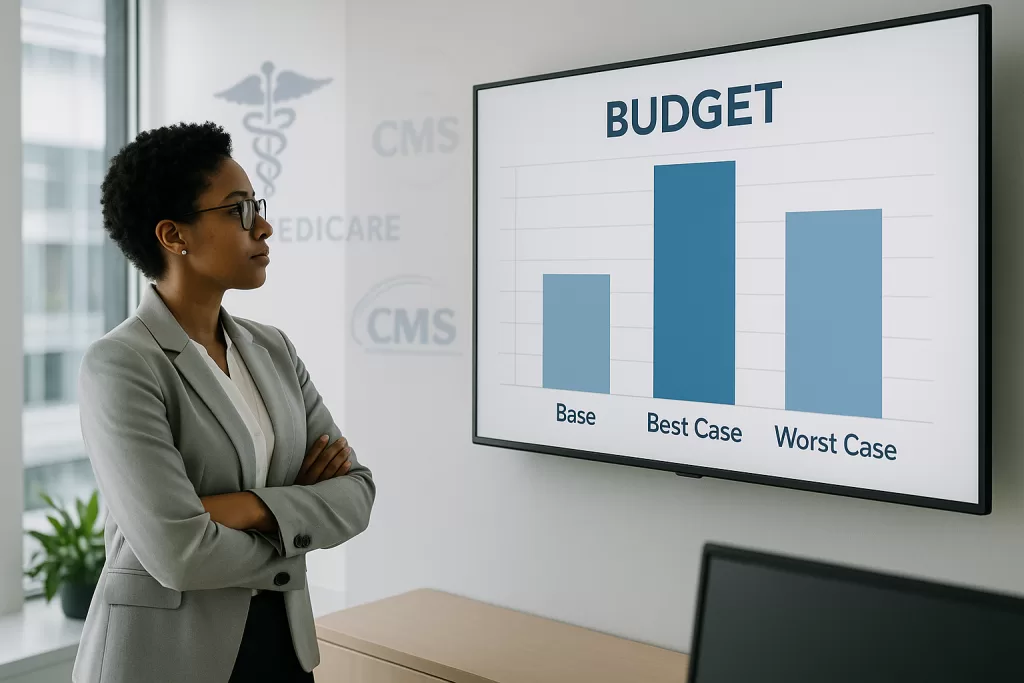
Regardless of where you fall in that debate, agencies can’t gamble on CMS softening the blow. Budgeting for 2026 means planning for multiple scenarios:
Base Case Scenario: -6.4% Cut
Assume CMS finalizes the cuts as proposed: -6.4% overall. Agencies will need to restructure pay models, optimize scheduling, and revisit visit mix.
Best Case Scenario: Moderate Reductions
CMS moderates the temporary recoupment adjustment. Instead of a full -5%, they scale it back to -4% or -4.5%. This would reduce the overall cut to around -5%. Still painful, but slightly more manageable.
Worst Case Scenario: Extended Payment Cuts
CMS not only finalizes the proposed cuts but also signals additional temporary adjustments in 2027 and beyond. Agencies would face multiple years of negative payment adjustments, making long-term planning extremely tough.
Tools and Models for 2026 Home Health Budget Planning
So how do you actually prepare? Agencies should be using a mix of financial modeling and scenario testing. That means plugging the new payment rates, PDGM recalibration, and LUPA thresholds into your revenue models to see exactly where margins erode.
For example, agencies can:
- Compare current visit mix to projected 2026 reimbursement by case-mix group
- Model clinician pay under both per-visit and salary scenarios
- Forecast staffing levels needed to sustain productivity targets without tipping into burnout
Even a simple table like this can help frame discussions with leadership and staff:
| Scenario | Cut % | Impact on Revenue | Agency Response |
|---|---|---|---|
| Base Case | -6.4% | $1.135B aggregate cut | Restructure pay models; optimize scheduling |
| Best Case | -5.0% | Slightly less severe | Delay layoffs; moderate productivity targets |
| Worst Case | -7.0%+ | Additional temporary cuts | Aggressive cost-cutting; possible service reductions |
CMS Home Health Final Rule Timeline
Timing matters here. The CMS home health final rule timeline follows a familiar pattern:
- June 30, 2025 → Proposed rule released
- August 29, 2025 → Comment period closed
- October/November 2025 → Final rule published
- January 1, 2026 → Effective date
That means agencies have a small but critical window between Q4 2025 and January 2026 to finalize budgets, retrain staff, and adjust workflows. Waiting until the final rule drops is too late. Agencies that start modeling now will be better prepared, no matter how the details shift.
CMS Home Health Fact Sheet Subscription and Updates
One practical tip: CMS updates its fact sheet page with finalized numbers, weight tables, and LUPA thresholds once the final rule is published. If you haven’t already, subscribe to the CMS fact sheet updates. It’s the fastest way to see what’s changed and to verify that your financial models line up with the final data.
Think of it as your real-time GPS for navigating the Medicare home health payment changes 2026.
CMS updates its Medicare ASP Drug Pricing page regularly, and the same applies for their home health rule fact sheets.
Importance of Early Planning for 2026
Even if CMS backs off slightly in the final rule, the odds of agencies getting a “free pass” are slim. Cuts are coming, and agencies that start scenario planning today will be better positioned to pivot in January.
That means:
- Updating budget assumptions now
- Training intake and billing staff on new protocols
- Talking to clinicians about compensation changes before they happen
- Building worst-case plans so you’re not blindsided later
The agencies that survive 2026 will be the ones treating the CMS home health proposed rule 2026 not as a “wait and see” but as a call to action.
Action Plan for Agencies Under the CMS Proposed Rule 2026
We’ve talked about numbers, operations, staffing, and industry pushback. Now let’s land this plane with something you can actually use: a roadmap for dealing with the CMS home health pay reduction 2026. Remember, while the proposal still isn’t final, the odds of cuts in some form are high. That means agencies need to plan today, not wait for the final rule in Q4.
Here’s how to stay ahead of the curve.
Step 1: Monitor the Final Rule Timeline
Circle the big dates: the proposed rule was released June 30, 2025, the comment period closed August 29, and the final rule will usually be published in October or November. From that point, agencies have just a few weeks before the January 1, 2026, effective date.
That window is tiny. Don’t treat Q4 as a planning period—treat it as an execution period. Your preparation should already be done before CMS posts the final fact sheet.
Step 2: Subscribe to CMS Fact Sheet Updates
This one’s easy but often overlooked. CMS posts finalized PDGM weight tables, LUPA thresholds, and HHVBP measure lists on its fact sheet page. If you don’t already, subscribe for updates. It’s the fastest way to confirm the exact adjustments once the final rule drops.
Agencies that rely on secondhand updates risk missing critical details. If there’s ever a year to go straight to the source, it’s now.
Step 3: Recalibrate Budgets for 2026
Budgeting for 2026 means planning for three scenarios: base, best, and worst case. Even if CMS moderates the temporary recoupment adjustment CMS 2026, permanent cuts under PDGM are here to stay.
That means you should:
- Run financial models with the -6.4% net cut
- Layer in possible reductions of -5% (best case) and more than -7% (worst case)
- Adjust revenue assumptions for PDGM recalibration, case-mix shifts, and LUPA risk
By stress-testing your financials now, you’ll know where the weak points are before you’re forced to make hard calls.
Step 4: Redesign Staffing and Pay Models
The Medicare home health payment changes 2026 will ripple directly into staffing. Agencies should take time now to review how they compensate clinicians. That could mean testing per-visit pay models, revisiting salaries with built-in productivity targets, or piloting hybrid systems.
The important thing is transparency. Clinicians don’t want to be blindsided in January when contracts suddenly change. Having conversations now—before the cuts are official—gives you a chance to build trust and retention.
Step 5: Update Operations Around PDGM and HHVBP
Don’t underestimate the operational impact of recalibrated PDGM adjustment 2026 and the HHVBP updates 2026. Agencies will need to:
- Retrain intake teams on case-mix shifts
- Tighten scheduling to minimize LUPA exposure
- Improve OASIS documentation accuracy to capture ADL measures
- Track new claims-based metrics that carry heavier weight in HHVBP
Think of this as tuning your engine before a long road trip. The adjustments may look small on paper, but they’ll determine whether your agency runs smoothly or breaks down under the new system.
Step 6: Build Conservative Cash Flow Plans
The home healthcare reimbursement cuts 2026 will reduce margins, which means less room for error. Agencies should consider:
- Cutting discretionary spending
- Delaying major capital projects
- Negotiating with vendors for better terms
- Setting aside reserves for staffing bumps or turnover
Cash flow is king in 2026. Agencies that keep a conservative cushion will weather payment volatility better than those running lean.
Step 7: Track Trade Group Advocacy
While you can’t rely on trade groups to “save” you from cuts, you also shouldn’t ignore their work. Organizations like NAHC may secure modest changes, such as reducing the temporary recoupment from -5% to -4.5%. That doesn’t solve the problem, but it can soften the blow.
Stay plugged in so you know where the advocacy winds are blowing. Even half a percentage point matters when you’re running tight margins.
Step 8: Communicate with Staff and Patients
Finally, don’t forget the human side. These changes aren’t just about balance sheets—they affect real people. Staff need clarity on pay models, productivity expectations, and job security. Patients may need reassurance that their care won’t disappear overnight.
Agencies that lead with transparency will come out stronger, both financially and culturally.
CMS Home Health Proposed Rule 2026: Frequently Asked Questions
What is the CMS home health proposed rule 2026?
The CMS home health proposed rule 2026 is a set of payment policy updates from the Centers for Medicare & Medicaid Services. It introduces permanent and temporary reimbursement cuts, PDGM recalibration, and changes to value-based purchasing and reporting, all set to take effect January 1, 2026.
Why is CMS cutting home health payments in 2026?
CMS is required by law to maintain budget neutrality under PDGM. Between 2020 and 2024, agencies were reimbursed more than expected. The 2026 cuts, including a permanent -4.059% PDGM adjustment and a temporary -5% recoupment, are CMS’s way of realigning payments with statutory requirements.
How much will home health reimbursement be reduced in 2026?
When you combine the permanent PDGM behavioral adjustment, the temporary recoupment adjustment, and the routine positive update, the net impact equals a -6.4% cut for 2026. CMS estimates this will reduce aggregate home health spending by $1.135 billion compared to 2025 levels.
What is the PDGM adjustment 2026?
The PDGM adjustment 2026 permanently reduces the 30-day base rate by -4.059%. It’s based on CMS’s analysis that agencies billed in ways that produced higher-than-expected payments under PDGM. This adjustment lowers payment rates permanently, making it a structural shift rather than a one-time change.
What is the temporary recoupment adjustment CMS 2026?
The temporary recoupment adjustment CMS 2026 is a one-time -5% payment cut designed to recover overpayments made from 2020 to 2024. While it’s technically limited to 2026, CMS has indicated it could propose additional temporary cuts in future years if needed to meet repayment goals.
How will the proposed rule affect staffing and clinician pay?
The CMS home health pay reduction 2026 will put pressure on margins, pushing agencies to rethink staffing and compensation. Many may shift toward per-visit pay models, raise productivity benchmarks, and optimize travel routes. Clinician workload, job security, and pay transparency will be major concerns in 2026.
When will the final CMS home health rule be published?
The proposed rule was released on June 30, 2025, with the comment period closing August 29, 2025. CMS typically publishes the final rule in October or November of the same year. That means agencies will have only weeks to adjust before the January 1, 2026, effective date.
What should agencies do to prepare now?
Agencies should begin modeling best, base, and worst-case budgets immediately. Steps include reviewing compensation models, optimizing scheduling, preparing for PDGM recalibration, and improving documentation for HHVBP and QRP updates. Early planning helps agencies avoid last-minute financial shocks when the final CMS rule goes into effect.
The Bottom Line on Home Health Reimbursement Cuts 2026
The CMS home health proposed rule 2026 is one of the most significant payment shifts in years. Between the PDGM adjustment 2026, the temporary recoupment adjustment, and the broader Medicare home health payment changes 2026, agencies face a tough road ahead.
But tough doesn’t mean impossible. By watching the timeline, recalibrating budgets, updating operations, and leading with clear communication, agencies can adapt.
Cuts are coming, yes—but so is an opportunity to streamline, modernize, and prepare for the next phase of home health care.