How Federally Qualified Health Centers Connect Patient Access With Operational Responsibilities
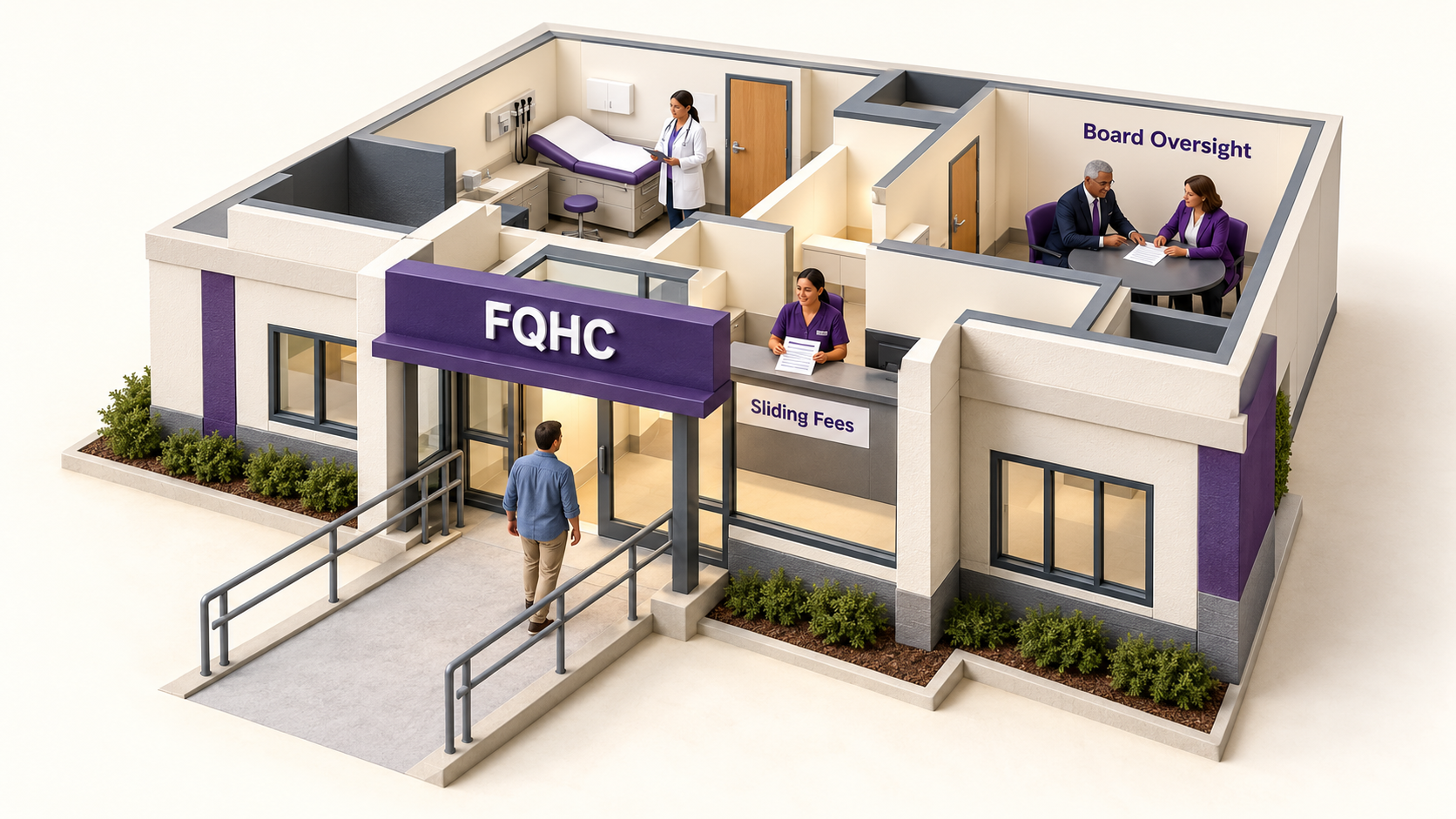
Federally Qualified Health Centers connect access to care with a defined set of organizational responsibilities. Their work reaches beyond providing appointments at a lower cost. Leaders must coordinate services, patient discounts, governance, payment, and oversight within the requirements that apply to their organization.
That distinction matters when a practice considers becoming a health center, joining a health-center organization, or providing services through an agreement. FQHC status does not make every service reimbursable or every program benefit automatic. An organization needs to understand its specific status before building a budget or changing its operations.
The practical question is how the model works from one department to the next. A board-approved policy must reach registration and billing. A referral arrangement must connect patients with care and return information. A new site needs more than staff and an opening date. Each decision should fit the organization’s approved scope and applicable payment requirements.
Key Takeaways
- FQHC eligibility follows specific federal pathways. Confirm the organization’s status before relying on program funding or protections.
- Health Center Program operations must connect community needs, required services, access arrangements, and the approved project scope.
- Governance requires meaningful board oversight, including applicable patient representation and documented approvals.
- Sliding-fee policies must reach registration, patient charges, billing systems, and collection workflows.
- Medicare and Medicaid payment rules require separate enrollment, billing, and reconciliation checks.
- Quality, reporting, financial controls, scope changes, and conditional program benefits need continuing oversight.
Table of Contents
What FQHC Status Means—and Which Federal Rules Apply
An FQHC is a qualifying outpatient safety-net provider recognized under federal Medicare and Medicaid provisions. These providers serve communities with barriers to healthcare, in urban as well as rural settings. The category includes Health Center Program award recipients and look-alikes, along with certain tribal and urban Indian outpatient programs.
The Health Resources and Services Administration, or HRSA, administers the Health Center Program under Section 330 of the Public Health Service Act. Its Compliance Manual explains program eligibility and operational requirements. CMS administers the Medicare framework, while state Medicaid programs implement their applicable payment and enrollment rules.
These are related layers of responsibility. An HRSA designation does not settle every Medicare billing question. Likewise, payer enrollment does not replace the need to meet Health Center Program requirements. This article focuses primarily on HRSA-funded health centers and look-alikes. Tribal and other qualifying pathways may have different requirements and exceptions.
Funded Health Centers and Look-Alikes
Health Center Program award recipients receive Section 330 funding and must meet the conditions attached to that support. Look-alikes meet Health Center Program requirements but do not receive its grant funding. Their designation can support access to certain programs, subject to the applicable eligibility and participation rules.
For these Health Center Program pathways, organizational eligibility generally requires a private nonprofit entity or public agency. Serving uninsured patients or offering a discount does not establish that status. An ordinary medical practice must evaluate organizational eligibility and the application requirements before treating designation as an available business option.
Start with the organization’s actual award or designation documents. Confirm the entity, approved activities, conditions, and renewal responsibilities. Keep that information accessible to finance, operations, and compliance staff. It provides a more reliable starting point than a general list of FQHC benefits.
FQHCs and Rural Health Clinics Are Separate Programs
An FQHC can operate in an urban or rural community. A Rural Health Clinic, or RHC, follows a separate certification framework with rural-location and shortage-area requirements. Both can serve patients who face access barriers, but that shared purpose does not make their program rules interchangeable.
| Model | Status and federal relationship | Operational distinction |
|---|---|---|
| HRSA-funded health center | Section 330 award support and Health Center Program requirements | Budget and operations must address award conditions and program obligations |
| Health Center Program look-alike | HRSA designation without Health Center Program grant funding | Similar program obligations, with a different funding and protection profile |
| Rural Health Clinic | Separate CMS certification framework | Verify RHC-specific location, certification, staffing, and payment requirements |
A clinic should establish which pathway applies before comparing reimbursement or making changes. Carrying an FQHC procedure into an RHC workflow can create an incorrect assumption about governance, patient discounts, or payment.
How FQHCs Organize Services Around Community Needs
Health centers must serve a medically underserved population or qualifying special populations. These may include migratory and seasonal agricultural workers, people experiencing homelessness, and residents of public housing. Underservice concerns access to health services; it should not be treated as a synonym for being uninsured.
Community needs affect more than the service list. Transportation, language, hours, and the availability of follow-up care can determine whether a patient can use an appointment. Leaders should connect the needs assessment to staffing and access decisions instead of maintaining it only as an application document.
Required Services and Approved Project Scope
Required primary health services include general primary medical care and a broader set of preventive, diagnostic, and enabling services. Examples include laboratory and radiology access, screenings, immunizations, preventive dental care, pharmaceutical services, case management, and eligibility assistance. Certain population-specific requirements also apply, such as substance use disorder services for Health Care for the Homeless programs.
Some services are required; others may be additional services approved to meet community needs. Mental health or expanded dental services should not simply be described as a universal, identical service package at every site. The health center’s approved service list and delivery arrangements provide the relevant detail.
The HRSA-approved scope of project identifies the sites, services, providers, service area, and populations associated with the project. Review it when changing operations. A service offered by the organization is not automatically part of the Health Center Program project merely because it uses the same name or building.
Access, Referral Arrangements, and Continuity of Care
Health centers may deliver services directly, through written contracts, or through formal referral arrangements. Each method has different responsibilities for payment and documentation. A referral arrangement also needs a process for managing referrals and bringing information back for appropriate follow-up.
For example, a health center may arrange diagnostic services with an outside provider. The operational review should establish how the patient gets scheduled, what information travels with the referral, and how results return. Staff also need to understand the patient’s charges and available discounts under the arrangement.
A directory of outside providers does not establish how those responsibilities will be completed.
Operational Snapshot
An outside service may be available while the patient’s referral remains unfinished. For example, a missed appointment can leave the health center waiting for results that will never arrive. Assign responsibility for checking completion and resolving barriers, alongside the process for receiving records.
Jennifer Blevens-Smith explains how staff can follow an outside specialist referral through scheduling, completed care, and returned information. Use these operational checks when assigning follow-up ownership and defining when a referral is complete.
Service access also includes appropriate interpretation and translation, accessible locations and hours, and coverage arrangements for medical emergencies during and after hours. These subjects should connect to actual scheduling and patient instructions. A policy has limited value if staff cannot explain what a patient should do when the health center is closed.
Who Governs an FQHC and Makes Operational Decisions?
Health Center Program governance gives the board a defined role in overseeing the project. It is not simply an advisory group or a fundraising committee. Leaders need to identify which decisions require board approval and provide information that supports those decisions.
Management carries out the approved policies and runs daily operations. The board’s required authority includes areas such as services, locations, hours, the project budget, and key health-center policies. Public-agency arrangements may allocate certain functions differently under the applicable framework.
Patient Representation and Governing-Board Authority
The standard Health Center Program board structure includes 9 to 25 members, with at least 51 percent being patients served by the health center. Patient members must collectively represent the population served. Applicable exemptions and approved waivers need to be assessed rather than overlooked or assumed.
That patient role gives operational decisions a connection to the people using the services. An access report may show appointment availability while patient experience reveals transportation or language barriers. Board information should make those differences visible.
Maintain evidence of the required decisions and approvals. When management proposes changed hours or a revised sliding-fee policy, the supporting material should explain the problem, proposed response, and expected effect. After approval, assign responsibility for updating systems and staff instructions.
A board-approved policy needs a corresponding operational process that staff can follow.
A useful quality-control check is to compare the policy, the system configuration, and a sample of actual transactions. Differences reveal where a decision has not reached the workflow. That review supports implementation; it does not replace the board’s required authority.
How the FQHC Sliding-Fee Program Works in Practice
The sliding-fee discount program adjusts charges based on ability to pay within the applicable Health Center Program requirements. It is a defined process with eligibility rules, approved schedules, and patient communication. Staff should not improvise discounts according to which patient asks most insistently.
The program applies to required and additional services within the approved scope that have distinct fees, with requirements addressing different delivery methods. Health centers must also operate so patients are not denied services because they cannot pay.
Income, Family Size, and Discount Eligibility
Eligibility assessment uses income and family size under board-approved policies. The schedule must reflect current federal poverty guidelines. Those policies also establish how staff assess and reassess patients and document the result.
| Income relative to current federal poverty guidelines | Discount treatment for directly provided services | Staff verification |
|---|---|---|
| At or below 100 percent | Full discount, with an optional qualifying nominal charge | Apply the approved policy and confirm the charge is the applicable nominal amount |
| Above 100 percent through 200 percent | Partial discounts across at least three discount pay classes | Assign the correct class using income and family size |
| Above 200 percent | No discount under this required sliding-fee schedule | Distinguish this result from separate, applicable assistance policies |
The income boundaries describe the program; they do not establish that every patient above a boundary must be refused care. Separate assistance or collection policies need their own authority and implementation. Staff should understand which policy they are applying and how the decision is recorded.
For practical implementation, compare the approved schedule with the practice-management system. Check how a new eligibility determination affects charges, statements, and collection work. A correct assessment can still produce an incorrect patient bill if the discount does not reach the account.
Insured Patients, Outside Services, and Collection Practices
Having insurance does not automatically remove a patient from sliding-fee assessment. Eligible patients with third-party coverage have protections for out-of-pocket charges under HRSA’s framework, subject to potential legal and contractual restrictions. Billing staff needs a defined process for applying those requirements.
An insurance card does not tell staff whether the patient qualifies for a sliding-fee discount.
Compliance Alert
Sending every insured patient directly to the standard copay workflow can bypass sliding-fee assessment. Staff need to connect documented eligibility with the applicable patient charge and identify legal or contractual restrictions. This requires a controlled billing process, rather than an informal promise to waive whatever insurance leaves unpaid.
The delivery method also matters. For contracted services, the health center must ensure the required discounts. Formal referral arrangements have their own discount expectations. Do not promise that an outside provider will honor the health center’s charges unless the arrangement supports that statement.
Patient communication should explain how to request assessment, which services the arrangement covers, and who can resolve a disputed charge. Monitor complaints and use of the program. HRSA requires evaluation of its effectiveness at least once every three years, with findings used to identify and implement needed changes.
How FQHC Funding, Reimbursement, and Enrollment Fit Together
Funding and reimbursement answer different questions. A grant supports approved purposes under its terms. A payer payment depends on covered services, enrollment, billing requirements, and the applicable payment method. Combining them into a single promise of enhanced reimbursement can obscure the work needed to collect the revenue.
Grants and Service Revenue
A funded health center may combine Health Center Program awards with Medicare, Medicaid, commercial insurance, patient payments, and other support. A look-alike must plan without Section 330 program funding. Neither model removes the need to monitor costs and cash flow.
Finance leaders should identify which resources can support which activities. A projected grant award should not appear in the operating budget as confirmed revenue before its terms and availability are established. Likewise, anticipated patient-service revenue needs a realistic collection timeline.
| Source | What it contributes | Operational check |
|---|---|---|
| Health Center Program award | Support for the approved project under award terms | Verify availability, allowable use, conditions, and reporting |
| Medicare | Payment under applicable FQHC and separately payable service rules | Confirm covered service, billing method, and enrollment |
| Medicaid | Payment under the state’s applicable PPS or qualifying alternative method | Verify rates, encounter rules, reconciliation, and state instructions |
| Commercial insurance | Revenue under the payer agreement | Confirm network participation and payment terms |
| Patient payments | Applicable patient responsibility after required discounts | Confirm eligibility assessment, charges, and collection policies |
The budget should show how these sources fit the service plan. An organization can meet its access mission and still experience payment delays or rising operating costs. Leaders need enough detail to see where a financial problem originates.
Medicare and Medicaid Payment Rules
Medicare generally pays qualifying FQHC visits through its prospective payment system, or PPS. The framework uses an encounter-based national rate with applicable adjustments. Certain services have separate payment rules, and not every patient interaction establishes a separately payable visit.
Billing teams need current CMS instructions for the service, practitioner, setting, and date of service. A required health-center service and a Medicare-covered FQHC encounter are different determinations. The service may support the mission without generating the payment that staff expected.
Medicaid’s federal framework establishes PPS payment protections and permits qualifying alternative payment methodologies agreed to by the state and health center. The state implements its payment methodology through its approved plan and operational instructions. Verify how the state defines payable encounters and handles relevant changes in services.
Medicaid managed care can also involve supplemental payments that bridge the difference between plan payment and the applicable PPS amount. Some qualifying arrangements route the full payment through the plan. The organization must understand its state’s method before projecting receivables.
A managed-care payment may be only one part of the amount the health center must reconcile.
Technical Deep Dive
A plan remittance and a supplemental payment may represent different parts of the same reimbursement obligation. Reconciliation connects eligible encounters with the applicable payment method and amounts received. Without that connection, staff can mistake an initial payment for complete reimbursement or pursue an amount already included through another payment route.
Use a practical reconciliation process that connects qualifying encounters, plan payments, and any supplemental payment activity. Investigate missing amounts and retain the records required by the applicable process. A payment protection is useful only when the underlying encounters and payments can be accounted for.
Clinical Credentialing, Privileging, and Payer Enrollment
Clinical credentialing verifies qualifications. Privileging establishes which services a clinician may provide within the organization. Health Center Program procedures address initial and recurring review of clinical staff, including applicable employees, individual contractors, and volunteers.
Payer credentialing and enrollment are separate administrative requirements. Medicare and Medicaid enrollment follow distinct program processes. Determine the applicable organization, site, practitioner, and billing relationships for each payer. HRSA approval does not answer every question about when a new clinician or location can be billed.
For a new provider, an operational readiness check should connect the clinical file, granted privileges, payer requirements, and the planned start date. Assign someone to resolve gaps before the schedule assumes that every service will produce a payable claim. Preserve payer-specific qualifications rather than imposing one universal enrollment sequence.
What an FQHC Must Monitor After Approval
Approval begins a continuing responsibility to keep operations aligned with the applicable framework. Leaders need a way to recognize changes, assign follow-up, and verify completion. A compliance calendar can organize work, but it should connect each item to evidence.
Quality, Reporting, and Financial Controls
Health centers must maintain a quality improvement and assurance program and reporting systems that support oversight. HRSA’s Uniform Data System, or UDS, reporting requires timely, accurate, and complete information under the current instructions. Management and the board also need useful performance reports.
Registration and clinical documentation choices affect later reporting. If staff apply different definitions or omit relevant information, the reporting team may find errors after the reporting period closes. Review definitions and validate data during the year so staff can correct recurring problems at their source.
Financial oversight includes appropriate accounting, budget monitoring, billing, and collection controls. Medicare-participating FQHCs also have annual cost-report responsibilities. Keep these activities connected while recognizing that a financial report, UDS submission, and Medicare cost report serve different purposes.
Assign responsibility for reviewing each report and addressing discrepancies. A completed submission does not prove that management resolved the operational issue behind an unusual result. Track the response until the organization has evidence of the correction.
Scope Changes and Conditional Program Protections
Evaluate proposed site and service changes against the current scope requirements before implementation. HRSA’s Scope of Project Policy Manual is the current primary scope policy resource. Some changes require prior approval; others involve different documentation or reporting procedures.
A proposed site should trigger a coordinated review of scope, access, staffing, payer enrollment, and financial assumptions. The work is easier to manage before the organization commits to an opening date. One department’s approval should not stand in for all the other checks.
Program protections also have boundaries. Eligible funded health centers and subrecipients must apply for FTCA deeming under the applicable requirements. Deeming does not establish coverage for every person or activity, and Health Center Program look-alikes are not eligible for this protection.
An FTCA deeming determination does not resolve coverage for every clinician or activity.
Compliance Alert
Confirming that an organization is deemed is only part of the coverage review. Individual eligibility and the activity’s relationship to covered employment also matter. When clinicians work across organizations or provide additional services, verify those circumstances before treating the health center’s deeming determination as sufficient evidence of protection.
Treat 340B participation and other assistance programs as separate eligibility and compliance questions. Do not assume that designation automatically completes registration or satisfies continuing obligations. This article identifies those boundaries without turning into a detailed 340B or workforce-program discussion.
Effective FQHC operations connect the organization’s status with the work patients and staff experience. Services, discounts, governance, and payment need to agree with one another. When leaders review those connections regularly, they can recognize gaps before an access problem, patient bill, or unpaid claim becomes the only signal that something needs attention.
Frequently Asked Questions
Does every FQHC receive a federal grant?
No. Health Center Program award recipients receive Section 330 support, while look-alikes meet program requirements without that funding. Other qualifying FQHC pathways also exist. Leaders should verify the organization’s actual status and available funding before relying on grants in a budget or describing them as a program benefit.
Is a look-alike subject to fewer operational requirements?
A Health Center Program look-alike must meet Health Center Program requirements despite not receiving its grant funding. The designation does not remove governance, service, sliding-fee, or reporting responsibilities. Leaders should review the applicable designation conditions and renewal instructions rather than assume the obligations are lighter.
Can patients with insurance qualify for sliding-fee discounts?
Yes. Insurance coverage does not automatically exclude a patient. Assessment uses income and family size under the approved policy. HRSA addresses out-of-pocket charges for eligible insured patients, subject to potential legal and contractual restrictions. Billing staff need a process that applies the correct discount without disregarding those restrictions.
Must every required service be delivered inside the health center?
No. Health centers can use direct services, written contracts, and formal referral arrangements, as applicable. The approved service-delivery method determines responsibilities for payment, documentation, patient discounts, and follow-up. An outside provider listing alone does not establish an adequate arrangement or explain how patients will receive the service.
Is a Rural Health Clinic the same as an FQHC?
No. They are separate federal programs. RHCs follow their own certification and rural-location requirements, while FQHCs can operate in rural or urban areas through qualifying pathways. Similar access goals do not make governance, service requirements, payment rules, or eligibility interchangeable. Confirm the applicable program before adopting an operational procedure.
Does HRSA designation complete payer enrollment?
No. HRSA status and payer participation address different requirements. The organization must verify applicable Medicare, state Medicaid, and commercial payer enrollment and billing arrangements. A clinician’s internal credentialing or privileges also do not establish every payer’s payment readiness. Check the entity, site, practitioner, and billing relationship involved.
Does FQHC status automatically provide FTCA malpractice protection?
No. Eligible funded health centers and subrecipients must obtain deeming under the applicable requirements, and coverage depends on individual and activity eligibility. Look-alikes are not eligible for Health Center Program FTCA protection. Review the actual coverage circumstances rather than relying on a general statement that FQHCs have federal malpractice coverage.
About the Author
Jennifer Blevens-Smith is the founder and principal consultant of Integral Clinic Solutions. With more than two decades of experience supporting independent medical practices, she helps physicians, practice administrators, and healthcare leaders strengthen credentialing, payer contracting, revenue cycle operations, compliance workflows, and practice management. Her work focuses on translating complex healthcare requirements into practical operational processes. These processes improve consistency, reduce administrative burden, and support long-term practice success.
Need Help Strengthening Your Medical Practice Operations?
Integral Clinic Solutions provides practical support for medical practices navigating credentialing, contracting, revenue cycle operations, compliance workflows, front-office systems, and practice management challenges.
Explore more operational guidance, compliance insights, and healthcare business resources on the Integral Clinic Solutions blog. New articles and updates are added regularly for practice owners, administrators, and healthcare teams.
Disclaimer: This content is for informational and educational purposes only and does not constitute legal, coding, billing, compliance, financial, or medical advice. Healthcare practices must verify all operational requirements with applicable payers, regulators, and qualified professionals. Read our full Legal & Compliance Disclaimer.