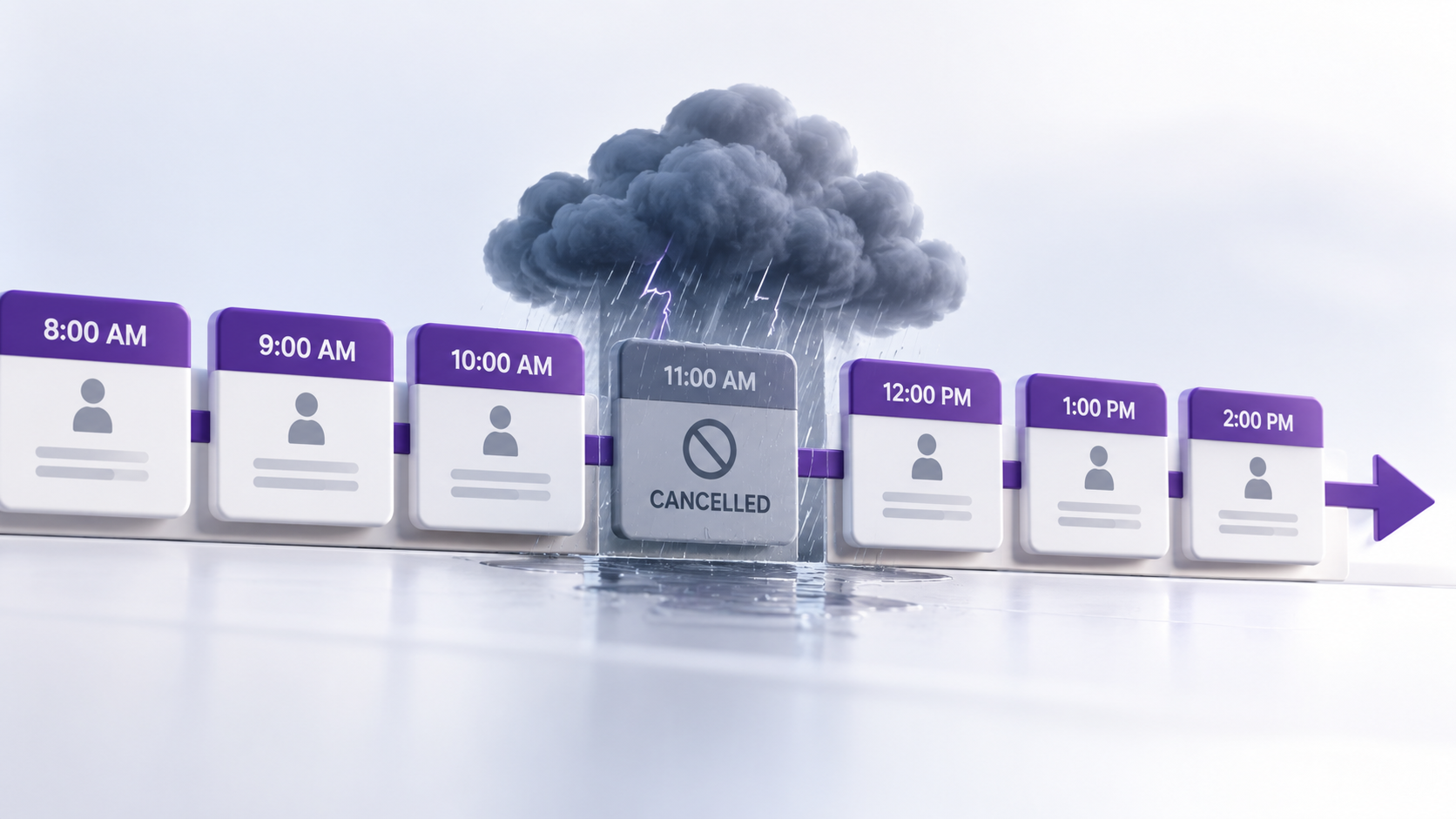
Inclement Weather Policies That Prepare Medical Practices for Disruptions
Severe weather creates more than a decision about whether a medical practice should open or close.
A delayed opening affects the appointment schedule. An early closure creates patients who need to be contacted and rescheduled. Staff may be unable to travel safely while others are already onsite.
Patients may still arrive because they did not receive the closure notice. Phones, portals, prescription requests, referrals, authorizations, and other administrative work may continue even when the physical office is unavailable.
Effective medical practice policies and procedures address operational expectations before they are needed, and an inclement weather policy should address those consequences before the weather event occurs.
The objective is not to predict every possible storm. It is to establish a decision-making, communication, continuity, and recovery structure that can be applied when normal operations are disrupted.
Inclement Weather Policy Priorities for Medical Practices
- An inclement weather policy should define both who can change operations and who executes the resulting scheduling, staffing, communication, and continuity tasks.
- Delayed openings, reduced operations, closures, and reopening can function as predefined triggers for related workflows.
- Patient notification needs ownership and exception handling because activating multiple communication channels does not guarantee every affected patient is reached.
- Weather closures create deferred appointment demand, making schedule recovery an important part of patient-access planning.
- Remote work should rely on approved access, technology, privacy and security safeguards, and established responsibilities rather than emergency improvisation.
- Testing and post-event review can expose single-person dependencies, failed handoffs, access problems, and other continuity weaknesses before they recur.
Table of Contents
Establish How the Practice Will Make Weather Decisions
Define Who Has Authority to Change Operations
One of the first questions an inclement weather policy should answer is who has authority to modify clinic operations.
That decision should not be left to a group text the morning of a storm.
Depending on the practice, authority may sit with the practice administrator, owner, medical director, or another designated leader. A backup decision-maker should also be identified in case the primary person is unavailable.
The policy should establish which operational decisions that person can make. These may include delayed opening, early closure, full closure, or reduced staffing. They may also include schedule modification or activation of approved remote workflows.
Timing matters as well.
When possible, decisions should be made early enough for staff and patients to adjust their plans. However, the policy also needs to accommodate rapidly changing conditions. A clinic may open normally and later need to close because conditions deteriorate.
The important control is not a rigid decision time. It is knowing who is monitoring conditions, what information leadership will consider, who has authority to change operations, and how that decision moves into communication and scheduling workflows.
Operational Snapshot
Decision authority and execution ownership are separate controls. Once a leader changes operating status, the practice should have a defined mechanism for translating that decision into assigned scheduling, staffing, communication, and continuity actions. Implementation should not depend on the decision-maker personally coordinating every downstream task.
Use a Simple Operational Response Framework
Weather conditions do not always require an all-or-nothing response.
A practice may remain fully open, operate with reduced capacity, delay opening, close early, or close the physical office while maintaining selected administrative functions remotely.
Each status should trigger a predefined response so staff know what changes without waiting for separate instructions for every task.
| Operational Status | Immediate Priority | Workflow Impact |
|---|---|---|
| Normal operations | Monitor conditions | Prepare communications if conditions change |
| Delayed opening | Contact early appointments | Reschedule or shift affected patients |
| Reduced operations | Match schedule to available staff/providers | Prioritize appropriate appointments and essential functions |
| Early closure | Address remaining patients and staff departure | Cancel/reschedule later appointments and update communications |
| Physical office closed | Notify patients and staff | Activate approved remote functions where appropriate |
| Reopening | Restore schedule and unresolved work | Manage backlog and communicate current hours |
This prevents staff from having to invent a response every time weather affects the practice. It also gives leadership a repeatable framework for moving from a weather decision to specific operational actions.
Plan Patient Communication and Schedule Recovery
Build Patient Communication Into the Closure Process
A closure decision is not complete when staff has been notified.
Patients need timely information, particularly those scheduled during the affected period.
Practices should determine in advance which communication channels will be used. Depending on available systems, that may include direct text or email notifications, portal messages, and telephone outreach. It may also include website updates, voicemail changes, or public communication channels.
More than one method may be necessary because patients do not all use the same communication tools. A backup method is also important when the primary communication system is unavailable or a patient cannot be reached through the usual channel.
The message itself should remain simple. It should explain what has changed and which appointments are affected. It should also explain whether patients should expect further contact and where they can obtain updated information.
Staff should also know who is responsible for each channel and how completion is confirmed.
If everyone assumes someone else updated the voicemail or sent the patient notification, the practice can technically be closed while patients continue driving to the office. Assigning ownership turns communication from an assumption into a workflow that leadership can verify.
Technical Deep Dive
Multi-channel communication is most reliable when failed contact attempts become actionable exceptions. Practices can strengthen the workflow by defining how undelivered messages, unreachable patients, and imminent appointments are identified and routed for alternate outreach rather than assuming that activating several channels guarantees successful notification.
Decide How the Appointment Schedule Will Be Recovered
Weather-related closures create displaced appointments, and those appointments do not disappear when the clinic reopens.
This is where an inclement weather event becomes a patient-access problem.
The practice should determine how canceled appointments will be prioritized for rescheduling. A routine follow-up may have different urgency from a postoperative check, time-sensitive treatment, or appointment connected to medication management or another clinical need.
Clinical leadership should define which situations require review rather than expecting scheduling staff to make clinical prioritization decisions independently. The operational goal is to give scheduling staff a clear escalation path when they cannot safely determine where a displaced patient belongs.
The practice also needs to consider where displaced appointments will go.
If an entire clinic day is canceled, simply adding those patients to an already full schedule can create several weeks of access problems, overtime, and patient dissatisfaction. Depending on capacity, recovery may require temporary schedule adjustments or additional appointment blocks. It may also require appropriate telehealth conversion where available or deliberate redistribution across future openings.
Weather planning therefore needs a recovery strategy, not just a cancellation strategy.
Operational Snapshot
A canceled clinic session creates deferred demand rather than eliminating workload. Leadership should consider both the urgency and volume of displaced appointments so recovery capacity can be planned deliberately; otherwise, restoring one canceled day may reduce access for patients trying to schedule during the following days or weeks.
Define Staff and Remote-Work Expectations
Establish Staff Expectations Before the Weather Event
Employees should know how weather-related decisions will be communicated and what they are expected to do when operations change.
The policy should address how employees report that they cannot safely travel and who they contact. It should also address what happens when the practice remains open with reduced staffing and which roles may be eligible for remote work.
Employment, attendance, leave, and compensation provisions should be developed with consideration for applicable federal, state, and local requirements, including federal wage requirements during natural disasters, as well as the practice’s existing employment policies.
Practices should avoid assuming that the same pay or leave rule applies to every employee. Requirements can differ based on factors such as employee classification, the reason for the absence, whether the practice closes, and applicable state or local law.
Compliance Alert
A single weather event can produce different employment scenarios across the workforce. Practices should establish how closure status, employee classification, and inability to travel interact under applicable requirements. They should also establish how remote-work availability, attendance, leave, and compensation interact before managers are forced to interpret those distinctions during an active disruption.
Operationally, consistency is important.
Managers should not be inventing different rules for different employees in the middle of an emergency. Expectations should be established in advance and applied through the practice’s approved employment and attendance policies.
Practices should also avoid assuming that every employee who cannot reach the office can simply work remotely. Some positions depend on onsite responsibilities, while others may have work that can be performed securely offsite.
Those distinctions should be established before they are needed.
Define Which Work Can Continue Remotely
Remote work can preserve some administrative capacity during a closure, but it should be intentional.
Potential remote functions may include scheduling changes, certain patient communications, and revenue-cycle work. They may also include administrative follow-up and other tasks that can be performed through approved systems.
Whether a particular function can be performed remotely depends on the employee’s role, system access, privacy and security requirements, practice policies, and the nature of the work.
The practice should establish:
- which roles are approved for remote work
- which systems employees are authorized to access
- what devices and access methods are permitted
- how patient information is protected from unauthorized viewing or disclosure
- how telephone and electronic communications are handled
- who employees contact when technical or privacy issues occur
For practices subject to HIPAA, HIPAA privacy and security requirements continue when protected health information is accessed or handled remotely. Remote workflows involving electronic protected health information should operate under the practice’s established administrative, physical, and technical safeguards rather than improvised workarounds created during the closure.
The operational question is not simply whether an employee has internet access at home. Leadership should know whether the employee has approved access and whether the device and connection meet practice requirements. Leadership should also know whether the work can be performed privately and whether access can be supported if something fails during the closure.
Compliance Alert
Emergency remote work should activate previously approved safeguards rather than create temporary exceptions to them. Access authorization, devices, and communication methods should be established and tested beforehand. Privacy conditions and technical support should also be established and tested beforehand so operational pressure during a closure does not encourage improvised methods for handling protected health information.
Maintain Essential Functions During the Disruption
Identify the Functions That Cannot Simply Wait
Closing the physical office does not necessarily stop every operational obligation.
There may be incoming patient messages, time-sensitive clinical communications, scheduled procedures requiring cancellation, or referrals in progress. There may also be authorization deadlines, laboratory or diagnostic information, prescription-related requests, or other work that requires appropriate review.
Each practice should identify which functions need coverage during a closure and which can safely wait until operations resume. The policy should also identify who owns those functions during the disruption and how unresolved items are handed back to normal operations when the practice reopens.
Technical Deep Dive
Continuity planning should account for both activation and deactivation of emergency workflows. Work handled during a closure needs a visible tracking location and a defined handoff back to normal operations so messages, authorizations, referrals, or other unresolved items do not become stranded when onsite teams resume their usual queues.
This is specialty-dependent.
A primary care office, surgical practice, behavioral health practice, and infusion clinic may have very different continuity requirements. The policy should reflect the actual clinical and administrative risks of the organization rather than relying on a generic closure checklist.
Clinical matters requiring judgment should remain within appropriate clinical workflows even if administrative staff are working remotely. A weather closure changes where work occurs; it should not blur the practice’s established boundaries for clinical decision-making.
Prepare Communication Tools Before They Are Needed
The morning of a weather emergency is a poor time to discover that nobody knows how to change the voicemail greeting.
A small readiness package can prevent unnecessary delays.
It may contain current staff contact information, instructions for activating patient notifications, and approved closure and delay messages. It may also contain website-update procedures, remote-access instructions, vendor or building contacts, and escalation information.
This material supports operational speed and continuity while reducing dependence on one employee remembering how each communication system works.
When a closure decision is made, authorized staff should be able to execute the communication plan without searching for access information, drafting messages from scratch, or trying to determine who has permission to update a system.
Templates should still leave room for event-specific information. A delayed opening requires different instructions from a full-day closure or an early shutdown during clinic hours.
Plan for Midday Weather Changes
Not every disruption provides overnight warning.
Conditions can deteriorate while providers, employees, and patients are already in the building. An inclement weather policy focused only on morning closures leaves the practice without guidance for one of the more complicated scenarios.
A midday closure requires coordination.
Leadership must decide when to stop bringing additional patients into the clinic and which patients already onsite can reasonably complete their visits. Leadership must also decide whether later appointments should be canceled and how quickly staff should begin leaving.
Patient safety and clinical circumstances may affect those decisions, so a midday closure may require coordination between administrative and clinical leadership rather than a purely administrative decision.
The communication process must also switch immediately from monitoring to execution. Patients with later appointments need to be contacted, public-facing information updated, and the next day’s operating status addressed when possible.
Practices should specifically discuss this scenario during preparedness reviews because it requires more coordination than simply announcing that the office will not open.
Test, Recover, and Improve the Inclement Weather Plan
Test the Workflow Before Severe Weather Arrives
A policy can look complete on paper while still failing operationally.
Before the relevant weather season, practices should verify that critical parts of the plan actually work.
Can the appropriate employee send a mass patient notification? Can the voicemail be changed remotely if necessary? Do approved remote workers have functioning access? Is the staff contact list current? Does everyone know who makes the closure decision? Can leadership identify all patients affected by a schedule change?
A short tabletop exercise can reveal these problems without requiring an elaborate emergency drill. Testing should also confirm that employees understand their responsibilities, consistent with OSHA guidance emphasizing employee training and plan review as part of effective emergency preparedness.
The purpose is to test the handoffs, access, ownership, and backup capability that support reliable operational processes rather than simply confirm that a written policy exists.
For example, if only one employee knows how to send patient notifications, the exercise has identified a single-person dependency that can be addressed before an actual disruption. The same review can expose similar vulnerabilities involving remote access, schedule changes, website updates, vendor contacts, or reopening procedures.
Operational Snapshot
Tabletop testing can double as a key-person dependency audit. Any critical action that fails when one employee is unavailable—whether notification, system access, schedule modification, vendor coordination, or reopening—identifies a continuity gap that should be addressed through backup access, documentation, or cross-training.
Review What Happened After the Practice Reopens
Weather planning should include recovery and review.
After a significant disruption, leadership should examine what happened to the schedule, patient communications, staffing, essential functions, and unresolved work.
Were patients notified quickly enough? Did some arrive despite the closure? Were staff unclear about expectations? Did remote access work? How large was the rescheduling backlog? Did important tasks sit unattended? Were there patient complaints that revealed a communication gap?
Those observations should be used to update the policy, supporting procedures, communication tools, and staff training where needed.
A practice may discover that its closure decision was appropriate but its rescheduling workflow was inadequate. Another may find that text notifications worked well but the website and voicemail remained outdated. A third may discover that too much operational knowledge depended on one employee.
Those are process problems that can be corrected before the next event. A post-event review turns an individual disruption into information the practice can use to strengthen future business continuity.
Inclement Weather Planning Is Business Continuity Planning
A useful inclement weather policy does more than tell employees whether to come to work.
It defines how the practice makes decisions, changes the schedule, and communicates with patients. It also defines how the practice manages staff availability, protects information during remote work, maintains essential functions, and recovers after normal operations resume.
That structure is useful whether the disruption comes from snow, ice, flooding, severe storms, wildfire conditions, or another event that affects safe access to the practice.
The weather itself may be unpredictable. The practice’s response does not have to be.
When responsibilities, communication channels, operational thresholds, backup coverage, and recovery workflows are established in advance, leadership can focus on the conditions in front of them. They do not have to build a response from scratch. That is what turns an inclement weather policy from an employee handbook statement into a practical business continuity tool.
Frequently Asked Questions About Inclement Weather Policies for Medical Practices
What should an inclement weather policy for a medical practice include?
An inclement weather policy should define decision authority, operational response levels, staff communication, patient notifications, scheduling procedures, remote-work expectations, essential-function coverage, and reopening responsibilities. It should also establish backup responsibilities so the practice is not dependent on one person to carry out critical steps during a disruption.
Who should decide whether a medical practice closes for severe weather?
The practice should designate a specific decision-maker, such as an owner, administrator, medical director, or other leader, along with a backup. The policy should also define that person’s authority so staff know who can approve delayed openings, reduced operations, early closures, full closures, or approved remote workflows.
Should a medical practice have a plan for rescheduling patients after a weather closure?
Yes. A closure can create a significant patient-access backlog. Practices should establish how displaced appointments will be identified, prioritized, and rescheduled. Clinical leadership should define when scheduling staff need clinical guidance so administrative employees are not expected to independently determine the urgency of postoperative, medication-related, or other time-sensitive care.
Can medical practice employees work remotely during a weather closure?
Some functions may be appropriate for remote work, but the practice should decide this in advance. Role responsibilities, approved system access, privacy and security requirements, devices, communication methods, and technical support should all be considered. Remote work should use established practice safeguards rather than improvised access methods created during the closure.
How often should a medical practice test its inclement weather plan?
The practice should review and test critical parts of the plan before the weather risks most relevant to its location are likely to occur and after significant disruptions. Testing should confirm that communication systems, remote access, staff contact information, backup responsibilities, schedule reporting, and other essential handoffs actually work as expected.
About the Author
Jennifer Blevens-Smith is the founder and principal consultant of Integral Clinic Solutions. With more than two decades of experience supporting independent medical practices, she helps physicians, practice administrators, and healthcare leaders strengthen credentialing, payer contracting, and revenue cycle operations. She also helps them strengthen compliance workflows and practice management. Her work focuses on translating complex healthcare requirements into practical operational processes. These processes improve consistency, reduce administrative burden, and support long-term practice success.
Need Help Strengthening Your Medical Practice Operations?
Integral Clinic Solutions provides practical support for medical practices navigating credentialing, contracting, revenue cycle operations, compliance workflows, front-office systems, and practice management challenges.
Explore more operational guidance, compliance insights, and healthcare business resources on the Integral Clinic Solutions blog. New articles and updates are added regularly for practice owners, administrators, and healthcare teams.
Disclaimer: This content is for informational and educational purposes only. It does not constitute legal, coding, billing, compliance, financial, or medical advice. Healthcare practices must verify all operational requirements with applicable payers, regulators, and qualified professionals. Read our full Legal & Compliance Disclaimer.
One thought on “Inclement Weather Policies That Prepare Medical Practices for Disruptions”