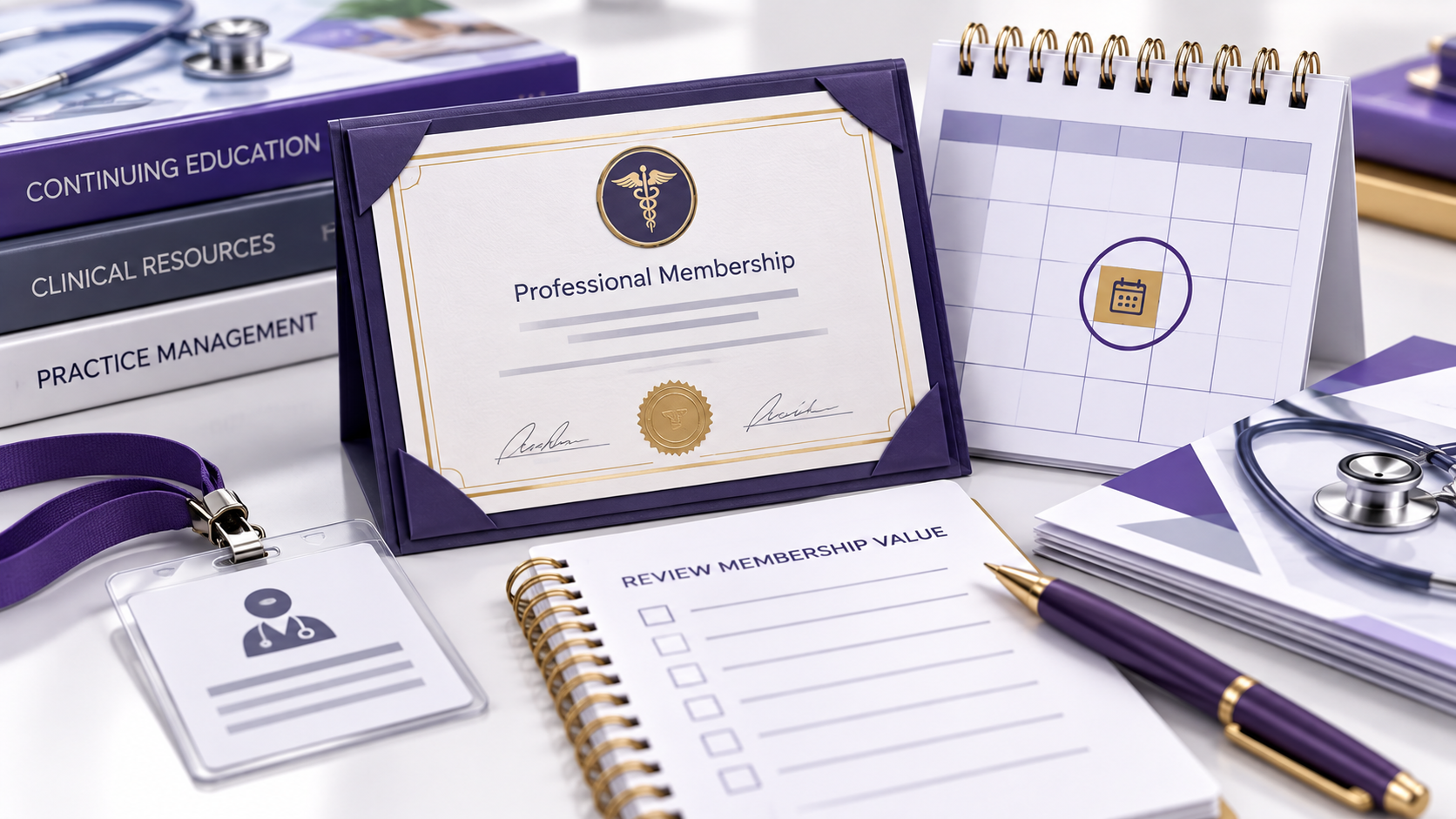
Choosing Professional Memberships That Support Your Medical Practice
Professional memberships for medical practices include a wide range of professional associations, specialty societies, state organizations, management groups, and role-specific organizations available to healthcare professionals.
The challenge for a medical practice is not finding memberships. It is determining which ones provide enough practical value to justify the cost and attention they require.
For practice owners and administrators, professional memberships can serve purposes beyond networking. Depending on the organization, they may provide education, specialty-specific guidance, regulatory updates, operational resources, and benchmarking information.
They may also offer conferences, professional development, or opportunities to learn how other practices address similar challenges.
Those benefits can make an association a useful resource. Membership alone, however, does not improve a practice.
The value comes from choosing organizations that address an actual professional or operational need, giving the appropriate people access to their resources, and creating a plan for turning useful information into action.
Key Takeaways
- Professional memberships should address a defined clinical, professional, staffing, or operational need rather than being maintained automatically.
- Association updates can support regulatory awareness, but practices still need to determine applicability and manage implementation through their own processes.
- Membership value depends heavily on actual utilization, including education, reference resources, peer learning, and professional development.
- Continuing education should be verified against the specific profession, credential, jurisdiction, credit type, and applicable requirements.
- Information gained through associations creates greater organizational value when the practice has a process for evaluating and sharing it.
- Periodic review helps practices identify underused memberships, duplicated resources, changing needs, and opportunities to redirect access.
Table of Contents
Start With the Problem the Membership Should Solve
A common mistake is joining an organization because it is well known or because membership seems like something a healthcare professional is expected to maintain.
A better starting point is to identify what the practice or individual needs.
A physician may want specialty-specific clinical education. A practice administrator may need stronger healthcare management resources, such as those offered by the Medical Group Management Association. A billing employee may benefit from coding and revenue-cycle education. Clinical support staff may need role-specific professional development.
These are different needs and may be better served by different organizations.
| Practice Need | Potential Membership Value |
|---|---|
| Specialty knowledge | Clinical guidance, specialty education, peer discussion |
| Practice management | Operational education, management resources, benchmarking |
| Billing and coding | Technical education, coding resources, professional development |
| Regulatory awareness | Updates, summaries, educational programs, implementation resources |
| Staff development | Role-specific education, credentials, conferences, peer communities |
| Leadership development | Management education, networking, operational perspectives |
Thinking this way prevents the practice from treating every membership as equally valuable.
Use Associations as an Information Source, Not a Compliance Program
Professional organizations can be useful for staying aware of changes affecting healthcare operations.
Some associations monitor developments from government agencies, payers, accrediting organizations, and other healthcare entities and provide members with updates, summaries, or educational resources. That can save practice leaders considerable time.
But association membership should not be confused with compliance.
Receiving an update does not mean the practice has determined whether it applies or interpreted it correctly. It also does not mean the practice has changed the necessary workflow, trained affected employees, or monitored implementation.
The association is an information resource.
The practice still needs a process for deciding what information requires action and who is responsible for that action.
For example, when leadership receives an update that may affect billing or operations, the practice may need to determine applicability and involve the appropriate subject-matter expert. The practice may also need to revise procedures, configure systems, educate staff, and monitor the change.
That is where information becomes operational implementation.
Compliance Alert
Treat association alerts as inputs to the practice’s compliance workflow, not as completed compliance tasks. Leadership should establish ownership for validating applicability and documenting decisions. Leadership should also establish ownership for assigning implementation steps and confirming that required operational changes actually occurred.
Use Memberships to Support Staff Development
Match Memberships to Professional Development Needs
Practice owners are not the only employees who may benefit from professional organizations.
Managers, billers, coders, nurses, medical assistants, and other team members may have associations relevant to their responsibilities.
This can be particularly useful when the organization provides education that directly supports the employee’s role.
The key is to connect professional development to actual competency needs.
Paying for a membership that no one uses provides little value. Paying for a role-specific membership that gives an employee access to relevant education, reference material, and professional development may be much more useful.
Practices should therefore consider memberships as part of the broader staff-development strategy rather than automatically treating them as individual employee perks.
Evaluate Continuing Education Carefully
Education is one of the strongest reasons to consider professional membership.
Associations may provide conferences, webinars, courses, publications, certification programs, or continuing-education opportunities.
The value depends on the professional and the applicable requirements.
Licensure, certification, credentialing, and continuing-education requirements can differ by profession and credential. They can also differ by specialty and jurisdiction. Practices should verify the requirements that apply rather than assuming that any particular association’s educational program automatically satisfies them.
Compliance Alert
Before relying on association education for a credentialing or renewal requirement, verify the applicable profession, jurisdiction, credit type, and approval criteria. A useful course can still create a compliance gap if the issuing program does not satisfy the specific requirement being tracked.
There is also a difference between meeting a continuing-education requirement and improving job performance.
An employee may complete required education while still needing practice-specific training on workflows, systems, policies, or responsibilities.
Professional education and internal competency development should complement each other.
Evaluate the Resources the Organization Provides
Look Beyond the Annual Conference
Conferences can be useful, but they should not be the only factor used to evaluate an association.
The more important question is what the organization provides throughout the year.
That may include publications, newsletters, webinars, reference materials, specialty updates, templates, discussion communities, benchmarking information, or access to educational resources.
For a medical practice, frequently used resources may create more operational value than a once-a-year event.
Practice leaders should review the complete membership offering and identify which benefits employees are realistically likely to use.
Use Networking for Operational Learning
Networking is often presented as a generic benefit of professional associations, but its practical value can be more specific.
Independent medical practices frequently encounter problems that other organizations have already faced.
A manager implementing a new workflow may benefit from hearing how peers approached a similar transition. A billing professional may learn that other practices are seeing the same payer issue. A practice owner considering a new service may gain perspective from physicians who have already implemented it.
Peer information should not automatically be treated as authoritative guidance. Another practice’s solution may not be appropriate for your organization.
Peer experience is most useful as a source of questions, comparisons, and implementation lessons that the practice can evaluate against its own requirements and operating environment.
Operational Snapshot
Peer experience is most valuable during problem definition and option discovery, before the practice commits to a solution. Use what other organizations report to sharpen questions and identify implementation risks. Then validate the proposed approach against your own contracts, systems, policies, and requirements.
But professional networks can provide context, identify questions leadership has not considered, and help practices understand how operational challenges are appearing elsewhere in healthcare.
Evaluate Specialty-Specific Resources
Broad healthcare organizations and specialty societies serve different purposes.
A specialty organization may provide information closely connected to the practice’s clinical services, documentation requirements, coding issues, reimbursement concerns, or specialty-specific operational changes.
That can make the membership particularly valuable when generic healthcare resources lack the necessary detail.
Practice leadership should consider whether an organization understands the actual environment in which the practice operates.
The more specialized the operational question, the more valuable a relevant specialty resource may become.
Evaluate Membership Cost Against Actual Use
The annual membership fee is only part of the investment.
Participation may also involve conference registration, travel, employee time, certification expenses, continuing-education costs, or subscriptions to additional resources.
That does not make membership a poor investment.
It means leadership should evaluate the total commitment against the expected use.
Operational Snapshot
The meaningful cost of membership is the resources committed relative to actual utilization, not simply the dues shown on the renewal notice. A low-cost membership can be wasteful when ignored, while a more expensive one may be justified when its resources replace other spending or support recurring operational needs.
Before adding or renewing memberships, consider:
- which employees use the organization’s resources
- what information or education the practice receives
- whether similar resources already exist elsewhere
- whether conference or education discounts are actually being used
- whether the membership supports a defined professional or operational need
- whether another organization would provide more relevant value
This review does not need to become an elaborate return-on-investment calculation. It simply prevents memberships from renewing indefinitely without anyone asking whether they remain useful.
Consider the Organization Behind the Resources
Professional associations are organizations with their own priorities, governance, policies, advocacy positions, and professional standards.
Practice leaders should understand the organization, its purpose, and the activities associated with membership before deciding whether it aligns with the practice’s needs.
For some members, an association’s public positions or advocacy activities may be important. Others may care primarily about educational resources or professional development.
Either way, the decision should be informed.
Review the organization’s purpose, membership requirements, major activities, resources, and positions that are relevant to the decision. Membership should reflect a deliberate choice rather than an assumption that every organization representing a profession is interchangeable.
Turn Membership Information Into Practice Improvement
The greatest missed opportunity may occur when employees attend conferences, webinars, or association programs and the information never reaches the practice.
Professional development creates more value when useful information enters the organization’s normal management processes.
An employee who learns about a workflow improvement may bring it to a manager for evaluation. A regulatory update may be routed to the person responsible for determining whether operational changes are needed. A useful template may prompt the practice to review an outdated procedure.
Not every new idea should be implemented.
The practice needs to determine whether the information is relevant, appropriate, and supported before changing operations.
The goal is to create a defined bridge between external professional development and internal improvement so useful information does not remain with the individual who attended the program or received the resource.
Operational Snapshot
Professional development produces organizational value only when knowledge can move beyond the person who received it. A simple intake-and-review process for relevant ideas, updates, and resources reduces dependence on individual memory and gives leadership a consistent way to evaluate potential changes.
Review Memberships as the Practice Changes
The organizations that provide value to a startup practice may not be the same ones that provide value several years later.
Roles change. Services expand. Employees obtain new credentials. Leadership priorities shift. The practice may enter new payer relationships or develop different operational challenges.
Membership decisions should change with them.
A simple periodic review can identify which organizations remain valuable, which memberships should move to different staff members, and which no longer support the practice’s needs.
Leadership can also use the review to identify memberships that overlap substantially, resources employees are not using, or new organizational needs that existing memberships no longer address.
Operational Snapshot
Treat memberships as a portfolio of organizational resources rather than isolated annual renewals. Reviewing them together makes it easier to spot duplicated benefits, coverage gaps, underused access, and opportunities to redirect memberships toward employees whose current responsibilities create greater practical value.
That makes professional memberships an actively managed resource rather than another recurring expense.
Professional Membership Should Have a Purpose
Professional associations can provide valuable education, specialized information, peer connections, professional development, and practical resources. For an independent medical practice, those benefits can strengthen both individual employees and the organization.
But joining more organizations does not automatically create more value.
The strongest approach is selective. Identify what the practice or employee needs and choose an organization positioned to address that need. Make sure its resources are actually used and create a pathway for useful information to move back into the practice.
When professional memberships are managed that way, they become more than credentials on a biography or subscriptions that renew every year. They become another resource the practice can use to strengthen staff knowledge, management decisions, and operational awareness.
Frequently Asked Questions About Professional Memberships for Medical Practices
Are professional association memberships worth the cost for a medical practice?
They can be when the membership addresses a defined need, and its resources are actually used. Practices should consider education, reference materials, networking, specialty resources, staff development, and other benefits alongside dues, employee time, conference expenses, and additional costs.
How should a medical practice choose a professional association?
Start by identifying the problem or professional-development need the membership should address. Then evaluate whether the organization’s resources, specialty focus, educational programs, peer community, and other benefits align with that need and are likely to be used by the practice or employee.
Should a medical practice pay for professional memberships for employees?
Paying for employee memberships can make sense when the organization provides resources relevant to the employee’s responsibilities or development needs. Practices should treat these memberships as potential staff-development resources rather than automatically approving them as employee perks.
Does continuing education from a professional association automatically count toward licensing or certification requirements?
Not necessarily. Continuing-education requirements can vary by profession, credential, jurisdiction, and type of credit. Before relying on an association program to satisfy a requirement, verify that the education meets the specific approval and credit requirements that apply.
Can a medical practice rely on professional association guidance for compliance decisions?
Association guidance can help practices identify regulatory, payer, and operational developments, but receiving guidance does not complete the compliance process. Practices still need to determine applicability, verify requirements when necessary, assign responsibility, implement appropriate changes, educate affected staff, and monitor the result.
How often should a medical practice review its professional memberships?
There is no single review schedule that fits every practice, but memberships should be reassessed periodically and when organizational needs change. Review which resources are actually used, whether memberships overlap, whether access should move to another employee, and whether each organization still supports a current professional or operational need.
About the Author
Jennifer Blevens-Smith is the founder and principal consultant of Integral Clinic Solutions. With more than two decades of experience supporting independent medical practices, she helps physicians, practice administrators, and healthcare leaders strengthen credentialing, payer contracting, revenue cycle operations, compliance workflows, and practice management. Her work focuses on translating complex healthcare requirements into practical operational processes. These processes improve consistency, reduce administrative burden, and support long-term practice success.
Need Help Strengthening Your Medical Practice Operations?
Integral Clinic Solutions provides practical support for medical practices navigating credentialing, contracting, revenue cycle operations, compliance workflows, front-office systems, and practice management challenges.
Explore more operational guidance, compliance insights, and healthcare business resources on the Integral Clinic Solutions blog. New articles and updates are added regularly for practice owners, administrators, and healthcare teams.
Disclaimer: This content is for informational and educational purposes only and does not constitute legal, coding, billing, compliance, financial, or medical advice. Healthcare practices must verify all operational requirements with applicable payers, regulators, and qualified professionals. Read our full Legal & Compliance Disclaimer.