Local Coverage Determinations: How to Avoid Medicare Claim Denials
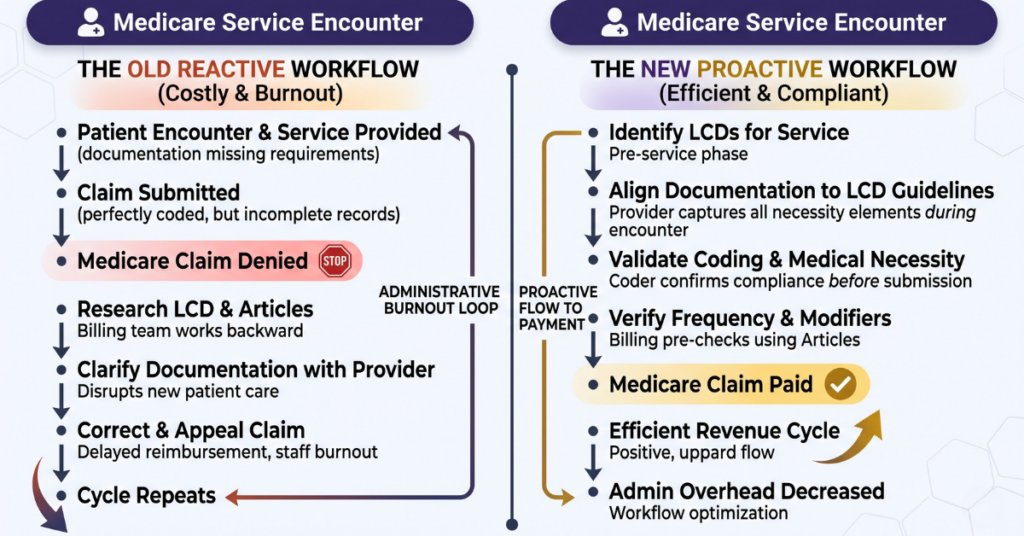
For many medical practices, Local Coverage Determinations (LCDs) only become part of the workflow after a Medicare claim has already been denied. In practice, this often means the billing team begins researching the applicable policy, providers are asked to clarify documentation after the encounter, and reimbursement is delayed while the claim is corrected or appealed.
In my work as a practice management consultant, I’ve seen this cycle repeat across countless clinics. The most common “silent killer” of a practice’s revenue isn’t a complex procedure code. It’s a missed modifier or a missing documentation element that was specifically identified in the accompanying Billing and Coding Article months earlier.
Shifting to a proactive approach isn’t just about getting claims paid. It also reduces the administrative burden on your staff, allowing them to spend less time fighting denials and more time supporting patient care.
Operational Snapshot
When I audit practice workflows, I prioritize the ‘pre-service’ phase. Treating LCDs as clinical guidance rather than billing afterthoughts is one of the most effective ways to reduce the ‘denial-and-appeal’ loop. My clients who make this shift typically see a significant decrease in administrative overhead within one quarter.
Understanding how LCDs influence medical necessity, documentation, coding, and billing allows practices to build stronger workflows that reduce denials before claims are submitted. Rather than viewing LCDs as billing references, successful organizations treat them as operational guidelines that affect multiple departments across the practice.
Understanding Local Coverage Determinations
A Local Coverage Determination is a Medicare policy developed by a Medicare Administrative Contractor (MAC) that defines when a service is considered medically reasonable and necessary within that contractor’s jurisdiction.
Unlike national Medicare policies that apply uniformly across the country, LCDs are developed by individual Medicare Administrative Contractors (MACs) for their respective jurisdictions. As a result, providers performing the same procedure in different states or regions may encounter different documentation requirements, diagnosis limitations, covered services, or billing instructions depending on the applicable MAC policy.
An LCD often answers several important questions before a service is billed:
| LCD Component | Operational Purpose |
|---|---|
| Covered services | Identifies when Medicare considers a procedure medically necessary. |
| Diagnosis requirements | Specifies which ICD-10 diagnoses support coverage. |
| Procedure codes | Lists applicable CPT or HCPCS codes. |
| Documentation expectations | Explains what clinical records must support the service. |
| Frequency limitations | Defines how often Medicare will reimburse certain services. |
These policies influence much more than claim submission. Documentation decisions made during the patient encounter, diagnosis selection, CPT code selection, and charge capture all affect whether a claim ultimately satisfies the applicable LCD and Medicare medical-necessity requirements.
LCDs Affect More Than the Billing Department
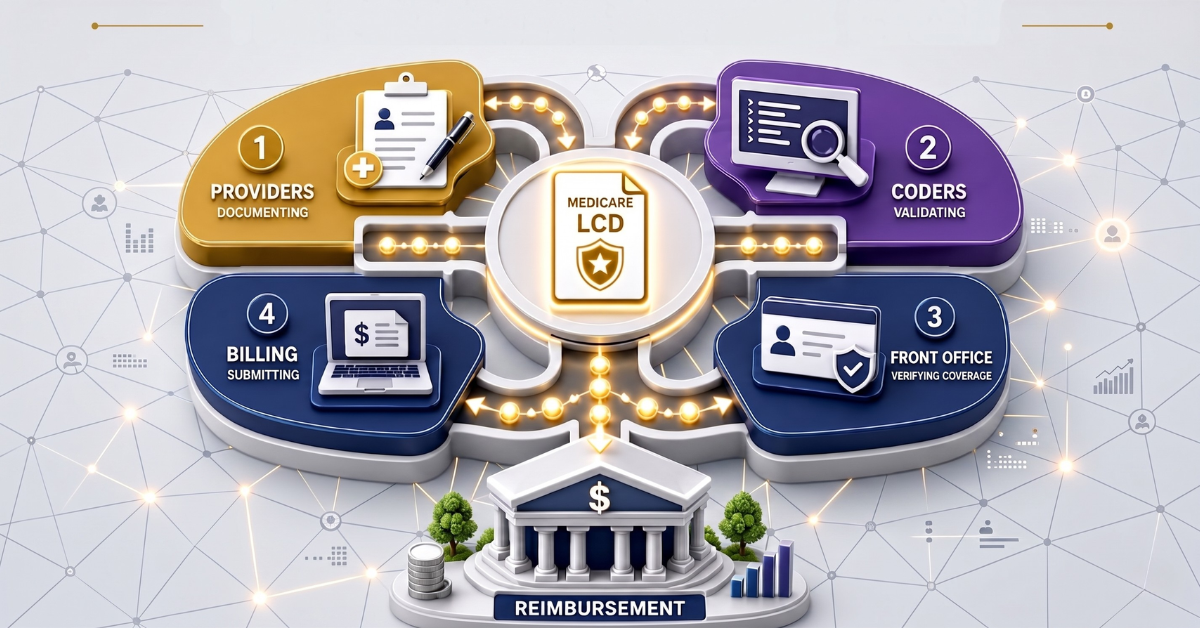
One of the biggest misconceptions is that LCDs are primarily a billing issue. In well-managed practices, LCD requirements are incorporated into clinical documentation, coding validation, and billing workflows before services are submitted to Medicare rather than being researched only after a denial occurs.
In reality, billing teams can only submit claims based on the documentation they receive. If providers fail to document medical necessity in accordance with LCD requirements, coders have little flexibility. Even perfectly coded claims may be denied if the clinical record does not support the service under the applicable policy. That makes LCD compliance a shared operational responsibility.
Operational Snapshot
LCD compliance is not solely a billing responsibility. Providers, clinical staff, coders, and billing teams all contribute to documenting and validating medical necessity before a claim is submitted.
Providers need to understand what documentation supports medical necessity before services are performed. Clinical staff must capture complete and accurate encounter information. Coding teams must validate that diagnosis and procedure coding align with LCD requirements. Billing staff must verify that the submitted claim reflects both the documentation and Medicare’s current coverage criteria.
When one part of that workflow breaks down, the entire claim may be placed at risk.
Medical Necessity Is the Foundation of Every LCD
Most LCDs are built around one central concept: medical necessity. Simply performing a procedure does not guarantee Medicare coverage. The documentation must clearly demonstrate why the service was medically appropriate for that specific patient under the criteria established by the LCD.
For example, an orthopedic procedure may require documentation showing conservative treatment failed before surgery became appropriate. A wound care policy may require evidence of ongoing assessment, treatment progression, and measurable improvement. Imaging studies may only be covered when certain symptoms or diagnoses are documented.
If those elements are missing from the medical record, Medicare may determine that the service does not meet coverage requirements, regardless of whether the procedure itself was performed correctly. A diagnosis code alone does not establish medical necessity.
The clinical documentation must support the conclusion that the service was reasonable and necessary under the applicable LCD. For that reason, documentation should never be viewed as a task completed after patient care. It is part of the reimbursement process from the beginning.
Compliance Alert
A correctly performed procedure may still be denied if the medical record fails to demonstrate LCD-defined medical necessity. Documentation must support coverage before reimbursement can occur.
Consider a practice that performs a Medicare-covered injection, imaging study, or wound care service. The applicable LCD may require the record to show specific symptoms, failed conservative treatment, measurable wound progression, or other clinical findings before Medicare considers the service medically necessary.
If the provider documents only the procedure performed, the billing team may still submit a technically accurate claim that fails to meet Medicare’s coverage requirements because the clinical record does not support that the service was reasonable and necessary for that patient.
Billing and Coding Articles Are Just as Important
Many practices review the LCD itself but overlook the accompanying Billing and Coding Article.
These articles often contain practical billing instructions for submitting a compliant claim. They may specify:
- Covered CPT and HCPCS codes
- Acceptable ICD-10 diagnosis codes
- Required modifiers
- Frequency limitations
- Coding combinations that result in automatic denials
Compliance Alert
Reviewing the LCD alone is not enough. The accompanying Billing and Coding Article often contains required diagnosis codes, modifiers, and billing instructions that directly affect claim acceptance.
Providers need to understand what documentation supports medical necessity before services are performed. Clinical staff must capture complete and accurate encounter information. Coding teams must validate that diagnosis and procedure coding align with LCD requirements. Billing staff must verify that the submitted claim reflects both the documentation and Medicare’s current coverage criteria.
Billing and Coding Articles translate Medicare policy into claim-submission instructions. While the LCD explains when a service may be covered, the accompanying article often determines how the claim must be coded for that coverage decision to be recognized during claims processing.
For billing teams, the LCD and its associated Billing and Coding Article should always be reviewed alongside accurate CPT code selection to help ensure claims reflect both Medicare coverage requirements and the documented services provided.
Why LCD Denials Continue to Occur
Despite clear Medicare guidance, the same LCD-related denial patterns appear repeatedly across medical practices. Some practices rely on historical billing habits without recognizing that LCDs are periodically updated. Others assume documentation requirements remain unchanged from previous years or fail to communicate policy updates to providers and clinical staff.
In many cases, the denial is not caused by a complicated coding issue. Instead, it results from routine operational gaps such as incomplete documentation, outdated diagnosis coding, or failure to verify whether a service meets current coverage criteria before it is performed.
These issues rarely occur because the staff lacks experience. More often, they develop when practices lack a standardized process for monitoring Medicare policy revisions, communicating documentation changes to providers, and updating coding and billing workflows as LCDs evolve.
Building LCD Reviews Into Your Workflow
Practices that consistently reduce Medicare denials typically integrate LCD reviews into their routine operations rather than relying on staff to research policies only after problems arise.
A practical workflow begins by identifying the LCDs that govern high-volume services and assigning responsibility for monitoring policy updates. As revisions occur, practices should educate providers on documentation changes and update coding references.
They should also revise internal workflows as necessary and ensure that billing staff work from the current Medicare guidance. This structured approach creates consistency across departments and reduces unnecessary variation throughout the revenue cycle.
Operational Snapshot
Successful organizations incorporate scheduled LCD reviews into routine operations instead of researching policies after denials occur. Standardized workflows keep providers, coders, and billing teams aligned with current Medicare requirements.
Instead of individual employees interpreting policies independently, everyone works from the same standards. Providers understand what must be documented, coders know what to validate, and billing teams submit claims with greater confidence that Medicare’s requirements have been met.
As payer policies evolve, these workflows become increasingly valuable because they reduce variation throughout the revenue cycle.
LCD Compliance Is an Ongoing Process
LCDs are not static documents. Medicare Administrative Contractors regularly revise policies to reflect new clinical evidence, coding updates, and regulatory changes. Services covered under previous criteria may require additional documentation after an update, and diagnosis or procedure code lists may also change.
Practices that proactively monitor these revisions are better positioned to update documentation, coding, and billing workflows before policy changes begin affecting reimbursement.
Compliance Alert
LCDs are updated regularly as Medicare policies evolve. Assigning responsibility for monitoring and communicating revisions helps prevent avoidable denials caused by outdated documentation or coding practices.
Assigning ownership for LCD monitoring, whether to a compliance coordinator, coding specialist, or revenue cycle manager, helps ensure policy revisions are reviewed. It also helps ensure internal documentation guidance is updated and changes are communicated to providers, coders, and billing staff before they begin affecting reimbursement.
Frequently Asked Questions About Local Coverage Determinations (LCDs)
What is a Local Coverage Determination (LCD)?
A Local Coverage Determination (LCD) is a Medicare coverage policy developed by a Medicare Administrative Contractor (MAC). It explains when specific medical services are considered medically reasonable and necessary for Medicare reimbursement within that contractor’s jurisdiction.
How is an LCD different from a National Coverage Determination (NCD)?
A National Coverage Determination (NCD) applies uniformly across the United States, while an LCD is issued by an individual Medicare Administrative Contractor for a specific geographic jurisdiction. When no applicable NCD exists, providers should review the relevant LCD and any associated Billing and Coding Article to determine coverage requirements.
Who is responsible for complying with LCD requirements?
LCD compliance is a shared responsibility. Providers must document medical necessity, clinical staff should collect complete encounter information, coding professionals must assign accurate diagnosis and procedure codes, and billing teams should verify that claims align with current Medicare coverage requirements before submission.
Why are claims denied even when the correct CPT and ICD-10 codes are used?
Accurate coding alone does not guarantee Medicare reimbursement. Claims may still be denied if the medical record does not demonstrate medical necessity or if documentation does not satisfy the requirements outlined in the applicable LCD and its associated Billing and Coding Article.
How often do Local Coverage Determinations change?
Where can providers find the applicable LCD for a Medicare service?
Providers can search the Medicare Coverage Database or review the website of their Medicare Administrative Contractor (MAC) to locate the applicable Local Coverage Determination and any associated Billing and Coding Article for a specific service.
Should providers review the Billing and Coding Article and the LCD?
Yes. While the LCD explains Medicare’s coverage policy, the accompanying Billing and Coding Article often provides diagnosis codes, procedure codes, modifier requirements, frequency limitations, and billing instructions for submitting a compliant claim. Reviewing both documents helps reduce preventable billing errors.
Can following an LCD guarantee Medicare payment?
Following an LCD helps establish that a service meets Medicare’s published coverage criteria, but payment still depends on factors such as patient eligibility, timely filing, benefit limitations, coordination of benefits, and other claim-specific requirements.
Can a Local Coverage Determination apply outside of Medicare?
Local Coverage Determinations are Medicare policies and generally apply to Original Medicare claims within a specific Medicare Administrative Contractor’s jurisdiction. Commercial insurers may establish similar medical-necessity or coverage policies, but they establish their own requirements independently of Medicare.
The Strategic Value of Proactive LCD Management
Local Coverage Determinations are far more than Medicare reference documents. They establish the coverage standards that influence documentation, coding, medical necessity, and ultimately whether many Medicare services meet Medicare’s coverage requirements for reimbursement.
When practices view LCDs as part of a coordinated operational process rather than an isolated billing requirement, they strengthen documentation, improve coding accuracy, reduce avoidable denials, and create a more predictable revenue cycle.
The goal is not simply to know where LCDs are located or how to search for them. The real advantage comes from incorporating those policies into everyday clinical and administrative workflows. This helps keep medical necessity, documentation, coding, and billing aligned before a claim is ever submitted.
That proactive approach not only protects reimbursement but also creates a more efficient system for providers, billing teams, and practice leadership alike.
About the Author
As the founder and principal practice management consultant at Integral Clinic Solutions, I have spent more than 20 years helping independent medical practices strengthen their revenue cycle operations. My work focuses on helping providers build efficient healthcare businesses while maintaining high standards of patient care and regulatory compliance.
Need Help Strengthening Your Medical Practice Operations?
Integral Clinic Solutions provides practical support for medical practices navigating credentialing, contracting, provider enrollment, and revenue cycle operations. The company also supports compliance workflows, front-office systems, and practice management challenges.
Explore more operational guidance, compliance insights, and healthcare business resources on the Integral Clinic Solutions blog. New articles and updates are added regularly for practice owners, administrators, and healthcare teams.
Disclaimer: This content is provided for informational and educational purposes only. Credentialing, enrollment, contracting, reimbursement, licensing, and compliance requirements vary by payer, provider type, specialty, location, and regulatory authority. Providers and healthcare organizations should verify current requirements directly with applicable payers and regulatory agencies. Read our full Legal & Compliance Disclaimer.