Understanding Medical Billing and Coding Responsibilities in a Medical Practice
Medical billing and medical coding are often discussed as though they are a single function. In practice, they address different parts of revenue cycle management. Understanding that distinction matters when a medical practice is deciding how to staff, outsource, and oversee its reimbursement operations.
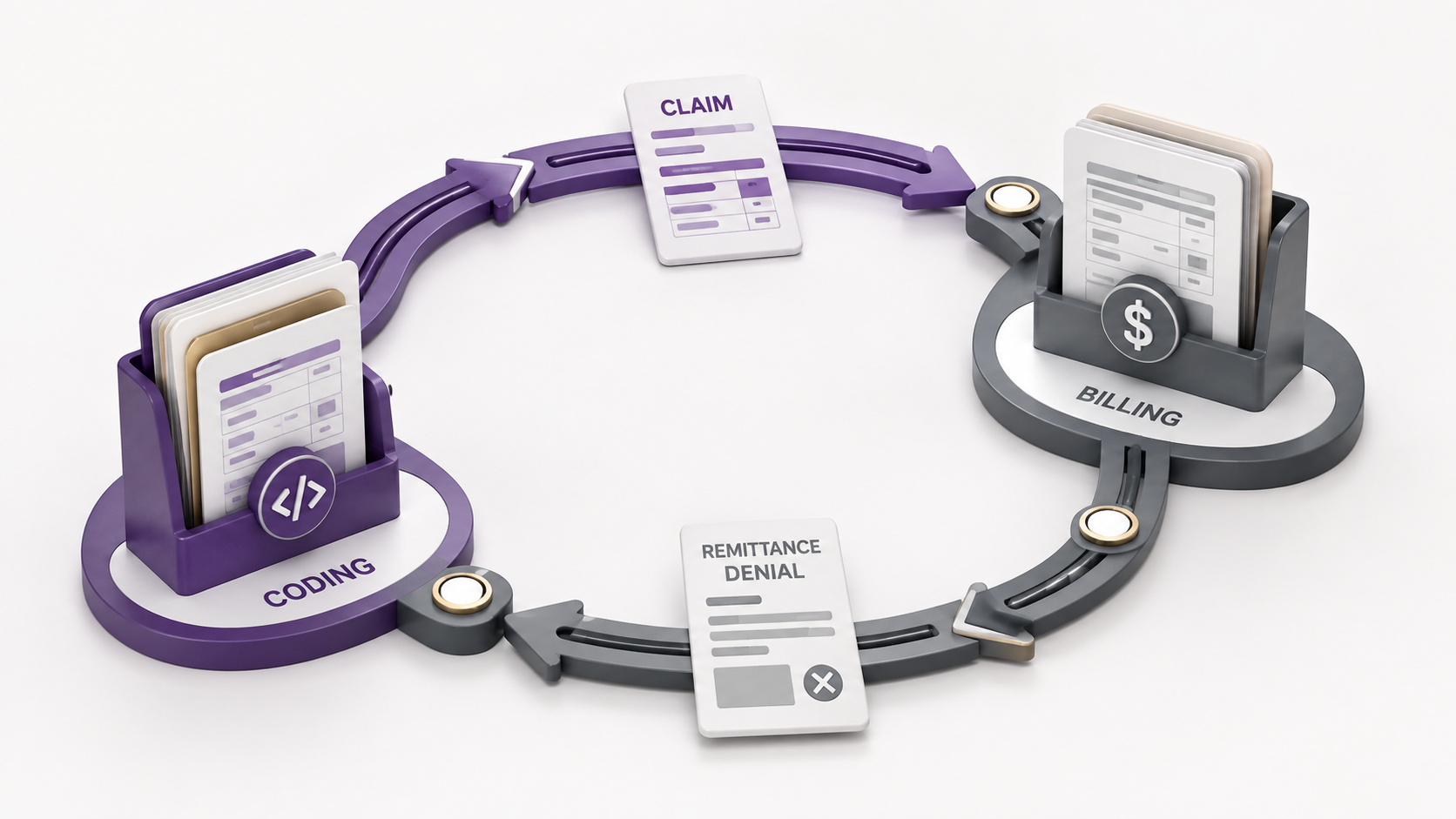
Coding determines how the services documented in the medical record are represented for billing. Billing takes that coded information through claim submission, payer adjudication, payment posting, denial follow-up, and patient collections.
The two functions are closely connected, but they are not interchangeable. A coding problem can prevent an otherwise valid claim from being paid correctly, while a perfectly coded claim can still lose revenue if submission and follow-up processes are weak.
For practice leadership, the more useful question is not simply whether the practice has a biller and a coder. It is whether responsibility is clearly assigned across the entire revenue cycle and whether the people performing those functions communicate when problems occur.
Key Takeaways
- Medical coding and medical billing are connected revenue-cycle functions, but they have different responsibilities.
- Coding translates documented clinical services into appropriate claim information; billing manages submission and much of what occurs after the claim enters the payer process.
- Denials should be investigated for root cause rather than automatically assigned to billing or coding based on job title.
- Combining billing and coding responsibilities can work, but leadership should evaluate workload, expertise, backlogs, A/R, and unresolved claims.
- Outsourcing tasks does not eliminate the practice’s responsibility to monitor revenue-cycle performance and define vendor scope.
- Strong revenue-cycle operations require clear ownership and feedback between billing, coding, providers, front-office staff, and leadership.
Table of Contents
Understanding the Difference Between Medical Billing and Coding
What the Medical Coder Is Responsible For
The coder’s work begins with the clinical record.
Using the provider’s documentation, the coder identifies the appropriate diagnosis and procedure codes. The coder also determines whether modifiers or other coding elements are necessary based on the documented service and applicable coding requirements. Depending on the setting and services provided, this may involve code sets such as CPT, HCPCS Level II, and ICD-10-CM.
This is an important compliance distinction: code selection should be supported by the medical record and applicable coding requirements. The coder’s role is not to select whichever combination of codes produces the highest reimbursement.
Experienced coders understand how code selection, sequencing, modifiers, payer requirements, and specialty-specific rules interact. They can also identify when documentation may not adequately support the service being reported. They can route the issue through the practice’s established clarification or documentation-review process before the claim is submitted.
That review creates an important compliance control by helping the practice identify unsupported, inconsistent, or incomplete coding before the claim reaches the payer.
Undercoding can cause the practice to report services below what the documentation supports. It can potentially cause the practice to lose legitimate reimbursement. Overcoding can create overpayment, repayment, audit, and compliance exposure.
Inconsistent coding can contribute to denials while also making reimbursement and utilization data less reliable. Strong coding processes help the practice remain between those extremes by ensuring that claims accurately reflect documented services.
Compliance Alert
Coding review is both a reimbursement control and a compliance control. Leadership should monitor whether documentation questions are resolved before submission and whether recurring coding patterns suggest systematic underreporting, unsupported reporting, or inconsistent application of coding requirements.
What the Medical Biller Is Responsible For
Once the coded information is ready for billing, responsibility moves further into the revenue cycle.
Depending on how the practice divides revenue-cycle responsibilities, the biller’s work may include claim submission and monitoring rejections and denials. The work may also include payment and adjustment posting, unpaid-claim follow-up, appeals, and portions of patient billing and collections.
This means the biller works extensively with what happens after the claim leaves the practice.
A claim may be coded correctly and still fail because of an eligibility issue, missing authorization, incorrect patient information, payer processing problem, or another administrative requirement. The biller needs to identify why the claim failed or remains unpaid. The biller then needs to route the issue to the appropriate corrective action or responsible workflow.
That may involve correcting and resubmitting a claim, providing additional information, appealing a payer decision, or returning the issue to coding or another department.
Effective billing requires both accurate claim submission and consistent follow-up after the claim enters the payer process.
A practice can maintain an excellent clean-claim submission process and still experience poor financial performance. This can occur if it does not consistently follow up on unpaid claims and denials within applicable filing or appeal deadlines.
Billing effectiveness becomes especially visible in accounts receivable. Unresolved claims can move into older aging categories and increase the risk of missed payer deadlines, unresolved balances, and eventual revenue loss.
Operational Snapshot
A/R aging can expose billing capacity problems that claim-submission metrics miss. Leadership should distinguish between balances awaiting normal payer processing and balances aging because follow-up work is delayed, since the latter can indicate a workload or workflow problem before revenue is permanently lost.
Where Billing and Coding Meet
The handoff between coding and billing should not be a one-way transfer.
Information needs to move in both directions.
If billing identifies repeated denials involving a particular code, modifier, or coding combination, it should communicate that pattern to coding for review. Likewise, coding should communicate recurring documentation or coding concerns identified before submission to providers and relevant staff. The underlying issue can then be evaluated rather than corrected one claim at a time.
A simplified division of responsibility looks like this:
| Function | Coding | Billing |
|---|---|---|
| Review clinical documentation | Primary responsibility | May review when resolving claim issues |
| Assign diagnosis and procedure codes | Primary responsibility | Uses coded information |
| Apply appropriate modifiers | Often coding responsibility | Uses coded information and monitors payer response |
| Identify documentation that may not support reported services | Primary coding responsibility | May identify concerns during denial or claim follow-up |
| Submit claims | Supports claim accuracy before submission | Primary responsibility |
| Monitor claim rejections | Assists when rejection involves coding | Primary responsibility |
| Work denials | Reviews coding- or documentation-related issues | Primary responsibility for payer follow-up and resolution |
| Correct and resubmit claims | Supports coding corrections when needed | Primary responsibility |
| Submit or coordinate appeals | Provides coding support when applicable | Often primary responsibility, depending on workflow |
| Follow unpaid claims | Supports coding questions when identified | Primary responsibility |
| Post payments and adjustments | — | Often billing responsibility, depending on workflow |
| Manage patient balances and collections | — | May be billing responsibility, depending on workflow |
| Identify recurring reimbursement problems | Coding and documentation perspective | Payer, claims, denial, and A/R perspective |
| Communicate recurring problems upstream | Identifies coding and documentation patterns | Identifies payer, claim, denial, and payment patterns |
The exact division of responsibility varies by practice, specialty, staffing model, payer mix, and the qualifications of the people performing the work. In smaller organizations, one employee may perform several of these functions. What matters is that none of the responsibilities disappear simply because the job titles are combined.
How Billing and Coding Problems Affect Revenue-Cycle Performance
Denials Show Why the Distinction Matters
Denial management is one of the clearest examples of how coding and billing depend on one another.
Suppose a payer repeatedly denies a particular service. Billing identifies the recurring denial pattern and begins investigating the cause. If the denial involves a code or modifier, coding may need to review the claim and documentation.
Coding may also need to review applicable coding requirements. If the submitted coding is supported but the payer denied the claim because required authorization was missing, the root cause may sit upstream in scheduling or authorization rather than billing or coding.
That is why automatically sending every denial back to the biller—or every coding-related denial back to the coder—does not solve the larger operational problem.
Denials should create a feedback loop.
The immediate claim needs to be worked, but the practice should also determine whether the same issue is likely to affect future claims. Repeated authorization denials may require changes to scheduling or authorization workflows. Eligibility denials may require changes at registration. Documentation-related denials may require provider education.
Billing identifies many of these problems downstream. Coding helps determine whether the issue involves how the clinical service was represented. Practice leadership then needs to make sure the root cause is addressed in the correct workflow.
Technical Deep Dive
Effective denial management requires routing by root cause rather than by whichever department first encounters the denial. Categorizing recurring denials by coding, documentation, eligibility, authorization, registration, or payer processing allows corrective work to reach the workflow capable of preventing the next occurrence.
Combining the Roles Can Work, but Capacity Matters
Small practices frequently use one person for both billing and coding. That arrangement can work when claim volume and coding complexity are manageable and the employee has sufficient expertise in both areas.
The risk is assuming that because one person can perform both functions, there is enough capacity to perform both functions well.
Coding requires concentration and technical knowledge. Billing requires persistent follow-up, reconciliation, denial management, and communication. As the practice grows, one side of the role can begin consuming the time needed for the other.
This may not show up immediately. Instead, leadership begins seeing older A/R, delayed payment posting, coding backlogs, or denials that remain unresolved.
At that point, leadership should evaluate whether the problem is employee performance or whether one position has simply been assigned more coding and billing work than can be completed accurately and on time.
Operational Snapshot
When one employee handles both functions, performance should be evaluated as a capacity question as well as a competency question. Simultaneous growth in coding queues and aging receivables may indicate that competing workloads—not lack of skill—are preventing timely completion of both responsibilities.
Signs Billing and Coding Responsibilities Need to Be Reassessed
A practice does not need to wait for a major revenue problem before reconsidering how billing and coding responsibilities are divided. Smaller operational signals can show that the existing structure is no longer keeping pace with the workload.
Warning signs may include growing coding backlogs, delayed claim submission, increasing older accounts receivable, and repeated coding-related denials. They may also include payment-posting delays and unresolved payer requests. Another warning sign is staff regularly shifting between coding and claim follow-up without enough time to complete either function consistently.
Leadership should also pay attention when responsibility becomes unclear. If billing assumes coding will correct an issue while coding assumes billing will resolve it with the payer, claims can remain unresolved even when qualified people are involved.
These patterns do not automatically mean another employee or vendor is needed. They indicate that leadership should evaluate workload, role definitions, staff expertise, workflow handoffs, and performance data. Leadership can then decide whether to separate, combine, outsource, or redistribute the work.
In-House, Outsourced, or Hybrid?
Practices also need to decide where these functions should reside.
There is no universally correct structure. The right model depends on claim volume, specialty complexity, available staff, management capacity, and the practice’s ability to recruit and retain qualified personnel.
An in-house model provides direct access to staff and can make communication with providers easier. It also gives management more immediate visibility into claim problems. However, the practice assumes responsibility for staffing, training, coverage, technology, and performance oversight.
Outsourcing can reduce some of that administrative burden and provide access to specialized billing or coding resources, but responsibility for monitoring revenue-cycle performance remains with practice leadership.
Practice leadership still needs timely access to accounts receivable, denial and rejection trends, claim status, payment activity, collection performance, and other reporting needed to evaluate whether the outsourced function is producing the expected results. A practice should never have to rely solely on a vendor’s assurance that billing is going well.
Operational Snapshot
Outsourcing changes who performs the work, not who must govern the revenue cycle. Vendor oversight is strongest when leadership can independently review aging, denial patterns, unresolved claims, payment activity, and other performance indicators instead of treating vendor reporting as a substitute for operational visibility.
It is also important to define exactly what an outsourced service includes. Billing and coding should not be assumed to be bundled together. Scope should be clarified before the relationship begins. This includes responsibility for coding, denials, appeals, payment posting, patient balances, reporting, and unresolved claims.
Some practices use a hybrid model, keeping coding expertise closer to the providers while outsourcing claim submission and follow-up. That can be effective, but only when the handoff between the two functions is well defined.
Evaluate the Workflow, Not Just the Vendor or Employee
When determining whether a billing and coding structure is working, leadership should look beyond credentials and job descriptions.
A functioning billing and coding structure should produce measurable evidence that claims are being coded accurately, submitted promptly, followed appropriately, and moving through the revenue cycle toward appropriate reimbursement or resolution.
Are coding-related denials recurring? Are unpaid claims receiving timely follow-up? Is older A/R increasing? Are payment and adjustment data being posted accurately? Can management identify denial patterns, why claims are being denied, and what is being done to prevent recurrence?
Those questions reveal more about the health of the operation than whether the practice technically employs a coder and a biller.
They also prevent a common management problem: assigning responsibility without establishing accountability.
A billing company can be responsible for claims follow-up while still performing poorly. An experienced coder can be responsible for coding while documentation deficiencies continue to create problems. Leadership needs reporting and defined workflows to determine whether each function is actually producing the expected result.
Strong Revenue-Cycle Performance Depends on the Entire Workflow
The distinction between medical billers and coders matters, but the larger lesson is that neither role operates independently.
Coding helps translate clinical documentation into the information reported on the claim. Billing manages much of the process that moves the claim from submission toward reimbursement or other resolution. Both functions depend on information created elsewhere in the practice. This includes patient registration, eligibility verification, authorization, clinical documentation, and payer enrollment.
That is why revenue cycle problems cannot always be solved inside the billing department.
An effective practice creates clear ownership across the entire process. It ensures that problems identified downstream are routed back to the workflow where they originated. That feedback allows billing, coding, providers, and front-office staff to address recurring issues at their source rather than treating each affected claim as an isolated problem.
Whether those functions are performed in-house, outsourced, or through a hybrid arrangement is ultimately an operational and staffing decision. The operational requirement remains the same: accurate coding before submission, disciplined billing after submission, and a reliable feedback loop between the two.
When those pieces work together, the practice is better positioned to submit accurate claims and reduce preventable denials. It is also better positioned to identify problems earlier, protect appropriate reimbursement, and maintain stronger control over the revenue cycle.
Frequently Asked Questions About Medical Billing and Medical Coding
What is the difference between medical billing and medical coding?
Medical coding translates documented clinical services into the diagnosis, procedure, modifier, and other coding information needed for a claim. Medical billing manages claim submission and much of the downstream process, including rejections, denials, unpaid-claim follow-up, payment activity, and other reimbursement workflows.
Can the same person handle medical billing and medical coding?
Yes. In smaller practices, one employee may perform both functions when claim volume and coding complexity are manageable and the employee has sufficient expertise. Leadership should also evaluate capacity because one person may have the knowledge to perform both roles without having enough time to complete both workloads effectively.
Does a medical biller assign CPT and ICD-10 codes?
Coding responsibility varies by practice and staffing model, but assigning diagnosis and procedure codes is generally a coding function. Billing typically uses the coded information to submit and manage claims. Practices should clearly define these responsibilities rather than assuming every biller also performs coding.
Who is responsible for fixing medical billing denials?
Responsibility depends on the reason for the denial. Billing may manage payer follow-up, while coding may need to review coding- or documentation-related issues. Authorization, eligibility, or registration denials may originate elsewhere in the practice. Denials should therefore be routed according to root cause rather than job title.
Should a medical practice outsource billing and coding together?
Not necessarily. Billing and coding should not be assumed to be included in the same outsourced service. Before selecting a vendor, practices should define responsibility for coding, claim submission, denials, appeals, payment posting, patient balances, reporting, and unresolved claims.
How can a practice tell whether its billing and coding structure is working?
Leadership should monitor measurable indicators such as claim-submission timeliness, coding backlogs, recurring coding-related denials, unpaid-claim follow-up, older accounts receivable, payment-posting accuracy, and unresolved payer issues. Negative trends can indicate problems with capacity, expertise, workflow design, or unclear responsibility.
About the Author
Jennifer Blevens-Smith is the founder and principal consultant of Integral Clinic Solutions. With more than two decades of experience supporting independent medical practices, she helps physicians, practice administrators, and healthcare leaders strengthen credentialing, payer contracting, revenue cycle operations, compliance workflows, and practice management. Her work focuses on translating complex healthcare requirements into practical operational processes. These processes improve consistency, reduce administrative burden, and support long-term practice success.
Need Help Strengthening Your Medical Practice Operations?
Integral Clinic Solutions provides practical support for medical practices navigating credentialing, contracting, revenue cycle operations, compliance workflows, front-office systems, and practice management challenges.
Explore more operational guidance, compliance insights, and healthcare business resources on the Integral Clinic Solutions blog. New articles and updates are added regularly for practice owners, administrators, and healthcare teams.
Disclaimer: This content is for informational and educational purposes only and does not constitute legal, coding, billing, compliance, financial, or medical advice. Healthcare practices must verify all operational requirements with applicable payers, regulators, and qualified professionals. Read our full Legal & Compliance Disclaimer.