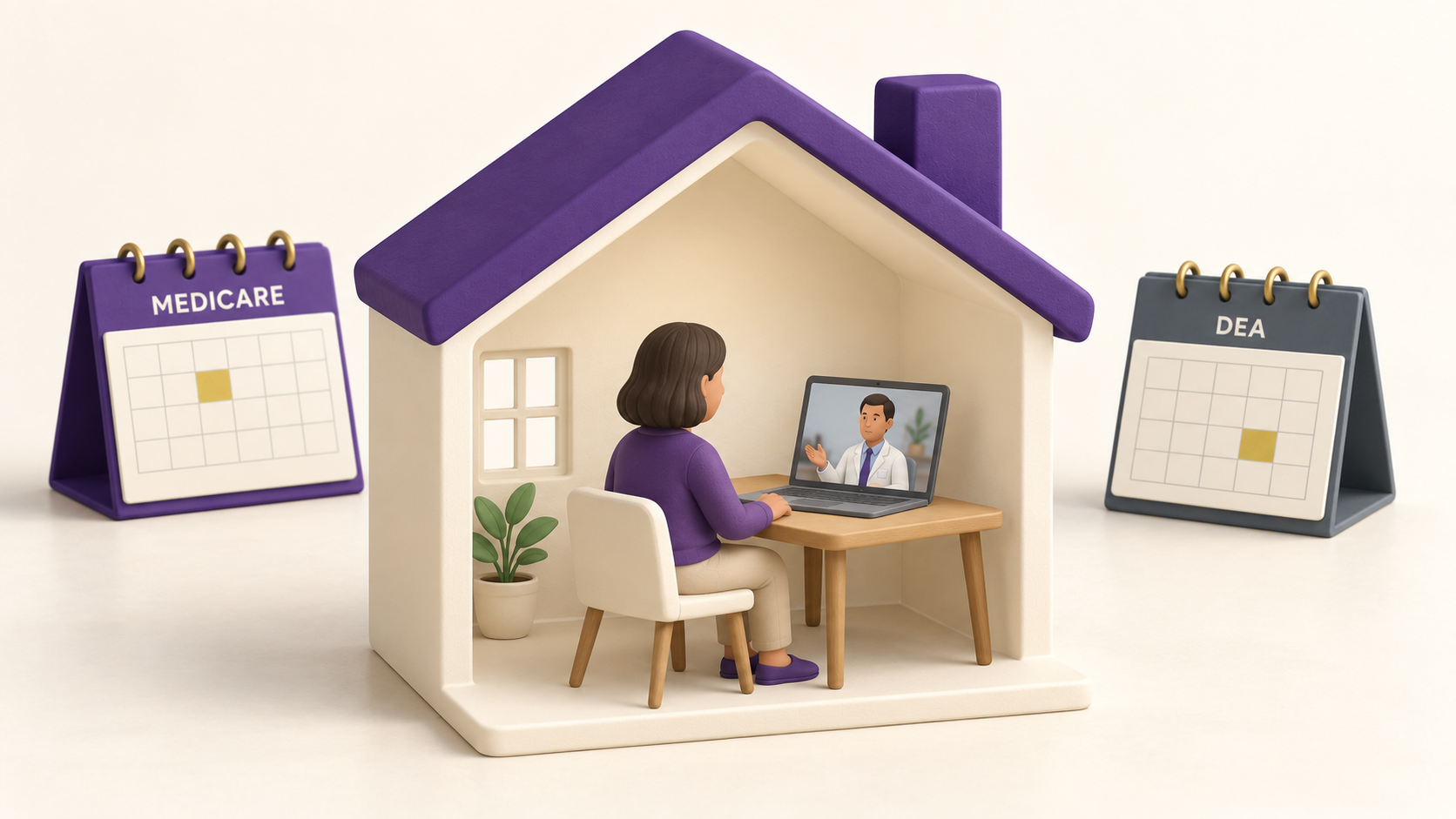
The Critical Medicare Telehealth Details Practices Need to Get Right
Medicare telehealth rules affect more than whether a patient can attend an appointment from home. They determine which services qualify, which practitioners can furnish them, and how the practice should report the encounter. They also interact with separate requirements for supervision, practitioner enrollment, and prescribing.
The challenge is that these requirements do not all change together. Congress can extend access while CMS changes a billing or supervision policy through annual rulemaking. A prescribing flexibility may expire on a different date. Treating every change as one “telehealth final rule” can leave staff working from an incomplete picture.
As of September 30, 2026, many Medicare telehealth access flexibilities continue through December 31, 2027. That includes broad access to eligible services from the patient’s home. Older warnings about automatic April or October 2025 rollbacks should not guide today’s scheduling and billing decisions.
For independent medical practices, the useful question is more specific: which requirements apply to this service, practitioner, patient location, and date of service? Answering that question provides a stronger foundation than relying on a headline or an old deadline.
Key Takeaways
- Many Medicare telehealth access flexibilities currently continue through December 31, 2027. Verify each provision separately.
- Practitioner eligibility, service coverage, patient location, and delivery conditions require separate checks.
- POS 02 and POS 10 identify different patient locations; a valid POS code does not establish coverage.
- Virtual supervision and practitioner home-address reporting follow their own service and enrollment requirements.
- Controlled-substance prescribing operates under separate authority, with applicable telemedicine flexibilities extended through December 31, 2026.
- Assign policy-review ownership, update staff references, and verify that appointment decisions and claims reflect the implemented change.
Table of Contents
Which Medicare Telehealth Rules Apply Today?
Medicare telehealth policy contains both temporary extensions and lasting changes. An extension preserves a particular flexibility for a defined period. It does not necessarily make that flexibility permanent or remove other conditions attached to the service.
HHS currently identifies several provisions continuing through December 31, 2027. These include non-behavioral health telehealth from home, relief from geographic originating-site restrictions, expanded eligible practitioners, and specified audio-only access. Behavioral health home access and relief from geographic restrictions also have permanent provisions. The associated in-person visit requirements are a separate issue; their implementation is delayed through that same date.
These distinctions matter when a practice builds its written policies and procedures. A single expiration date at the top of a telehealth checklist can imply that every item expires together. Instead, staff should be able to see which rule they are checking and which service category it affects.
What happened to the 2025 deadlines?
Early 2025 guidance discussed an approaching March 31 expiration and possible restrictions beginning April 1. The Full-Year Continuing Appropriations and Extensions Act, enacted March 15, 2025, extended specified flexibilities through September 30, 2025.
The later October deadline also needs historical context. CMS now states that claims for telehealth services during the government shutdown will be paid under flexibilities applied retroactively, as though the temporary lapse had not occurred. Current guidance reflects the subsequent extension through December 31, 2027.
| Historical reference | How practices should interpret it now |
|---|---|
| Expected April 1, 2025 restrictions | The March 2025 law extended specified provisions before that deadline. |
| September 30, 2025 expiration | This was an earlier extension endpoint, not the current endpoint. |
| October 2025 lapse | CMS describes retroactive application of the flexibilities to affected services. |
| December 31, 2027 | Current endpoint for many access flexibilities; verify each provision separately. |
The operational lesson is to distinguish what was expected from what was enacted and implemented. An old article may accurately describe the uncertainty staff faced at the time while providing the wrong instruction for a current encounter.
Practices should also distinguish law from agency policy. Congressional extensions and CMS Physician Fee Schedule changes address different parts of the framework. A final rule published before a later law may contain a deadline that has since changed. Check current implementation guidance alongside the original rule when reconciling them.
Operational Snapshot
When a deadline changes, the practice may need to replace more than a billing memo. Scheduling criteria and patient instructions may still reflect the earlier rule. Review the references staff actually use so one department does not continue applying a restriction that another department has already removed.
Medicare Telehealth Eligibility and Patient Locations
Two terms help clarify the location questions. The originating site is the patient’s location when receiving the service. The distant site is the practitioner’s location when delivering it. Those locations affect different checks and should not be treated as interchangeable.
For example, a patient can be at home while the practitioner works in an office. Another patient may be in a facility while the practitioner works remotely. Both encounters use telecommunications, but that does not make their location reporting identical.
Current CMS guidance permits beneficiaries to receive eligible Medicare telehealth services throughout the United States and its territories through December 31, 2027. Expanded practitioner eligibility includes physical therapists, occupational therapists, speech-language pathologists, and audiologists during that period. These access provisions do not independently establish that every service performed by an eligible practitioner qualifies.
This is where a broad scheduling instruction can become unreliable. “Medicare allows telehealth” gives staff too little information to decide whether a specific appointment fits the practice’s covered service model. The practice needs a reference tied to the services it actually offers and the practitioners who furnish them.
When reviewing that reference, separate three questions: whether the practitioner qualifies, whether the service qualifies, and whether the encounter meets the applicable delivery conditions. An answer to one question should not be used as the answer to all three.
Behavioral health and specialized settings
Behavioral health has distinct provisions, including permanent access from the patient’s home without geographic restrictions. Its in-person visit conditions need their own review; staff should not apply an old six-month or annual-visit instruction without checking its current effective date.
Rural Health Clinics and Federally Qualified Health Centers also have setting-specific payment arrangements. Current guidance continues their distant-site role for non-behavioral health services through December 31, 2027. Practices operating in those settings should use the applicable billing guidance rather than transplanting an office-based professional claim checklist.
Independent practices should verify which Medicare telehealth requirements apply to their services. Specialized exceptions may require a separate review for the service or setting involved. Do not treat a short list of behavioral health, dialysis, or stroke exceptions as a complete description of Medicare telehealth coverage.
Geographic coverage flexibility also does not resolve professional authorization. A patient’s location can affect licensure and other requirements. A practice should verify the applicable authorization separately before interpreting Medicare coverage as permission to provide care in another jurisdiction.
Compliance Alert
A Medicare coverage flexibility answers a payment question. It does not independently authorize the practitioner to treat a patient in another jurisdiction. Confirm the patient’s location and applicable professional authorization separately so broad geographic access does not become an assumption about where the practitioner may deliver care.
How Practices Should Verify Medicare Telehealth Billing
Start with the service and date of service. CMS maintains a Medicare Telehealth Services List, and additions or deletions generally take effect January 1 through the annual Physician Fee Schedule process. Use the applicable year’s list when checking whether a particular code qualifies.
The access extension and the services list answer different questions. Allowing patients to receive care from home does not place every office service on the telehealth list. Likewise, finding a code on the list does not eliminate its billing, documentation, or delivery conditions.
For illustration, a practice might confirm home access and assume its usual office code can be submitted unchanged. If no one checks the service’s telehealth status or delivery conditions, the claim can reach billing with a coverage question still unresolved. A reliable review catches that uncertainty before staff build a recurring appointment type around it.
POS 02 and POS 10 remain distinct
CMS continues to identify POS 02 as telehealth provided somewhere other than the patient’s home. POS 10 identifies telehealth provided in the patient’s home. POS 10 did not retire simply because a temporary coverage provision approached expiration.
This distinction concerns the patient, not the practitioner’s workstation. A practitioner working in the office does not turn a home-based patient encounter into an office visit. Staff should use the actual encounter circumstances and current billing instructions when selecting the code.
Coverage eligibility and POS accuracy therefore require separate checks. Selecting a valid POS code does not make a noncovered service covered. Changing the code to one associated with a different location cannot correct an encounter that did not meet the applicable requirements.
| Billing checkpoint | Question the practice should resolve |
|---|---|
| Service | Does the applicable guidance support this code and service? |
| Practitioner | Does the furnishing practitioner qualify under the relevant requirements? |
| Delivery method | Was the service delivered through an allowed modality? |
| Patient location | Does the location qualify, and does the claim report it accurately? |
| Claim instructions | What POS, modifiers, and other reporting requirements apply? |
| Documentation | Does the record support the service and circumstances reported? |
Audio-only encounters need a deliberate review as well. Current CMS guidance permits eligible home audio-only telehealth through December 31, 2027. That is not a blanket instruction to bill every phone call as a telehealth visit. Check the particular service and applicable conditions before creating an audio-only billing pathway.
The practice’s billing reference should connect those findings to the information clinicians and staff need to capture. If coders need to know the patient’s location or whether the encounter used video, those details should be available in the record. Otherwise, the billing team has to reconstruct the encounter after it occurs.
A practical documentation review asks whether the record explains what happened and supports the reported service. It should not rely on a copied telehealth phrase while leaving important encounter details unclear. The exact requirements depend on the service; the practice should verify them and translate them into usable documentation instructions.
Telehealth documentation needs to describe the actual encounter and support the service reported. In this video, Jennifer discusses telehealth documentation and audit readiness, complementing the service-specific checks outlined above.
Finally, keep payer distinctions visible. This discussion primarily concerns traditional Medicare requirements. Practices should check Medicare Advantage plan instructions and other payer policies separately. One Medicare reference should not become an undocumented assumption about every insurance product the practice accepts.
Technical Deep Dive
Claim settings can only apply encounter details that the practice captures accurately. If a telehealth template assumes every patient is at home, that assumption may flow into POS selection. Compare the actual patient location and delivery method with the generated claim to identify errors before they become recurring billing patterns.
Supervision, Provider Addresses, and Prescribing
Telehealth coverage is only one part of the review when a service involves supervised work, a remote practitioner, or controlled-substance prescribing. Each brings a separate question. Combining them under one expiration date makes it harder to see which requirement actually governs the decision.
Virtual supervision depends on the service
The CY 2026 Physician Fee Schedule allows virtual direct supervision for specified services through real-time audio-video technology, excluding audio-only. Services with a 010 or 090 global surgery indicator are excluded from this provision. CMS also permits teaching-physician virtual presence in all teaching settings when the relevant service is furnished virtually, subject to the applicable requirements.
Direct supervision and teaching-physician presence should not be collapsed into a general statement that “remote oversight is allowed.” Identify the arrangement first, then check the rule governing it. The technology used for a patient encounter does not, by itself, establish that the supervision requirement was met.
Practices should review the services they actually furnish under supervision and document the applicable arrangement. That review may involve the clinical leader, coding staff, and compliance personnel. Their task is to connect the specific service to its governing requirement, rather than assuming every remotely supervised activity follows the same pathway.
This also corrects an outdated planning assumption. Practices should not reorganize staffing around a blanket claim that virtual supervision ended in December 2025. They should evaluate current service-specific conditions before changing schedules or supervision coverage.
Working from home does not create one universal address rule
CMS distinguishes two situations. A practitioner furnishing telehealth from home who also has a physical practice location generally does not need to report the home address on the Medicare enrollment application. A virtual-only practitioner whose sole physical practice location is home needs to enroll that address. CMS provides an administrative/telehealth home-office designation to suppress street-address details on Care Compare.
Before changing enrollment records, determine which situation applies. An occasional remote workday and a fully virtual practice are different operating models. Staff should not make an address change based only on the fact that a practitioner sometimes connects from home.
Keep enrollment reporting separate from patient-location POS reporting. They identify different information for different purposes. When the practice’s model changes, review the relevant enrollment and billing instructions together so internal records remain consistent with the actual arrangement.
DEA prescribing rules have their own deadline
DEA and HHS extended the applicable telemedicine prescribing flexibilities through December 31, 2026. Under the extension, a DEA-registered practitioner may prescribe certain controlled medications without a prior in-person evaluation when the required conditions are met. Audio-video and limited audio-only pathways have different conditions; federal and state requirements still apply.
That deadline differs from the Medicare access extension. A covered telehealth appointment does not independently establish that a controlled-substance prescription is permitted. Prescribing authorization, encounter conditions, and Medicare payment are separate determinations.
Practices offering these services should assign the prescribing review to qualified clinical and compliance personnel. They should verify the current pathway, applicable DEA registration requirements, and relevant state rules. Avoid presenting a proposed special-registration process as an available exception before confirming its final status and applicability.
Compliance Alert
One approved part of a telehealth encounter does not establish compliance with every other part. Medicare coverage, supervision, enrollment reporting, and prescribing each require their own review. A practice can have a covered appointment while still needing to resolve a separate supervision arrangement or controlled-substance prescribing condition.
Monitoring and Implementing Policy Changes
Managing telehealth operations requires more than a bookmarked policy page. The practice needs a method for deciding whether an update changes its services and, if so, what staff should do differently. The most useful monitoring process produces a specific implementation decision.
Begin with an inventory of the Medicare telehealth services the practice furnishes. Identify the codes, practitioners, patient settings, and delivery methods involved. Include supervised services or prescribing pathways where relevant. This narrows the review to the requirements that could affect actual care and claims.
Maintain a policy register that records the source, review date, effective date, and affected service. Note whether the information describes a proposal, enacted law, final rule, or implementation instruction. When one source updates an earlier deadline, retain enough history to explain why the practice changed its reference.
That history helps when staff encounter older instructions. A scheduler may still have a handout warning that home visits ended in 2025. Simply telling the scheduler that it is outdated leaves the original misconception unresolved. Explain which provision changed and replace the reference used for appointment decisions.
Assign an owner for monitoring and a backup for absences. The owner should coordinate the review, but clinical, billing, and enrollment questions may need different reviewers. Leadership should be able to identify who approved the interpretation and who is responsible for putting it into practice.
For a verified change, follow a defined sequence:
- Identify the affected services, practitioners, and dates of service.
- Confirm the applicable instruction and resolve conflicting guidance.
- Update scheduling criteria, documentation instructions, and billing references as needed.
- Review claim settings and retire outdated reference materials.
- Train the staff whose responsibilities change.
- Communicate with affected patients and review initial results.
Patient communication should follow the verified decision. Explain which appointments are affected and what options remain available. Avoid promising that a temporary flexibility will continue indefinitely, but do not announce a possible future restriction as though it already applies.
For example, if a change affects only one delivery method, review those appointments rather than automatically canceling all virtual care. A focused response gives patients accurate options and prevents a narrow policy change from disrupting services it does not affect.
After implementation, review a sample of affected encounters and claims. Compare the reported details with the actual visit and current instructions. Look for patterns involving a particular service, practitioner, or claim setting. When problems repeat, review the interpretation and configuration instead of correcting each claim without changing the underlying process.
Operational Snapshot
A policy update is not fully implemented when the reference document changes. Staff instructions, appointment decisions, and claim settings need to reflect the same interpretation. Reviewing affected encounters after implementation helps leadership distinguish a correctly updated document from a process that still operates under the older rule.
Medicare telehealth works more reliably when the practice understands which rule answers which question. Coverage, billing, supervision, enrollment, and prescribing fit together, but each requires its own verification. A current reference and a defined implementation process help staff turn policy changes into accurate appointment decisions and supported claims.
Frequently Asked Questions
Did Medicare retire POS 10?
No. POS 10 continues to identify telehealth provided in the patient’s home. POS 02 identifies telehealth provided elsewhere. Select the code that accurately reflects the patient’s location and applicable billing instructions. A valid POS code does not independently establish that the service qualifies for coverage.
Can therapy practitioners still furnish Medicare telehealth?
Expanded practitioner eligibility currently continues through December 31, 2027, including physical therapists, occupational therapists, speech-language pathologists, and audiologists. Eligibility alone does not make every service covered. Verify the particular service, code, delivery conditions, and date of service before treating a practitioner’s virtual appointment as ready for billing.
Does Medicare cover every audio-only phone call?
No. Current guidance permits eligible home audio-only telehealth through December 31, 2027, subject to applicable conditions. Staff should verify the service and delivery requirements before selecting a billing pathway. An ordinary phone conversation does not become a covered telehealth service simply because audio-only access remains available.
Must every practitioner working from home enroll that address?
No. CMS distinguishes practitioners who also have a physical practice location from virtual-only practitioners whose sole physical location is home. The latter need to enroll the home address. Review the actual practice model and current instructions before changing enrollment records; patient-location POS reporting is a separate question.
Does the Medicare extension also extend DEA prescribing flexibility?
No. Medicare access and DEA prescribing operate under separate authorities. Many Medicare access flexibilities currently continue through December 31, 2027, while the applicable DEA prescribing extension runs through December 31, 2026. Prescribing still requires its own conditions to be met, including applicable federal and state requirements.
Should practices assume every telehealth rule ends on the same date?
No. Temporary access provisions, lasting policy changes, supervision requirements, enrollment instructions, and prescribing rules need separate review. Record the source and effective date for each provision relevant to your services. An extension of one flexibility should not automatically change every item in the practice’s telehealth reference.
About the Author
Jennifer Blevens-Smith is the founder and principal consultant of Integral Clinic Solutions. With more than two decades of experience supporting independent medical practices, she helps physicians, practice administrators, and healthcare leaders strengthen credentialing, payer contracting, revenue cycle operations, compliance workflows, and practice management. Her work focuses on translating complex healthcare requirements into practical operational processes. These processes improve consistency, reduce administrative burden, and support long-term practice success.
Need Help Strengthening Your Medical Practice Operations?
Integral Clinic Solutions provides practical support for medical practices navigating credentialing, contracting, revenue cycle operations, compliance workflows, front-office systems, and practice management challenges.
Explore more operational guidance, compliance insights, and healthcare business resources on the Integral Clinic Solutions blog. New articles and updates are added regularly for practice owners, administrators, and healthcare teams.
Disclaimer: This content is for informational and educational purposes only and does not constitute legal, coding, billing, compliance, financial, or medical advice. Healthcare practices must verify all operational requirements with applicable payers, regulators, and qualified professionals. Read our full Legal & Compliance Disclaimer.
One thought on “The Critical Medicare Telehealth Details Practices Need to Get Right”