Medicare Therapy Thresholds for PT, OT, and Speech Therapy in 2026
Medicare outpatient therapy billing becomes more operationally demanding as a patient’s annual therapy expenses increase. For practices providing physical therapy, occupational therapy, or speech-language pathology services, the challenge is not simply knowing a dollar threshold. The practice has to know when the threshold is approaching, apply the appropriate modifier when required, and maintain documentation that supports continued medical necessity.
These responsibilities cross clinical documentation and revenue cycle workflows. The therapist determines and documents why skilled treatment remains necessary. Billing staff needs accurate coding and modifier information. Administrative staff may need to monitor accumulated therapy expenses.
accurate coding and modifier information. Administrative staff may need to monitor accumulated therapy expenses. When those functions are disconnected, clinically appropriate therapy can still result in preventable denials or delayed reimbursement because the documentation, threshold monitoring, modifier use, and claim submission process are not working together.
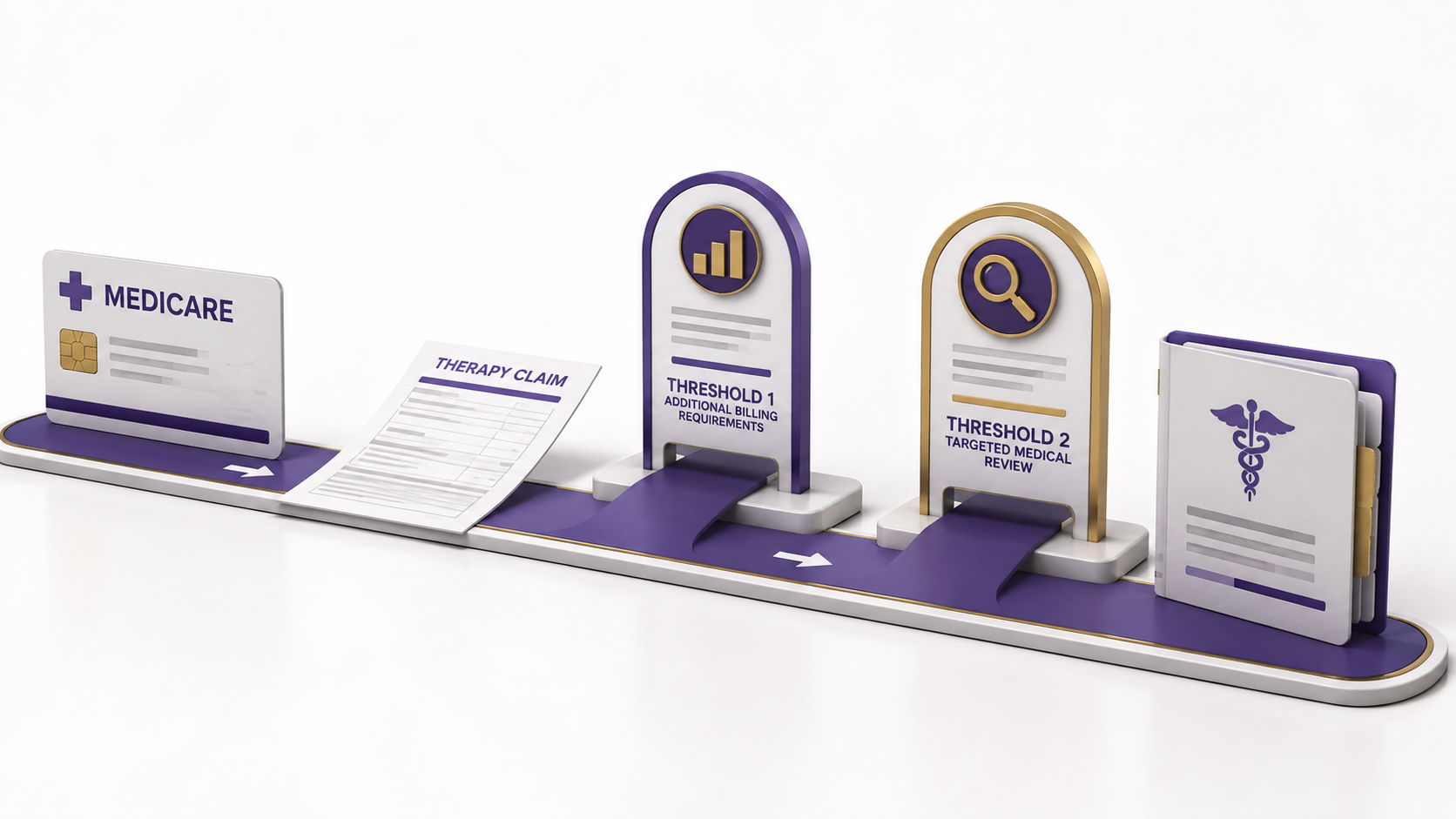
For 2026, practices should build their processes around two important Medicare thresholds: the KX modifier threshold and the targeted medical review threshold.
Key Takeaways
- The 2026 KX modifier threshold is $2,480 for PT and SLP combined and $2,480 for OT separately.
- Reaching the KX threshold does not automatically cap coverage; continued qualifying services require appropriate documentation and KX modifier use.
- PT and SLP share an accumulated expense threshold, making beneficiary-level monitoring important even when services come from different providers.
- The $3,000 targeted medical review threshold does not automatically subject every claim above that amount to review.
- Threshold monitoring, clinical documentation, modifier use, and claim submission should function as a coordinated workflow rather than separate responsibilities.
- Denials and record requests can expose problems that originated earlier in documentation, expense monitoring, or internal communication.
Table of Contents
Understanding the 2026 Medicare Therapy Thresholds
One important distinction is that Medicare’s historical outpatient therapy caps are no longer actual coverage caps. The Bipartisan Budget Act of 2018 repealed the application of those caps while retaining annual dollar amounts as thresholds for additional billing requirements.
For calendar year 2026, the KX modifier threshold is $2,480 for physical therapy and speech-language pathology services combined and $2,480 for occupational therapy services separately.
That distinction matters operationally. Reaching $2,480 does not automatically mean Medicare stops covering therapy. Instead, once expenses reach the applicable threshold, continued services that meet Medicare requirements must be supported as medically reasonable and necessary. Claims above the threshold require the KX modifier.
Physical therapy and speech-language pathology share the same accumulated expense category. Occupational therapy is tracked separately. A patient receiving PT from one provider and speech-language pathology services from another can therefore approach the combined PT/SLP threshold even when neither individual practice has provided $2,480 in services on its own.
Operational Snapshot
Internal billing totals may provide an incomplete picture of a beneficiary’s progress toward the PT/SLP threshold. Practices need a monitoring process that accounts for applicable services delivered elsewhere, or the KX requirement may arrive earlier than the organization’s own records suggest.
That is why practices cannot treat threshold monitoring as a simple count of visits performed internally.
What the KX Modifier Actually Represents
The KX modifier is more than a billing mechanism added to a Medicare claim after a patient reaches the applicable threshold.
Use of the KX modifier indicates that services at and above the applicable threshold are medically reasonable and necessary and that the medical record supports the continued therapy. Medicare states that claims above the applicable threshold without the required KX modifier are denied.
That makes the modifier part of a larger documentation process, not a standalone billing task.
A practice that automatically adds KX once a patient reaches the threshold without confirming that the clinical record supports continued skilled therapy creates a different type of risk. The claim may contain the required modifier, but the medical record must still support the services it represents.
Compliance Alert
KX should not function as an automatic system response to crossing a dollar threshold. Because its use represents that continued therapy satisfies Medicare requirements, modifier activation should be paired with a documentation checkpoint that verifies the clinical record can support what the claim communicates.
The operational workflow therefore needs to connect three functions: monitoring accumulated expenses, identifying when KX becomes necessary, and confirming that the underlying documentation supports use of the modifier on the claim.
| 2026 Medicare Therapy Threshold | PT + SLP | OT | Operational Meaning |
|---|---|---|---|
| KX modifier threshold | $2,480 combined | $2,480 | Continued qualifying services at and above the threshold require KX and supporting documentation |
| Targeted medical review threshold | $3,000 combined | $3,000 | Claims above the threshold may be subject to targeted medical review |
Documentation Must Support Continued Skilled Therapy
Strong therapy documentation should allow someone reviewing the record to understand what was performed, why skilled intervention was required, how the service relates to the patient’s functional needs, and why continued treatment remains reasonable and necessary.
Consider the difference between documenting that a patient “received balance training” and documenting the specific intervention, the patient’s performance, the clinical reason for the activity, and the functional objective being addressed.
The second approach does more than add words to the note. It creates a clinical narrative connecting the treatment to the patient’s condition and plan of care.
For example, documentation might identify that the patient completed a defined period of proprioceptive and weight-shifting activities. It might describe the level of assistance or difficulty observed and connect the intervention to a functional objective such as safer ambulation or reduced fall risk.
That level of specificity becomes particularly important once the KX modifier is required because the medical record must support the continued services represented on the claim.
Documentation should also accurately correspond to the services and units reported on the claim. If timed services are billed, the clinical record needs to support the time associated with those services. If several therapy procedures are performed during one encounter, the documentation should clearly state what was provided and why.
Threshold Tracking Is a Revenue Cycle Responsibility
Waiting for a denial to discover that a patient crossed the KX threshold is not an effective control.
Practices need a repeatable process for monitoring accumulated Medicare therapy expenses so staff can identify when the applicable threshold is approaching or has been reached. Information available through Medicare Administrative Contractor resources can support that process, particularly when patients receive services from more than one provider.
This becomes especially important for PT and speech-language pathology because those services share a threshold. Your practice may see only its own services in the immediate workflow, while Medicare evaluates the beneficiary’s accumulated expenses across applicable services.
Threshold monitoring should therefore occur at defined points throughout treatment rather than relying on staff to recognize when a patient appears to be approaching the threshold.
A well-designed workflow establishes who checks accumulated expenses and when the check occurs. It also establishes where the result is documented and how the billing team is notified when KX becomes necessary. Without that ownership, everyone may assume someone else is watching the threshold until a claim is denied.
Technical Deep Dive
A threshold check is only useful if its result reliably changes downstream behavior. The workflow should convert the expense status into a documented handoff. That handoff should trigger clinical verification and the appropriate billing action so that knowledge of the threshold does not remain isolated with the person who performed the check.
The workflow should also define what happens when a patient approaches the threshold. Rather than treating KX as a billing change that occurs after the fact, use the threshold as a checkpoint to confirm accumulated expenses, notify the appropriate clinical and billing staff, and ensure documentation supports continued therapy before affected claims are submitted.
What the $3,000 Targeted Medical Review Threshold Means
For 2026, Medicare’s targeted medical review threshold remains $3,000 for PT and speech-language pathology services combined and $3,000 for occupational therapy services separately.
Practices should not interpret this as an automatic review of every claim once the patient reaches $3,000. CMS describes this as a targeted medical review process, meaning not all claims above the threshold are necessarily selected for review.
Operationally, practices billing services above the targeted medical review threshold should ensure that their normal documentation and billing processes are prepared to support the services if a claim is selected for review.
The mistake is trying to “prepare” the record only after a documentation request arrives. At that point, the practice is limited to the clinical documentation that already exists. A retrospective explanation cannot reliably replace a contemporaneous record that clearly supports the services billed.
Compliance Alert
Crossing the targeted medical review threshold increases the importance of records that stand on their own at the time of service. A practice’s strongest control is therefore prospective: documentation standards should be sufficient before any review is anticipated, rather than depending on later reconstruction or clarification.
That means audit readiness should be built into normal treatment documentation rather than activated only when Medicare requests records.
Common Billing Problems Usually Start Earlier in the Workflow
Therapy denials are often treated as billing department problems because billing staff are the first people to see them. In reality, many originate earlier.
A missing KX modifier may reflect poor threshold monitoring. An unsupported modifier may point to inadequate clinical documentation. Incorrect units may originate with incomplete treatment records. A surprise threshold crossing may indicate that the practice lacks a consistent process for checking accumulated beneficiary expenses.
The denial is simply where the operational weakness becomes visible.
Operational Snapshot
Repeated therapy denials should be treated as control signals, not isolated claim defects. Tracking denial causes by workflow stage can help leadership distinguish whether failures originate in threshold surveillance, clinical documentation, coding, or claim preparation. It can also help leadership direct corrective action to the process producing the error.
This is why denial management should include root-cause analysis, not just correction. Correcting a modifier when appropriate may address the immediate reimbursement problem. Taking the necessary next step on the affected claim may also address the immediate reimbursement problem. Determining why the modifier was missed helps prevent the same problem across the broader Medicare therapy population. Correcting that workflow helps prevent it from recurring.
The same principle applies to documentation. If record requests repeatedly expose vague treatment notes, the answer is not to have billing staff chase therapists for clarification after the fact. Build documentation expectations into clinical workflows, training, and routine oversight.
Build Controls Before Patients Reach the Threshold
The most reliable Medicare therapy workflow is proactive.
Before submitting affected claims, practices should have a defined method for identifying patients approaching the KX threshold and assigning responsibility for the necessary clinical and billing response. Leadership can then use patterns in denials, record requests, and documentation weaknesses to identify where the workflow is not functioning consistently.
These controls become more important when multiple therapists, locations, or disciplines are involved. Informal communication may work when a practice is small, but it becomes unreliable as patient volume and staffing increase.
The goal is to create a workflow where threshold monitoring, documentation, CPT coding, and claim submission reinforce one another rather than operating as separate tasks.
Frequently Asked Questions About Medicare Therapy Billing
What is the Medicare KX modifier threshold for 2026?
For 2026, the KX modifier threshold is $2,480 for physical therapy and speech-language pathology services combined and $2,480 for occupational therapy services separately. Reaching the threshold does not automatically end Medicare coverage, but continued qualifying services require appropriate documentation and use of the KX modifier.
Are physical therapy and speech therapy combined for the Medicare KX threshold?
Yes. Physical therapy and speech-language pathology share the same accumulated expense threshold. Occupational therapy is tracked separately. Because PT and SLP expenses are combined at the beneficiary level, services received from different providers can contribute toward the same threshold.
Does reaching the Medicare KX threshold mean therapy is no longer covered?
No. The KX threshold is not an automatic coverage cap. Services can continue beyond the threshold when they meet Medicare requirements for reasonable and necessary therapy and the medical record supports continued treatment. Claims at and above the applicable threshold require the KX modifier.
What does the KX modifier indicate on a Medicare therapy claim?
Use of the KX modifier indicates that services at and above the applicable threshold are medically reasonable and necessary and supported by the medical record. Practices should not treat KX as an automatic billing edit based only on accumulated expenses; documentation must support the continued services represented on the claim.
What is the Medicare targeted medical review threshold for therapy in 2026?
For 2026, the targeted medical review threshold is $3,000 for physical therapy and speech-language pathology services combined and $3,000 for occupational therapy services separately. Crossing this threshold does not mean every claim will automatically undergo medical review.
What is the difference between the KX threshold and the targeted medical review threshold?
The $2,480 KX threshold triggers additional claim and documentation requirements for qualifying continued therapy. The $3,000 threshold relates to Medicare’s targeted medical review process. The thresholds serve different purposes, so practices need workflows that account for both as a patient’s accumulated therapy expenses increase.
Medicare Therapy Billing Is a Coordinated Operational Process
The 2026 Medicare therapy thresholds should not be viewed as isolated billing rules. They create operational checkpoints that require coordination between clinical care and the revenue cycle.
At $2,480, the KX modifier requirement makes documentation and claim accuracy especially important. At $3,000, the targeted medical review threshold becomes another consideration, reinforcing the need for records that support the services billed without depending on retrospective reconstruction.
Practices that manage these requirements effectively do not wait for a denial or records request to determine whether the documentation is sufficient. They track accumulated expenses and establish clear ownership. They connect modifier use to documented medical necessity and make audit readiness part of the routine workflow.
That approach does more than reduce Medicare denials. It creates a more reliable connection between the care being delivered, the clinical record supporting that care, and the reimbursement the practice ultimately receives.
About the Author
Jennifer Blevens-Smith is the founder and principal consultant of Integral Clinic Solutions. With more than two decades of experience supporting independent medical practices, she helps physicians, practice administrators, and healthcare leaders strengthen credentialing, payer contracting, revenue cycle operations, compliance workflows, and practice management. Her work focuses on translating complex healthcare requirements into practical operational processes. These processes improve consistency, reduce administrative burden, and support long-term practice success.
Need Help Strengthening Your Medical Practice Operations?
Integral Clinic Solutions provides practical support for medical practices navigating credentialing, contracting, revenue cycle operations, compliance workflows, front-office systems, and practice management challenges.
Explore more operational guidance, compliance insights, and healthcare business resources on the Integral Clinic Solutions blog. New articles and updates are added regularly for practice owners, administrators, and healthcare teams.
Disclaimer: This content is for informational and educational purposes only and does not constitute legal, coding, billing, compliance, financial, or medical advice. Healthcare practices must verify all operational requirements with applicable payers, regulators, and qualified professionals. Read our full Legal & Compliance Disclaimer.