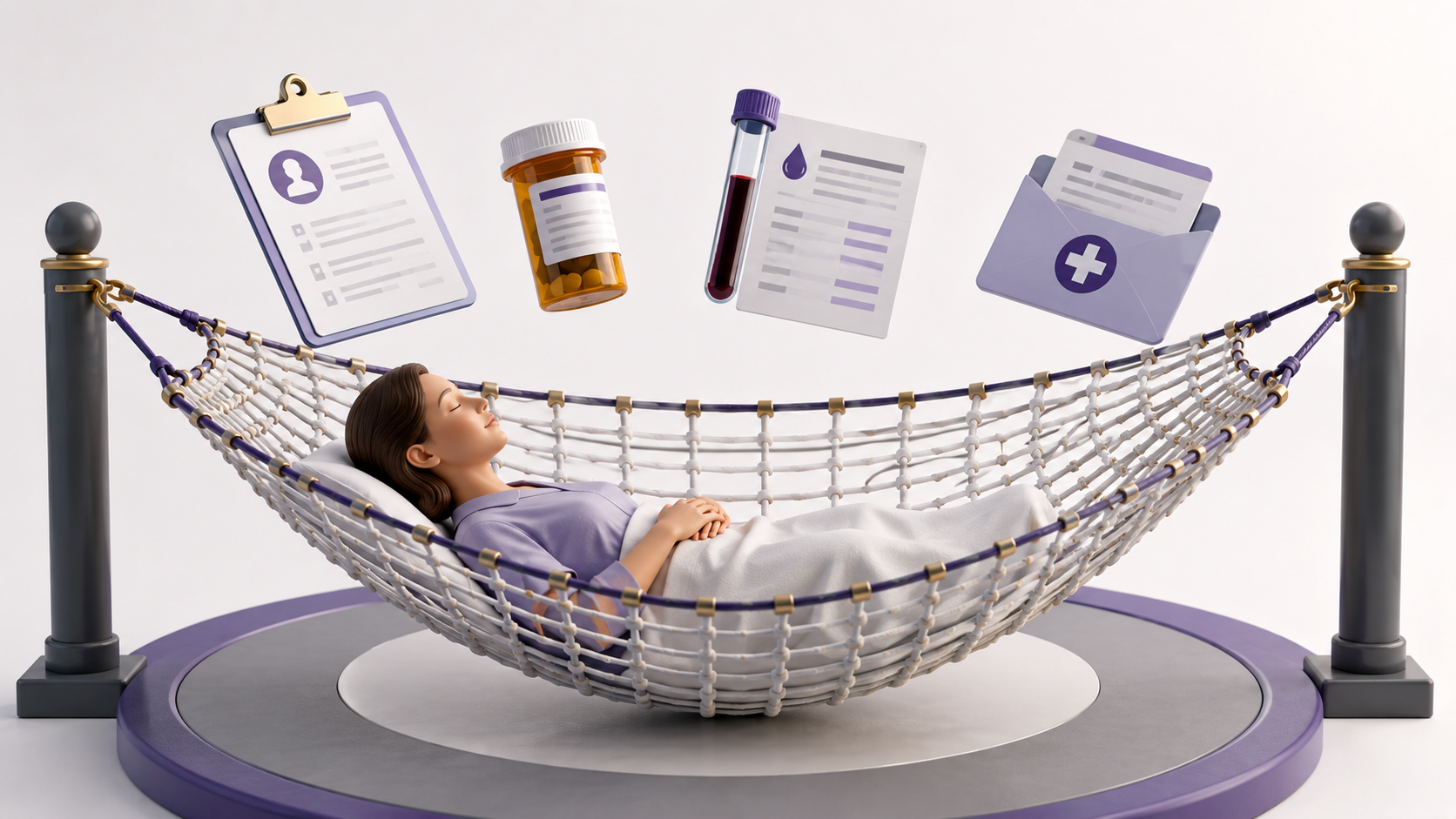
How Better Workflows, Staffing, and Communication Improve Patient Safety
Patient safety is often discussed as a clinical responsibility, but many of the risks patients encounter originate in the operational systems surrounding their care.
A pharmacy calls with a medication question, but the message never reaches the provider. A test result enters the EHR without clear responsibility for follow-up. A patient reports worsening symptoms to the front desk, but the employee does not know how urgently the message should be escalated. An understaffed team falls behind on callbacks, refills, and documentation.
These are not necessarily failures of clinical knowledge. They are failures in how work moves through the practice.
For independent medical practices, improving patient safety therefore requires looking beyond individual performance. Leadership needs to understand where information can be lost and where responsibilities are unclear. They also need to understand where workload creates shortcuts and where a process depends too heavily on someone remembering what to do next.
Patient safety improves when the practice makes the safe action the reliable action.
Key Takeaways
- Patient safety can be affected by operational workflows as well as clinical decisions.
- Patient-related work is more reliable when ownership, completion criteria, escalation pathways, and exception processes are clearly defined.
- Staffing problems should be evaluated at the workflow level to identify where workload creates delays, shortcuts, backlogs, or unreliable handoffs.
- Documentation and technology support safety when they make responsibilities, pending work, and exceptions visible rather than simply digitizing an unreliable process.
- Safety events, near misses, and recurring patient complaints can help practices identify underlying system weaknesses.
- Sustainable patient-safety improvement depends on designing workflows that help the right information reach the right person with a clear path to completion.
Table of Contents
Patient Safety Is Built Into Workflow Design
Every medical practice has workflows that directly or indirectly affect patient care.
Scheduling determines whether certain patients receive timely access. Telephone workflows determine whether clinical concerns reach the appropriate person. Referral processes affect whether recommended specialty care actually occurs. Medication workflows influence how refill requests, pharmacy questions, and adverse effects are handled.
Even a seemingly administrative process can carry clinical consequences.
Consider a pharmacy calling about a potential medication interaction. The front-office employee does not need to make a clinical determination, but that employee does need to know where the message goes, what information needs to be captured, and whether the situation requires immediate escalation.
If the practice relies on a sticky note, verbal handoff, or someone’s memory, the process contains an obvious point of failure.
The safer alternative is a defined workflow in which the message is documented and routed to the appropriate person. It is prioritized according to established protocols and tracked until the required action or follow-up is completed.
That same principle applies throughout the practice.
Clarify Ownership of Patient-Related Work
One of the most common operational vulnerabilities is a task that everyone assumes someone else is handling.
A result is reviewed, but who communicates it to the patient? A referral is ordered, but who verifies that it was sent? A patient leaves a message about worsening symptoms, but who confirms that the message received an appropriate response?
Assigning a task is not enough when the outcome matters to patient care.
Practices need clarity around ownership and completion.
| Workflow | Safety Question |
|---|---|
| Patient messages | Who receives, prioritizes, routes, and closes the message? |
| Test results | Who reviews the result and ensures required follow-up occurs? |
| Medication requests | Who handles refills, pharmacy questions, and clinical escalation? |
| Referrals | Who tracks whether the referral was completed when follow-up is necessary? |
| Abnormal findings | Who is responsible for communicating and documenting next steps? |
| Patient instructions | How does the practice confirm the patient received the necessary information? |
These questions expose an important difference between completing an administrative step and completing the entire workflow.
Sending a referral is not necessarily the same as ensuring appropriate follow-up. Routing a patient message is not the same as making sure someone responded to it.
For higher-risk processes, practices need a closed-loop workflow that makes incomplete follow-up visible and establishes how the practice confirms that the required action occurred.
A closed loop also needs an exception process. If a result remains unreviewed or a referral is not completed, the practice needs a defined way to identify the open item. The same applies if a patient cannot be reached or a message remains unresolved beyond the expected timeframe. The practice then needs to determine what additional follow-up or escalation is appropriate.
An outside specialist referral shows why sending information and completing patient-care work are different steps. Jennifer Blevens-Smith explains how ownership, tracking, documented barriers, and clinician review help keep unresolved referrals visible.
Operational Snapshot
A workflow is only truly closed when the practice can detect when the expected next step does not occur. Leadership should define both completion criteria and exception thresholds so unresolved patient-care work becomes visible before delay turns into a safety concern.
Communication Needs an Escalation Path
Telling employees to “communicate better” rarely fixes a communication problem.
Staff need defined pathways for different types of information.
A routine scheduling question should not move through the practice the same way as a report of worsening symptoms. A standard refill request may follow one workflow while a pharmacy concern about a medication interaction requires another.
Employees need to know both where information goes and when the normal process should be bypassed or accelerated.
This is particularly important for nonclinical staff. Front-office employees often receive information that may have clinical significance, but they should not be expected to independently determine the appropriate medical response.
Their responsibility is to recognize information that meets the practice’s established escalation criteria and route it according to protocol, rather than independently determine the appropriate clinical response.
Clear escalation procedures reduce dependence on individual judgment while helping urgent information reach the people qualified to evaluate it.
Staffing and Training Affect Workflow Reliability
Staffing Decisions Can Become Safety Decisions
Staffing levels are often evaluated primarily as a financial issue. In a medical practice, they can also become a patient safety issue, and AHRQ’s Medical Office Survey on Patient Safety Culture specifically evaluates work pressure and pace alongside patient care tracking, staff training, office processes, and other patient-safety factors.
When workload consistently exceeds available capacity, work begins to queue.
Messages wait longer. Documentation gets postponed. Employees rush through handoffs. Refills accumulate. Follow-up tasks remain open. Staff members begin creating shortcuts simply to keep up.
That does not mean every busy practice is unsafe or that adding staff automatically improves safety. Leadership needs to understand where workload is causing delays, shortcuts, backlogs, or unreliable handoffs in processes that can affect patient care.
A useful question is not simply, “Are we understaffed?”
It is, “Which patient-care workflows become unreliable when volume increases?”
A practice may discover that the real problem is staffing at a particular time of day, unclear division of responsibilities, inefficient task routing, unnecessary administrative work, or a workflow that sends too many tasks to one person.
Operational Snapshot
Capacity problems are most actionable when measured at the workflow level rather than only through total staffing ratios. Tracking where turnaround times, open-task counts, or handoff failures worsen during predictable volume spikes can reveal the appropriate remedy. That remedy may be additional coverage, redistribution of work, or process redesign.
Addressing the actual bottleneck is more useful than assuming headcount alone is the solution.
Train Staff for the Decisions Their Roles Require
Training contributes to patient safety when it prepares employees for situations they will actually encounter.
Front-office staff needs to know how to handle patient messages and recognize escalation triggers. Medical assistants need training appropriate to their clinical responsibilities and practice workflows. Managers need to understand how to identify breakdowns and intervene when a process is not functioning reliably.
Employees also need to understand the reason behind important steps.
If a staff member sees documentation as clerical work, a detailed pharmacy message may feel unnecessarily time-consuming. If that employee understands that incomplete information can delay a provider’s response or lead to a misunderstanding, the operational purpose becomes clearer.
Role-specific training is particularly important after workflow changes. Introducing a new EHR function, communication platform, staffing model, or clinical service can alter how work moves through the practice.
When a workflow changes, the people responsible for it should understand their roles, escalation points, handoffs, and expectations under the new process.
Documentation and Technology Should Make Work Visible
Documentation Should Support Continuity of Care
Clinical documentation contributes to patient safety because it allows information to move reliably between people and across time.
The objective is not to document every possible detail. More documentation is not automatically better documentation.
Useful documentation captures the information needed for the next person to understand what occurred and what was communicated. It also captures what action was taken, what remains pending, and who is responsible for the next step.
That becomes particularly important with patient calls, medication questions, results, referrals, and other workflows involving multiple employees.
Technology can support documentation and continuity by making patient-related work easier to route, track, and retrieve. But digitizing a process does not by itself make the underlying workflow reliable.
An electronic inbox containing hundreds of unresolved tasks is not inherently safer than a paper system simply because it is digital.
Technical Deep Dive
Electronic tasking becomes a safety control only when queue design includes ownership, expected response intervals, aging visibility, and a method for surfacing exceptions. Without those controls, digitization can relocate an unreliable workflow into the EHR without materially reducing the underlying risk.
Technology Should Create Reliability, Not Additional Complexity
Technology can strengthen patient safety when its features support a well-defined workflow. EHR alerts can identify certain medication concerns. Electronic task systems can show whether a message remains unresolved. Standard templates can help staff capture necessary information. Automated reminders can support follow-up.
These tools still depend on effective process design.
Every alert needs an appropriate response. Every task needs an owner. Every inbox needs a monitoring process. Every automated workflow needs a way to identify exceptions. Otherwise, technology can simply create another place for work to accumulate.
When evaluating a new tool, practices should consider whether it makes a critical process more reliable—not simply whether it adds another feature.
Use Problems and Feedback to Find System Weaknesses
Look for Breakdowns, Not Just Mistakes
When something goes wrong, it is natural to focus on the person closest to the incident.
Sometimes individual performance is the problem. But stopping there can allow the same failure to happen again.
Suppose a patient message was not returned. The immediate explanation may be that an employee forgot about it. A deeper review might show that messages are written on paper, handed between employees, and never entered into a system that allows anyone to see whether they remain unresolved.
In that case, reminding the employee to be more careful addresses the individual incident but not the underlying risk.
Practices should examine safety events and near misses for recurring operational weaknesses:
- unclear ownership of tasks
- missing or inconsistent escalation procedures
- communication that depends on memory or verbal handoffs
- excessive workload at predictable points in the day
- inadequate training for a specific workflow
- technology that does not support reliable task completion
This is where patient safety and operational improvement intersect most directly.
The question is not only, “Who made the mistake?” It is also, “What conditions allowed the failure to occur or remain undetected?” Another question is, “What could prevent the same problem from reaching a patient next time?”
Patient Experience Can Reveal Safety Problems
Patient experience and patient safety are not the same thing, but they frequently intersect.
A patient who says nobody returned a call may be identifying a communication breakdown. A complaint about repeatedly explaining the same medication information may reveal poor documentation or handoff practices. A patient who does not understand follow-up instructions may expose a weakness in how information is communicated.
Practices should not treat every complaint as evidence of a safety event. They should, however, pay attention when feedback points toward a process that may affect care.
Patterns matter.
Repeated complaints about delayed callbacks, confusing instructions, difficulty obtaining results, or unresolved medication requests deserve operational review even when no harm has occurred.
Operational Snapshot
Patient complaints can function as leading indicators when they are grouped by underlying workflow rather than reviewed only for service recovery. Repeated friction around callbacks, results, medications, or instructions may justify process review before the same weakness produces a documented safety event.
Those signals provide an opportunity to correct a process before a more serious event exposes the same weakness.
Patient Safety Becomes More Reliable When Workflows Catch Problems
Patient safety depends on competent clinicians and staff, but even experienced employees work within systems that influence their performance.
A well-designed practice does not assume everyone will remember every task, recognize every exception, or communicate perfectly during a busy day. It creates safeguards around the points where failure is most likely.
That means clear ownership, defined escalation pathways, and appropriate staffing and workload management. It also means role-specific training, reliable documentation, and systems that make incomplete work visible.
It also means examining incidents without automatically assuming the solution is another policy or another training session. Sometimes training is appropriate. Other times the real correction is changing who owns the task or redesigning the handoff. It may also involve adjusting workload or building a better tracking mechanism.
Patient safety becomes more sustainable when it is built into the way the practice operates. The goal is not simply to tell employees to be careful. It is to create workflows that help the right information reach the right person at the right time. Those workflows should provide a clear path to completion.
Frequently Asked Questions About Patient Safety in Medical Practices
How can medical practice workflows affect patient safety?
Workflows affect how information, tasks, and follow-up move through a practice. Unclear ownership, missed handoffs, delayed messages, unresolved results, or poorly designed escalation processes can create safety risks even when employees have appropriate clinical knowledge and training.
What is a closed-loop workflow in patient care?
A closed-loop workflow tracks a patient-related task through completion rather than stopping when the task is assigned or routed. The practice should be able to identify who owns the next step, whether the required action occurred, and when unresolved work requires additional follow-up or escalation.
How should nonclinical staff handle patient concerns that may require clinical attention?
Nonclinical staff should follow established escalation protocols rather than independently determine the clinical significance of a patient’s concern. Practices should train employees to recognize information that meets defined escalation criteria, document the necessary information, and route it promptly to the appropriate clinical staff.
Can understaffing affect patient safety in a medical practice?
It can. When workload exceeds available capacity, patient-related work may be delayed or become less reliable. Practices should look for backlogs, rushed handoffs, unresolved messages, delayed documentation, and other workflow problems rather than assuming that staffing levels alone determine whether a safety problem exists.
How can patient complaints help identify safety risks?
Patient complaints are not automatically safety events, but recurring complaints can reveal workflow weaknesses. Patterns involving delayed callbacks, unresolved medication requests, difficulty obtaining results, or confusing instructions may indicate processes that deserve review before the same weakness contributes to patient harm.
How can technology improve patient safety in a medical practice?
Technology can improve safety when it makes patient-related work visible, trackable, and easier to complete. Electronic task systems, alerts, templates, and reminders can help, but they still require clear ownership, monitoring, response expectations, and processes for identifying unresolved work and exceptions.
About the Author
Jennifer Blevens-Smith is the founder and principal consultant of Integral Clinic Solutions. With more than two decades of experience supporting independent medical practices, she helps physicians, practice administrators, and healthcare leaders strengthen credentialing, payer contracting, revenue cycle operations, compliance workflows, and practice management. Her work focuses on translating complex healthcare requirements into practical operational processes. These processes improve consistency, reduce administrative burden, and support long-term practice success.
Need Help Strengthening Your Medical Practice Operations?
Integral Clinic Solutions provides practical support for medical practices navigating credentialing, contracting, revenue cycle operations, compliance workflows, front-office systems, and practice management challenges.
Explore more operational guidance, compliance insights, and healthcare business resources on the Integral Clinic Solutions blog. New articles and updates are added regularly for practice owners, administrators, and healthcare teams.
Disclaimer: This content is for informational and educational purposes only and does not constitute legal, coding, billing, compliance, financial, or medical advice. Healthcare practices must verify all operational requirements with applicable payers, regulators, and qualified professionals. Read our full Legal & Compliance Disclaimer.