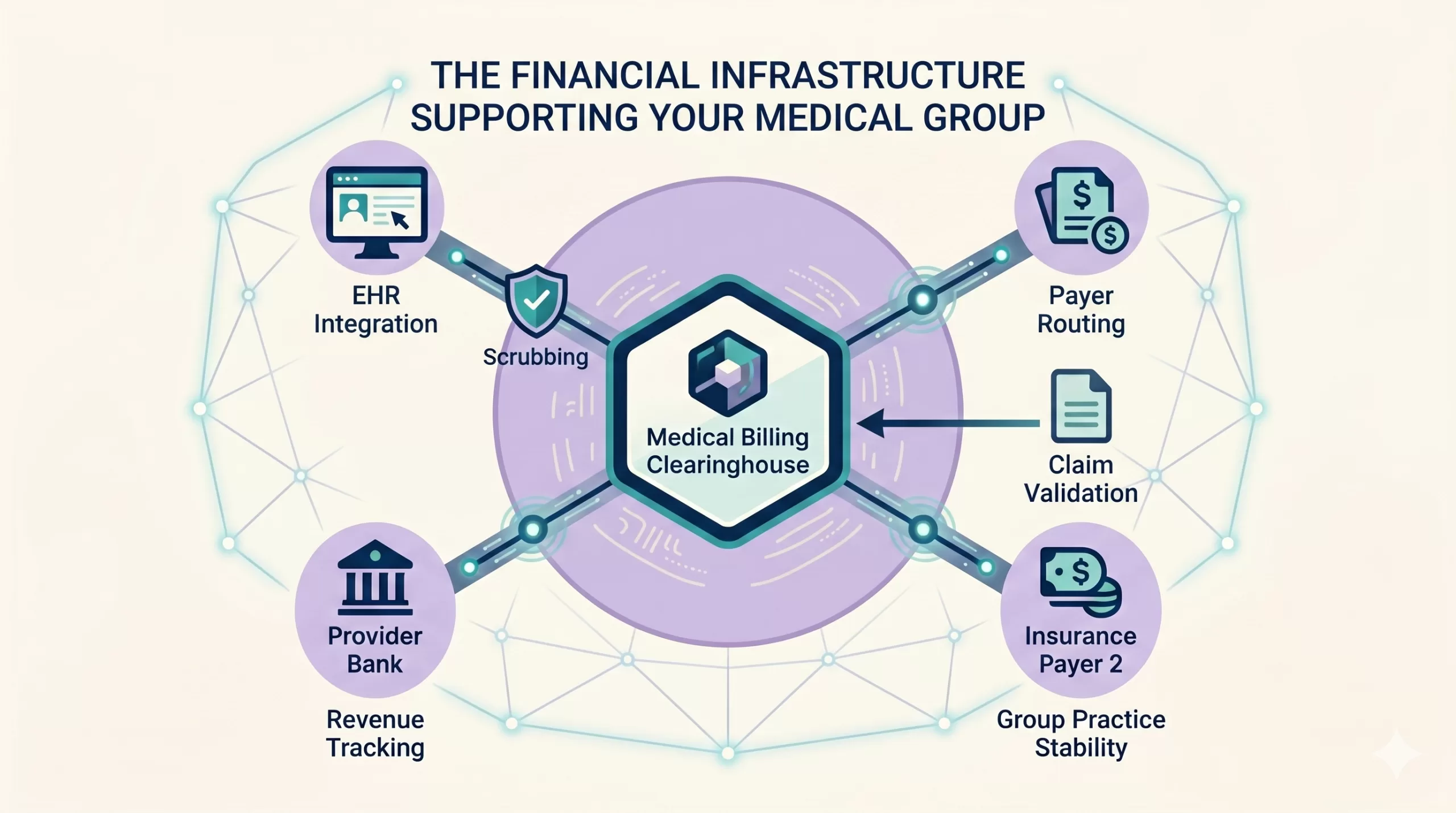
The Medical Billing Clearinghouse: Your Core Revenue Infrastructure
Most medical practices don’t spend much time thinking about their clearinghouse until something stops working. Claims suddenly stop transmitting. Eligibility checks fail without warning, rejections begin spiking, and payment posting stalls. Within hours, the staff is left scrambling. They open support tickets and call vendors to determine where the breakdown began.
By the time leadership notices the disruption, the bottleneck has usually already rippled across multiple departments. Clearinghouses are not simply background technical conduits between software systems and insurance companies. They sit near the center of the practice’s revenue cycle infrastructure, directly influencing reimbursement velocity, front-office workflows, and long-term practice stability.
Practices that treat the clearinghouse as an isolated tech vendor often underestimate the extent of systemic dependency surrounding it. In reality, it serves as the financial infrastructure that supports the entire medical group.
Operational Snapshot
A clearinghouse is more than a technical connector between systems. Its performance directly influences reimbursement speed, front-office efficiency, and the overall stability of a medical practice’s revenue cycle.
Key Takeaways
- Clearinghouses function as a core revenue cycle infrastructure layer rather than a passive software utility.
- Eligibility verification failures frequently originate upstream and create downstream denial exposure.
- Claim scrubbing helps identify both technical claim issues and broader workflow training gaps.
- ERA and EFT enrollment delays often prolong avoidable manual payment posting processes.
- Practices should retain direct administrator-level clearinghouse access even when outsourcing billing operations.
Table of Contents
The Intermediary Mechanics: What a Clearinghouse Actually Does
At its most fundamental level, a medical billing clearinghouse functions as a secure electronic middleman that translates and formats data between clinical practices and insurance companies. In a healthcare ecosystem where hundreds of distinct commercial and government payers utilize varying proprietary software guidelines, the clearinghouse standardizes your administrative workflows.
Instead of forcing billing staff to log in to multiple payer portals and submit claims manually, a medical group routes all encounter data through a single centralized transaction hub. Understanding this pathway as part of your broader medical practice’s revenue cycle management and operations is critical to keeping workflows synchronized and preventing financial bottlenecks from multiplying downstream.
Technical Deep Dive
Clearinghouses eliminate the operational burden of maintaining separate payer connections. Centralized transaction routing standardizes claim workflows while reducing administrative complexity across hundreds of carrier relationships.
Rather than managing a chaotic grid of individual provider-to-payer connections, your team interacts with one dashboard that reformats, verifies, and securely delivers data to both commercial networks and government claims registries. To visualize this data movement, the system follows an exact, step-by-step automated claim flow:
- EHR/PM System Creates the Claim: Once a clinician finalizes medical documentation, the practice management or electronic health record system aggregates the diagnoses, procedure codes, and patient demographics into an unformatted draft file.
- Claim Goes to the Clearinghouse: The billing team securely transmits these raw data files to the clearinghouse server via an encrypted batch file or real-time connection.
- The Claim is Scrubbed: The clearinghouse automatically screens the data against compliance checklists and payer routing rules, instantly flagging missing modifiers or subscriber mismatches before transmission.
- Claim Goes to the Payer: Once scrubbed clean, the clearinghouse packages the file into a standardized, HIPAA-compliant format and routes it directly to the targeted insurance company’s adjudication server.
- ERA Comes Back to the Practice: Following claim processing, the insurer issues an Electronic Remittance Advice file back through the clearinghouse. This response updates your billing records automatically with allowances, payment posting info, or explicit denial reasons.
Watch: How a Medical Billing Clearinghouse Actually Works
If you want to see how these transactions move between a medical practice, clearinghouse, and payer, the video below walks through the process step by step. It also explains the difference between claim rejections and denials, how eligibility and ERA transactions move through the clearinghouse, and what practices should monitor to prevent small transmission problems from becoming larger revenue cycle issues.
Understanding the Types of Healthcare Clearinghouses
Not all clearinghouse setups handle data the same way. Depending on your software configuration, volume metrics, and operational goals, you will interact with different types of clearinghouses within the healthcare landscape. Understanding these structural variations helps practice leaders identify where workflow dependencies reside.
| Clearinghouse Architecture | Core Operational Focus | Workflow and Cost Impact |
|---|---|---|
| Standalone EDI Hubs (e.g., Claim.MD, Office Ally) | Secure electronic data transmission, payer routing, and HIPAA-compliant formatting. | Often provides strong visibility and lower direct fees, but may require separate portal logins for rejection review and error correction. |
| Enterprise RCM Networks (e.g., Waystar, Availity) | Expanded revenue cycle tools, analytics, denial dashboards, and payer activity tracking. | Can support broader organizational consolidation, but may involve higher SaaS costs and longer onboarding timelines. |
| Native EHR/PM Conduits (e.g., eClinicalWorks, Change Healthcare) | Embedded clearinghouse functions inside the practice management or billing workflow. | Can reduce clicks and improve back-office speed, but may create higher transaction costs or vendor lock-in. |
Operational Snapshot
The optimal clearinghouse architecture depends on operational priorities. Practices must balance cost, transparency, workflow efficiency, reporting capabilities, and long-term vendor flexibility.
1. EDI Clearinghouses (Electronic Data Interchange)
These platforms focus strictly on the secure, compliant transmission of raw healthcare data between the practice and the payer. They convert standard practice fields into highly regulated, HIPAA-compliant transaction structures that are monitored and standardized by industry authorities such as the Workgroup for Electronic Data Interchange (WEDI).
Once formatted, the platform securely routes the files directly to the carrier. Independent vendors like Claim.MD or Office Ally are classic examples of highly efficient EDI hubs favored by small- to mid-sized practices for direct, transparent batch claim uploads.
2. Comprehensive, All-in-One Revenue Cycle Clearinghouses
These larger enterprise networks go beyond simple routing to offer end-to-end revenue cycle tools, including deep analytics, contract management, patient propensity-to-pay modeling, and advanced denial management dashboards. Industry-leading networks like Waystar, Availity, and TriZetto (Cognizant) operate at this comprehensive scale, making them ideal for large medical groups and hospital systems that require total database consolidation.
3. Integrated and Specialty Billing Conduits
These clearinghouses function as a native, embedded component of your existing Electronic Health Record (EHR) or Practice Management (PM) system. Instead of logging into an external software layout, the infrastructure is white-labeled right behind your standard billing screens.
Native setups handled through portals like eClinicalWorks or independent utility pipelines like Change Healthcare dramatically reduce manual clicking workflows. While they offer exceptional day-to-day visibility for back-office teams, they can sometimes carry higher bundled transaction fees or lock you into a single tech ecosystem.
Why Clearinghouse Performance Touches the Front Office
One of the most pervasive misconceptions in healthcare management is that clearinghouses only matter to the back-office billing department. In reality, they dictate the efficiency of workflows across the entire practice footprint.
Consider a busy multi-specialty clinic on a Monday morning. Front-desk teams depend on real-time eligibility verification integrated directly into the scheduling software to validate insurance coverage before patients walk through the door. This convenience allows staff to check coverage instantly across multiple carriers simultaneously.
While utilizing individual commercial payer portals remains a powerful tool for your medical practice during complex administrative exceptions or deep denial tracking, forcing your front office to navigate those disjointed vendor sites for routine check-ins creates avoidable labor inefficiencies.
Eligibility failures are among the earliest points at which significant revenue leakage begins. If inactive coverage, missing authorizations, referral requirements, or plan inaccuracies are not identified before the encounter occurs, the resulting denial only surfaces weeks later during formal payer adjudication.
Compliance Alert
Small registration errors often appear harmless at check-in but can trigger claim failures weeks later. Correcting these issues after service delivery consumes significantly more administrative resources.
| Workflow Stage | Upstream Front-Office Trigger | Downstream Revenue Cycle Leak |
|---|---|---|
| Insurance Eligibility | Skipping real-time checks or ignoring plan alpha-prefixes at patient check-in. | Weeks of delayed adjudication leading to delayed adjudication, denials, or balances that may be difficult to collect.. |
| Patient Demographics | Minor typos in names, middle initials, or subscriber ID strings. | Immediate clearinghouse firewall rejection, stalling data tracking momentum. |
| Coding Validation | Data-entry formatting inputs mismatching current carrier guidelines. | Spikes in pre-submission rejections that demand intensive billing desk cleanup. |
At that point, if an eligibility error slips through, the practice has already invested provider time, clinical staff resources, room utilization, and operational overhead into an encounter that may yield zero reimbursement. The downstream cleanup work then drains administrative capacity.
Watch: Why the Correct Payer ID Matters
Insurance registration involves more than matching the payer name on a patient’s card to a plan in your system. The payer ID helps determine where electronic transactions are routed, and selecting the wrong payer configuration can create rejections, delayed claims, and unnecessary follow-up work. In the video below, I explain what a payer ID is, where it fits into the clearinghouse workflow, and why your front-office staff needs to understand it.
Billing staff must launch an investigation, track down the patient for corrected info, resubmit the claim, and potentially transition the account to a structured self-pay fee schedule to manage out-of-pocket balances that may otherwise never be recovered. When eligibility workflows are properly configured and consistently executed, these bottlenecks are addressed at the front desk long before they can affect cash flow continuity.
Claim Scrubbing as a Revenue Protection Function
Before a claim ever reaches a payer’s server, the clearinghouse applies validation edits designed to catch common submission errors before they lead to an official denial. This process acts as an automated quality-control layer, screening claims for a variety of technical and structural issues:
- Invalid CPT or ICD-10 code combinations
- Missing or misplaced modifiers
- Patient subscriber mismatches
- Incorrect commercial payer routing codes
- Provider enrollment and credentialing mismatches
Operational Snapshot
Claim scrubbing functions as a proactive quality-control system. Identifying technical defects before payer submission dramatically reduces denial management workloads and reimbursement delays.
Catching these errors at this stage provides an immense operational advantage because clearinghouse rejections are significantly faster and cheaper to correct than formal payer denials. Once a claim is fully adjudicated incorrectly, recovering that reimbursement requires substantial manual labor. Staff must review documentation and correct claim issues. Appeals may also need to be managed before reimbursement can resume.
Furthermore, recurring clearinghouse rejections function as an invaluable early warning indicator for systemic front-office errors. Frequent subscriber mismatches usually point directly to front-desk registration training gaps.
Consistent modifier errors signal a need for broader template updates. Because clearinghouse edits are your final safety net before adjudication, tracking these patterns reveals exactly when your team needs to revisit proper documentation standards and guidelines for ICD-10 coding workflows before large claim volumes are impacted.
The Hidden Friction in ERA and EFT Enrollment
Electronic Remittance Advice (ERA) and Electronic Funds Transfer (EFT) setups are two areas where healthcare leaders frequently underestimate the level of operational coordination required. ERA allows automated payment responses to post directly into the billing software rather than forcing staff to manually key in data from paper Explanations of Benefits (EOBs). Concurrently, EFT routes insurance payments directly to the practice’s bank account rather than letting checks sit in a mail pile.
Combined, these tools dramatically reduce manual posting labor, accelerate bank reconciliation, and shorten your overall days in accounts receivable (A/R). The problem is that many practices assume these workflows activate automatically once standard claims begin transmitting.
In practice, commercial payer requirements vary wildly. Some insurance carriers require completely separate enrollment applications for ERA and EFT. Others have strict approval timelines that can stretch out for several weeks. Some also require repeated administrative follow-up before setup is finalized. Without an organized tracking system for these applications, practices often end up processing manual paper checks and paper remittances far longer than necessary. This introduces avoidable friction into the revenue cycle.
| Operational Focus | Common Revenue Cycle Failure | Downstream Operational Impact |
|---|---|---|
| ERA Integration | Enrollment applications left incomplete or untracked | Delayed payment posting, increased manual entry errors, and artificially high A/R days |
| EFT Configuration | Payer-specific approval delays and processing holds | Slower cash deposits and prolonged bank reconciliation timelines |
| Eligibility Workflows | Incomplete PM/EHR interface integration | Spike in front-desk verification failures and preventable downstream eligibility denials |
| Claim Scrubbing | Validation edits not monitored or updated consistently | Higher initial rejection volume and increased billing team remediation workloads |
Compliance Alert
Incomplete ERA and EFT enrollments often remain unnoticed for months while staff continue unnecessary manual processes. Structured enrollment tracking prevents avoidable revenue cycle inefficiencies.
Data Transparency and Vendor Governance Risks
When clearinghouse ownership and reporting lines are poorly defined, practice visibility breaks down rapidly. This is particularly common in complex tech ecosystems where certain EHR platforms require specific clearinghouse connections, while an outsourced billing vendor prefers an entirely separate provider.
A major operational risk surfaces when a medical practice outsources its billing operations but loses direct portal access to its clearinghouse reports. When a practice cedes absolute control of this interface to a third-party vendor, leadership completely loses independent visibility into claim rejections, payer acknowledgments, and raw eligibility trends.
To maintain clear accountability, management should establish explicit operational ownership over the following parameters:
- Which internal team members retain master administrator-level portal access
- Who is responsible for daily monitoring and remediation of front-end rejections
- Who tracks new payer ERA/EFT enrollments during clinician onboarding
- Who owns the formal escalation path when vendor transmission drops occur
Compliance, Security, and System Outage Exposure
Because clearinghouses transmit massive volumes of electronic healthcare records, they carry substantial compliance and data security obligations. Every file processed contains an extensive mix of general demographics, insurance information, diagnosis coding, and financial records. For healthcare compliance teams, it is critical to recognize that a clearinghouse routinely handles general data identifiers.
The moment those details are attached to an individual’s medical history or payment files, they transition legally from simple data fields into tightly regulated health profiles.
Understanding the core legal boundaries between general PII and PHI is essential for administrators managing these networks, as group practices rely on third-party partners to maintain the secure custody of highly sensitive protected patient files.
Compliance officers and clinical partners must look beyond standard baseline HIPAA checkboxes. They should actively verify how a clearinghouse manages end-to-end encryption standards, user access parameters, formal audit logging, and breach response protocols.
As the healthcare industry learned firsthand during the Change Healthcare cyber incident, clearinghouse system outages can paralyze claim flows, freeze patient eligibility verification channels, and significantly disrupt cash flow in a short period of time.
Compliance Alert
A clearinghouse outage is not merely an IT problem. Disruptions can halt claims, interrupt eligibility verification, delay payments, and rapidly affect organizational cash flow.
Practices should manage these relationships with clear backup plans, documented escalation steps, and basic business continuity procedures. This includes maintaining active backup clearinghouse options and clear business continuity protocols as a basic safeguard against systemic vendor vulnerabilities.
This risk does not mean practices should shy away from utilizing robust clearinghouses; modern medical groups cannot function efficiently without them. Leadership should evaluate the clearinghouse as a core operational risk and infrastructure dependency rather than a passive IT connection.
The Onboarding Roadmap: Setting Up Your Clearinghouse Infrastructure
Implementing or migrating a clearinghouse portal is a high-stakes operational transition that demands precise cross-department coordination. If rushed or poorly managed, onboarding can create immediate claim backlogs caused by incomplete electronic links or unverified payer configurations. To secure your workflows during onboarding, your administration should guide the implementation team through five distinct phases:
| Implementation Phase | Core Operational Tasks | Primary Focus Area |
|---|---|---|
| 1. Software Compatibility Audits | Verify core EHR API or PM database integrations. Confirm whether it operates as a native white-labeled utility or requires manual file uploads. | Technical Infrastructure |
| 2. Payer Electronic Enrollments | Complete and track targeted EDI, ERA, and EFT enrollment packets for major commercial networks and government registries to link tax IDs. | Payer Credentialing & Links |
| 3. Portal Gateways & Validation Logic | Configure administrator dashboard access levels, set up automated daily reporting drops, and adjust pre-submission scrubbing filters. | System Settings Optimization |
| 4. Workstation Staff Training | Train front-office reception and back-office billing personnel on real-time rejection alerts, eligibility mismatches, and system overrides. | Workforce Preparedness |
| 5. Long-Term Governance Roles | Designate clear operational owners to oversee daily rejection logs, monitor changing insurance guidelines, and handle onboarding files. | Continuous Maintenance |
Four Crucial Questions to Ask Vendors Before Signing a SaaS Agreement
Before binding your medical group to a long-term clearinghouse contract, practice administrators should lock down clear, contractual answers regarding four core operational performance benchmarks:
- “Does your software operate as a fully embedded integration within our current EHR layout, or will our billing staff have to jump into an external web browser to clear front-end rejections?”
- “Are automated pre-submission claim scrubbing filters and real-time eligibility checks bundled into our flat monthly provider rate, or do they carry additional transactional surcharges?”
- “What is your formal support escalation timeline (SLA) when a primary commercial or government electronic routing channel drops or experiences a severe transmission delay?”
- “Does our medical group retain absolute, independent administrator ownership of all raw historical transmission logs, ERA histories, and audit files if we terminate our outsourced billing company relationship?”
Compliance Alert
Vendor agreements should clearly define ownership of operational data, reporting access, and support obligations. Losing access to historical transmission records can create significant governance challenges.
The True Cost of a Low-Cost Clearinghouse Vendor
Many practices evaluate clearinghouses primarily through the narrow lens of monthly line-item SaaS pricing. While managing vendor software expenses is necessary, evaluating performance solely on subscription fees is an operational trap.
A low-cost clearinghouse that features substandard reporting interfaces, sluggish customer support response times, fragile eligibility APIs, or weak validation logic will quickly cost a practice multiple times its monthly savings. The financial losses accumulate through administrative labor inefficiencies, prolonged back-and-forth communication, and delayed collections.
The true value of an enterprise-grade clearinghouse is not the raw technical capability to push an electronic file to an insurance company. From a clinical administrator’s perspective, the vendor’s performance must be evaluated against how well it supports your daily operations.
A strong clearinghouse setup should support a high clean claim rate, faster rejection turnaround, easier eligibility verification, and better visibility into payer activity. Investing in infrastructure that supports these specific operational improvements ultimately protects a healthcare organization’s thin operating margins.
Common Clearinghouse Problems and Fixes
Even with a premium enterprise integration in place, technical friction points occasionally pop up during live claims tracking. Most of these transmission holdups stem from localized interface mismatches or registry updates rather than comprehensive software failures.
When these bottlenecks surface, knowing how to isolate the root cause and implement a fast clearinghouse claim-rejection fix keeps your billing desk from losing critical cash-flow momentum and prevents raw claim files from piling up in an unworked backlog.
1. Claims Stalled or Stuck at a “Pending” Transmission Status
When a large batch of electronic claims sits in limbo without receiving a formal acceptance or rejection timestamp from the portal dashboard, the bottleneck usually signals an active API validation drop between your EHR database and the clearinghouse gateway. Check your billing system’s output log to verify whether the server authentication keys require a mapping refresh. If those keys look stable, cross-reference your internal logs to confirm the underlying payer electronic enrollment has been formally finalized by the carrier.
2. Real-Time Eligibility Checks Returning Blank or Inaccurate Coverage Results
If front-desk staff regularly receive missing coverage responses or blank status returns during check-in, the breakdown typically points to data-entry formatting inputs. Ensure your front-office teams are entering patient demographic fields exactly as they are stamped on the insurer’s physical card. This includes names, suffix parameters, and plan alpha-prefixes. A minor typo in a middle initial or numeric policy string can trigger an immediate automated mismatch from the clearinghouse eligibility bridge.
3. Sudden Spikes in Repeated Pre-Submission Payer Rejections
An unexpected spike in front-end rejections for a specific insurance plan indicates a sudden change in that carrier’s processing guidelines. Payers routinely update their internal coding rules, subscriber registry databases, and credential-tracking parameters without notice. When this surfaces, check the specific clearinghouse error details. Your billing team may need to adjust your practice management claim templates or contact your account representative to align with the new formatting updates.
FAQ: Medical Billing Clearinghouses Explained
How long does clearinghouse enrollment usually take?
Enrollment timelines vary by payer and transaction type. Basic claim submission enrollments may activate quickly, while ERA and EFT approvals can take several weeks depending on the insurance carrier’s requirements and processing backlog.
Is a clearinghouse different from a billing company?
Yes. A clearinghouse primarily handles electronic transaction routing and claim validation, while a billing company manages broader revenue cycle responsibilities, including claim follow-up, denial management, payment posting, and patient billing.
Why are claims rejected before reaching the insurance company?
Most front-end rejections result from formatting issues, missing data, invalid coding combinations, payer routing errors, or subscriber mismatches identified during clearinghouse validation edits.
Should practices keep direct access to their clearinghouse portal?
Yes. Even when billing operations are outsourced, practices should maintain administrator-level portal access to preserve visibility into claim activity, payer responses, rejection trends, and historical transaction records.
What happens if a clearinghouse goes down?
A major clearinghouse outage can interrupt claims transmission, eligibility verification, payment posting workflows, and remittance processing. Practices should maintain documented downtime procedures and escalation plans to reduce operational disruption.
What is the difference between ERA and EFT?
ERA (Electronic Remittance Advice) provides digital payment explanations and denial details, while EFT (Electronic Funds Transfer) moves the actual insurance payment directly into the practice’s bank account.
Securing Your Financial Infrastructure Against Outage Gaps
Clearinghouse health directly impacts far more than back-office electronic billing submissions. Performance variations dictate real-time front-desk validation accuracy, back-office audit workflows, overall days in A/R, and clinical staff focus across the entire group practice ecosystem.
When managed strategically, clearinghouses serve as an exceptional tool for stabilizing cash flow. This requires designated ownership of the internal portal, rigorous documentation protocols, and constant attention to rejection patterns. When ignored or outsourced without internal tracking oversight, clearinghouses can quietly become a primary driver of preventable denials and administrative waste.
At the operational level, the clearinghouse should never be viewed as an isolated software adapter. It must be monitored and maintained as the financial infrastructure supporting your clinical operations.
About the Author
Jennifer Blevens-Smith is the founder and sole consultant driving Integral Clinic Solutions. Armed with deep domain expertise and a commitment to protecting independent medicine, she delivers the personalized, executive-level guidance that healthcare leaders need to build sustainable, high-performing organizations.
Need Help Strengthening Your Medical Practice Operations?
Integral Clinic Solutions provides practical support for medical practices navigating credentialing, contracting, revenue cycle operations, compliance workflows, front-office systems, and practice management challenges.
Explore more operational guidance, compliance insights, and healthcare business resources on the Integral Clinic Solutions blog. New articles and updates are added regularly for practice owners, administrators, and healthcare teams.
Disclaimer: This content is for informational and educational purposes only and does not constitute legal, coding, billing, compliance, financial, or medical advice. Healthcare practices must verify all operational requirements with applicable payers, regulators, and qualified professionals. Read our full Legal & Compliance Disclaimer.