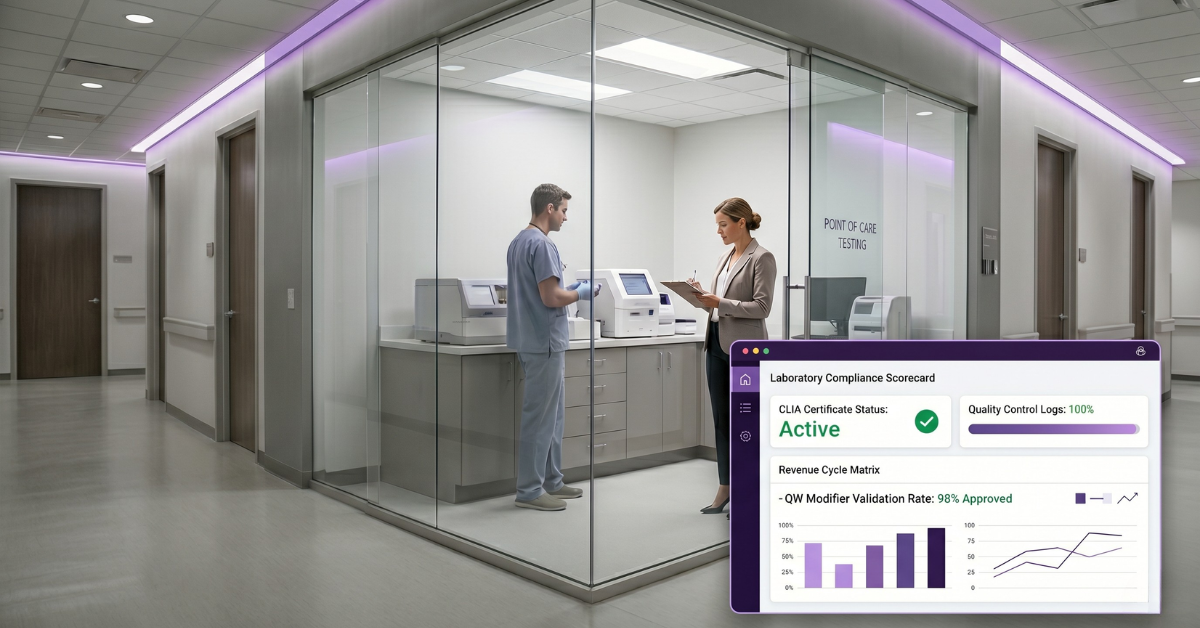
CLIA Waivers and Certifications: Simplified Guide for Healthcare Practices
CLIA waivers and certifications may not be exciting, but they are essential for healthcare practices and laboratories. Whether you’re managing a family medicine clinic, an urgent care facility, or even a specialty practice, understanding the operational mechanics of CLIA will help you stay compliant, avoid severe audit headaches, and keep your revenue cycle running smoothly.
To be clear, this article is not legal, financial, or regulatory advice. Always check your state’s specific requirements. Local regulations can vary significantly. Let’s break this down into actionable practice protocols.
Key Takeaways
- CLIA requirements depend on test complexity.
- Waived testing reduces administrative burden but still requires oversight.
- Documentation is critical for compliance and inspections.
- Staff training and competency records should be maintained consistently.
- Quality control processes should be standardized and documented.
- Revenue cycle workflows should support accurate laboratory billing.
- Practices should regularly review testing menus, supplies, and compliance procedures.
Table of Contents
The Executive Briefing
For practice managers and clinical directors tracking multiple operational targets, here is the immediate baseline framework for in-house testing compliance and revenue cycle mapping:
| Operational Vector | Core Threat | Strategic Resolution |
|---|---|---|
| Certificate Selection | High administrative overhead on complex testing lines. | Stick strictly to a Certificate of Waiver (CoW) for basic point-of-care menus. |
| Revenue Cycle Management | Automatic denials on simple billing submissions. | Apply the -QW modifier when required for waived lab codes and use -25 on E&M codes when a significant, separately identifiable service is supported. |
| Audit Readiness | Unannounced inspections triggered by systemic data red flags. | Maintain a centralized documentation system for QC, staff training, and patient testing activity. |
| Quality Management | Regulatory non-compliance upon stepping into advanced clinical lines. | Evaluate whether an Individualized Quality Control Plan (IQCP) is appropriate for moderate- or high-complexity testing systems. |
Understanding CLIA Requirements
The Clinical Laboratory Improvement Amendments (CLIA) establish federal standards for facilities that perform testing on human specimens for diagnostic or treatment purposes. Enacted under Section 353 of the Public Health Service Act, these regulations establish baseline operational criteria for all domestic testing environments.
Any practice performing laboratory testing in-house must have the appropriate CLIA certification based on the complexity of the tests being performed. This applies to primary care offices, urgent care centers, specialty practices, and other healthcare organizations that conduct diagnostic testing outside of a reference laboratory. Detailed rules regarding administrative oversight can be found directly through the Centers for Medicare & Medicaid Services CLIA Program portal.
The purpose of CLIA is straightforward: to ensure laboratory testing produces accurate, reliable, and consistent results regardless of where the testing occurs. From an operational standpoint, CLIA compliance is about much more than possessing a certificate. It requires practices to establish processes that support quality testing and proper documentation. Practices must also support staff competency and regulatory readiness.
Choosing the Appropriate CLIA Certificate
The type of CLIA certificate a practice needs depends entirely on the complexity of the testing menu as determined by the FDA’s scoring criteria. There are five distinct pathways scaled to clinical scope:
- Certificate of Waiver (CoW): Designed for tests classified by the FDA as simple, low complexity, and carrying a negligible risk for producing erroneous results when performed strictly according to manufacturer instructions.
- Certificate for Provider-Performed Microscopy (PPM): For limited, specific microscopy evaluations performed personally by qualified physicians, dentists, or mid-level providers during a patient visit. Managing these mid-level enrollment steps smoothly requires strict alignment with our baseline 7 steps of the credentialing process to ensure your clinicians are fully authorized to execute and bill these tests from day one.
- Certificate of Registration: A temporary certificate issued to laboratories applying for moderate- or high-complexity testing lines while awaiting their initial inspection by federal or state surveyors.
- Certificate of Compliance (CoC): Required for labs conducting moderate- to high-complexity tests that choose to clear regular biennial inspections conducted by state public health surveyors.
- Certificate of Accreditation (CoA): Issued to complex laboratory programs accredited through private, CMS-approved organizations (such as CAP or COLA) that enforce equal or more stringent quality standards.
Operational Snapshot
Select the correct CLIA certificate based on testing complexity and maintain documentation supporting quality control, training, and testing activity. Always follow manufacturer instructions for all waived tests, prepare for inspections through organized records and documented workflows, and monitor reimbursement requirements for laboratory billing.
For many organizations, remaining within the scope of waived testing is a strategic operational decision. It allows practices to provide convenient diagnostic services while minimizing the administrative burden associated with moderate- and high-complexity laboratory programs.
The appropriate certificate should always align with the actual testing performed. Expanding testing capabilities without evaluating CLIA requirements can create significant compliance exposure. You can audit test methods and categorize hardware assets utilizing the U.S. Food and Drug Administration CLIA Database.
The Operational Value of CLIA-Waived Testing
CLIA-waived testing offers advantages that extend beyond regulatory simplicity. Rapid access to results can improve clinical decision-making during the patient visit, reduce delays in treatment, and eliminate unnecessary follow-up appointments. Patients benefit from faster answers, while providers gain access to immediate diagnostic information.
There are also workflow advantages. Most waived tests require minimal equipment. They can be performed by trained staff and integrate easily into existing clinical processes. To optimize clinical layouts, managers can leverage official training materials and workflows found on the CDC Clinical Laboratory Improvement Amendments Database.
From a revenue perspective, in-office testing can create additional billable services while reducing patient leakage to outside laboratories. However, those benefits only materialize when testing programs are properly managed, documented, and verified. To streamline how your team checks fee schedules and verifies policy updates for lab coverage, see our guide on optimizing payer portals, simplified to cut down administrative research time.
Common examples of CLIA-waived tests include:
- Finger-prick glucose or Hemoglobin A1c testing
- Rapid strep, flu, and COVID-19 antigen tests
- Urinalysis chemical dipsticks
- Urine pregnancy tests (hCG)
- Prothrombin time / INR clotting checks for patients on anticoagulants
How to Apply for a CLIA Certificate or Waiver
Applying for a CLIA Certificate of Waiver requires completing the official Form CMS-116. Depending on your state, you will either submit this form directly to the federal regional office or route it through your state’s designated health agency (for instance, the Oregon Health Authority manages local processing for practices located in Oregon).
When preparing your application, ensure you have the following information consolidated:
- Practice ownership structure and corporate tax identification details
- Complete contact data and the physical address for each unique geographic testing site
- An exact list of all point-of-care tests you intend to run in-house
- The specific equipment manufacturers and test model details
After submission, the practice will receive fee instructions, and the amount may vary based on certificate type and current CMS fee schedules. Once received, display the certificate in the testing area where staff and inspectors can easily locate it. Keep in mind that CLIA certificates are valid for two years and must be renewed biennially to prevent operational lapses or automatic billing disruptions.
Compliance Alert
Individualized Quality Control Plans (IQCP) apply strictly to Moderate- and High-Complexity testing lines (including certain Provider-Performed Microscopy setups). If your clinical lab operates 100% under a basic CLIA Certificate of Waiver, you are legally exempt from the IQCP framework. Your core compliance obligation is to follow the manufacturer’s instructions and maintain appropriate documentation for your testing activities.
Common Compliance Risks in Waived Laboratories
Most compliance issues stem from routine operational breakdowns rather than intentional violations. Common problem areas include:
- Using expired testing materials or reagents
- Improper storage of laboratory supplies
- Missing quality control records
- Incomplete staff competency documentation
- Failure to maintain an active Certificate of Waiver
- Inconsistent patient test result documentation
While these issues may seem minor, they can create significant problems during inspections, payer reviews, or patient disputes. They can also undermine test reliability and patient safety.
Documentation Protocol: Your Defense Checklist
A clean, organized paper trail shows that you’ve diligently maintained CLIA compliance. Enforce the tracking of these three critical vectors:
- 1. Quality Control (QC) Logs: Your logs are the first line of defense proving that your waived tests are being performed correctly. They must outline the exact date and time of the check, explicit pass/fail results, and the initials of the staff member running the control. Include detailed notes on any corrective actions taken if a control failed.
- 2. Training & Competency Records: Inspectors will want to verify that the clinical staff processing specimens are adequately educated. Document formal training session dates and the specific topics covered, such as reading package inserts or processing controls. Include participant names and the trainer’s signature.
- 3. Chronological Patient Test Logs: Keep an ongoing record of every single waived test you perform. Track patient details, the date of service, and the results. This permits inspectors to trace how tests are logged and proves your workflow contains no structural gaps.
The Inspection-Readiness Checklist
When an inspector walks through your front door, your clinic shouldn’t panic. A well-prepared clinic relies on an established 4-step checklist to handle the live audit process smoothly:
- Display Your Credentials: Your active certificate must be physically visible in the testing zone. Frame it, post it, or laminate it—just make sure it’s easily accessible to prove you operate under appropriate authority.
- The Consolidated Lab Binder: Maintain a centralized binder or digital repository containing your required quality control records, manufacturer instructions, and staff competency documentation.
- Designate a Point Person: Appoint a single team member—usually your lead MA, office manager, or your Lab Director—to handle all auditor interactions. This cuts down on confusion, provides a knowledgeable point of contact, and keeps the inspection moving calmly.
- Enforce Workspace Hygiene & Expiration Audits: Inspectors look at shelves instantly. Keep the workspace immaculate, label kit boxes clearly with the exact date they were opened, and run regular checks to ensure no expired inventory is on the shelves.
If an inspector identifies an administrative deficiency, review the findings carefully, implement corrective actions promptly, and submit any required responses on time. Demonstrating a timely corrective-action process is often as important as the deficiency itself.
Quality Control and Staff Competency
Laboratory compliance depends heavily on consistency. Employees performing laboratory testing should complete documented training and competency validation before testing independently. Periodic reassessments help maintain consistency as procedures and staffing evolve.
Quality control begins long before a patient specimen is tested. Practices should have firm procedures for receiving, storing, monitoring, and tracking laboratory supplies. Manufacturer instructions should guide all storage requirements, environmental controls, and quality control activities.
Equally important is establishing a clear response plan when quality control failures occur. If a control result falls outside expected parameters, staff should know exactly how to respond. They should know who should be notified and when testing should be suspended. Continuing to perform patient testing when test reliability is in question creates both compliance and clinical risk. Effective quality control programs are not complicated. They must be consistent and documented.
Deep Dive: Moderate Complexity & IQCP Setup
If your practice branches out beyond basic waivers into moderate-complexity territory—such as automated hematology analyzers (CBC machines) or advanced microscopic evaluations—you are entering strict quality management territory. This is where an Individualized Quality Control Plan (IQCP) comes into play.
Technical Deep Dive
An IQCP shifts quality management from generic regulatory requirements to a documented, risk-based framework tailored to your laboratory environment. The strength of the plan depends on the quality of the underlying risk assessment and monitoring controls.
An IQCP allows a clinical lab to customize its quality control protocols based on a formal risk assessment of their specific environment, staff, and hardware. This approach replaces default reliance on rigid, generic CLIA regulations. Below is an operational template of how a compliant IQCP document is constructed for an in-house analyzer line:
Example CLIA IQCP (Individualized Quality Control Plan)
Laboratory Name: XYZ Medical Diagnostics
CLIA Number: 12D3456789
Effective Date: February 2025
Review Date: February 2026
1. Test System & Purpose
- Test Name: Hemoglobin A1C
- Manufacturer: ABC Diagnostics
- Test Method: Point-of-care immunoassay analyzer
- Purpose: This IQCP replaces generic QC metrics with a customized quality strategy driven by a site-specific Risk Assessment and Quality Control Plan (QCP) to ensure the continuous accuracy and reliability of Hemoglobin A1C testing.
2. Risk Assessment (RA) Matrix
The laboratory evaluated potential sources of error across five core operational pillars:
A. Specimen Handling & Collection
• Risks: Incorrect patient identification, improper capillary/venous collection, sample contamination.
• Controls: Mandate dual-patient ID verification prior to draw; conduct hands-on staff training on proper specimen collection techniques; maintain an error log for collection discrepancies.
B. Personnel
• Risks: Staff unfamiliarity with analyzer workflows or calibration procedures.
• Controls: Conduct annual competency assessments and maintain current SOPs for all testing personnel.
C. Environment
• Risks: Room temperature spikes or excessive humidity degrading reagent stability.
• Controls: Secure all reagents within strict manufacturer-recommended temperature zones; check and log storage area temperatures daily; perform environmental monitoring.
D. Equipment & Reagents
• Risks: Instrument calibration drift; accidental use of expired kits; incorrect storage layout.
• Controls: Perform and document daily automated calibration checks; enforce a strict inventory system that uses only validated, non-expired reagents; document all maintenance and troubleshooting activities.
Compliance Alert
CLIA certificates are valid for two years and must be renewed biennially to prevent operational lapses. Note that the CLIA program is fully paperless; paper coupons, paper certificates, and paper check payments are no longer accepted by CMS. Ensure your clinic’s current email is on file with your State Agency and that all renewal fees are routed electronically through Pay.gov.
E. Test Performance & Result Interpretation
• Risks: Incorrect interpretation of flagged values; manual reporting entry errors.
• Controls: Participate in monthly external proficiency testing; configure automated electronic alerts for flagged results; require secondary clinical review for critical values.
3. Quality Control Plan (QCP) Procedures
| QC Measure | Frequency | Action Plan on Failure |
|---|---|---|
| External Liquid QC Samples | Daily, prior to any patient runs | Halt patient testing; repeat check; troubleshoot per SOP if still out of range. |
| Instrument Calibration | Weekly | Force full recalibration sequence if automated drift is flagged. |
| Environmental Monitoring Logs | Daily | Adjust climate control systems if room metrics breach parameters. |
| Personnel Competency Checks | Annually | Provide immediate hands-on retraining and pause testing privileges if failed. |
| External Proficiency Testing | Quarterly | Investigate root cause of any inconsistent results and document findings. |
| Error Tracking & Review | Ongoing | Review operational trends during monthly management meetings. |
• Laboratory Director Signature: _______________________ Date: _________
• Technical Supervisor Signature: _______________________ Date: _________
Revenue Cycle Management for In-House Labs
Your in-house lab can run beautifully on a clinical level, but if you fail to align it with broader financial workflows, your practice will absorb painful losses. Maximizing lab profitability requires a high-performing billing infrastructure. If your clean claim rate is struggling outside of laboratory codes, explore our foundational masterclass on revenue cycle management to transform your medical practice’s financials before modifying granular rules.
Once your broader infrastructure is stabilized, getting reimbursed for waived diagnostics requires following rigid coding and claim formatting rules established by the National Uniform Claim Committee (NUCC).
The Twin-Modifier Strategy
To avoid automatic claim rejections, your billing team must master two highly distinct medical billing modifiers:
1. The QW Modifier (Waived Lab Identifier): This modifier tells the insurance company that the specific CPT code being submitted falls under your simplified CLIA waiver framework. If a waived test requires modifier QW and it is missing, the claim may be rejected or denied, depending on payer rules and claim-editing logic.
Operational Snapshot
Many laboratory claim denials are caused by missing modifiers or incomplete claim configuration rather than clinical errors. Automating modifier assignment and CLIA-number population can significantly reduce avoidable reimbursement delays.
2. Modifier 25 (Significant, Separately Identifiable E&M Service): If you run a lab test during the exact same visit as a routine patient check-up or medical evaluation, you must append modifier 25 to your main E&M office visit code (such as 99213). This signals to the payer that the cognitive evaluation work and the rapid lab test are independent services. It helps ensure you receive full reimbursement for both rather than having the lab test bundled or dismissed.
Step-by-Step Billing Setup & Automation
To protect your bottom line, configure your practice management software to handle this workflow automatically rather than relying on manual staff entry:
Step 1: Automate Code Mapping – Coordinate with your software vendor to build rule-based logic. Ensure that any waived test code requiring a QW modifier receives it automatically upon selection.
Step 2: Hardcode Your CLIA Number – Ensure your unique 10-digit CLIA certificate number populates seamlessly into Box 23 on every electronic or paper Form CMS-1500 claim file. Missing this number means automatic processing failure.
Step 3: Keep Status Lists Updated & Track Renewals – Regularly audit your testing list to ensure your test kits remain designated as CLIA-waived by the FDA. Additionally, track your certificate’s expiration date; CLIA certificates must be renewed biennially to ensure your 10-digit number remains active in payer systems.
Step 4: Execute Denial Loop Sweeps – Allocate time each month to review denied claims related to your in-house lab. If you spot a recurring pattern—such as a structural clearinghouse glitch blocking your 10-digit certificate identifier—you must isolate the technical bottleneck immediately. Review our framework on managing clearinghouse claim rejections to establish proactive front-end editing rules before claims leave your practice.
Here is a classic billing configuration model for standard same-day diagnostics:
| Clinical Service | CPT Code | Required Modifier Mapping | Automation Target |
|---|---|---|---|
| Office Visit (E&M) | 99213 | -25 (Appended to E&M) | Manual / Provider Triggered |
| Urinalysis (UA Machine) | 81003 | -QW (Appended to Lab) | System-Automated |
| Rapid Strep Test | 87880 | -QW (Appended to Lab) | System-Automated |
| Influenza A & B | 87804 | -QW (Appended to Lab) | System-Automated |
| Blood Glucose Check | 82962 | -QW (Appended to Lab) | System-Automated |
Integrating Lab Testing with Your EHR
To maximize operational efficiency, explore direct laboratory hardware integration with your electronic health record (EHR) platform. Linking your point-of-care analyzers straight to your clinical system offers massive operational benefits:
- Automatic Chart Documentation: Test values push directly into the patient’s record, eliminating transcription typos.
- Digital Quality Control Tracking: Built-in systems flag missing daily control checks or alert leadership to pending maintenance milestones automatically.
- Clean Claim Transmission: Integrating orders with your billing software ensures your pre-mapped CPT codes and modifiers bundle together smoothly before leaving the clinic.
Future Trends: Point-of-Care Diagnostics
Clinical technology is moving quickly, and CLIA-waived tools are evolving alongside it. Innovations in point-of-care testing (POCT) are rapidly delivering faster, molecular-grade capabilities directly into small, local clinics.
Three major clinical trends are currently reshaping in-house operations:
- Multiplex Testing Panels: Moving away from single-target diagnostics toward multi-pathogen identification using a single patient swab (e.g., isolating Flu, RSV, and COVID-19 simultaneously).
- Rapid Molecular Diagnostics: High-complexity PCR-grade precision has crossed over safely into the 15-minute waived testing landscape via platforms like the Abbott ID NOW, offering lab-standard accuracy straight to the exam room.
- High-Portability Bedside Hardware: Handheld analyzers (such as the i-STAT or HemoCue) are becoming compact enough to facilitate complex electrolyte, blood gas, and metabolic profiling right at the patient’s bedside or out in mobile community health units.
Do CLIA-waived tests eliminate documentation requirements?
No. CLIA-waived laboratories must still follow manufacturer instructions and maintain documentation that supports testing activities. Common records include quality control logs, staff training records, patient test documentation, and inventory tracking for testing supplies. Organized documentation helps demonstrate compliance and supports reliable testing operations.
Can a practice perform moderate-complexity testing under a Certificate of Waiver?
No. A Certificate of Waiver only permits testing that has been classified as waived by the FDA. Practices that want to perform moderate-complexity testing must obtain the appropriate CLIA certification and meet additional requirements related to personnel qualifications, quality management, proficiency testing, and regulatory oversight.
Are quality control logs important for waived testing?
Yes. Quality control logs help verify that test kits, instruments, and testing processes are functioning properly. They also provide evidence that staff performed required quality checks, identified problems when they occurred, and took appropriate corrective action before patient testing continued.
Does every laboratory need an Individualized Quality Control Plan (IQCP)?
No. Laboratories performing only CLIA-waived testing generally do not need an IQCP. IQCP requirements are typically associated with moderate- and high-complexity testing environments that use an individualized quality control approach rather than specific default quality control requirements. Practices should verify applicable requirements based on their testing menu and certification type.
What should a practice do if a quality control check fails?
Patient testing should generally be paused until the issue is investigated and resolved in accordance with the manufacturer’s instructions and internal procedures. Staff should document the failure, perform any required troubleshooting, record corrective actions, and confirm acceptable quality control results before resuming testing.
How often should staff competency be evaluated for laboratory testing?
The appropriate frequency depends on the complexity of testing and applicable regulatory requirements. Practices should provide initial training before staff perform testing independently, and conduct periodic competency assessments to ensure procedures are performed accurately and consistently.
Why is laboratory compliance important beyond passing inspections?
Laboratory compliance supports accurate test results, patient safety, operational consistency, and proper reimbursement. Well-managed testing programs reduce the risk of documentation deficiencies, billing problems, workflow disruptions, and patient care issues while helping practices maintain reliable clinical services.
Can CLIA-waived testing generate additional revenue for a medical practice?
Potentially, yes. In-house testing may create additional billable services while improving patient convenience and reducing referrals to outside laboratories. However, reimbursement depends on proper coding, documentation, payer requirements, and compliance with applicable billing rules. Accurate workflows are essential for realizing the financial benefits of in-office testing.
Beyond Compliance: Building Reliable Laboratory Operations
The most successful laboratory programs view CLIA compliance as part of operational excellence rather than a regulatory obligation. Practices that maintain organized documentation, monitor expiration dates, consistently train staff, and follow standardized procedures are typically better positioned to avoid disruptions and maintain reliable testing services.
The goal is not simply to pass an inspection. The goal is to create a system that produces dependable results while supporting patient care, reimbursement, and organizational stability.
Operational Snapshot
CLIA compliance is not limited to obtaining a certificate. Successful programs combine documentation, staff competency, quality control procedures, audit readiness, and reimbursement workflows into a single operational process.
A well-managed CLIA-waived laboratory supports clinical efficiency, improves patient convenience, and creates additional service opportunities for the practice. At the same time, poor documentation, inadequate training, and inconsistent quality control can expose the organization to compliance issues. They can also create reimbursement challenges and patient safety concerns. Practices that treat laboratory compliance as an operational process rather than a regulatory checkbox generally achieve the most reliable outcomes.
About the Author
Jennifer Blevens-Smith is the founder and sole consultant driving Integral Clinic Solutions. Armed with deep domain expertise and a commitment to protecting independent medicine, she delivers the personalized, executive-level guidance that healthcare leaders need to build sustainable, high-performing organizations.
Need Help Strengthening Your Medical Practice Operations?
Integral Clinic Solutions provides practical support for medical practices navigating credentialing, contracting, revenue cycle operations, compliance workflows, front-office systems, and practice management challenges.
Explore more operational guidance, compliance insights, and healthcare business resources on the Integral Clinic Solutions blog. New articles and updates are added regularly for practice owners, administrators, and healthcare teams.
Disclaimer: This content is for informational and educational purposes only and does not constitute legal, coding, billing, compliance, financial, or medical advice. Healthcare practices must verify all operational requirements with applicable payers, regulators, and qualified professionals. Read our full Legal & Compliance Disclaimer.