Building a Patient Information Verification Process That Prevents Downstream Errors
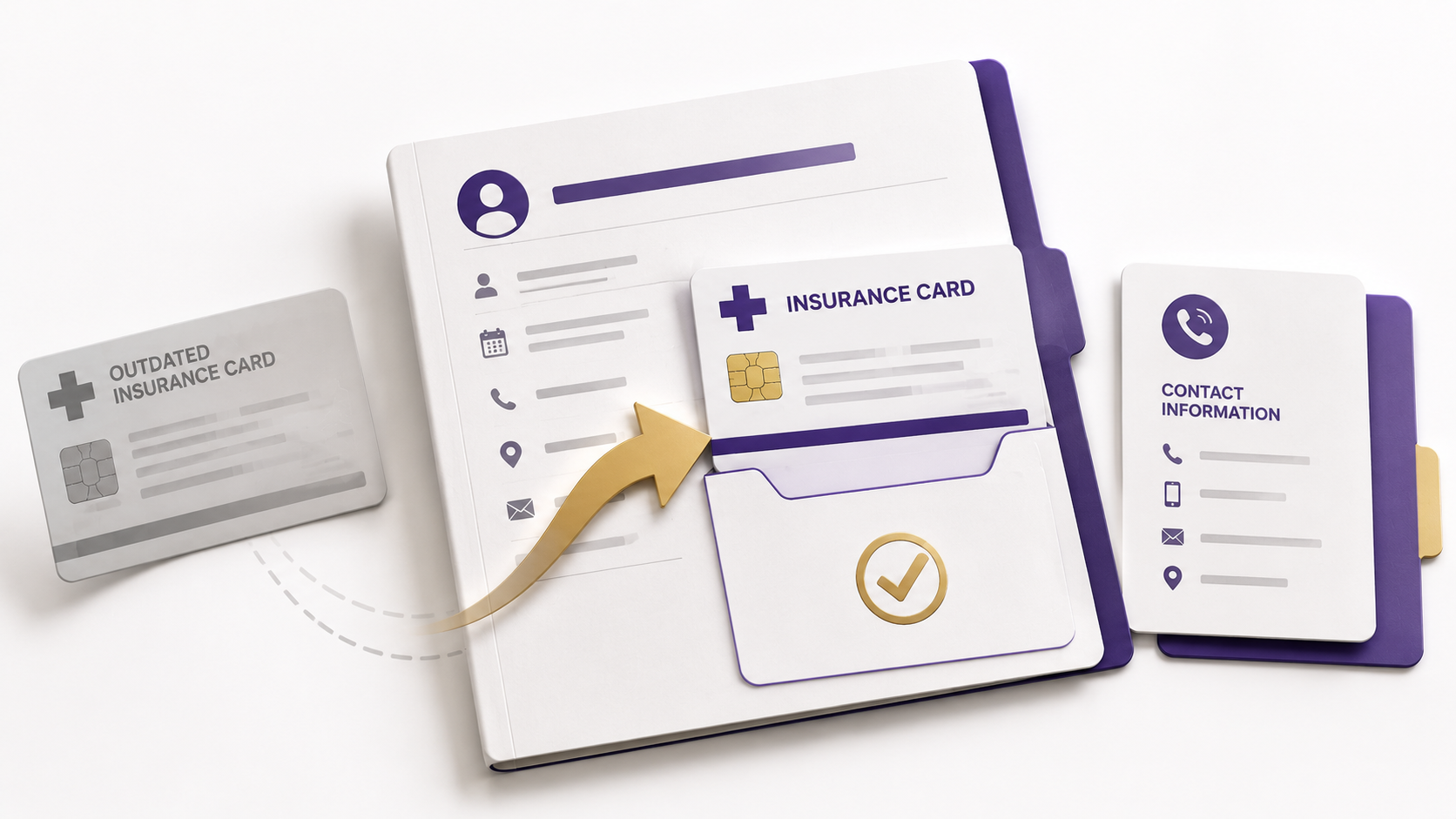
Patient information may look like basic registration data, but it supports nearly every part of a medical practice’s operations. Insurance details determine where claims are sent. Addresses and phone numbers support billing and patient communication.
Emergency contacts matter when the practice needs to reach someone quickly. Even a small error can ripple downstream across several workflows.
That is why outdated patient information is more than a front-desk problem.
When information is not routinely verified, practices can experience claim denials, returned statements, delayed collections, additional administrative work, and communication problems with patients. Individually, these issues may seem minor. Repeated across a full patient population, however, they consume staff time and delay reimbursement.
They also increase rework and make outstanding balances more difficult to resolve.
The solution is not simply telling staff to pay closer attention. Practices need a consistent verification process that fits naturally into the patient workflow.
Key Takeaways
- Patient information verification is a front-end operational process with downstream effects on billing, collections, communication, clinical follow-up, and staff workload.
- Established patients still require defined verification checkpoints because insurance and contact information can change between visits.
- Active verification can identify discrepancies more effectively than asking patients whether everything is “still the same.”
- The practice should define verification frequency rather than leaving it entirely to individual staff judgment.
- A complete workflow should establish responsibility, required fields, documentation expectations, discrepancy resolution, and escalation procedures.
- Repeated downstream corrections can help management identify weaknesses in the registration and verification process.
Table of Contents
Patient Registration Is Part of the Revenue Cycle
Revenue cycle management begins before a claim is ever created. By the time billing receives an account, many factors affecting reimbursement have already been established. The patient’s demographics have been entered, insurance information has been collected, eligibility may have been checked, and services have already been provided.
If that information is accurate, billing has a stronger starting point. If it is not, the billing team may inherit a registration or eligibility problem that must be investigated and corrected after the patient has already left the practice.
Consider an established patient whose insurance changed but was never updated in the system. The patient is seen, and the claim is generated. The billing team then submits it using the coverage on file. If the claim is rejected or denied because of the outdated coverage, staff may then need to investigate the account and contact the patient. They may need to obtain the current insurance information, update the record, and determine the appropriate next step for the claim.
What may have required only a few minutes to resolve during registration has now become a revenue-cycle recovery task involving additional investigation, patient contact, record correction, and claim follow-up.
Operational Snapshot
Registration errors become more expensive to resolve as they move downstream. Practices can reduce avoidable recovery work by treating the patient’s presence at check-in as the lowest-friction opportunity to resolve coverage discrepancies before they become billing exceptions.
Insurance Information Requires Ongoing Verification
One of the easiest mistakes to make is assuming established patients still have the same insurance.
Patients change jobs, employers change benefit offerings, coverage terminates, and plan information changes. In some situations, eligibility can change even when the patient believes the same coverage is still in place.
This is particularly important for practices with patients who return frequently. Familiarity can unintentionally weaken the verification process because staff may become less likely to actively confirm information for patients they see regularly. When staff see the same patient every week or month, it becomes easy to assume nothing has changed.
But visit frequency does not guarantee information accuracy.
When outdated coverage reaches billing, the financial consequences depend on the payer and circumstances. At minimum, the practice may experience a rejection or denial and additional staff work.
In more difficult situations, delayed identification of the correct coverage can create timely filing problems or leave the practice with fewer options for recovering payment. This depends on the payer, applicable filing limits, and the claim’s circumstances.
Compliance Alert
An insurance discrepancy is not always just a rework issue. When correct coverage is identified late, payer filing requirements may turn a preventable registration problem into a financial exposure, making unresolved coverage issues especially important to identify and escalate promptly.
Insurance verification therefore needs to be an established workflow rather than a response to problems after they occur.
Contact Information Affects More Than Patient Statements
Addresses, phone numbers, and email addresses create a different type of operational risk.
A patient statement sent to an outdated address may be returned. Staff then have to research the account and attempt to reach the patient through another channel. They also have to update the demographic information and potentially send the statement again.
The postage or printing cost is not the primary concern. Staff time and delayed collection are usually more significant.
The same issue applies to digital communication. A practice may send billing reminders, appointment notifications, portal messages, or other communications electronically, but those systems depend on accurate underlying data. An automated message sent to an outdated phone number has technically been processed but accomplished nothing.
Meanwhile, the account continues aging.
This creates an important distinction: sending a communication does not necessarily mean communication occurred. Practices need accurate patient information for their communication systems to function as intended.
Operational Snapshot
Automated communication metrics can create false reassurance when contact data is stale. Practices should distinguish between messages successfully processed by a system and communications that have a realistic path to the patient, particularly when evaluating collection or outreach performance.
Data Accuracy Also Supports Patient Care
The consequences extend beyond reimbursement.
Clinical and administrative teams may need accurate contact information to reach patients regarding follow-up care, scheduling changes, referrals, or other important communications. These communications are subject to the practice’s established communication and privacy procedures. Emergency contacts can also become relevant when the practice needs another reliable point of contact.
This is why demographic accuracy should not be treated as an isolated billing responsibility. The information collected during registration supports multiple departments simultaneously.
A weak verification process therefore creates shared operational risk. Billing may experience delayed payments, clinical staff may face communication issues, and front-office staff may spend extra time correcting information.
The original error may be small, but the downstream workload is distributed across the practice.
Create a Consistent Patient Information Verification Process
Active Verification Works Better Than Passive Confirmation
How staff verifies information matters almost as much as whether they verify it.
A common check-in question is, “Is everything still the same?”
It is quick, but it lets the patient confirm the entire record without actively reviewing the individual information the practice relies on. Established patients may answer yes automatically, especially when they are focused on checking in and seeing the provider. Active verification creates a stronger checkpoint.
| Passive Confirmation | Active Verification |
|---|---|
| “Is your address still the same?” | “Can you confirm your current mailing address?” |
| “Same phone number?” | “What’s the best phone number to reach you?” |
| “Same insurance?” | “Can I see your current insurance card?” |
These questions require the patient to provide or actively confirm the information rather than simply agree with what is already on file.
That small change can help staff identify discrepancies while the patient is physically present and the problem is relatively easy to correct.
Set a Reasonable Verification Cadence
A strong verification process does not necessarily mean conducting a complete demographic review at every encounter for every patient.
Practices should establish a reasonable cadence based on visit frequency and operational risk.
A patient who visits once a year may need a comprehensive review at every appointment. A patient receiving a recurring service every week may not need the same complete review each time, but the practice still needs scheduled checkpoints for confirming demographics and insurance.
The appropriate verification frequency can vary based on the practice, patient population, visit frequency, information being verified, and operational risk. The important point is to establish a defined cadence. Staff should know when information must be verified and which fields need review. They should also know what documentation is expected.
One employee may verify insurance regularly. Another may only ask when the patient mentions a change. A third may assume that frequent patients are already current.
At that point, the practice lacks a verification workflow. It has several individual habits producing different results.
Operational Snapshot
A verification cadence functions as a control only when staff can apply it consistently. Defining triggers, required fields, and documentation expectations also gives management a standard against which missed verification can be identified, measured, and improved.
Build Verification Into the Workflow
Patient information accuracy improves when verification is treated as a defined operational responsibility.
The workflow should identify who performs verification and when it occurs. It should identify what information is reviewed, how changes are documented, and what happens when the necessary information cannot be obtained.
The workflow should also define how discrepancies are resolved. Staff need to know when they can update information directly and when supporting documentation is needed. They also need to know when an insurance discrepancy requires additional eligibility research and when an unresolved issue should be escalated before the account moves further through the revenue cycle. Identifying inaccurate information is only useful if the practice has a consistent process for correcting it.
Technical Deep Dive
A verification workflow needs an exception path, not just a confirmation step. Systems and procedures should make unresolved discrepancies visible to the appropriate staff so an account does not continue downstream simply because the standard registration sequence was completed.
Technology can support the process through EHR prompts, registration alerts, electronic forms, eligibility tools, and scheduled demographic reviews. But technology does not determine when verification should occur or who is responsible for reviewing discrepancies. It also does not determine what happens when information cannot be confirmed.
Management also needs clear signals to recognize when the verification process is failing before individual errors develop into recurring billing or communication problems.
Returned mail, repeated eligibility problems, claims submitted to outdated insurance, disconnected phone numbers, and billing staff frequently requesting corrected demographics are all operational signals. If the same problems recur, management should look upstream rather than treating each account as an isolated error.
The question becomes less about who made a particular mistake and more about why the existing workflow allowed the error to reach the next department.
Operational Snapshot
Recurring downstream corrections can serve as leading indicators of a weak registration control. Tracking the type and frequency of these exceptions helps management distinguish isolated patient changes from a verification process that is systematically allowing preventable errors through.
Frequently Asked Questions About Patient Information Verification
What patient information should a medical practice routinely verify?
Practices should determine which information is essential to their registration and operational workflows. This commonly includes patient demographics, mailing address, phone number, insurance information, and other contact information the practice relies on for billing, communication, and administrative processes.
How often should patient information be verified?
No single verification schedule fits every medical practice. The appropriate frequency depends on visit frequency, patient population, the information being verified, and operational risk. Practices should establish defined checkpoints rather than leaving verification entirely to individual staff judgment.
Should established patients still have their information verified?
Yes. Established patients can change insurance plans, employers, addresses, phone numbers, and other information between visits. Patients seen frequently can pose a particular risk because familiarity may lead staff to assume the information on file is still accurate.
What is the difference between active verification and passive confirmation?
Passive confirmation asks patients whether existing information is still correct, such as asking whether everything is still the same. Active verification asks patients to provide or confirm specific information, such as their current mailing address or insurance card, creating a stronger opportunity to identify discrepancies.
What should staff do when patient information cannot be verified?
The practice should have a defined process for unresolved information. That process may include additional eligibility research, obtaining supporting documentation, documenting the discrepancy, or escalating the issue to designated staff before the account moves further through the revenue cycle.
How can a practice tell if its patient information verification process is not working?
Repeated eligibility problems, claims submitted to outdated insurance, returned mail, disconnected phone numbers, and frequent requests from billing staff for corrected demographics can indicate a weak verification process. Tracking recurring problems can help management determine whether errors are isolated or reflect a larger workflow issue.
Patient Information Verification Is a Front-End Operational Control
Patient information verification is a good example of how small front-end processes influence the entire medical practice.
When information is inaccurate, the effects can appear in billing, collections, patient communication, clinical follow-up, staff workload, and accounts receivable. A reliable verification process moves that work upstream, where corrections are usually easier and require less downstream staff intervention.
Addressing those discrepancies upstream is usually easier and less resource-intensive than correcting them after they have reached billing, collections, or other downstream workflows.
The goal is not to create a burdensome check-in process or repeatedly ask patients for information without reason. It is to establish predictable checkpoints that keep essential information current.
When staff know what to verify and patients actively confirm their information, registration becomes more than an administrative task. The same is true when the practice monitors recurring data problems. Registration becomes an operational control that supports clean claims and more reliable communication. It also reduces rework and supports a healthier revenue cycle.
About the Author
Jennifer Blevens-Smith is the founder and principal consultant of Integral Clinic Solutions. With more than two decades of experience supporting independent medical practices, she helps physicians, practice administrators, and healthcare leaders strengthen credentialing, payer contracting, revenue cycle operations, compliance workflows, and practice management. Her work translates complex healthcare requirements into practical operational processes. These processes improve consistency, reduce administrative burden, and support long-term practice success.
Need Help Strengthening Your Medical Practice Operations?
Integral Clinic Solutions provides practical support for medical practices navigating credentialing, contracting, revenue cycle operations, compliance workflows, front-office systems, and practice management challenges.
Explore more operational guidance, compliance insights, and healthcare business resources on the Integral Clinic Solutions blog. New articles and updates are added regularly for practice owners, administrators, and healthcare teams.
Disclaimer: This content is for informational and educational purposes only and does not constitute legal, coding, billing, compliance, financial, or medical advice. Healthcare practices must verify all operational requirements with applicable payers, regulators, and qualified professionals. Read our full Legal & Compliance Disclaimer.