
Avoid Denials! Clean Claims Strategies for Faster Medical Billing Payments
Clean claims are one of the strongest indicators of a healthy revenue cycle. While denials often receive the most attention, the real objective is preventing them in the first place. Every claim that must be corrected, appealed, or resubmitted consumes staff time, delays reimbursement, and increases the administrative cost of getting paid.
A clean claim is more than a correctly completed insurance form. It reflects the combined work of scheduling, registration, clinical documentation, coding, billing, and claim review. When each step is performed consistently, claims move through the payer’s adjudication process with fewer interruptions. This results in more predictable cash flow and less administrative rework.
Operational Snapshot
A declining clean claim rate should not automatically be assigned to billing. Leadership should trace errors back through registration, eligibility, authorization, documentation, coding, claim configuration, and final review before deciding where corrective action belongs.
While working directly with independent medical practices, I have consistently found that many claim denials are not isolated billing mistakes. They are operational problems that begin earlier in scheduling, registration, insurance verification, documentation, or authorization workflows.
They surface later as denials, payment delays, or underpayments. Practices with stronger clean claim performance therefore treat claim quality as an organization-wide responsibility rather than a billing department metric.
Key Takeaways
- Clean claim performance begins with accurate scheduling, registration, eligibility, and authorization workflows.
- Documentation, coding, provider information, billing rules, and payer requirements all contribute to claim quality.
- Preventing avoidable errors is generally more efficient than correcting rejections and denials after submission.
- Claim scrubbing provides an important technical review but does not replace documentation, coding, or payer-policy analysis.
- First-Time Pass Rate is useful only when the organization clearly defines how the metric is calculated.
- A clean claim may still be subject to payer coverage and adjudication decisions despite meeting submission requirements.
- Technology is most effective when paired with standardized workflows, trained staff, reliable data, and ongoing oversight.
Table of Contents
What Is a Clean Claim?
A clean claim contains the information generally required by the receiving payer, is supported by appropriate documentation and coding, follows applicable billing and submission requirements, and is submitted in a manner that allows it to move through initial payer processing without avoidable intervention.
That means the claim includes:
- Accurate patient demographics and insurance information
- Appropriate CPT, ICD-10, and HCPCS codes
- Required modifiers when applicable
- Valid provider and payer information
- Necessary referrals or prior authorizations
- Documentation that supports medical necessity
When these elements come together correctly, the likelihood of rejection for missing information or denial because of preventable billing errors is significantly reduced, although additional payer reviews may still affect claim adjudication.
The exact requirements are not identical across Medicare, Medicaid, commercial insurers, workers’ compensation programs, and other payer arrangements, even though claims are submitted using HIPAA standard transactions. Required modifiers, authorization rules, documentation standards, filing formats, and claim edits may differ by payer, plan, service, and place of service. Practices should verify current payer-specific requirements rather than relying on one universal definition of a clean claim.
Although every practice encounters occasional denials, a consistently low clean claim rate may indicate operational problems that began before the claim reached the billing department, including registration errors, incomplete verification, missing authorization information, documentation deficiencies, coding inconsistencies, or payer configuration issues.
Why Clean Claims Matter Beyond Faster Payment
Most practices recognize that denials delay reimbursement, but the financial impact extends far beyond waiting a few extra weeks for payment.
Each denied claim can create additional work throughout the organization. Billing staff investigate the denial. Clinical staff may need to provide additional documentation. Coders may review the encounter again. Managers may become involved when reconsideration or appeal is necessary.
During revenue cycle reviews, it is common to find that one preventable denial has passed through several employees before it is ultimately resolved. This increases the administrative cost of collecting the payment.
This additional labor increases the cost to collect the revenue and reduces the time available for unresolved accounts, payment accuracy reviews, patient balance follow-up, and other higher-value revenue cycle work.
Even when a claim is ultimately reimbursed, each correction, phone call, appeal, and resubmission adds administrative work and reduces operational efficiency. Those resources could have been devoted to processing new claims, reducing accounts receivable, or addressing higher-value revenue cycle activities.
A clean claim improves the likelihood of efficient processing but does not guarantee full or immediate reimbursement. Payment may still be affected by eligibility, patient benefits, medical necessity, contractual adjustments, deductibles, coinsurance, coordination of benefits, bundling rules, benefit exclusions, and other payer determinations. Clean claim performance should therefore be evaluated alongside denial rates, payment accuracy, days in accounts receivable, underpayments, and patient responsibility collection.
Where Clean Claims Are Won—or Lost
In practice assessments, we frequently find that the root cause of claim denials can be traced to front-end workflows rather than billing itself. Registration errors, incomplete eligibility verification, and missing prior authorizations often create downstream problems that become visible only after claims are submitted.
By the time a claim reaches the billing department, many of the factors that determine whether it will process successfully have already been established.
| Workflow Stage | Common Risk | Operational Impact |
|---|---|---|
| Patient Registration | Incorrect demographics or insurance information | Eligibility failures and claim rejections |
| Insurance Verification | Coverage, network, or authorization not confirmed | Preventable denials and delayed reimbursement |
| Clinical Documentation | Incomplete or unsupported documentation | Coding discrepancies and medical necessity denials |
| Coding | Incorrect diagnosis, procedure, or modifier selection | Rejections, denials, and underpayments |
| Claim Review | Missing data or payer edits not identified | Additional corrections and resubmissions |
Reviewing clean claim performance by workflow stage helps leadership identify whether errors are originating in registration, verification, documentation, coding, claim configuration, or final submission review. The highest-volume and highest-value error categories should generally receive priority rather than assuming every workflow problem has the same financial impact.
It Starts at Patient Registration
The revenue cycle begins before the patient sees the provider.
Front desk and scheduling staff collect demographic information and confirm the active insurance plan. They verify eligibility and benefits, identify referral or prior authorization requirements, and determine whether the scheduled provider and service appear consistent with the patient’s network and plan requirements. Errors or incomplete information introduced during registration may not become visible until the claim is rejected, denied, underpaid, or assigned to patient responsibility several days or weeks later.
For example, outdated insurance information may not be discovered during scheduling or check-in. Once the claim reaches the payer, it may be rejected because the member number is invalid, the plan is inactive, or a different insurer was responsible on the date of service. Staff must then research the coverage and contact the patient when necessary. They update the account, correct the claim, and resubmit it.
These are avoidable delays that originate at the beginning of the workflow rather than the end.
Operational Snapshot
Many claim denials originate long before billing begins. Strong scheduling, eligibility verification, registration, and authorization workflows can reduce downstream problems that are more costly and time-consuming to correct after claim submission.
A Common Front-End Scenario
A common pattern occurs when insurance information is verified only when the appointment is scheduled, even though the visit may take place several weeks later. Coverage can terminate, the patient’s plan can change, or the provider’s network status may differ under the new plan before the date of service.
A more reliable workflow includes verifying coverage close enough to the appointment to identify meaningful changes, while recognizing that an eligibility response is not a guarantee of payment. Staff should also have a defined process for resolving discrepancies before services are rendered whenever possible.
Practices with stronger clean claim performance rely on documented registration procedures, written verification steps, defined escalation paths, and ongoing staff education instead of informal processes. The process should also account for payer-specific exceptions and changes in plan requirements.
Accurate Coding Depends on Accurate Documentation
Even experienced coders cannot assign fully supported codes when the medical record is incomplete, unclear, or inconsistent with the services performed.
Even experienced coders cannot maintain CPT coding accuracy when the medical record is incomplete, unclear, or inconsistent with the services performed.
Clinical documentation should accurately describe the services performed and contain the information necessary to support the diagnosis, procedure, supply, and modifier selections reported on the claim. Medical necessity and coverage determinations also depend on the applicable payer policy and the patient’s benefits. When the documentation, coding, and payer requirements are not aligned, the risk of denial increases. The risk of downcoding, payment delay, or post-payment review also increases.
Modifier usage is another area where accuracy, payer-specific review, and National Correct Coding Initiative (NCCI) edits may affect reimbursement. A missing, unsupported, or incorrectly applied modifier can cause bundling edits, payment reductions, requests for documentation, or claim denials, even when the underlying service was performed. Modifier selection should be supported by the medical record and current coding and payer guidance.
Services that may require a referral, notification, precertification, or prior authorization should be identified before care is provided whenever possible. Discovering a missing requirement after the service can significantly limit reimbursement options, although the available correction or appeal process depends on the payer, plan, circumstances, and applicable rules.
These issues highlight why documentation, coding, and front-office workflows should never operate independently. Each depends on the accuracy of the others.
Coding and billing staff should not add, infer, or alter clinical information merely to obtain payment. When the documentation is unclear or incomplete, the practice should use an appropriate provider query or clarification process that follows organizational policy and applicable coding and compliance standards.
Claim Scrubbing Provides a Final Quality Check
Even well-designed workflows benefit from a final review before submission.
Claim scrubbing can identify missing claim data, formatting problems, code combinations, payer-specific edits, provider enrollment or credentialing indicators, and certain authorization-related issues before the claim reaches the payer. It may be performed through automated software, manual review, or a combination of both. In each case, claim scrubbing functions as an important final technical quality check within the revenue cycle.
Technical Deep Dive
Review scrubber edits by payer, provider, service, and rejection category. Repeated overrides or recurring edits may indicate outdated system rules, training gaps, claim-configuration problems, or unresolved errors earlier in the workflow.
Correcting an error before submission is generally less costly and time-consuming than resolving it after payer rejection or denial. However, claim scrubbing cannot compensate for poor documentation, inaccurate registration, incorrect benefit interpretation, missing authorization, or unsupported coding. Complex claims still require trained staff to evaluate the medical record, coding guidance, payer policies, and contractual requirements.
Measuring Performance with First-Time Pass Rate
Measuring performance is essential, and First-Time Pass Rate (FPR) provides useful insight into initial claim submission performance.
First-Time Pass Rate generally measures the percentage of claims that pass initial claim edits or are accepted for payer processing on the first submission without being returned for correction. Organizations do not always define this metric in the same way. Industry organizations such as the Healthcare Financial Management Association (HFMA) recognize that performance measures should be interpreted within the context of each organization’s reporting methodology.
Some systems measure clearinghouse acceptance, while others include payer acceptance, rejection activity, or later denial outcomes. Practices should document the exact definition used in their reports before comparing results.
Operational Snapshot
Before reviewing FPR trends, document the report source, numerator, denominator, exclusions, treatment of corrected claims, and point at which a claim is considered successful. Changes to any of these elements can create an apparent performance shift even when operations have not changed.
First-Time Pass Rate should not automatically be treated as the same metric as clean claim rate, first-pass yield, initial acceptance rate, or denial rate. Reporting systems and industry organizations may calculate these measures differently. Leadership should confirm the numerator, denominator, exclusions, and data source before using the metric for performance decisions.
A commonly used calculation is:
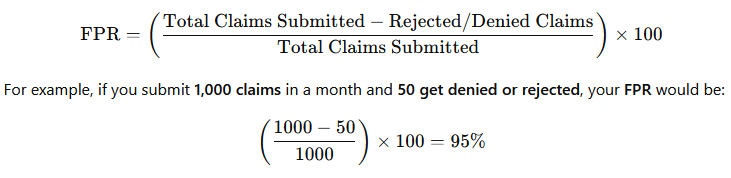
Some revenue cycle organizations use a target near or above 95% for initial claim acceptance or first-pass performance. However, the relevance of that benchmark depends on how the metric is defined, the specialty, payer mix, claim complexity, submission method, and reporting exclusions. Practices should avoid presenting 95% as a universal standard unless the definition and source are clearly identified.
Internal trends are often more useful than an unsupported industry comparison. A sustained decline may indicate payer edit changes, clearinghouse configuration problems, registration inconsistencies, documentation deficiencies, coding errors, staffing disruptions, or changes in claim volume or service mix.
Reviewing the metric monthly can help leadership determine whether workflow changes are producing measurable results, provided the calculation remains consistent from one reporting period to the next. Significant changes should be evaluated by payer, location, provider, service type, rejection reason, and responsible workflow stage.
Identifying Denial Patterns
Every practice experiences denials, but not every denial deserves equal attention.
When the same denial or rejection reasons appear repeatedly, they may point to a recurring process weakness rather than isolated mistakes. Common categories include eligibility problems, coordination of benefits, code or modifier edits, missing referrals or authorizations, provider enrollment issues, medical necessity determinations, duplicate claims, and timely filing.
Rather than treating each denial independently, practices should analyze patterns by payer, plan, provider, location, service, adjustment reason, denial code, dollar value, and root cause. If eligibility-related denials continue month after month, improving front-end verification and discrepancy resolution may have a greater long-term impact than simply increasing denial follow-up activity.
This approach shifts denial management from reactive correction toward proactive prevention.
Operational Snapshot
Prioritize denial categories using both frequency and financial impact. A low-volume denial affecting high-dollar services may deserve attention before a more common denial involving small balances.
Payer Claim Adjustment Reason Codes (CARCs) should not be interpreted in isolation. The payer’s stated reason may describe the immediate processing outcome without identifying the true operational cause. Staff should review the remittance information, claim history, eligibility response, authorization record, medical documentation, payer policy, and contract terms before assigning a root cause.
Technology Supports Good Processes—It Doesn’t Replace Them
Automation is an important component of modern revenue cycle management. Electronic eligibility tools, claim edits, payer-specific scrubbing rules, work queues, and denial analytics can reduce repetitive manual work and improve consistency. However, the accuracy of these tools depends on system configuration, current payer information, reliable data entry, and appropriate staff oversight.
Technology performs best when supported by consistent operational processes, reliable data, current payer information, ongoing staff education, system testing, and defined exception-handling procedures. It can strengthen well-designed operations, but it cannot independently resolve every clinical, contractual, coding, or payer-specific issue that affects reimbursement.
Common Misconceptions About Clean Claims
Does a High Claim Acceptance Rate Mean the Practice Is Being Paid Correctly?
No. A high acceptance rate shows that claims are entering the payer’s adjudication system, but it does not confirm that payments are accurate. Practices must still review contractual adjustments, underpayments, bundling, downcoding, patient responsibility, and other payment variances.
Do All Clean Claim Metrics Measure the Same Thing?
No. One system may measure clearinghouse acceptance, while another measures payer acceptance or claims that reach payment without correction. Practices should confirm the numerator, denominator, exclusions, and data source before comparing clean claim results across reports or organizations.
Does the Denial Code Always Identify the True Root Cause?
No. A denial code identifies the payer’s reason for denying the claim, but it does not always identify the underlying operational or workflow failure that caused the denial. Determining the true root cause may require reviewing eligibility verification, authorization records, claim history, clinical documentation, coding, payer policies, and contract terms.
It’s also important to distinguish claim denials from clearinghouse claim rejections. A denial occurs after the payer receives and adjudicates the claim, whereas a clearinghouse claim rejection prevents the claim from reaching payer adjudication in the first place.
A clearinghouse claim rejection contains errors that prevent the claim from entering the payer’s adjudication process, such as missing or invalid information.
What Medical Practices Ask About Clean Claims
Can a claim be accepted by a payer and still be denied later?
Yes. Initial acceptance confirms only that the claim passed basic submission edits and entered the payer’s processing system. It does not mean adjudication is complete. The payer may later deny, reduce, or reassign the claim based on coverage, medical necessity, coordination of benefits, filing requirements, contract terms, or other payment rules.
What is the difference between a rejected claim and a denied claim?
A rejected claim contains errors that prevent it from entering the payer’s adjudication process, such as missing, invalid, or improperly formatted information. These errors must typically be corrected before the claim can be resubmitted.
A denied claim has been received and adjudicated by the payer, but payment is refused or reduced because of coverage rules, medical necessity, documentation, coding, eligibility, authorization requirements, contractual provisions, or other payer determinations.
Should corrected or replacement claims be included in clean claim reporting?
That depends on how the practice defines the metric. Corrected, replacement, voided, secondary, and resubmitted claims may be included or excluded by different systems. The reporting methodology should clearly document these rules so results remain consistent and comparable over time.
What should a practice investigate when one payer’s clean claim rate suddenly declines?
Review recent payer edit changes, clearinghouse reports, provider enrollment records, claim configuration, authorization requirements, code updates, and rejection patterns. Comparing affected claims by provider, service, location, and submission date can help determine whether the problem is operational, technical, or payer-specific.
Why might a practice have a high clean claim rate but still experience slow cash flow?
A high clean claim rate does not account for every factor affecting reimbursement timing. Slow cash flow may still result from payer processing delays, authorization reviews, coordination of benefits, patient responsibility, underpayments, credentialing problems, or ineffective follow-up on unpaid claims.
How can a small medical practice improve clean claim performance without hiring additional staff?
Many improvements come from refining existing workflows rather than adding personnel. Standardizing registration procedures, verifying insurance before appointments, using claim edits consistently, monitoring denial trends, and providing ongoing staff education can often improve claim quality while making better use of current resources.
Building Better Clean Claims
Improving clean claim performance is not simply a billing objective. It is an operational strategy that can influence reimbursement timing, staff workload, accounts receivable, payment accuracy, and patient balance communication.
Every claim reflects decisions made throughout scheduling, registration, eligibility verification, authorization, documentation, coding, charge entry, billing, and claim review. When those processes are standardized, monitored, and updated for payer changes, claims are less likely to encounter preventable interruptions. Staff can then spend less time correcting avoidable errors. They can spend more time managing unresolved balances, supporting patients, and improving practice operations.
Strong clean claim performance depends on identifying where errors begin, assigning responsibility for correction, and measuring whether workflow changes produce lasting improvement. This approach helps practices reduce avoidable rework, improve reimbursement predictability, and focus staff resources on unresolved or higher-value accounts.
Because payer requirements and billing guidance continue to evolve, practices should review their clean claim workflows regularly and update policies whenever significant payer or regulatory changes occur.
About the Author
Jennifer Blevens-Smith is the founder and principal consultant of Integral Clinic Solutions. She has nearly two decades of experience supporting independent medical practices with revenue cycle management, credentialing, payer enrollment, contracting, compliance workflows, front-office operations, and practice management.
Her consulting focuses exclusively on helping independent physician practices improve operational performance, strengthen compliance processes, and optimize revenue cycle workflows. She works directly with practice owners, administrators, and healthcare teams to identify operational risks, improve reimbursement processes, and build more sustainable practice systems.
Need Help Strengthening Your Medical Practice Operations?
Integral Clinic Solutions provides practical support for medical practices navigating credentialing, contracting, revenue cycle operations, compliance workflows, front-office systems, and practice management challenges.
Explore more operational guidance, compliance insights, and healthcare business resources on the Integral Clinic Solutions blog. New articles and updates are added regularly for practice owners, administrators, and healthcare teams.
Disclaimer: This content is for informational and educational purposes only and does not constitute legal, coding, billing, compliance, financial, or medical advice. Healthcare practices must verify all operational requirements with applicable payers, regulators, and qualified professionals. Read our full Legal & Compliance Disclaimer.