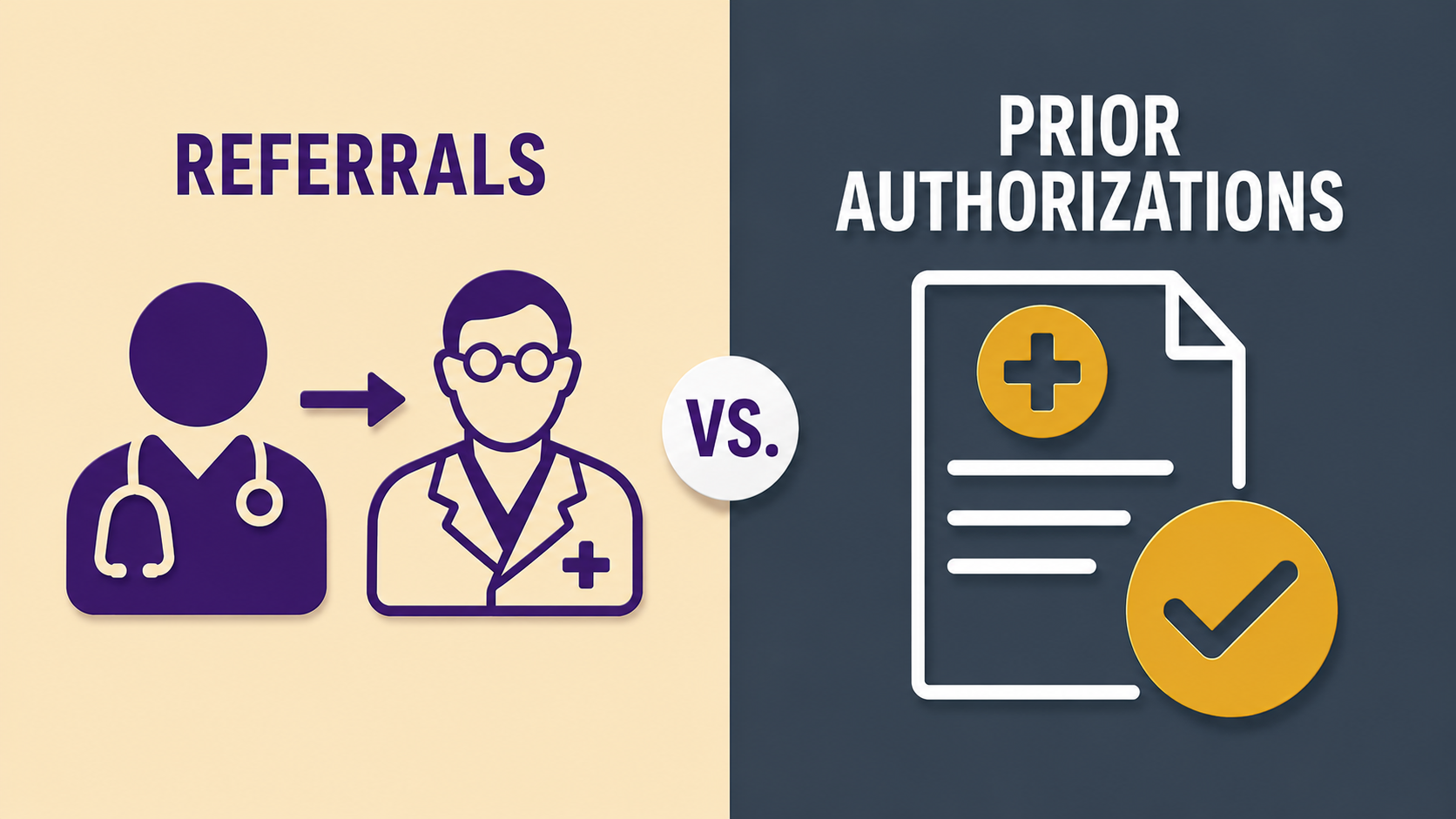
Prior Authorizations and Referral Requirements: How They Affect Scheduling, Billing, and Claim Denials
Prior authorizations and referrals are often discussed together, but they are not the same thing. They serve different purposes, follow different payer rules, and create different operational challenges for medical practices. What they do have in common is their ability to disrupt the revenue cycle when they aren’t managed correctly.
Many referral- and authorization-related denials don’t happen because the payer changed its mind about covering a service. They happen because a required step was missed before the patient was seen, approval details weren’t communicated to billing, or the claim didn’t match what the payer approved.
Managing these requirements isn’t just an insurance verification task. It involves coordination between scheduling, front-office staff, authorization teams, providers, and billing. When each department understands its role, practices can reduce avoidable denials, improve cash flow, and minimize delays for patients.
In our work with independent medical practices, referral and prior authorization issues are recurring operational causes of preventable claim delays, rework, and reimbursement denials. Most breakdowns do not occur because coverage was unavailable—they occur when required information is missing, incomplete, or fails to move accurately between departments.
Key Takeaways
- Clear Distinction: Prior Authorizations and Referrals are separate requirements; treating them as interchangeable can create preventable denials.
- Verification Depth: True verification goes beyond checking “active coverage”—it requires confirming specific service, provider, and CPT-level requirements.
- Proactive Scheduling: Scheduling decisions should reflect whether all required approvals have been obtained and verified.
- Standardized Handoffs: Revenue cycle integrity depends on the accurate transmission of referral and authorization information to billing.
- No Payment Guarantee: Prior authorization confirms approval for a service, but does not override contractual or eligibility-based reimbursement requirements.
Table of Contents
Prior Authorizations and Referrals Are Different Requirements
Although they’re frequently mentioned together, prior Authorizations and referrals are separate payer requirements that should never be treated as interchangeable.
Operational Snapshot
Prior authorizations and referrals are separate payer requirements with different approval pathways. Receiving one does not automatically satisfy the other, making it essential to verify exactly what each patient’s health plan requires before care is delivered.
I’ve seen preventable revenue loss occur when teams assume that a referral also satisfies the prior authorization requirement. These are distinct administrative checkpoints. A referral generally supports access to another provider or specialist, while a prior authorization reflects payer review of a particular service, procedure, medication, or treatment. When a health plan requires both, each must be verified and managed separately.
A referral generally directs a patient to another provider or specialist and may be required by the health plan before specialist services are covered. Many HMO and managed care plans require the referral to originate from the patient’s primary care provider.
A prior authorization is the payer’s review and conditional approval of a specific service, procedure, medication, or treatment before it is provided. The approval applies only under the provider, location, coding, timing, and benefit conditions documented by the payer. Depending on the payer and service, this may apply to advanced imaging, surgeries, injections, durable medical equipment, specialty medications, or other high-cost services.
If your team uses the terms referral and prior authorization interchangeably, this video explains the difference, when a patient may need one or both, and several common mistakes that can lead to scheduling problems and denied claims.
Some health plans require one or the other, while others require both. Receiving a referral does not automatically satisfy prior authorization requirements, and obtaining a prior authorization does not eliminate the need for a referral when the patient’s plan requires one.
Referral and prior authorization requirements can vary by payer, health plan, employer group, state regulations, and the specific service being performed. Practices should verify current requirements directly with the patient’s health plan before rendering services, rather than relying on prior approvals or assumptions.
| Requirement | Referral | Prior Authorization |
|---|---|---|
| Primary purpose | Supports or authorizes access to another provider or specialist | Documents payer approval of a specific service, procedure, or treatment |
| Usually applies to | Provider or specialist visits | Individual services, procedures, medications, or equipment |
| Commonly initiated by | Referring provider, often the primary care provider | Requesting provider, with determination issued by the payer |
| May include | Visit limits, approved provider, effective dates | Approved CPT codes, diagnosis, provider, facility, service dates, or units |
For a complete breakdown of authorization requirements, submission, tracking, and follow-up, review our guide to the prior authorization process.
Prescription prior authorizations often follow a separate, pharmacy-driven process and may require medication history, step-therapy documentation, or formulary alternatives.
Verify Requirements Before Scheduling the Patient
The strongest opportunity to prevent referral and authorization denials occurs before the appointment is scheduled.
Insurance verification should extend beyond confirming active coverage to verify every payer requirement associated with the scheduled service. Practices should document how the requirements were verified, including the verification date, reference number when available, and any payer instructions that may affect scheduling or billing.
Staff should determine exactly what the patient’s specific plan requires for the scheduled services. Relying on the payer’s name, previous visits, or patient recollection creates unnecessary risk because requirements often vary between plans offered by the same insurer.
Compliance Alert
Insurance verification should confirm far more than active coverage. Missing referral, authorization, provider, location, date, or CPT requirements before scheduling can create preventable denials that affect every downstream department.
During verification, practices should confirm:
- whether a referral is required
- whether prior authorization is required
- the approved rendering provider
- the approved facility or service location
- the authorized service or CPT code
- diagnosis requirements when applicable
- effective and expiration dates
- approved visit or unit limits
- any additional payer-specific requirements
This information becomes the foundation for the rest of the revenue cycle. If verification is incomplete, every downstream department inherits that uncertainty, increasing the likelihood of delays, rework, and claim denials.
Scheduling Should Match the Approval Status
Scheduling decisions should reflect the current status of referral and authorization requirements.
If all required approvals have been obtained and verified, the appointment can typically move forward as planned. If required approvals are still pending, however, practices should have a consistent process for determining whether the appointment should proceed, be held, or be flagged for additional review.
This is particularly important when approvals are tied to specific providers, facilities, or dates. Scheduling a patient with the wrong rendering provider or at an unapproved location can create a denial even when an authorization exists.
In practice, this often occurs when an appointment is moved to a different provider or location after the authorization has already been obtained. The approval may still apply to the original provider, location, or service date but not to the rescheduled encounter. Unless staff reverify and update the authorization, the claim may be denied even though the practice originally completed the approval process correctly.
Clear communication with patients is equally important. When appointments must be delayed because an approval is pending, explaining the reason up front helps manage expectations and reduce confusion later. Patients often assume their insurance has already approved care simply because an appointment has been scheduled.
A consistent scheduling process helps ensure that appointments align with payer requirements rather than depending on assumptions or last-minute corrections.
Even when approvals are obtained correctly, the revenue cycle can still fail if critical information is not transferred accurately to billing.
Accurate Billing Depends on a Complete Handoff
Obtaining a referral or prior authorization is only part of the process. The approval information must be accurately transferred to the billing team before the claim is submitted. If any part of the approval is missing or entered incorrectly, billing may submit a claim that does not match the payer’s approval.
Operational Snapshot
Obtaining an approval is only half the process. A standardized handoff ensures billing receives complete authorization details so claims accurately match what the payer approved before submission.
The information transferred to billing should include the referral or authorization number and the approved CPT code or service. It should also include the supporting diagnosis, the approved rendering provider, the approved facility or service location, the effective and expiration dates, and any visit or unit limits that apply. These details allow the billing team to verify that the claim reflects the payer’s approval before submission.
An authorization may approve a procedure for one rendering provider at a specific facility, but the patient may ultimately receive the service from another provider within the same practice. If that change is not communicated to the authorization team and billing, the resulting claim may not match the payer’s approval. This is why approval details should be reviewed whenever an appointment, provider, location, or service changes.
Just as importantly, this handoff should follow a documented process rather than relying on emails, handwritten notes, or verbal communication. Whenever possible, approval details should be entered into designated fields within the practice management system or electronic health record.
This allows scheduling, authorization staff, clinical teams, and billing to access the same information. Consistent documentation also creates an audit trail that helps practices determine whether a denial resulted from an internal workflow breakdown or a payer processing issue. When approval information consistently follows the patient throughout the revenue cycle, billing has the information needed to submit clean claims and reduce avoidable referral- and authorization-related denials.
Documentation Supports Every Stage of the Process
Referral and authorization documentation should remain accessible throughout the patient’s encounter and the claim lifecycle. Maintaining complete records allows staff to answer payer questions, support appeals when appropriate, and verify that claims accurately reflect the approved services.
The referral or authorization record should include verification dates, approval numbers, and covered services. It should also include applicable providers and locations, effective dates, expiration dates, visit or unit limits, and payer reference numbers. This information should remain accessible throughout the encounter and claim lifecycle.
Monitor Referral and Authorization Performance
Referral and authorization workflows should be monitored regularly to identify operational issues before they affect reimbursement. Tracking trends allows practices to improve internal processes while reducing preventable delays.
Useful performance indicators include authorization turnaround times, referral completion rates, appointments delayed while awaiting approval, expired authorizations, and claims denied because referral or authorization requirements were not met. Practices should review these measures by payer, service type, and department whenever possible. Overall totals may conceal recurring problems with a particular health plan or internal process.
A rising number of expired authorizations may indicate that approvals are being obtained too early, appointments are being rescheduled without revalidation, or expiration dates are not being monitored. A concentration of denials from one payer may instead indicate that the payer’s provider, location, or claim-submission requirements are not being identified or applied consistently.
Common Referral and Prior Authorization Denials
Many denials related to prior authorizations and Referrals are preventable, as they stem from operational breakdowns rather than medical-necessity decisions.
Common examples include:
- no referral on file
- missing prior authorization
- incorrect authorization number
- services performed outside the approved dates
- incorrect rendering provider
- incorrect facility or location
- procedure code that doesn’t match the approval
- exhausted visit or unit limits
- authorization information omitted from the claim
Another common misconception is that prior authorization guarantees payment. It does not.
Compliance Alert
Prior authorization is not a guarantee of payment. Claims must still meet eligibility, benefit, coding, documentation, and contract requirements to avoid reimbursement denials.
An authorization confirms that the payer approved the requested service under specific conditions. Coverage still depends on member eligibility, benefit limitations, coordination of benefits, contract provisions, medical documentation, and accurate claim submission. Even when a service was authorized, the claim may still be denied if those additional requirements are not met.
Because of this, practices should view referrals and authorizations as one component of clean claim submission rather than the final step in the reimbursement process.
Correcting Referral and Authorization Denials
When a referral- or authorization-related denial occurs, first identify the payer’s stated reason and compare it with the practice’s referral, authorization, and claim records.
Review the ERA or explanation of benefits and compare the denial reason against the referral or authorization documentation. Confirm that the provider, location, dates of service, procedure codes, diagnosis information, and authorization number all match the approved record.
The next step is identifying where the breakdown occurred. In some cases, verification failed to identify a requirement. In others, scheduling occurred before approval was obtained, billing omitted the authorization number, or the claim didn’t match the payer’s approved service.
Once the source of the error is identified, the practice can determine whether a corrected claim, reconsideration request, or formal appeal is appropriate. Some payers may allow corrections for administrative errors, while others maintain strict policies regarding missed referral or authorization requirements.
Practices should avoid relying on retroactive authorizations as a routine solution. Many payers prohibit retroactive authorization or consider it only under limited circumstances. Verifying requirements before scheduling and rechecking them when appointment details change is therefore more reliable than attempting to obtain approval after services have already been provided.
Referral and Prior Authorization Questions Answered
Who is responsible for obtaining a referral or prior authorization?
Responsibility varies by practice and payer. Referrals may originate with the referring provider, while prior authorization requests are often handled by clinical staff, authorization specialists, or the ordering provider’s office. Practices should define ownership clearly so requests are not delayed or duplicated.
Can a patient obtain their own referral or prior authorization?
In most cases, the required request must come from a provider or authorized practice representative. Patients can help by contacting their health plan to confirm benefits and follow up on any delays, but they usually cannot complete the formal process independently.
How often should referral and authorization requirements be rechecked?
Requirements should be rechecked whenever the patient’s insurance changes, the service changes, the appointment is rescheduled, or the provider or location changes. Practices should also confirm requirements when a new benefit year begins or when a payer updates its policies.
What should a practice do when the payer gives conflicting information?
Document the date, time, the representative’s name, the reference number, and the instructions provided. If the information conflicts with written payer guidance or a previous response, request clarification from a supervisor or payer escalation department before the service is performed.
Can a prior authorization be transferred to another provider?
Sometimes, but not automatically. Some payers allow the rendering provider or facility to be updated, while others require a new request. The practice should confirm the payer’s process before assuming the existing authorization will follow the patient.
What happens when the authorized service changes during treatment?
A change in procedure, frequency, dosage, units, or treatment plan may require an updated authorization. The clinical and authorization teams should review the change before the additional service is provided so the claim does not exceed the original approval.
Should practices keep copies of payer portal confirmations?
Yes. Portal confirmations, approval letters, reference numbers, and related correspondence should be retained according to the practice’s documentation and record-retention policies. These records can support claim correction, reconsideration, or appeal activity if a denial occurs.
How should urgent services be handled when approval is pending?
Urgent situations should follow the payer’s expedited review process and the practice’s clinical escalation procedures. Staff should document the urgency, submission method, supporting clinical information, and all payer communications. Emergency care requirements may follow different rules and should be verified separately.
Strengthening Referral and Authorization Process
Prior authorizations and referrals affect much more than insurance verification. They influence scheduling decisions, provider selection, claim submission, reimbursement, and ultimately the practice’s financial performance.
Preventing denials requires more than obtaining an approval. It requires verifying the correct requirements, scheduling patients according to those requirements, communicating approval information across departments, and ensuring the final claim accurately reflects what the payer approved.
Operational Snapshot
Referral and authorization performance depends on whether the approval remains accurate from verification through claim submission. Changes to the provider, location, service, date, or visit limits should trigger another review before care is delivered.
When a documented referral workflow connects verification, scheduling, clinical teams, and billing, prior authorizations and referrals become part of a predictable operational process rather than a recurring source of delays and rework. Consistent communication, complete documentation, and ongoing performance monitoring help practices reduce avoidable denials, improve patient access, and strengthen financial performance.
About the Author
Jennifer Blevens-Smith is the founder and sole consultant behind Integral Clinic Solutions, bringing nearly two decades of experience helping independent medical practices improve credentialing, contracting, revenue cycle operations, payer relations, compliance workflows, and practice management. She specializes in developing practical operational systems that improve administrative consistency, strengthen revenue cycle performance, and support sustainable medical practice operations.
Editorial Note: This article is based on operational experience working with independent medical practices and is reviewed periodically to reflect current healthcare administrative practices. Because referral and prior authorization requirements vary among payers and health plans, practices should always verify current requirements directly with the applicable insurance carrier before services are provided.
Need Help Strengthening Your Medical Practice Operations?
Integral Clinic Solutions provides practical support for medical practices navigating credentialing, contracting, revenue cycle operations, compliance workflows, front-office systems, and practice management challenges.
Explore more operational guidance, compliance insights, and healthcare business resources on the Integral Clinic Solutions blog. New articles and updates are added regularly for practice owners, administrators, and healthcare teams.
Disclaimer: This content is for informational and educational purposes only and does not constitute legal, coding, billing, compliance, financial, or medical advice. Healthcare practices must verify all operational requirements with applicable payers, regulators, and qualified professionals. Read our full Legal & Compliance Disclaimer.