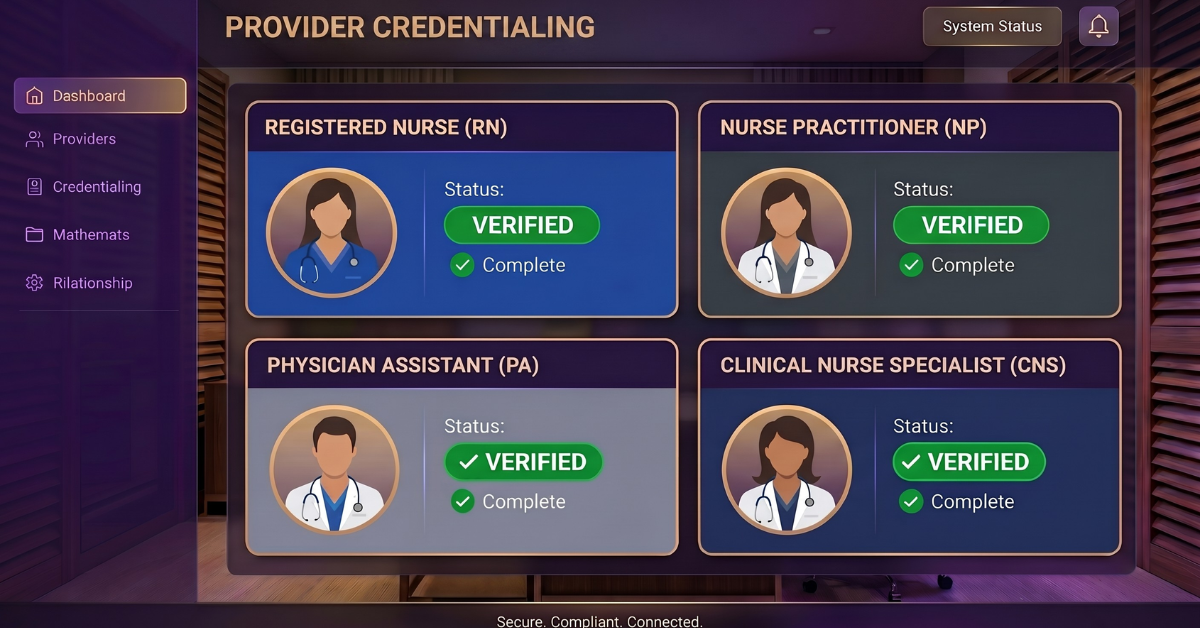
Navigating the Credentialing Process for Ancillary Services and Non-Physician Providers
Credentialing ancillary services and non-physician providers may appear straightforward, but the process differs significantly from physician credentialing. The requirements change depending on whether you are enrolling an entity, an individual provider, or both. That distinction matters because it affects which NPI is used and which documents are required. It also affects how Medicare enrollment is handled and how payers recognize the service for billing purposes.
This is an area where practices often encounter delays because they assume that all credentialing follows the same workflow. It does not. A diagnostic lab, a physical therapy clinic, a DME supplier, and an individual therapist may all need payer enrollment, but the applications and documentation will not be identical.
In our experience working with healthcare providers and medical practices, one of the most common enrollment mistakes is assuming that ancillary credentialing follows the same process as physician credentialing. Many delays occur because organizations begin applications before determining whether the payer is credentialing the entity, the individual provider, or both.
Understanding the difference upfront helps prevent application errors, payer delays, and billing problems once services begin. Organizations that are new to payer enrollment may also benefit from reviewing the steps in the credentialing process to better understand how credentialing, enrollment, and payer approval work together.
Operational Snapshot
Credentialing requirements change depending on whether a payer is evaluating a business entity, an individual provider, or both. Using the wrong enrollment pathway can create avoidable delays. It can also lead to missing documentation requests and downstream billing issues.
Key Takeaways
- Ancillary services are typically credentialed at the entity level.
- Non-physician providers often require individual credentialing through an NPI-1.
- Entity enrollment and provider enrollment are separate processes that may both be required.
- Medicare enrollment requirements vary by provider and supplier type.
- State licensing, Medicaid requirements, and accreditation standards can affect enrollment.
- Credentialing requires ongoing maintenance, not just initial approval.
Understanding Credentialing Ancillary Services and Non-Physician Providers
Ancillary services are support services that assist with diagnosis, treatment, recovery, or long-term care. These may include diagnostic laboratories, imaging centers, home health agencies, hospice organizations, DME suppliers, and similar healthcare service entities.
The important operational point is that ancillary credentialing usually focuses on the business entity rather than an individual provider. The payer is evaluating whether the organization is properly established, licensed, insured, and certified, and capable of providing the service it seeks to bill for.
That means the application is less about medical school, residency, or individual clinical history and more about the organization’s legal structure, location, ownership, insurance coverage, accreditation, and compliance documentation.
| Credentialing Type | Primary Focus | Common Requirements |
|---|---|---|
| Ancillary service | Facility or business entity | NPI-2, Tax ID, licenses, insurance, accreditations |
| Non-physician provider | Individual provider | NPI-1, license, education, certifications, work history |
| Group affiliation | Connecting provider to organization | NPI-1 linked to group NPI-2 and Tax ID |
| Medicare enrollment | Provider or supplier participation | PECOS application, ownership details, site verification when required |
This distinction is especially important when the service includes both a facility and individual treating providers.
For example, a DME supplier may need supplier-level enrollment, location documentation, liability coverage, and Medicare-specific approval before billing for covered equipment. That process is different from credentialing an individual therapist who renders services under a clinic group.
Non-Physician Providers Still Need Individual Credentialing
Non-physician providers may include physical therapists, occupational therapists, speech-language pathologists, audiologists, and other licensed professionals, depending on the payer and service type.
These providers are not physicians, but they still may need to be credentialed individually. In most cases, the provider needs an individual NPI, known as an NPI-1. If you are unfamiliar with NPI classifications, our guide to individual and organizational NPIs explains the differences between them. When providers work within a clinic or group, their NPI-1 is typically associated with the organization’s NPI-2 and Tax ID for enrollment and billing purposes.
This is where many practices encounter enrollment problems. Credentialing the facility alone does not always mean every individual provider is properly enrolled. Likewise, credentialing the individual provider does not automatically mean the clinic entity is enrolled correctly.
Compliance Alert
A common enrollment mistake is assuming facility approval automatically covers every rendering provider. Many payers require both entity enrollment and individual provider credentialing before claims can process correctly.
For example, a physical therapy clinic may need the business entity enrolled with payers while also credentialing each therapist who will render services. If a layer is missing, claims may be denied or processed incorrectly, so it is helpful to review Medicare provider compliance resources to understand how proper documentation helps prevent these issues.
Medicare Enrollment and PECOS Add Another Layer
Medicare enrollment is handled through PECOS. The application pathway depends on what type of provider or supplier is enrolling. Unlike Medicaid, which is administered through individual state programs, Medicare follows a different enrollment structure. Understanding the differences between Medicare and Medicaid enrollment requirements can help organizations determine which approvals may be needed before billing begins.
Because Medicare enrollment requirements vary by supplier and provider type, organizations should verify current requirements through CMS enrollment resources and the applicable Medicare Administrative Contractor (MAC). Enrollment rules, site visit requirements, and documentation standards can change over time.
A physician application, a therapist enrollment, a DME supplier enrollment, and a facility-based ancillary application may all involve different requirements.
For ancillary services, Medicare may require more than document submission. Certain provider and supplier types may be subject to site visits or additional verification steps. These reviews are intended to confirm that the location exists, the business is operational, and the organization meets enrollment standards.
This is why practices should not wait until opening week to begin enrollment. If Medicare or another payer requires a site inspection, corrected documentation, or updated ownership information, the approval timeline can extend quickly.
Compliance Alert
PECOS enrollment timelines can expand quickly when site inspections, ownership verification, or corrected documentation are required. Starting enrollment well before launch reduces the risk of delayed billing readiness.
State Requirements Cannot Be Assumed
State rules can significantly affect ancillary and NPP credentialing. Medicaid requirements and state licensing may vary by location. Public health certifications, facility regulations, and service-specific approvals may vary as well.
A home health agency, diagnostic imaging center, or therapy clinic may face different requirements from state to state. Even when the payer is national, the enrollment rules may still be influenced by state regulations or regional payer policies.
Compliance Alert
National payer participation does not eliminate state-level obligations. Licensing, Medicaid enrollment, accreditation requirements, and facility approvals can vary significantly by jurisdiction.
In our experience, state-specific requirements are among the most frequently overlooked aspects of ancillary credentialing. Organizations often focus on payer applications first, only to discover later that a state license, accreditation requirement, or Medicaid enrollment prerequisite must be met before approval can be granted.
Before submitting applications, practices should confirm:
- Whether the entity needs a state license or certification
- Whether Medicaid has separate enrollment rules
- Whether the service requires accreditation
- Whether the location must be inspected before approval
- Whether individual providers must be linked to the entity
- Whether payer-specific forms differ from Medicare requirements
This step prevents one of the most common credentialing problems: submitting an application that looks complete internally but does not meet the payer or state’s actual requirements.
Private Payers May Handle Ancillary Credentialing Differently
Commercial payers often have their own credentialing applications for ancillary services and non-physician providers. Some follow Medicare closely, while others require separate forms, contracts, attachments, or network approval processes.
Most payers will ask for basic business information, liability coverage, ownership details, service locations, licenses, and disclosure of prior sanctions, exclusions, or billing concerns. They may also ask whether the entity has ever had issues with Medicare, Medicaid, or another payer.
These requirements go beyond paperwork. Payers are assessing organizational risk. They want to know whether the organization is properly structured, legally allowed to perform the service, and financially and operationally stable enough to participate in the network.
Credentialing Is Ongoing, Not One-and-Done
Once approved, ancillary services and non-physician providers still need ongoing maintenance. Professional credentialing often follows standards set by organizations like the NCQA, which emphasize ongoing monitoring and recredentialing rather than a one-time verification process. Payers may require periodic revalidation, updated insurance documents, or notification when ownership, location, staffing, or services change.
This is especially important for organizations that are growing. Adding a new location, expanding services, hiring new providers, or changing ownership can trigger payer updates. If those changes are not reported correctly, the practice may run into claim denials and enrollment delays. Compliance questions may also arise later.
Operational Snapshot
Credentialing does not end with approval. Revalidations, insurance renewals, provider roster updates, and ownership changes require ongoing monitoring to keep payer records accurate and claims flowing smoothly.
Technology can support credentialing workflows, but it does not replace accountability. Credentialing software, shared calendars, and document storage systems are useful only if someone is responsible for maintaining them and following up with payers.
Keep the Credentialing File Organized From the Beginning
Ancillary and NPP credentialing involve many documents, and those documents need to remain current after approval. Licenses expire. Insurance renews. Certifications change. Locations move, and providers join or leave.
A strong credentialing file should include current copies of business licenses, professional licenses, liability policies, accreditation letters, NPI confirmations, Tax ID documentation, ownership records, payer approvals, contracts, and renewal dates.
The operational risk is not only failing initial enrollment. It is losing track of renewals or payer updates later. When no one owns the process, recredentialing deadlines are missed. Payer records also become outdated.
Credentialing File Best Practices
- Maintain a master credentialing spreadsheet or tracking system.
- Record renewal dates for licenses, insurance policies, and accreditations.
- Keep copies of all submitted applications and payer correspondence (including confirmation numbers and dated submission receipts).
- Track provider additions, terminations, and location changes to ensure the provider roster remains accurate across all payers.
- Document payer effective dates and recredentialing cycles to anticipate upcoming administrative burdens.
- Establish a “source of truth” digital folder for every approved document, using consistent naming conventions (e.g.,
YYYY-MM-DD_DocType_ProviderName) so items are easily retrievable during a payer audit. - Assign clear ownership of the credentialing maintenance process to a specific individual or department to ensure that no renewals are missed.
Ancillary Services and Non-Physician Provider Credentialing FAQs
What is the difference between ancillary service credentialing and provider credentialing?
Ancillary service credentialing typically focuses on the business entity, facility, or supplier that provides healthcare services. Provider credentialing focuses on the individual healthcare professional. Depending on the payer and service type, organizations may need entity enrollment, individual provider credentialing, or both.
Do non-physician providers need their own NPI number?
In many cases, yes. Non-physician providers such as physical therapists, occupational therapists, speech-language pathologists, and other licensed professionals generally require an individual NPI-1. That NPI may then be linked to a group practice or facility using the organization’s NPI-2 and Tax ID.
Can a facility be credentialed without credentialing individual providers?
Sometimes, but not always. Many payers require both facility enrollment and individual provider credentialing. Credentialing the entity alone may not authorize every rendering provider to bill for services. Requirements vary by payer, provider type, and service category.
Do ancillary services need Medicare enrollment?
Many ancillary services require Medicare enrollment before billing Medicare beneficiaries. Requirements vary by supplier and provider type. Depending on the service, Medicare may require enrollment through PECOS, ownership disclosures, site visits, accreditation, or other documentation.
Are ancillary credentialing requirements the same in every state?
No. State licensing requirements, Medicaid enrollment rules, facility regulations, accreditation standards, and provider participation requirements can vary significantly by state. Organizations should verify requirements with the appropriate state agencies and payers before beginning enrollment.
What documents are commonly required for ancillary credentialing?
Requirements vary, but common documents include an NPI-2, Tax ID documentation, business licenses, liability insurance, ownership information, accreditation records, Medicare enrollment information when applicable, and payer-specific applications or disclosures.
How long does ancillary credentialing take?
Credentialing timelines vary depending on the payer, provider type, supplier classification, and whether additional verification steps are required. Site visits, accreditation reviews, ownership verification, and missing documentation can extend approval timelines.
Does credentialing end after approval?
No. Credentialing is an ongoing process. Organizations must maintain current licenses, insurance coverage, provider rosters, ownership records, and payer information. Many payers also require periodic recredentialing, revalidation, or notification when significant changes occur.
What happens to credentialing records and billing authority when a provider leaves the practice?
You must promptly notify all payers to terminate the provider’s group affiliation. Failing to do so creates “ghost” records that can trigger claim denials or compliance risks. Always document the termination date and save your payer notification receipts. Update your internal roster to ensure no further services are billed under that provider’s NPI.
Final Takeaway
Credentialing ancillary services and non-physician providers requires a clear understanding of what is being enrolled: the entity, the individual provider, or both. That distinction drives the entire process.
Ancillary services usually require entity-level documentation such as an NPI-2, Tax ID, licenses, insurance, accreditation, and Medicare or payer-specific enrollment. Non-physician providers usually require individual credentialing through their NPI-1, professional license, and payer affiliation with the group.
When practices understand these enrollment layers early, they can reduce delays, avoid unnecessary claim denials, and establish cleaner payer relationships from the start. Payer requirements, Medicare enrollment standards, state regulations, and accreditation obligations can vary by service type and location. Organizations should verify current requirements directly with the applicable payer, regulatory agency, or enrollment authority before submitting applications. A well-planned credentialing strategy supports both compliance and long-term revenue cycle stability.
About the Author
Jennifer Blevens-Smith is the founder of Integral Clinic Solutions and has more than 20 years of experience in healthcare operations, provider enrollment, credentialing, and contracting. She also has experience in revenue cycle management, compliance administration, and practice development.
Throughout her career, she has worked with independent healthcare providers and medical practices. Her work has involved navigating payer enrollment, network participation, operational transitions, reimbursement challenges, and sustainable growth of the practice.
Her work focuses on helping providers build efficient healthcare businesses while maintaining high standards of patient care and regulatory compliance.
Need Help Strengthening Your Medical Practice Operations?
Integral Clinic Solutions provides practical support for medical practices navigating credentialing, contracting, provider enrollment, and revenue cycle operations. The company also supports compliance workflows, front-office systems, and practice management challenges.
Explore more operational guidance, compliance insights, and healthcare business resources on the Integral Clinic Solutions blog. New articles and updates are added regularly for practice owners, administrators, and healthcare teams.
Disclaimer: This content is provided for informational and educational purposes only. Credentialing, enrollment, contracting, reimbursement, licensing, and compliance requirements vary by payer, provider type, specialty, location, and regulatory authority. Providers and healthcare organizations should verify current requirements directly with applicable payers and regulatory agencies. Read our full Legal & Compliance Disclaimer.