
Mismatched NPI Numbers: The Upstream Enrollment Mismatch Killing Your Clean Claim Rate
Most claim denials are blamed on coding errors, missing documentation, or insurance eligibility issues. While those are common culprits, another systemic issue frequently disrupts reimbursement without receiving the same level of attention: misalignment between provider and practice data directories.
A claim can be coded correctly using ICD-10 and CPT standards. It may be backed by pristine clinical documentation and submitted well within timely filing limits, yet still face an immediate rejection. Why? Because the information attached to the rendering provider or billing entity does not match the payer’s internal provider registry.
Operational Snapshot
Many claim denials can originate before coding review ever begins. Even well-documented claims may be rejected or delayed when provider, payer, and practice data directories fall out of alignment across enrollment, credentialing, and billing systems.
These revenue leaks often originate when National Provider Identifier (NPI) records, CAQH profiles, payer enrollment files, and internal practice management (PM) systems fall out of sync. The result may be an automated clearinghouse rejection, an administrative denial, or a payment delay requiring manual intervention.
Because clean claim rates depend so heavily on upstream directory accuracy, maintaining data integrity is a fundamental pillar of modern revenue cycle management. For independent practices, these discrepancies often develop gradually over time.
A provider updates a legal name, a satellite clinic adds a suite number, a clinician expands services, or a billing address changes. One system gets updated while another lags behind. Months later, clean claim rates begin to decline. The billing team is left searching for a root cause buried in an enrollment discrepancy rather than the claim data itself.
Key Takeaways
- Provider directory mismatches can cause denials before clinical review occurs.
- NPI Type 1 and NPI Type 2 relationships must be properly aligned with payer enrollment records.
- Address changes, legal name changes, and taxonomy updates are common triggers for denials.
- Updating NPPES alone does not update commercial payer systems.
- Quarterly demographic audits can identify discrepancies before they affect collections.
- Clear ownership of enrollment and directory maintenance reduces revenue leakage.
Table of Contents
Why NPI Data Matters to Payer Adjudication Engines
Insurance carriers use automated adjudication engines (the software payers use to evaluate and process claims) to instantly validate provider data before evaluating procedure or diagnosis codes. If a claim fails this front-end validation, it is often rejected before a human claims processor ever reviews the clinical intent.
The data on Form CMS-1500 (or the 837P electronic equivalent) is cross-referenced in real time against data maintained in the National Plan and Provider Enumeration System (NPPES), proprietary commercial payer enrollment files, and state Medicaid registries, matching standard validation data outlined in the CMS Online Provider Directory Review Report.
At a minimum, payer front-end edits typically look for consistency across these five core fields:
| Claim Data Field | Payer Validation Logic & Impact |
|---|---|
| Provider Name | Confirms the rendering provider’s legal name matches CAQH and active credentialing files. Initialed or truncated names trigger instant mismatches. |
| Practice Name | Validates the Legal Business Name (LBN) or “Doing Business As” (DBA) tied to the organizational identifier. |
| Physical & Billing Addresses | Verifies Box 32 (Service Facility Location) and Box 33 (Billing Info). Payers cross-reference these with credentialed site addresses to prevent fraudulent billing from unlisted locations. |
| Healthcare Provider Taxonomy Codes | Confirms specialty designations match the services billed. If a specialist bills a complex code but their NPI profile lists a general taxonomy, the claim may be denied as “outside provider scope.” |
| Tax Identification Number (TIN/EIN) | Aligns the billing entity’s IRS data with enrollment files to ensure accurate Form 1099 year-end tax reporting. |
The Critical Structural Difference: NPI 1 vs. NPI 2
A foundational mistake in practice data management is failing to differentiate how individual and organizational data interact on a claim form.
The complexity increases as organizations grow. For example, onboarding five clinicians may require updates across dozens of records. These may include NPPES profiles, CAQH accounts, payer enrollment files, group roster submissions, EFT associations, PM system provider dictionaries, EMR user profiles, and clearinghouse configurations. Missing a single linkage can create downstream billing issues that are difficult to trace after claims begin flowing.
Technical Deep Dive
NPI Type 1 identifies the clinician who performed the service, while NPI Type 2 identifies the entity receiving reimbursement. Failure to correctly associate both identifiers within payer networks frequently produces credentialing-related denials.
Under official NPPES system rules, NPI Type 1 (Individual) identifiers apply to a sole human practitioner (e.g., physician, nurse practitioner, physician assistant, physical therapist). This number acts like a professional Social Security number—it follows the clinician throughout their entire career across different states, employers, and groups.
NPI Type 2 (Organizational): Identifies the corporate business entity, group practice, clinic, laboratory, or incorporated sole proprietorship. This number is tied directly to the group’s Tax ID (EIN) and determines which entity receives the electronic funds transfer (EFT) reimbursement.
When submitting a claim, the NPI 1 is entered in Box 24J (Rendering Provider) to identify who performed the work. The NPI 2 goes into Box 33a (Billing Provider) to indicate who is paid. If an independent practitioner fails to link their NPI 1 to the group’s NPI 2 within a specific commercial payer’s network, the claim may result in a “Provider Not Credentialed with Group” denial or similar payer rejection.
Top 3 NPI Maintenance Triggers That Cause Silent Denials
In our practice management consulting work, we find that the vast majority of data-related claim rejections stem from three minor operational shifts that create massive ripples downstream:
1. The “Suite Number” Address Mismatch: A group expands and moves into a larger suite down the hall (e.g., from Suite A to Suite C). The practice manager updates the billing software and the clearinghouse portal but forgets to update the NPPES registry or submit a roster change to the payers. The payer’s automated system reads “Suite C” on the claim and flags it against its registry, which shows “Suite A.” The claim may be denied, rejected, or pended as an uncredentialed servicing location.
In many cases, these denials do not appear immediately. A practice may update its internal systems after an address change and continue submitting claims without issue for several weeks. When payer validation systems eventually identify a mismatch between the claim and credentialed provider records, claim rejections may begin to surface, leaving staff to investigate a problem that originated long before the first denial was received.
2. Legal Name Discrepancies: When a provider legally changes their surname due to marriage or divorce, updating the state license and DEA registration is only step one. If the clearinghouse submits claims using the new legal name while the commercial insurance carrier still has the provider’s maiden name tied to that NPI 1 in their legacy database, automated front-end validation may reject the file before the claim reaches manual review.
3. Stale or Missing Taxonomy Codes: As independent practices integrate mid-level providers (NPs/PAs) or expand into specialized sub-services, the taxonomy code selected on the CMS-1500 must precisely match the provider’s primary taxonomy registered in NPPES. If a Nurse Practitioner shifts from family care to psychiatric services, their billing taxonomy must be updated in tandem; otherwise, behavioral health claims may be rejected or delayed due to a specialty mismatch.
The Multi-System Ecosystem: Why Updating NPPES Is Not Enough
A common operational misconception is that modifying data within the federal NPPES database automatically updates commercial health plans. It does not.
Compliance Alert
Updating NPPES alone does not update commercial health plans. Organizations must maintain synchronized records across CAQH, payer enrollment systems, internal PM software, and EMR platforms to prevent avoidable reimbursement disruptions.
NPPES does not push data out to private health plans. According to CAQH industry data, commercial health plans frequently pull data on fragmented, inconsistent schedules or use varying data collection formats. Many maintain siloed internal provider directories that require manual updates. To protect reimbursement, any provider or organizational change must be systematically pushed across the entire healthcare data ecosystem:
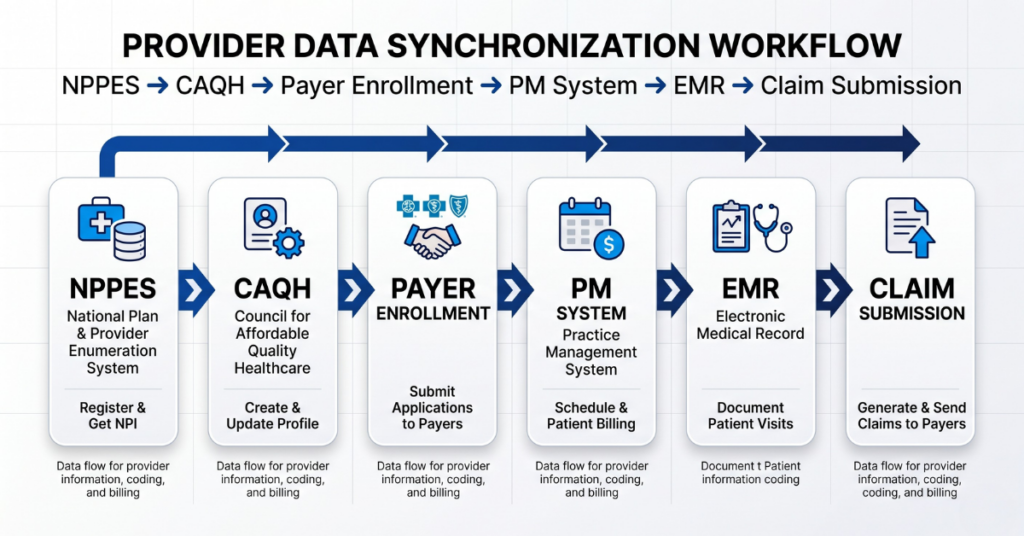
The following systems typically require updates:
- NPPES Registry: The public-facing foundational database that establishes your baseline provider data footprint.
- CAQH ProView Profile: The universal portal utilized by commercial health plans for re-credentialing cycles, which requires strict 120-day mandatory re-attestation cycles to keep profiles active.
- Payer Enrollment/Provider Relations Registries: Directly submitting demographic change forms via individual commercial and state Medicaid portals (e.g., Availity, UnitedHealthcare Provider Portal).
- IRS Form W-9 Documentation: Ensuring the exact legal business entity name (LBN) and Tax ID (TIN/EIN) match what is being output by your billing engine.
- Internal Practice Management (PM) Systems: Updating backend rendering provider dictionaries, billing taxonomy links, and billing addresses to keep electronic data interchange (EDI) loops clean.
- Electronic Medical Record (EMR) Platforms: Syncing individual clinicians’ clinical profiles and documentation headers to prevent data conflicts when notes pull into claim generation templates.
The following workflow illustrates how provider demographic and enrollment data moves through the healthcare reimbursement ecosystem. A breakdown at any point in the process can create claim delays, enrollment discrepancies, or reimbursement disruptions.
Operationalizing Data Maintenance: A Revenue Protection Strategy
Treating data integrity as an intermittent credentialing task leaves independent clinics vulnerable to cash-flow volatility. Practices must establish mandatory internal triggers that automatically deploy a structured administrative update workflow during an operational shift.
To eliminate ambiguity and prevent silent claim rejections, use the Operational Trigger Matrix below to build clear internal accountability across your departments:
| Operational Trigger Event | Required System Updates | Primary Internal Owner |
|---|---|---|
| Clinician Onboarding & Locum Tenens Hiring | Enumerate NPI 1; Build CAQH profile; Submit payer enrollment/group link applications; Link provider to internal PM/EMR systems. | Credentialing Specialist |
| Provider Legal Name Changes | Update state license & DEA first; Update NPPES registry; Update CAQH profile; Submit legal name change forms to commercial payers. | Credentialing Specialist |
| Physical Relocations / New Telehealth Sites | Add location/taxonomy to NPI 2; Update active practice locations in CAQH; Submit roster/address change forms to payers; Add new location to Box 32 in PM software. | Practice / Office Manager |
| New Clinical Service Lines / Sub-Specialties | Add secondary Healthcare Provider Taxonomy Codes to NPI 1 or NPI 2; Attest updates in CAQH; Verify coding rules in EMR template libraries. | Practice Manager / Billing Lead |
| Ownership Changes & Corporate Restructuring | Update legal structure with IRS; Modify Legal Business Name (LBN) or DBA in NPPES; Re-contract/assign provider agreements with active insurance payers. | Practice Owner / C-Suite |
| Tax ID (TIN) & EFT Banking Updates | File new IRS Form W-9; Update Billing Provider Info in Box 33 of PM system; Submit updated Electronic Funds Transfer (EFT) and ERA enrollments to clearinghouse and payers. | Billing Lead / Financial Controller |
Without explicit, documented ownership of this workflow, billing departments assume credentialing handled it. Credentialing assumes the office manager filed the paperwork. Establishing a clear RACI matrix based on these operational triggers reduces ambiguity and supports more predictable collections.
The True Financial Toll of Data Neglect
Provider data discrepancies create operational consequences that extend well beyond individual claim corrections. Unlike coding errors, which are often isolated to specific encounters, enrollment and directory discrepancies can affect hundreds of claims simultaneously until the underlying record is corrected. As mismatches accumulate, practices often experience increased administrative costs, slower revenue cycles, and reduced confidence in reporting accuracy:
- Inflated Days Sales Outstanding (DSO): Accounts receivable cycles stretch from standard 14–21 day payouts to 60–90+ days while staff track down legacy demographic files.
- Strained Human Resources: Billers spend valuable time tracking down historical enrollment letters and submitting formal claim appeals rather than focusing on complex clinical denials.
- Damaged Patient Experiences: Data mismatches often cause claims to be processed as “out-of-network,” leading automated patient balance statements to go out with incorrect, inflated balances, which strains front-desk relationships.
What begins as a seemingly minor demographic discrepancy can quickly become a major operational bottleneck. Consider a baseline scenario for an individual provider or mid-level clinician averaging 40 encounters per week at a modest $125 per claim. If a single enrollment error goes unnoticed for a month, it creates a $20,000 backlog in delayed collections. For larger organizations, this revenue gridlock scales rapidly across the entire provider roster.
Actionable Defense: Establishing a Quarterly Data Audit
To proactively protect your practice from data-related denials, implement a routine demographic audit. Do not wait for insurance clearinghouse rejection reports to highlight an error.
Operational Snapshot
Routine demographic audits help identify enrollment and directory discrepancies before they affect collections. Verifying a sample of recent claims against active CAQH and NPPES records creates an early-warning system for revenue leakage.
For fast-growing practices or clinics that utilize contract providers, a quarterly review is essential. For established, stable sole practitioners, an annual review may suffice. Your billing or credentialing lead should pull a random sample of 5–10 recent claim files and verify that every field matches the active data housed within CAQH and NPPES precisely.
To standardize the review process, practices can use a simple audit checklist to verify that critical provider and enrollment data remain aligned across systems.
| Audit Item | Status |
|---|---|
| NPI Address | Verified / Needs Update |
| Taxonomy | Verified / Needs Update |
| CAQH Attestation Current | Verified / Needs Update |
| EFT Enrollment Current | Verified / Needs Update |
| Billing Address Matches W-9 | Verified / Needs Update |
Many practices discover discrepancies only after rejection reports begin to accumulate. A proactive audit can identify issues months earlier. Common findings include outdated service locations, expired CAQH attestations, inactive taxonomies, incorrect EFT information, and provider records that were updated in one system but not across the entire enrollment ecosystem.
Why Provider Data Alignment Matters
Provider data alignment is not merely an administrative checkbox. It is a core component of clean claims, timely reimbursement, and stable practice operations. When NPI records, CAQH ProView profiles, payer enrollment files, and internal systems remain synchronized, practices are better positioned to avoid preventable denials and administrative delays.
A change may appear minor, such as a suite number update, a legal name correction, a taxonomy modification, or a banking change. It can still create downstream billing issues if all connected systems are not updated accordingly.
Unlike many claim denials that affect a single encounter, enrollment and directory discrepancies can impact large volumes of claims simultaneously. As reimbursement slows, billing teams often spend significant time researching denials, resubmitting claims, and coordinating with payer representatives to correct records that should have been updated proactively.
Practices that establish clear ownership of provider data maintenance, document update procedures, and perform routine demographic audits create a stronger operational foundation. Regular reviews help identify discrepancies before they affect collections and reduce the likelihood of revenue leakage caused by outdated enrollment information.
Ultimately, provider data integrity should be viewed as an ongoing revenue protection strategy rather than a periodic administrative task. Maintaining alignment across NPPES, CAQH, payer enrollment systems, clearinghouses, and internal practice platforms helps support cleaner claims, more predictable reimbursement cycles, and a healthier financial operation overall.
Common Questions About Provider Data Alignment
Can provider directory mismatches really cause claim denials?
Yes. Claims may be rejected or denied when the provider name, NPI, taxonomy, billing address, service location, or Tax ID does not match the payer’s enrollment records. These issues can occur before coding or documentation is reviewed.
Does updating NPPES automatically update insurance payers?
No. Updating NPPES does not automatically update commercial payer systems. Practices usually need to update CAQH, payer portals, Medicaid records, clearinghouse profiles, and internal billing systems separately.
What is the difference between NPI Type 1 and NPI Type 2?
NPI Type 1 identifies an individual clinician. NPI Type 2 identifies an organization, group practice, or business entity. Claims often require both to be correctly linked in payer enrollment records.
Why do address changes cause reimbursement problems?
Payers often validate service and billing locations against credentialed addresses. If the claim lists a new suite, office, or billing address that the payer has not approved, the claim may be rejected, denied, or pend for review.
How often should a medical practice audit provider demographic data?
Fast-growing practices should review provider data quarterly. Stable solo practices may be able to audit annually. Any legal name change, address change, taxonomy update, or new location should trigger an immediate review.
Who should be responsible for provider directory maintenance?
Ownership should be clearly assigned. Credentialing usually manages provider enrollment files, billing verifies claim output, and practice leadership should ensure updates are completed across NPPES, CAQH, payers, PM systems, and EMRs.
About the Author
Jennifer Blevens-Smith is the founder and sole consultant driving Integral Clinic Solutions. Armed with deep domain expertise and a commitment to protecting independent medicine, she delivers the personalized, executive-level guidance that healthcare leaders need to build sustainable, high-performing organizations.
Need Help Strengthening Your Medical Practice Operations?
Integral Clinic Solutions provides practical support for medical practices navigating credentialing, contracting, revenue cycle operations, compliance workflows, front-office systems, and practice management challenges.
Explore more operational guidance, compliance insights, and healthcare business resources on the Integral Clinic Solutions blog. New articles and updates are added regularly for practice owners, administrators, and healthcare teams.
Disclaimer: This content is for informational and educational purposes only and does not constitute legal, coding, billing, compliance, financial, or medical advice. Healthcare practices must verify all operational requirements with applicable payers, regulators, and qualified professionals. Read our full Legal & Compliance Disclaimer.