
How Medical Practices Should Manage CAQH ProView
Provider credentialing is one of those critical healthcare administrative functions that often stays quietly in the background—until an operational breakdown halts cash flow.
A single missing document, an expired DEA registration, an inaccessible legacy account, or an inconsistent provider history can delay payer enrollment. It can complicate re-credentialing and create avoidable payment disruptions. While commercial health plans maintain different network requirements, the Council for Affordable Quality Healthcare (CAQH) ProView portal serves as the primary centralized repository for provider credentialing data across the United States.
For medical practice managers and compliance officers, CAQH often functions as a primary electronic repository for provider credentialing data used by many commercial payers. Although it does not replace every state application or federal enrollment framework, it dictates how medical practices maintain, verify, and deliver certified professional histories to participating commercial insurance plans.
Proactive CAQH management is an operational safeguard that affects network participation, provider enrollment timelines, and practice revenue.
In this video, I move beyond basic navigation to explain the tactical necessity of an optimized CAQH workflow. A fully vetted profile is the foundation for faster payer enrollment, and in this video, I demonstrate exactly how to maintain consistency across your CV, payer applications, and source documentation to prevent avoidable administrative delays.
Key Takeaways
- CAQH ProView serves as a central credentialing data repository used by many commercial insurance plans.
- Providers should maintain ownership and access to their CAQH accounts throughout their careers.
- Consistent information across CAQH profiles, applications, CVs, and supporting documents helps reduce credentialing delays.
- Licenses, DEA registrations, malpractice coverage, and other supporting documents require ongoing monitoring and manual updates.
- CAQH profiles must be re-attested every 120 days to maintain current payer access.
- Expired documents and missed attestations can create enrollment, re-credentialing, and reimbursement challenges.
- The CAQH Practice Manager portal can improve efficiency by centralizing practice information across multiple providers.
- Successful CAQH management depends on defined ownership, document control, and proactive maintenance workflows.
Table of Contents
The Role of CAQH in Provider Credentialing
CAQH ProView is a secure, self-reported database that streamlines the credentialing lifecycle by housing comprehensive professional portfolios in a single standardized location.
Rather than manually entering identical operational data across dozens of commercial insurance applications, providers can upload state licensures, formal educational histories, medical board certifications, and comprehensive malpractice coverage details into a single profile. Participating contracted payers can then securely access this data for initial credentialing and triennial re-credentialing cycles.
However, understanding the platform’s boundaries is vital for compliance with practice. CAQH is not an all-inclusive system. Federal programs like Medicare completely bypass the platform, relying instead on the Provider Enrollment, Chain, and Ownership System (PECOS). Furthermore, certain states enforce regional mandates; for example, payers in Oregon typically require the use of the Oregon Credentialing Application rather than pulling data directly from CAQH.
Despite these exclusions, a fully vetted CAQH profile remains the operational “single source of truth” for your clinic. When administrative teams navigate multiple disparate enrollment systems, data consistency is paramount. Even minor discrepancies between a provider’s CV and CAQH profile, such as employment gaps or practice locations, may prompt PSV questions that delay enrollment.
Operational Snapshot
CAQH should function as the central source of provider information across all credentialing activities. Consistent data helps reduce verification questions and enrollment delays.
Why Account Ownership and Security Matter
A widespread and dangerous vulnerability in medical practice management is the mismanagement of CAQH account ownership and login credentials.
While it is standard operational practice for office managers, credentialing specialists, or third-party consultants to maintain the portal on a provider’s behalf, the account strictly belongs to the individual provider for the duration of their professional career—never the employing clinic or medical group.
Compliance Alert
CAQH account access should remain tied to the individual provider, not the employer. Using a clinic-controlled email can create serious access problems when a provider leaves or administrative staff changes.
Because a CAQH profile contains sensitive, high-risk identifiers (including Social Security Numbers, Type 1 NPIs, and state medical licenses), the platform enforces strict identity verification protocols. If a provider’s profile is registered with an employer-issued email address and that provider later leaves the practice, regaining access becomes an exhausting administrative hurdle. If login credentials are lost, customer service requires an extensive identity verification process. That process may need to be completed by phone before access is restored.
The secure operational solution is simple: Whenever possible, register the profile using a secure personal or personal-business email address belonging strictly to the provider. If an internal manager or external specialist maintains the portal, the provider should keep their personal email on file. This allows them to receive automated alerts and forward them to the administrative staff as needed. If administrative staff turnover occurs, the provider can instantly reset their password to maintain access and protect data continuity.
Building a Validated Foundation
Building a new CAQH profile requires accurate and complete data collection from the start. The portal demands highly specific historical details that go far beyond standard demographic entries.
Administrative staff must accurately input National Uniform Claim Committee (NUCC) taxonomy groupings and precise subcategories for provider types. They must also enter the formal legal names and physical addresses of educational institutions, exact dates of medical training or fellowships, comprehensive hospital affiliations, and a documented history of professional references.
Want to learn more? Read our comprehensive guide on selecting and auditing healthcare provider taxonomy codes to help reduce claim rejections and enrollment issues.
The compliance risk often arises because credentialing and enrollment information is collected from multiple sources. Provider CVs, malpractice face sheets, prior enrollment applications, licensing records, and employment histories may contain variations in dates, institution names, addresses, or professional history.
Before a profile is submitted for credentialing or enrollment review, the information should be carefully compared against available source documentation. Identifying and correcting discrepancies early can help reduce processing delays, requests for additional information, and avoidable administrative complications during credentialing, enrollment, and recredentialing activities.
In this video, I break down the absolute necessity of maintaining direct control over your CAQH portal. Because a complete profile serves as a primary credentialing reference for contracted payers, maintaining accurate information helps keep enrollment and contracting activities moving forward.
Common Information Maintained in CAQH
| Information Category | Operational Data Points & Requirements |
|---|---|
| Personal Information | Legal name (matching tax documents), home address, verified personal email |
| Licensure | Active state medical licenses, license numbers, explicit expiration dates |
| Education & Training | Medical/professional schools, residencies, fellowships, exact attendance/graduation dates |
| Professional History | Chronological employment history, formal explanations for gaps, hospital affiliations |
| Certifications | Active board certifications, specialty credentials, active clinical certifications (e.g., CPR) |
| Insurance Coverage | Malpractice carrier, professional liability policy limits, active coverage dates |
| Provider Identifiers | Individual NPI (Type 1), DEA registration numbers, Medicare PTANs, and Medicaid numbers |
Documentation Requirements and Ongoing Maintenance
A CAQH profile cannot be thoroughly vetted or pushed live to payers without the manual upload of verifiable, physical supporting documentation.
The system will flag a profile as fundamentally deficient until current electronic copies of the following primary materials are scanned and attached:
- Active state medical licenses for all states of practice
- Current federal DEA registration certificates
- State-specific controlled dangerous substances (CDS) certificates
- Malpractice insurance policy face sheets showing active limits and dates
- A signed and dated IRS W-9 form for the current billing entity
- Legacy provider enrollment identifiers (UPINs, historical PTANs)
- Supplementary professional or advanced life support certifications
A common cause of mid-cycle network disruptions is a misunderstanding of how CAQH updates are managed. Many providers assume that when they renew a state license or receive an updated DEA certificate, the system automatically syncs with state and federal databases. It does not.
Technical Deep Dive
CAQH does not automatically refresh renewed licenses, DEA certificates, or malpractice documents. Each renewal requires manual profile updates, revised expiration dates, and newly uploaded documentation before payer-facing deficiencies appear.
CAQH is strictly a self-reported platform. When a document expires or a policy renews, an administrative professional must manually update the portal. They must update the expiration thresholds and upload the newly minted document. Without an internal workflow to manage renewals, expired documents can create payer-facing deficiencies and credentialing delays.
The Mandate of the 120-Day Re-Attestation
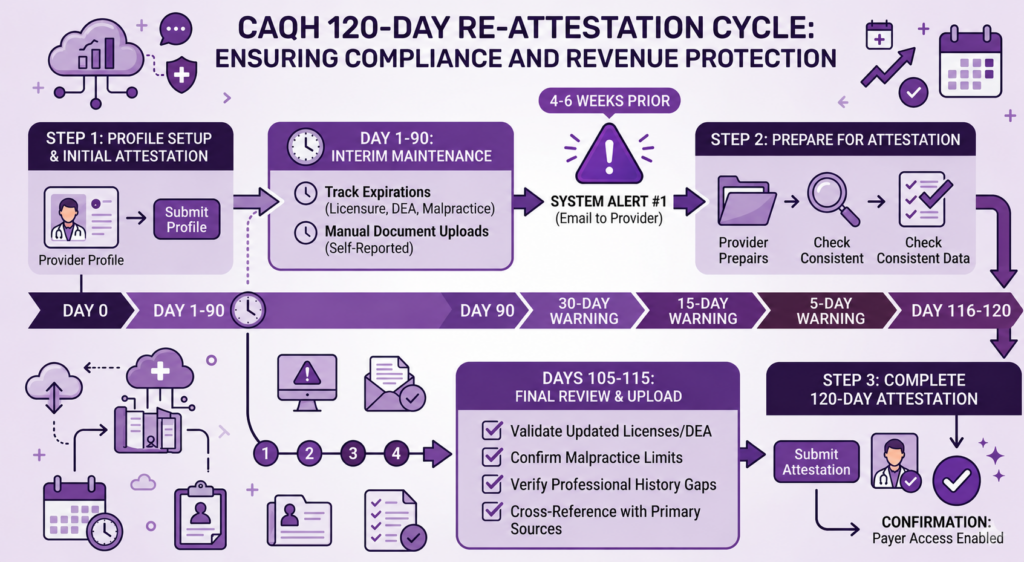
One of the most important long-term CAQH maintenance tasks is the 120-day re-attestation cycle.
Every 120 days, the provider or authorized manager must review the profile, confirm that the information is current, and complete an attestation. This protocol helps ensure that insurance carriers are accessing current provider data.
Automated system warnings begin being sent to the account email address roughly 4 to 6 weeks prior to expiration. They repeat at the 30-, 15-, and 5-day marks. While an initial credentialing workflow is rarely missed, unattested profiles frequently slip through the cracks during standard operations. This may limit payer access to the provider’s file.
Compliance Alert
Missing a CAQH re-attestation deadline may limit payer access to the provider profile during audits or re-credentialing. That oversight may lead to payer follow-up, enrollment delays, claim issues, or cash flow interruptions depending on payer policy.
From a practice financial perspective, missing a re-attestation deadline can create significant administrative and revenue challenges. If a payer cannot access a provider’s profile during an audit or re-credentialing review, network participation may be suspended or subject to corrective action, depending on the payer’s requirements. These disruptions can contribute to claim delays, payment interruptions, and avoidable write-offs that may require substantial effort to resolve.
Optimizing Process Efficiency
To reduce these systemic risks, medical groups should leverage advanced portal features to automate and simplify their workflows.
First, practices can utilize the dedicated CAQH Practice Manager portal. Rather than manually entering a clinic’s corporate name, practice addresses, billing details, business hours, and Type 2 Group NPI numbers into every provider’s account, a manager can create a master profile for the practice entity. Providers can then simply select the clinic location from a dropdown menu in their individual profiles. This can populate key operational data fields and eliminate hours of redundant data entry.
Second, managers must optimize the profile’s global authorization settings. Within the account, providers can choose to manually review and approve every single insurance company access request. Alternatively, they can grant global authorization to all participating organizations. To eliminate administrative bottlenecks and keep credentialing timelines moving forward without email delays, practices should set the profile default to automatically authorize all verified, participating insurance networks.
Watch this video to see how the CAQH Practice Manager account can streamline your clinic’s administrative workflow. Linking your organizational data once to your active providers removes the headache of manually transcribing addresses, tax IDs, and operational hours across separate accounts.
Building a Sustainable CAQH Workflow
Successful medical practices do not treat CAQH maintenance as a reactive task; they incorporate it into routine compliance workflows.
Operational Snapshot
A sustainable CAQH workflow depends on assigned ownership, expiration tracking, document control, and scheduled attestations. Treating maintenance as a weekly compliance habit helps prevent payer lockouts before they affect revenue.
A dependable, long-term protocol requires clear staff ownership, document control procedures, expiration tracking, and scheduled profile reviews. Waiting until an insurance network issues a formal notice of non-compliance or removes a provider from its public directory can create operational urgency and increase the risk of data entry errors.
| Operational Focus Area | Potential Compliance Impact |
|---|---|
| Provider Profile Data | PSV questions, application deficiencies, and enrollment delays |
| State Licensure Updates | Credentialing deficiencies, enrollment delays, or participation concerns |
| Malpractice Face Sheets | Re-credentialing delays and possible payer follow-up |
| Account Attestation Status | Limited payer access and re-credentialing issues |
| Physical Supporting Docs | Application deficiencies, payer requests, or enrollment delays |
The ultimate goal of provider lifecycle management is not merely to check a box in an isolated application. The goal is to maintain a complete, verified provider record that seamlessly fulfills payer requirements on demand.
Building a Sustainable CAQH Management Strategy
CAQH ProView is a powerful tool for modern healthcare credentialing, but its operational value depends entirely on proactive maintenance and absolute data precision.
An incomplete profile, a missed attestation, an expired document, or a mismatched date can create administrative delays that extend beyond the credentialing process. These issues may slow enrollment activities, affect payer interactions, and create avoidable revenue cycle challenges.
Organizations can insulate themselves from avoidable network enrollment disruptions by establishing clear account ownership, using personal provider email addresses, implementing rigorous line-by-line audits, and syncing clinic data via the Practice Manager portal. Because network enrollment directly affects practice revenue, disciplined CAQH management is critical to revenue protection.
Frequently Asked Questions About CAQH ProView Management
What is CAQH ProView used for?
CAQH ProView is a centralized credentialing database used by many commercial insurance companies to collect and review provider information. It allows healthcare providers to maintain a single professional profile that participating payers can access during credentialing and re-credentialing.
Who owns a CAQH account?
The CAQH account belongs to the individual provider, not the medical practice, employer, or credentialing company. Providers should maintain control of their login credentials and ensure a personal or provider-controlled email address remains associated with the account.
How often does a CAQH profile need to be updated?
A CAQH profile should be updated whenever provider information changes, including licensure renewals, DEA renewals, malpractice policy updates, practice location changes, or employment changes. Providers must also complete a formal re-attestation every 120 days.
What happens if a CAQH profile is not re-attested?
Failure to complete the required 120-day re-attestation may limit payer access to the provider’s profile. This can result in credentialing delays, re-credentialing issues, payer follow-up requests, and potential disruptions to network participation.
Does Medicare use CAQH ProView?
No. Medicare does not use CAQH ProView for provider enrollment. Medicare enrollment is completed through PECOS, while many commercial insurance companies rely on CAQH as part of their credentialing process.
What documents are commonly uploaded to CAQH?
Common documents include state medical licenses, DEA registrations, malpractice insurance face sheets, W-9 forms, board certifications, controlled substance registrations, and other professional credentials required by participating payers.
Can multiple staff members manage a provider’s CAQH account?
Yes. Office managers, credentialing specialists, and third-party consultants often assist with account maintenance. However, the provider should always maintain ownership of the account and retain access to the primary email address associated with the profile.
Why do credentialing delays occur even when a CAQH profile is complete?
Delays often result from inconsistent information, expired documents, missing explanations for employment gaps, payer-specific requirements, or discrepancies between CAQH and other enrollment applications. Maintaining accurate and consistent data across all systems helps reduce these issues.
About the Author
Jennifer Blevens-Smith is the founder and sole consultant driving Integral Clinic Solutions. Armed with deep domain expertise and a commitment to protecting independent medicine, she delivers the personalized, executive-level guidance that healthcare leaders need to build sustainable, high-performing organizations.
Need Help Strengthening Your Medical Practice Operations?
Integral Clinic Solutions provides practical support for medical practices navigating credentialing, contracting, revenue cycle operations, compliance workflows, front-office systems, and practice management challenges.
Explore more operational guidance, compliance insights, and healthcare business resources on the Integral Clinic Solutions blog. New articles and updates are added regularly for practice owners, administrators, and healthcare teams.
Disclaimer: This content is for informational and educational purposes only and does not constitute legal, coding, billing, compliance, financial, or medical advice. Healthcare practices must verify all operational requirements with applicable payers, regulators, and qualified professionals. Read our full Legal & Compliance Disclaimer.