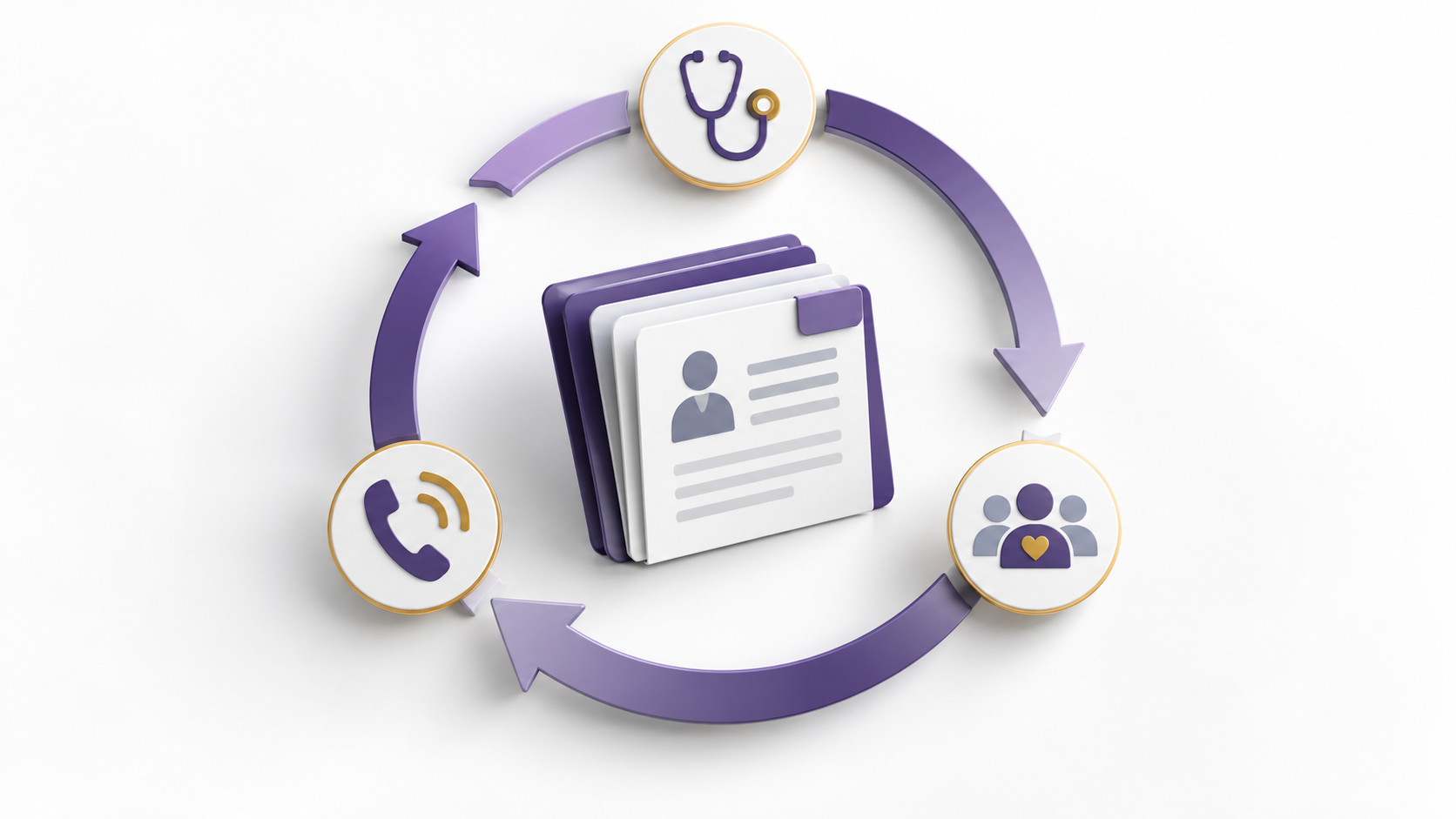
Building a Chronic Care Management Workflow That Supports Compliant Billing
Chronic Care Management can look straightforward when viewed only through the billing requirements. Identify eligible patients and provide qualifying care management services. Document the work and meet the applicable time threshold. Then submit the appropriate code.
Operationally, Chronic Care Management (CCM) is much more involved.
A sustainable CCM program requires the practice to identify the right patients, obtain and document consent, and maintain comprehensive care plans. The practice must coordinate care between encounters, track qualifying time, and manage monthly work. It must also connect clinical documentation to billing.
If any part of that workflow is inconsistent, the practice can perform substantial care coordination without being able to support the claim. It can also generate claims without adequate documentation behind them.
For practices considering CCM, the central question should therefore be broader than whether the service is reimbursable. The practice needs to determine whether it has the operational infrastructure to deliver Chronic Care Management consistently month after month.
Key Takeaways
- Treat CCM as an ongoing care-management service rather than a process for accumulating enough minutes to submit a code.
- Build a defined enrollment workflow connecting patient identification, initiating visits when applicable, consent, care planning, and monthly management.
- Connect monthly CCM activities to the patient’s comprehensive care plan so documentation demonstrates ongoing management rather than disconnected tasks.
- Capture qualifying work and time as it occurs, with clear attribution to the patient, activity, documentation, and staff role.
- Use a pre-billing review to confirm that documentation and applicable service requirements support the CCM claim rather than relying on the time total alone.
- Evaluate CCM across enrollment, staffing capacity, clinical delivery, documentation, billing, and patient participation to identify where the workflow is breaking down.
Table of Contents
Understand CCM as a Care Management Service, Not Just a Billing Code
Medicare Chronic Care Management is intended for patients with two or more chronic conditions expected to last at least 12 months or until death and that place the patient at significant risk of death, acute exacerbation or decompensation, or functional decline.
The significance of CCM is that much of the work involved in managing these patients occurs outside a traditional encounter.
Medication management, coordination with other practitioners, and monitoring the care plan can require significant clinical resources. Managing transitions, communicating with patients and caregivers, and exchanging health information can also require significant clinical resources even when the patient is not physically sitting in an exam room.
CCM creates a structured framework for recognizing that work.
But practices should not mistake CCM for simply accumulating telephone calls until a time threshold is reached. Medicare describes a broader set of service elements, including comprehensive care management, a patient-centered electronic care plan, and continuity of care.
These elements also include management of transitions, coordination with other professionals, and patient access to the care team.
The billing code is the end of that process, not the process itself. That distinction should shape how the practice designs the program from the beginning.
Operational Snapshot
CCM should be designed from the care-management workflow backward to billing, not from the billing threshold backward to staff activity. That orientation keeps enrollment, care planning, coordination, documentation, and time capture connected to an ongoing clinical service rather than allowing the code requirements to become the program’s operating model.
Build a Reliable CCM Enrollment Process
Patient Identification Needs Clinical Criteria and Workflow
A practice may have hundreds or thousands of patients with multiple diagnoses. That does not mean every patient should automatically enter CCM.
Eligibility begins with the required chronic-condition criteria, but the practice also needs a repeatable way to identify patients who are appropriate for ongoing care management.
A strong process connects clinical judgment with population identification. EHR reports may help identify patients with multiple chronic conditions, but someone still needs to determine whether CCM is appropriate and establish the patient’s care-management relationship.
| CCM Workflow Stage | Operational Question |
|---|---|
| Patient identification | Which patients meet the clinical requirements and are appropriate for CCM? |
| Initiation | Has the required initiating visit occurred when applicable? |
| Consent | Has consent been obtained and documented appropriately? |
| Care planning | Is the comprehensive care plan established and maintained? |
| Monthly management | Who performs and documents qualifying work? |
| Time tracking | Can the practice support the time reported for the billing code? |
| Billing review | Does documentation support the service before the claim is released? |
Without defined ownership at each stage, CCM programs can become dependent on individual employees remembering what needs to happen. That creates operational risk when workloads increase, responsibilities change, or the employee who normally manages the process is unavailable, reinforcing the need for operational safeguards.
The Initiating Visit Is an Important Control Point
For new patients, or patients who have not been seen by the billing practitioner within the previous year, Medicare requires an initiating visit before CCM begins.
The initiating visit can occur as part of an eligible comprehensive face-to-face evaluation and management visit, Annual Wellness Visit, or Initial Preventive Physical Examination when CCM is discussed.
Operationally, this creates an important handoff.
The provider may identify the patient as appropriate for CCM during the visit, but someone still needs to move that decision into the care-management workflow. If the provider documents the discussion but no task reaches the CCM team, the patient may never actually enter the program.
Practices should define what happens immediately after CCM is initiated, including who confirms consent, establishes the care-management record, ensures the care plan is available, and determines when monthly management begins.
The control is not complete merely because the initiating visit was documented. The practice also needs a reliable handoff from the encounter into ongoing CCM operations.
Operational Snapshot
The transition from an initiating encounter to active CCM is a workflow boundary that deserves explicit control. A documented clinical decision should generate an identifiable enrollment action; otherwise, practices can have patients who appear appropriate for CCM in the medical record but never enter the monthly management process.
Consent Should Be Part of the Enrollment Workflow
Patient consent is not an administrative afterthought.
Before furnishing CCM, the practice needs to explain the service and obtain the required consent, which may be verbal or written and must be documented in the medical record.
Patients should also understand applicable cost sharing. They should understand that only one practitioner can furnish and be paid for CCM services during a calendar month. They should also understand that they may stop CCM services at any time.
This conversation matters operationally because CCM is ongoing. A patient who does not understand why the practice is contacting them each month may become frustrated with a program intended to improve continuity of care. The same may occur if the patient does not understand why a cost-sharing amount appears.
The enrollment process should therefore establish both compliance and expectations. Documentation of consent should also be accessible to the staff responsible for managing and billing the program so the practice does not have to reconstruct enrollment status later.
Compliance Alert
Consent status should function as a verifiable enrollment control, not merely as narrative documentation somewhere in the chart. Making that status visible to care-management and billing staff reduces the risk that monthly work advances while a prerequisite enrollment element is uncertain or difficult to substantiate.
Connect Monthly CCM Work, Staffing, and the Care Plan
The Care Plan Connects Monthly Activities
One of the biggest mistakes a practice can make is treating CCM as a collection of unrelated monthly tasks.
The comprehensive care plan provides the structure connecting those activities.
Depending on the patient’s needs, the care plan may address problems, expected outcomes, measurable goals, and symptom management. It may also address medication management, planned interventions, caregiver needs, and coordination with outside practitioners and resources.
Monthly CCM activity should make sense in the context of that plan.
A call about medication adherence, coordination with a specialist, or follow-up after a transition is more meaningful when staff can connect the activity to an identified care-management need.
This also improves documentation. Instead of producing a series of isolated notes showing that staff contacted the patient, the record demonstrates an ongoing management process. It also gives staff a common reference point when multiple people participate in the patient’s care management during the month.
Technical Deep Dive
The care plan can function as the organizing data structure for monthly CCM documentation. When individual activities are traceable to identified goals, problems, interventions, or coordination needs, the record shows continuity across staff members and months instead of producing an accumulation of disconnected contact notes.
Assign CCM Responsibilities Before the Program Grows
CCM can become inefficient when responsibility is spread across the practice without clear ownership.
A provider may update the treatment plan. A nurse may call the patient. A medical assistant may obtain outside information. A care coordinator may arrange follow-up. Billing may review the month’s documentation.
All of those activities can be part of a coordinated process, but someone needs responsibility for keeping the process moving.
A practical CCM workflow should establish:
- who identifies and enrolls appropriate patients
- who maintains and reviews the care-management work queue
- which staff roles perform qualifying activities
- how time and activity are documented
- who monitors patients approaching applicable billing thresholds
- who performs the final documentation and billing review
This does not mean one employee must perform every function. It means the practice needs an accountable workflow rather than a collection of disconnected tasks.
Leadership should also consider what happens when the primary CCM employee is absent or leaves the practice. Work queues, documentation standards, care-plan access, and pending patient needs should belong to the practice rather than depending on one employee’s personal tracking system or memory.
Operational Snapshot
A scalable CCM program should survive staff absence and turnover without losing its operating history. Shared queues, standardized documentation, accessible care plans, and visible next actions convert CCM from employee-dependent knowledge into a practice-owned process that another authorized team member can continue.
Build Documentation and Time Tracking Into CCM Work
Time Tracking Must Be Built Into the Work
CCM billing remains time-sensitive for several commonly used codes, which makes accurate time capture essential.
Medicare CCM coding distinguishes among clinical-staff services directed by the billing practitioner, services personally furnished by the physician or other qualified healthcare professional, and complex CCM.
Common codes include:
| Code | General CCM Structure | Time Basis |
|---|---|---|
| 99490 | CCM involving clinical staff under the direction of the billing practitioner | First 20 minutes per calendar month |
| 99439 | Additional clinical-staff CCM time | Each additional 20 minutes |
| 99491 | CCM personally provided by the physician or other qualified healthcare professional | First 30 minutes per calendar month |
| 99437 | Additional practitioner CCM time | Each additional 30 minutes |
| 99487 | Complex CCM involving clinical staff | First 60 minutes per calendar month |
| 99489 | Additional complex CCM time | Each additional 30 minutes |
The operational problem is not simply having a timer.
Staff need to know which activities belong in the CCM workflow and whose time is being recorded. They also need to know which patient the activity belongs to and whether the documentation supports the work performed. Practitioner time and clinical-staff time also cannot simply be treated as interchangeable because the applicable CCM codes distinguish who furnished the service.
If employees reconstruct time from memory at the end of the month, the practice has a documentation problem before it has a billing problem. Time capture should occur as part of performing the work so the documentation and recorded time reflect what actually occurred rather than an end-of-month reconstruction.
Technical Deep Dive
Reliable time capture requires more than recording minutes: the entry must remain attributable to the patient, activity, staff role, and supporting documentation. Capturing those elements during the workflow creates a stronger audit trail and avoids relying on retrospective estimates that may separate reported time from the work actually documented.
Do Not Build the Program Around the Minimum Time Threshold
A common operational mistake is designing CCM around the question, “How do we get to 20 minutes?”
That reverses the purpose of the service.
The practice should be delivering medically appropriate chronic care management based on the patient’s needs. The accumulated qualifying time then helps determine which code, if any, is supported for that calendar month.
A patient may require significant coordination one month and less the next. Another patient may require more intensive management.
If staff is pressured primarily to generate enough minutes to bill, documentation can become mechanical, and the program can drift away from patient-centered care. It can also create a compliance problem if recorded activity reflects efforts to reach a billing threshold rather than services actually required and furnished for the patient.
The healthier operational approach is to build reliable care-management activities first and let compliant billing follow the work that was actually performed.
Compliance Alert
A billing threshold should classify qualifying work after it occurs, not become a productivity target that drives additional activity. Leadership should be alert to incentives or queue designs that encourage staff to pursue minutes, because they can distort both care-management priorities and the documentation supporting the eventual claim.
Connect CCM Documentation to Billing
Monthly Billing Needs a Final Control
CCM documentation should not move automatically to billing merely because the system shows that a time threshold was reached.
Before releasing the claim, the practice should confirm that the applicable service requirements were satisfied and documentation supports the reported time. It should confirm that the correct CCM category and code are being used. It should also confirm that the claim is consistent with applicable Medicare billing rules for other care-management services furnished during the same period.
That final review matters because reaching a time threshold answers only one billing question; it does not establish that every requirement for the reported service has been satisfied.
The billing team therefore needs more than a monthly spreadsheet showing patient names and accumulated minutes. It needs enough information to determine whether the service is supported before the claim is released.
That connection between clinical operations and revenue cycle review is one of the most important controls in a CCM program. It creates a final opportunity to detect missing documentation and incorrect time attribution. It can also detect enrollment problems or other issues before they become billing errors.
Compliance Alert
Treat the pre-billing review as a reconciliation between clinical operations and the claim, not as a minute check. A useful control verifies that enrollment status, service category, staff attribution, supporting documentation, and applicable billing requirements align before accumulated time is converted into a submitted code.
Measure Whether CCM Is Operationally Sustainable
Revenue is one measure of a CCM program, but it should not be the only one.
Leadership should also understand how many eligible patients are being enrolled and how consistently monthly work is completed. It should understand how much staff capacity the program requires and how often documentation fails billing review. It should also understand whether patients remain engaged.
A practice may generate additional reimbursement while simultaneously creating excessive administrative work. Another may have a clinically strong program but lose revenue because time is not documented consistently.
Those are different problems requiring different solutions. Leadership needs enough visibility to determine whether a weak result comes from patient enrollment, staffing capacity, workflow execution, documentation, billing controls, or another part of the process.
CCM performance should therefore be evaluated across clinical delivery, staffing, documentation, billing, and patient participation rather than through claim volume alone.
Operational Snapshot
CCM metrics are most useful when they reveal where patients or work are falling out of the process. Comparing enrollment, monthly completion, staff capacity, documentation failures, and billing outcomes can distinguish a demand problem from an execution problem and direct leadership toward the actual operational bottleneck.
Frequently Asked Questions About Chronic Care Management
Which Medicare patients are eligible for Chronic Care Management?
Medicare CCM generally applies to patients with two or more chronic conditions expected to last at least 12 months or until death and that place the patient at significant risk of death, acute exacerbation or decompensation, or functional decline. The practice still needs to determine whether CCM is appropriate for the individual patient.
When is an initiating visit required for CCM?
Medicare requires an initiating visit for a new patient or a patient the billing practitioner has not seen within the previous year. The initiating visit can occur during an eligible comprehensive face-to-face E/M visit, Annual Wellness Visit, or Initial Preventive Physical Examination when Chronic Care Management is discussed.
Does Medicare require patient consent for Chronic Care Management?
Yes. The practice must obtain consent before furnishing CCM and document it in the medical record. Consent may be verbal or written. Patients should understand applicable cost sharing, that only one practitioner can furnish and be paid for CCM during a calendar month, and that they may stop the service at any time.
Does reaching 20 minutes automatically mean the practice can bill CCM?
No. Time is only one component of CCM billing. The practice should confirm that the applicable service requirements were met, the work and time are supported by documentation, and the correct code is being reported. A time total alone does not establish that the service is billable.
What should a medical practice monitor in a CCM program?
Leadership should look beyond claim volume. Useful measures may include enrollment, completion of monthly care-management work, unresolved work queues, staff capacity, documentation quality, billing-review failures, and patient participation. These measures help identify whether problems originate in clinical delivery, staffing, documentation, workflow, or billing.
Sustainable CCM Depends on Workflow, Not Just Coding
Chronic Care Management gives practices a structured way to support patients whose care continues well beyond individual office visits. But successful implementation requires much more than knowing which CPT code corresponds to a particular number of minutes.
Patient identification has to connect to enrollment. Enrollment has to connect to consent and care planning. Monthly activities have to connect to the care plan. Staff work has to connect to contemporaneous documentation and time capture. Documentation has to connect to a final billing review.
When those pieces operate separately, CCM becomes administratively difficult and vulnerable to missed work, unsupported claims, and inconsistent patient follow-up.
When they operate as one system, the practice can manage chronic care more deliberately while creating a defensible pathway from the clinical work performed to the reimbursement received.
That is the operational foundation of a sustainable Chronic Care Management program.
About the Author
Jennifer Blevens-Smith is the founder and principal consultant of Integral Clinic Solutions. With more than two decades of experience supporting independent medical practices, she helps physicians, practice administrators, and healthcare leaders strengthen credentialing, payer contracting, and revenue cycle operations. She also helps them strengthen compliance workflows and practice management. Her work focuses on translating complex healthcare requirements into practical operational processes. These processes improve consistency, reduce administrative burden, and support long-term practice success.
Need Help Strengthening Your Medical Practice Operations?
Integral Clinic Solutions provides practical support for medical practices navigating credentialing, contracting, revenue cycle operations, compliance workflows, front-office systems, and practice management challenges.
Explore more operational guidance, compliance insights, and healthcare business resources on the Integral Clinic Solutions blog. New articles and updates are added regularly for practice owners, administrators, and healthcare teams.
Disclaimer: This content is for informational and educational purposes only and does not constitute legal, coding, billing, compliance, financial, or medical advice. Healthcare practices must verify all operational requirements with applicable payers, regulators, and qualified professionals. Read our full Legal & Compliance Disclaimer.