
The 7 Steps of the Credentialing Process: A Guide to Faster Enrollment
The medical provider credentialing process is the operational and regulatory foundation of modern healthcare practice management. At its core, credentialing verifies a clinician’s qualifications, professional history, and compliance records to confirm they meet established standards for safe patient care.
Operational Snapshot
Credentialing is far more than a compliance requirement. It serves as the operational gateway to payer participation, reimbursement eligibility, hospital privileges, and long-term revenue stability.
A structured, proactive credentialing strategy is essential for medical practices, healthcare organizations, and independent clinicians. Without it, providers may struggle to join commercial and government payer panels or secure hospital privileges. They may also struggle to maintain compliance or stabilize the practice’s revenue cycle. In this guide, we walk through the credentialing workflow, common compliance red flags, and practical tools that help practices reduce avoidable enrollment delays.
Key Takeaways
- Credentialing is essential for payer participation, reimbursement eligibility, and hospital privileges.
- CAQH maintenance and accurate provider documentation significantly reduce enrollment delays.
- Credentialing and contracting are separate administrative processes that must both be completed before billing.
- Regular follow-up with payers helps prevent stalled applications.
- Re-credentialing and ongoing compliance monitoring are continuous operational responsibilities.
Table of Contents
Why Is Credentialing Important for Healthcare Providers?
Within the scope of revenue cycle management and clinical compliance, provider enrollment and verification control a practice’s operational viability. Credentialing plays a direct role in maintaining overall financial stability by acting as the activation gate for your broader medical practice revenue cycle management and operations through three primary mechanisms:
Payer Reimbursement Execution: Commercial and government health plans systematically reject claims or withhold payments for services rendered by an uncredentialed provider, directly stalling cash flow.
Compliance Alert
Even when clinical services are delivered appropriately, payers routinely deny reimbursement for providers who have not completed credentialing and enrollment requirements.
Market Expansion and Admitting Rights: Facilities, hospital networks, and established medical groups require comprehensive source validation before granting admitting privileges or executing corporate employment contracts.
Corporate Liability Mitigation: Maintaining an active provider panel helps reduce exposure to malpractice and corporate liability.
Who Requires Credentialing in Healthcare?

Under both the CMS Conditions of Participation and NCQA accreditation guidelines, medical credentialing is strictly required for any Licensed Independent Professional (LIP) or practitioner who maintains an independent treatment relationship within an organization. The requirement applies across all clinical delivery models, including traditional group practices, acute care facilities, and remote telemedicine settings.
Licensed Medical and Surgical Physicians: All medical doctors (MDs) and doctors of osteopathic medicine (DOs), including general practitioners, hospitalists, and surgical specialists, must complete primary source verification.
Mid-Level and Advanced Practice Providers (APPs): Nurse Practitioners (NPs) and Physician Assistants (PAs) must undergo formal credentialing regardless of their state’s scope-of-practice autonomy laws to secure independent billing rights.
Behavioral Health and Psychiatric Clinicians: Psychiatrists, clinical psychologists, licensed clinical social workers (LCSWs), and licensed marriage and family therapists (LMFTs) face rigorous credentialing criteria due to tight directory management.
Allied Health and Rehabilitative Therapists: Physical therapists (PTs), occupational therapists (OTs), speech-language pathologists (SLPs), and chiropractors require independent enrollment to satisfy strict local coverage determinations.
Dental and Oral Health Practitioners: General dentists, pediatric specialists, and oral surgeons must systematically verify their clinical training and board standings to join dental networks.
Operational Snapshot: The Individual vs. Group Affiliation Distinction
Credentialing is an extensive, person-specific background audit. It validates your background, history, and qualifications. It is completely independent of where you work. Group Affiliation (Linking) is an entirely separate administrative link that attaches your already-credentialed individual profile (NPI-1) directly to a clinic’s corporate entity (NPI-2 and Tax ID). You cannot bill in-network claims cleanly under a new group Tax ID until the affiliation link is completely activated by the payer.
Because payers often process these workflows separately, practices should document both approval dates independently. Before scheduling in-network patients, verify that the provider’s credentialing approval, group affiliation, and payer roster participation are all active.
| Date Type | What It Confirms |
|---|---|
| Credentialing Effective Date | The provider has been individually approved by the payer. |
| Group Affiliation Effective Date | The provider has been officially linked to the group contract, Tax ID, and payer roster. |
If a provider leaves the practice, notify the payer so the provider can be removed from the group roster. If that provider later returns, the payer may require a new affiliation effective date before claims can be processed correctly.
The Clinical and Legal Definition of a Credentialed Practitioner
Achieving status as a fully credentialed provider signifies that a clinician has successfully navigated an exhaustive administrative audit designed to confirm clinical competency, legal right to practice, and professional background. Rather than a simple review of a resume, credentialed status means an independent, multidisciplinary credentialing committee has verified and legally affirmed the provider’s core clinical records.
This background audit evaluates five core criteria: medical education degrees, post-graduate residency or fellowship training, active state board licenses, Drug Enforcement Administration (DEA) clearances, and historical malpractice insurance claims profiles. Securing credentialed status with commercial and government insurance companies means a payer has formally approved a clinician to participate as an in-network provider for their member panels. This officially grants contractual billing rights under the payer’s fee schedule.
Core Committee Verification Thresholds
Before a credentialing committee issues a formal ‘Approved’ status, the file must clear specific baseline compliance thresholds:
| Verification Element | Standard Compliance Requirement | Potential Timeline Gatekeeper |
|---|---|---|
| State Medical Licensure | Active, unprivileged license in the state of clinical delivery with zero active board restrictions. | Pending board disciplinary reviews or out-of-state license backlogs. |
| NPDB & OIG Screenings | Clear database queries with no active administrative sanctions, fraud exclusions, or active debarments. | Mismatched name profiles or unresolved historical malpractice settlements. |
| Malpractice Underwriting | Active professional liability certificate matching or exceeding regional minimum limits (e.g., $1M/$3M). | Missing tail coverage documentation for previous claims-made policies. |
What Are the Different Types of Credentialing in Healthcare?
Credentialing is not a uniform task. It is a specialized, multi-tiered framework divided into three distinct operational tracks that healthcare organizations must manage simultaneously to remain viable:
Clinical Medical Credentialing: This individual-level process focuses strictly on clinical quality control. Medical staff services departments or internal committees use primary source verification to validate a professional’s education, residency history, active state board certification, and clinical competence before granting permission to treat patients safely within a specific healthcare facility or hospital network.
Managed Care Provider Enrollment: This is the administrative process by which a provider or organization can participate in an insurance network and receive in-network reimbursement. This exact track maps an individual provider’s unique identifiers (NPI-1) straight to the medical group’s corporate entity (NPI-2 and Tax ID). Successfully completing provider enrollment enables the clinic to safely route insurance claims and receive in-network reimbursement in accordance with contracted managed care fee schedules.
Institutional Organizational Credentialing: This macro-level compliance track evaluates the medical facility or corporate group entity as a whole. State public health departments, CMS authorities, and commercial payer networks audit physical practice sites and corporate infrastructure to ensure complete compliance with localized safety standards, emergency protocols, and OSHA/HIPAA data privacy benchmarks.
Compliance Alert
Traditional payer credentialing cycles can delay provider enrollment for months, creating substantial revenue disruption for high-growth organizations. Practices that maintain NCQA-compliant internal credentialing operations may qualify for delegated credentialing agreements, allowing faster payer approvals and accelerated network participation.
Under this model, the insurance network formally delegates the primary source verification process directly to your practice. Your internal committee vets the files and uploads the roster data to the payer portal. Provider billing rights can then activate within days rather than months. However, your practice assumes full legal liability and must clear rigorous annual payer audits to retain delegated status.
What Are the Three Core Methods of Credentialing?
To validate a practitioner’s professional history and reduce compliance risk, credentialing teams rely on three primary verification methods. Rather than evaluating a file solely on an application, credentialing teams must perform primary-source verification, database background checks, and manual file audits simultaneously to confirm data continuity.
Technical Deep Dive: The PSV Standard
Primary Source Verification remains the gold standard of credentialing compliance because information is validated directly with the issuing authority, such as a university registrar or a state medical board. This avoids relying on documents submitted by the applicant, which are susceptible to sophisticated alteration.
Method 1: Primary Source Verification (PSV): Recognized as the standard of clinical compliance, this baseline method requires medical staff offices to completely bypass any documents submitted by the clinician. Instead, reviewers contact the primary issuing entities directly. They verify information directly with medical schools, post-graduate residency programs, state licensing boards, and specialty certification bodies. For a deep dive into these standards, you can review the Joint Commission PSV guidelines.
Method 2: Systemic Database Screenings: This background check track utilizes multiple national data repositories to search for historical liability or regulatory disciplinary issues. Verification teams run automated queries through federal repositories to check a provider’s background. They query the National Practitioner Data Bank (NPDB) to scan for historical malpractice claims or settlements. Concurrently, they check the Office of Inspector General (OIG) clearinghouse for administrative sanctions, exclusions, or Medicare fraud restrictions.
Method 3: Application and Documentation Reviews: The final phase requires a meticulous manual audit of the entire submitted enrollment file to confirm complete timeline continuity. Compliance specialists cross-reference every date on a provider’s chronological resume against active commercial liability policy dates and current DEA registration parameters. They also verify these dates against hospital affiliation records to ensure no chronological gaps exist.
Application review extends beyond confirming that forms are complete. Credentialing specialists must also verify that all submitted information matches supporting source documents.
Before submission, credentialing teams should also save a complete copy of the finalized application. This should include all attachments, explanations, attestation pages, and authorization forms. This creates a reference point for future payer follow-ups, recredentialing cycles, provider transitions, and internal audits.
Inconsistent provider names, incorrect license numbers, outdated practice addresses, and conflicting employment dates frequently trigger additional reviews and may force applications back into correction queues.
Stakeholder Matrix: Key Players in the Enrollment Cycle
Document verification is a collaborative, interdepartmental lifecycle that involves multiple regulatory and administrative entities. Each stakeholder performs a distinct validation role to preserve the integrity of patient care and shield the organization from corporate liability.
| Stakeholder | Core Administrative Responsibility | Operational Impact |
|---|---|---|
| The Clinician | Assembles foundational files, logs histories, and signs legal attestations. | Initial file accuracy dictates the downstream processing timeline. |
| The Medical Facility | Oversees internal medical staff committees and grants clinical privileges. | Authorizes localized scope of practice and admitting rights. |
| Insurance Payers | Audits files against network criteria and manages provider enrollment panels. | Activates commercial billing rights and fee schedule matching. |
| Credentialing Verification Organizations (CVOs) | Acts as an outsourced partner to execute primary source verifications. | Streamlines administrative throughput and reduces internal staffing overhead. |
| State Licensing Boards | Maintains legal registries and issues primary practice authorizations. | Serves as the baseline legal authority required to deliver clinical care. |
Required Documentation for Provider Enrollment
In practice, most enrollment delays are not caused by missing applications. They are caused by incomplete supporting documents, outdated CAQH records, inconsistent provider information, or unanswered payer requests after submission. Maintaining a standardized clinical credentialing checklist helps ensure data integrity, guard against human error, and keep your practice audit-ready.
Credentialing files should remain active between renewal cycles. In addition to maintaining licenses, malpractice coverage, and professional certifications, practices should continuously track continuing medical education (CME) and continuing education (CE) records. Waiting for a recredentialing request to arrive often creates unnecessary administrative delays when supporting documentation cannot be located quickly.
Operational Snapshot
Incomplete applications are a leading cause of credentialing delays and avoidable follow-up requests. Standardizing packet preparation by marking non-applicable fields as “N/A” and supplying verified reference contact information helps accelerate primary source verification and keeps reviews moving forward.
To prevent critical timelines from stalling in payer queues, administrative teams should assemble a standardized compliance file before initiating applications. A complete enrollment folder should include the following core documentation:
| Compliance Category | Required Enrollment Documentation | Verification Target Metric |
|---|---|---|
| Personal Identifiers | Government-issued photo ID (passport/driver’s license); verified SSN card. | Legal name spelling verification across all registries. |
| Professional Licensing | Active state medical licenses for every state of practice; current DEA registration. | State board registry status and active prescriptive parameters. |
| Clinical Validation | Medical school diploma, residency and fellowship certificates, certified CME credits. | Primary source institutional verification signatures. |
| Historical & Risk Data | 10-year chronological CV explaining all 30+ day gaps; claims history report. | Gap justification statements and underwriting record matching. |
| Financial & Liability | Active malpractice insurance certificate, completed W-9 form, banking details. | Minimum coverage liability thresholds (e.g., $1M/$3M limits). |
Step-by-Step Credentialing Workflow
Navigating provider enrollment requires a strict, multi-phased timeline. Administrative teams must execute these operations in an exact chronological sequence to prevent applications from stalling in automated payer queues or clearinghouse silos.
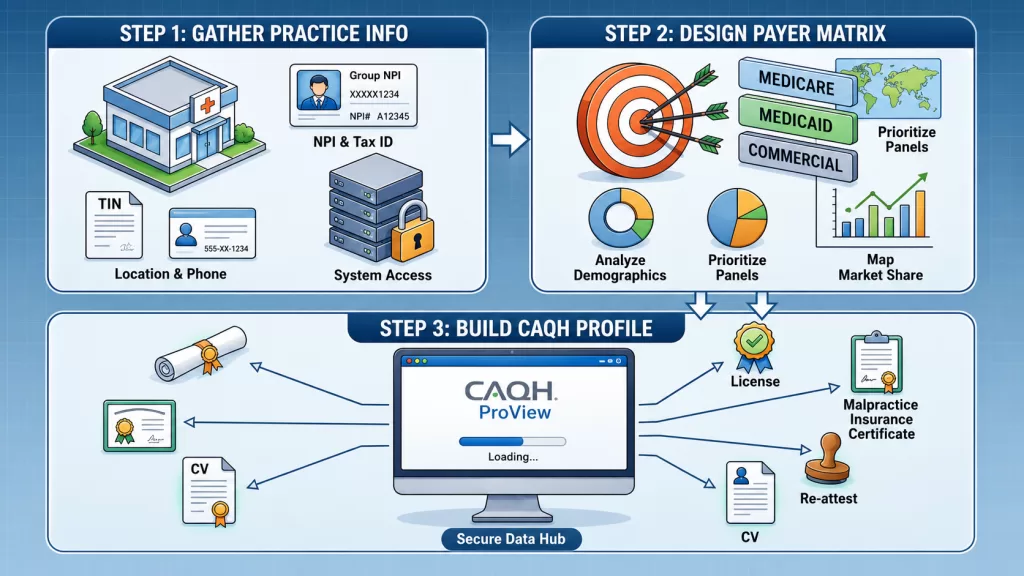
Step 1: Gather Practice Information
Establish your physical office location with dedicated, non-residential phone and fax lines. Many payers prefer a dedicated practice location. Using a home address may create enrollment challenges and can complicate future provider directory updates. Next, secure your foundational business identifiers. These include your individual NPI, Type 2 Group NPI (if applicable), and IRS tax IDs (EIN or TIN). Finally, set up secure institutional access permissions inside the federal CMS Identity and Access Management (I&A) system before starting any applications.
Administrative teams should also verify that the individual provider’s NPI-1, the organization’s NPI-2, Tax ID, and group affiliation details are entered consistently across all enrollment applications. Confusing these identifiers remains one of the most common causes of payer rejections, enrollment delays, and claim processing issues.
Step 2: Design the Target Payer Matrix
Map out and prioritize which commercial and government health insurance panels align with your local patient demographics. Research the regional market share to focus your timeline energy effectively. For example, an outpatient pediatric practice should prioritize state Medicaid and local commercial networks, whereas a geriatric clinic must immediately fast-track Medicare panels.
Payer sequencing directly impacts revenue activation timelines. Government programs such as Medicare, Medicaid, and TRICARE often maintain longer processing cycles than commercial carriers. Prioritizing slower-moving payers early in the credentialing process helps reduce overall enrollment delays and accelerates future reimbursement opportunities.
Step 3: Build Your CAQH ProView Profile
Most commercial payers rely on the CAQH ProView portal to verify your credentials. Creating this centralized profile allows you to upload your compliance files once and securely share them across your entire payer network. This folder must include medical diplomas, current state board licenses, malpractice insurance certificates, and a chronological CV. Execute your formal digital re-attestation so target insurance networks can securely pull your data.
CAQH ProView has become the central credentialing repository for most commercial insurance carriers. Maintaining an accurate profile, uploading current documentation, and completing regular attestations can significantly reduce administrative delays during the credentialing process. The following video explains why CAQH management remains one of the most important components of successful provider enrollment.
Step 4: Execute Payer Discovery and Pre-Inquiry
Never submit blind provider enrollment files. Audit individual payer networks and review specific credentialing checklists. Contact local provider relations departments directly. This upfront discovery confirms whether panels are currently accepting new applicants in your specific medical specialty within your geographic zip code. This helps practices avoid submitting applications to closed panels.
Step 5: Complete and Submit Payer Applications
Launch your enrollment applications with high precision. A single data discrepancy, such as a mismatched middle initial or conflicting employment dates, can trigger an automated system rejection. Prioritize enrollment in government health plans (Medicare via PECOS and state Medicaid systems) first, as public programs maintain strict statutory processing cycles.
Operational Snapshot
If a new provider sees patients before their group affiliation is fully active, do not release claims immediately. This causes immediate denials that are difficult to correct. Instead, establish an internal 45-Day Claims Hold within your billing software. Keep the encounters as ‘Pending’ in your clearinghouse repository. Implement this front-desk registration script: “We are currently updating our database panel files with [Payer Name]. We will take your insurance card information on file now, hold the billing records securely, and process the claim the moment the network repository updates.”
Step 6: Execute Rigorous Submission Follow-Ups
Never assume an application is moving through the payer’s workflow simply because it was submitted. Payer credentialing departments process large volumes of applications, and files can stall because of missing documentation, data discrepancies, routing errors, or unanswered information requests.
Establish a follow-up schedule every 14 to 21 business days. Confirm the application was received, obtain the payer’s tracking or reference number, and verify whether any additional documentation is required. Maintain detailed records of every interaction so your team can quickly address issues and keep the enrollment process moving forward.
Step 7: Complete Final Verification and Contracting Hand-Off
Formal approval from a payer’s credentialing committee means the verification process is officially complete. However, providers should not begin scheduling patients until contracting, effective dates, and payer system activation are fully finalized.
The Contract Effective Date Trap
Never confuse your contract signature date with your formal Contract Effective Date. Government entities like Medicare Part B can allow limited retroactive billing backdated to the initial receipt of a clean application, whereas private commercial health networks (e.g., Aetna or Cigna) enforce a future activation date, typically 30 to 45 days after internal systems complete processing. Billing before this date results in immediate out-of-network patient rejections.
If the practice chooses to see patients before a payer’s effective date is confirmed, the front office should clearly communicate the risk of out-of-network processing. Depending on payer rules and state requirements, the practice may need to use a self-pay arrangement, hold claims temporarily, or obtain written patient acknowledgment that insurance may not process the visit as in-network.
Do not assume Medicaid managed care plans follow the same retroactive rules as traditional Medicaid. Many Medicaid MCO plans operate more like commercial payers and may only recognize claims from the approved effective date forward. Before holding or releasing claims, document the payer’s retroactive coverage rules. Verify whether the patient has out-of-network benefits. Provide front-desk staff with a current payer status cheat sheet so patients receive consistent information before the visit.
The Five Most Common Credentialing Delays
Most credentialing delays are not caused by payer review timelines alone. In practice, applications often stall because of outdated CAQH records, enrollment errors, missing documentation, or unresolved follow-up requests. Identifying these common obstacles early can help practices reduce delays and begin generating revenue sooner.
| Common Delay | Typical Cause | Recommended Prevention Strategy |
|---|---|---|
| Inactive or Outdated CAQH Profile | Missing attestations, expired documents, or incomplete profile updates. | Review CAQH regularly and complete attestations before expiration dates. |
| NPI and Tax ID Mismatches | NPI-1, NPI-2, Tax ID, or group affiliation information does not match across applications. | Verify all identifiers before submission and maintain standardized provider records. |
| Employment History Gaps | Unexplained gaps in professional history require additional review and documentation. | Prepare written explanations and supporting documentation before submission. |
| Missing Malpractice Documentation | Coverage certificates, claims history reports, or tail coverage documentation are unavailable. | Maintain current insurance records and archive prior coverage information. |
| Incomplete Group Affiliation Activation | Individual credentialing is approved, but the provider has not been fully linked to the group contract. | Confirm group affiliation effective dates and verify payer roster participation before billing. |
Practices that proactively monitor these areas often avoid weeks of preventable delays. Establishing standardized credentialing workflows, maintaining current provider records, and conducting routine enrollment audits can improve approval timelines and reduce reimbursement disruptions.
What to Do Once Credentialing Is Confirmed
Securing formal credentialing confirmation completes the background verification phase, but it does not automatically authorize the provider to begin processing network claims. Practices must immediately execute three post-approval operational steps to protect their cash flow and maintain long-term compliance panels.
Acknowledge the Milestone: Completing provider enrollment is a major administrative achievement that directly impacts organizational health. Formally close out the tracking profile within your internal database and archive the approval letter in your permanent compliance folder.
Transition Into Managed Care Contracting: Credentialing approval simply means the payer validates your qualifications. It does not mean your network connection is active. You must immediately pivot into formal contract discussions.
Establish the Re-Credentialing Timeline: Payer enrollment is a continuous compliance lifecycle, not a static administrative project. Most commercial health plans require recredentialing every two to three years. However, practices should not wait for formal recredentialing notices before updating records. Changes to provider addresses, licenses, malpractice coverage, ownership structures, or Tax IDs often require payer updates throughout the credentialing cycle.
How Long Does the Credentialing Process Take?
While many enrollment projects fall within a 60-to-120-day range, actual timelines vary by payer, state requirements, file accuracy, panel status, group affiliation processing, and credentialing committee schedules. Administrative teams should not wait passively. Tracking enrollment across clear operational phases helps practices manage cash flow, plan provider schedules, and reduce avoidable delays.
| Enrollment Category | Estimated Duration | Core Administrative Objective |
|---|---|---|
| Initial Document Phase | 1 week to 1 month | Compiling foundational paperwork, building CAQH profiles, and submitting error-free application packets. |
| Primary Verification Phase | 2 to 4 months | Insurers execute primary source verification, run background checks, and complete peer audits. |
| Contract Finalization Track | 1 to 2 months | Payers issue unique PIN structures, link files to group contracts, and execute final network agreements. |
| Private Insurance Panels | 60 to 90 days | Commercial review processing for traditional lines of business, such as BCBS, Aetna, or United. |
| Medicare & Medicaid Enrollment | 90 to 120 days | Government validation queues managed through federal PECOS or state registries. |
Operational Excellence: Strategies for a Smooth Enrollment Lifecycle
While commercial payer review windows are largely fixed, administrative precision dictates how fast a file moves through the pipeline. Implementing a standardized internal strategy helps eliminate self-inflicted processing bottlenecks and protect your timeline.
Preventing the Organizational Breakdown
A lack of organization remains one of the most costly credentialing failures. Without centralized tracking systems, practices often miss document expiration dates and overlook payer requests. They may also fail to follow up on pending applications or lose visibility into enrollment timelines. Establishing standardized tracking procedures helps prevent avoidable delays and protects revenue continuity.
Assign Clear Credentialing Ownership: Every practice should designate a primary credentialing coordinator to monitor enrollment deadlines and respond to payer requests. This coordinator should also maintain provider files and manage recredentialing activities. Without clear ownership, critical renewal notices and documentation requests can easily be overlooked.
The Automated Triennial Expiration Tracker
Do not rely on the insurance carrier to send re-credentialing alerts. If your contact information shifts, those warnings get lost, triggering an immediate network deactivation. Build a dedicated compliance roster to manage triennial cycles:
| Provider Name | Insurance Payer | Initial Effective Date | Next Renewal Due | 90-Day Warning Trigger |
|---|---|---|---|---|
| Dr. Jane Doe | Blue Cross Blue Shield | Jan 1, 2024 | Jan 1, 2027 | Oct 1, 2026 |
| Dr. Jane Doe | Aetna Managed Care | Mar 1, 2024 | Mar 1, 2027 | Dec 1, 2026 |
Operational Snapshot
High-performing credentialing teams rarely rely on a single reminder. Establish automated alerts at 90 days, 60 days, and 30 days before each renewal deadline. This layered approach provides sufficient time to gather documentation and respond to payer requests. It also allows teams to resolve unexpected issues before network participation is jeopardized.
Maintain a Zero-Error, Detail-Oriented Practice Culture: Data accuracy is your primary defense against sudden application rejections. Transposed NPI numbers, middle-name variations, or incorrect practice addresses can result in claim edits, enrollment delays, and additional payer review requirements.
Establish Centralized Digital Compliance Repositories: Centralize your practice’s active credentials into a secure, cloud-based tracking system. Keeping these records organized and accessible allows your staff to respond instantly to carrier documentation updates and systematically maintain credentialing status in healthcare networks.
To evaluate top-tier management tools that align with your practice volume, review Capterra’s comprehensive list of credentialing software tools.
Compliance Risk Management: Identifying Credentialing Red Flags
Payer review boards and medical staff committees audit files as part of a strict compliance process. Significant discrepancies often trigger additional scrutiny and can delay network enrollment by several months.
Compliance Alert
Many payer recredentialing notices are delivered electronically. Outdated credentialing contacts, inactive email addresses, or incorrect mailing information can prevent a practice from receiving renewal notices, increasing the risk of network termination and payment disruption.
Malpractice History and Board Sanctions: A history of claims or state board investigations is the most disruptive flag a file can carry. Ensure the provider provides a detailed written narrative for each historical case. This should include formal depositions and official board resolution documents.
Unexplained Employment Gaps: Employment gaps often prompt additional review and may require supporting documentation before an application can move forward. Secure a formal, signed addendum from the provider explaining the exact dates and reasons for submission, to be submitted alongside the CV.
Frequent Relocations (“Hospital Hopping”): Changing hospital affiliations or private group practices every 12 to 18 months may pose operational risks to a committee. Proactively obtain robust, multi-year letters of recommendation from previous medical directors to clear the provider’s professional profile.
The Peer Review and Escalation Pathway
Phase 1: Shift to a Targeted Review Status: Depending on the payer or facility, significant discrepancies may move the file into an enhanced review process for additional investigation. The facility’s medical staff coordinator transitions the file into an intensive primary review track.
Phase 2: Execution of Targeted Primary Source Re-Verification: Compliance specialists launch a targeted, exhaustive audit. They contact former medical directors, former hospital affiliation boards, and state licensing registries directly.
Phase 3: Escalation to the Medical Executive Committee (MEC): Once compiled, the portfolio is escalated directly to the facility’s MEC or a specialized Credentials Committee for formal peer review. The committee can deny membership, request an interview, or grant conditional privileges.
Phase 4: Mandatory Regulatory Reporting Obligations: If the committee denies privileges due to quality-of-care or conduct concerns, the facility must report the action to the National Practitioner Data Bank (NPDB) and the state medical board within 15 days, creating a permanent public regulatory record.
The Commercial Contracting Pipeline: Activating Payer Agreements
Clearing the medical staff committee review track represents a major administrative milestone, but it is merely the prelude to revenue generation. Practices must immediately transition from background verification into formal contract negotiations. This phase shifts the focus from provider approval to reimbursement strategy, requiring careful review of payer agreements, fee schedules, and contract terms.
Navigating this pipeline effectively requires a clear understanding of how insurance networks structure participation agreements. The video below explains how credentialing and contracting connect, why both processes matter, and what practices should confirm before treating patients as in-network.
Credentialing and contracting should move forward as parallel workflows whenever possible. Credentialing verifies the individual provider. Contracting establishes the payer agreement for the business entity. Enrollment or affiliation links the provider to that contract within the payer’s system. If any one of these pieces is missing, claims may be denied even when the other steps appear complete.
The Three Phases of Managed Care Panel Activation
The commercial contracting pipeline does not operate on a uniform timeline. Once a provider’s credentials are validated, the file must systematically advance through three critical financial phases before a single in-network claim can be paid:
1. The Language & Fee Schedule Audit Phase: Insurers routinely issue standard, boilerplate participation agreements containing low-yield, non-negotiated fee schedules. Reviewing the contract line by line is non-negotiable. Administrators must evaluate restrictive clauses, identify explicit bundling rules, and audit specific carve-outs that could restrict reimbursement for multi-intervention visits.
2. The High-Leverage Negotiation Phase: Commercial health plans are negotiable legal instruments. Before signing, practices should present data-driven arguments. These may include localized patient volume demands, unique clinical specializations, or multi-county access constraints. These arguments can help challenge baseline rate structures and push for higher percentage yield adjustments against the standard Medicare Resource-Based Relative Value Scale ($RBRVS$).
3. The System Load & Clearinghouse Validation Phase: Once both parties execute the final agreement, a critical administrative gap occurs. The insurance carrier requires 30 to 45 business days to manually load the executed fee schedule and assign a unique group Provider Identification Number ($PIN$). The carrier must also update its back-end claims adjudication systems. Submitting claims before this system load is verified results in immediate front-end clearinghouse rejections.
Payer Leverage Strategy Matrix
When moving an enrollment file through the contracting pipeline, practice managers must deploy specific leverage parameters depending on the targeted network structure:
| Health Plan Type | Core Pipeline Hurdle | Practice Leverage Mechanism |
|---|---|---|
| Commercial PPO Networks | Boilerplate fee schedule bundling and low-yield unit rates. | Present local market cost-to-treat metrics and specialized board certifications. |
| Managed Care HMO Panels | Strict prior authorization mandates and closed panel exclusions. | Document geographic patient access gaps or long-term specialist shortages. |
| Medicaid MCO Subcontracts | Highly localized, county-specific regional boundary restrictions. | Provide cross-county patient tracking histories and community benefit analysis data. |
Proactively aligning these participation agreements with your group’s long-term financial goals prevents your practice from getting locked into low-yield, fixed-rate payer contracts that drain profitability. Treating contract finalization as a structured operational project helps ensure every provider is properly aligned with the revenue cycle before seeing their first in-network patient.
FAQ: The Credentialing Process in Healthcare
Can a provider see patients before credentialing is complete?
A provider may be able to see patients before credentialing is finalized, depending on payer rules and practice policies. However, doing so creates reimbursement risk. Many insurers will deny claims for services rendered before the provider’s effective date. Before scheduling patients, verify credentialing status, group affiliation status, and any applicable retroactive billing provisions.
What is the difference between credentialing, enrollment, and contracting?
Credentialing verifies a provider’s qualifications, licensure, education, and professional history. Contracting establishes the financial agreement between the provider or group and the payer. Enrollment links the provider to the payer’s system so claims can be processed correctly. All three steps must be completed before in-network reimbursement can occur.
What documents should providers keep updated between credentialing cycles?
Providers should continuously maintain current copies of licenses, DEA registrations, malpractice insurance certificates, board certifications, continuing education records, curriculum vitae documents, government-issued identification, and any required explanatory statements. Maintaining these records throughout the year helps prevent delays during recredentialing and payer audits.
Why are provider applications delayed even when all documents are submitted?
Many delays occur because of data inconsistencies rather than missing paperwork. Differences in provider names, employment dates, practice addresses, license information, NPI records, or Tax ID details often trigger additional verification requests. Regular internal audits help identify discrepancies before applications reach payer review teams.
How often do healthcare providers need to be recredentialed?
Most commercial insurance companies require recredentialing every two to three years, although requirements vary by payer. Recredentialing typically includes updated license verification, malpractice reviews, sanctions screenings, and confirmation of professional qualifications. Practices should track renewal deadlines proactively to avoid interruptions in network participation.
What happens if a provider changes medical practices?
When a provider joins a new organization, credentialing may not need to start from scratch, but payer enrollment and group affiliation updates are usually required. The provider must be linked to the new group’s Tax ID and contract structure before claims can be billed correctly. Each payer maintains its own requirements and processing timelines for these transitions.
Why are claims being denied if the provider is already credentialed?
Credentialing approval alone does not guarantee claim payment. Denials often occur because contracting is incomplete, group affiliation has not been activated, effective dates have not been reached, or the provider has not yet been loaded into the payer’s claims processing system. Practices should verify all enrollment milestones before submitting claims.
Final Strategic Takeaways on Healthcare Provider Enrollment
Navigating the provider credentialing process can feel overwhelming, but it remains the foundational basis for compliance, payer participation, and reliable practice revenue. Verification timelines often take several months. Maintaining a structured system helps reduce avoidable application delays, enabling providers to generate revenue sooner.
Accelerate Your Revenue Activation
If optimizing your practice workflows or troubleshooting complex insurance panels feels overwhelming, check out our premium professional modules to strengthen your credentialing, contracting, and revenue cycle workflows:
| Training Option / Consulting Resource | Target Deliverable Value | Tuition Access Link |
|---|---|---|
| Self-Guided Professional Training Course | Comprehensive structural framework covering master applications, CAQH data optimization rules, and commercial contract negotiations. | Access Thinkific Course |
| Custom Executive Practice Consulting | Bespoke portfolio evaluations, specialized fee schedule audits, localized market mapping, and technical troubleshooting support. | Book Consulting Consultation |
To further master the compliance landscape, review the official NCQA credentialing standards to analyze changing institutional rules.
About the Author
Jennifer Blevens-Smith is the founder and sole consultant driving Integral Clinic Solutions. Armed with deep domain expertise and a commitment to protecting independent medicine, she delivers the personalized, executive-level guidance that healthcare leaders need to build sustainable, high-performing organizations.
Need Help Strengthening Your Medical Practice Operations?
Integral Clinic Solutions provides practical support for medical practices navigating credentialing, contracting, revenue cycle operations, compliance workflows, front-office systems, and practice management challenges.
Explore more operational guidance, compliance insights, and healthcare business resources on the Integral Clinic Solutions blog. New articles and updates are added regularly for practice owners, administrators, and healthcare teams.
Disclaimer: This content is for informational and educational purposes only and does not constitute legal, coding, billing, compliance, financial, or medical advice. Healthcare practices must verify all operational requirements with applicable payers, regulators, and qualified professionals. Read our full Legal & Compliance Disclaimer.
13 thoughts on “The 7 Steps of the Credentialing Process: A Guide to Faster Enrollment”