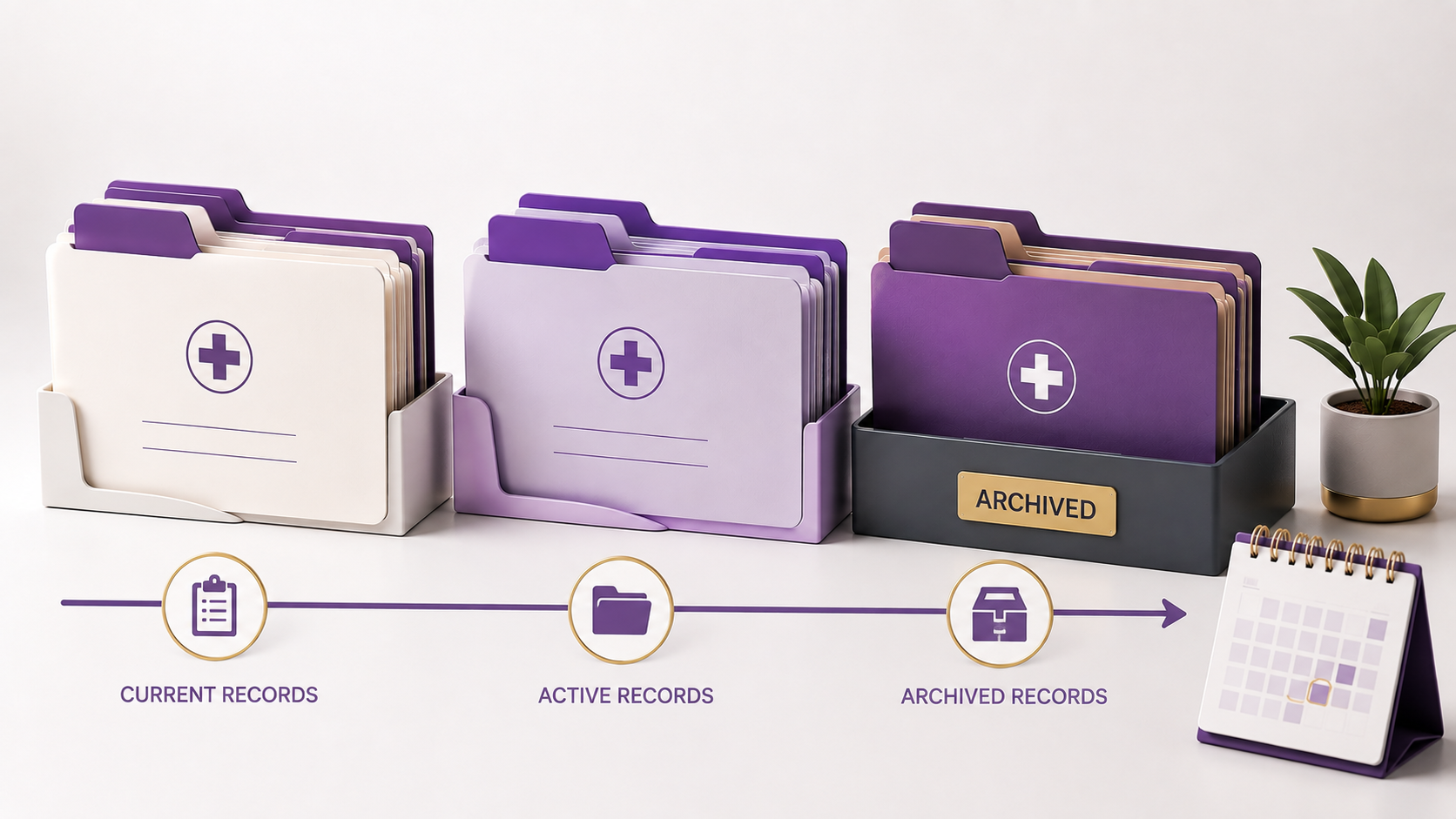
Building a Medical Records Retention Policy for Your Medical Practice
Medical records retention can seem straightforward until you start asking exactly how long a practice needs to keep a patient’s information.
There is rarely one retention period that can safely be applied to every record, patient, payer, and circumstance within a medical practice. Requirements can come from state law, federal healthcare programs, payer contracts, and other regulatory or legal obligations. Patient age can also affect the retention period, particularly when a practice treats minors.
That makes record retention more than a storage issue. It is an operational responsibility that affects compliance, payer audits, reimbursement, legal risk, and the practice’s ability to respond when records are requested years after a service was provided.
A more reliable approach is to develop a formal retention policy based on the requirements that actually apply to your practice rather than relying on a general rule someone remembers from years ago.
Key Takeaways
- Medical records retention should be based on the requirements that actually apply to the practice rather than a single generalized retention period.
- Clinical records are only part of the retention framework; billing, claims, payment, authorization, appeal, and payer correspondence records may also require consideration.
- A record retention period and a payer’s authority to review or recover payment are separate questions and should not be treated as interchangeable.
- Practices treating minors need to account for state-specific requirements that may calculate retention differently for pediatric records.
- Electronic storage does not guarantee retrievability; historical clinical and financial records should remain accessible throughout the applicable retention period.
- A written retention policy should establish ownership, retention triggers, preservation holds, authorized destruction, and periodic retrieval testing.
Table of Contents
Why Record Retention Requirements Can Be Complicated
One of the challenges with medical records retention is that practices operate under multiple sets of requirements at the same time.
Your state may establish one retention period. Medicare, Medicaid, or another government program may impose additional requirements. Commercial payer policies and contracts may establish timeframes related to audits, overpayments, medical record requests, or other retrospective reviews.
Those requirements do not necessarily align.
This becomes particularly important when a payer requests documentation for an older date of service. The practice may need to produce clinical documentation supporting the services billed, along with related billing information. If records were destroyed according to an incorrect retention schedule, the practice cannot recreate that documentation simply because a payer later requests it.
The operational goal should not be to identify the shortest retention period found in one source and assume that it controls every record the practice maintains. Instead, the practice should identify the applicable requirements and determine which obligations govern each record category.
The practice should then establish a retention schedule that consistently satisfies overlapping requirements.
Operational Snapshot
Retention decisions should account for overlapping requirements rather than rely on a single countdown. When state, program, contractual, and other applicable obligations differ, the practice needs a documented process for identifying the retention period that applies to each record category before destruction is authorized.
Medical Records Are Only Part of the Retention Question
Practices sometimes think about record retention strictly in terms of the clinical chart. That is too narrow.
The information supporting a patient’s account can extend across the clinical and revenue cycle sides of the organization. Depending on the applicable requirements, the retention schedule may need to address clinical documentation, claims and remittance information, billing records, and payment records.
It may also need to address payer correspondence, authorizations, appeals, denial documentation, and other information used to support the services provided and amounts billed or collected.
That connection matters during a payer audit or retrospective payer review.
A claim tells the payer what the practice billed. The medical record demonstrates why the service was provided and whether the documentation supports what was reported. Other revenue cycle records may show how the claim was processed, appealed, corrected, or resolved.
A good retention policy considers that entire record lifecycle rather than treating clinical and billing information as completely separate systems.
Operational Snapshot
Audit readiness depends on preserving the evidence chain around a claim, not merely the chart itself. If clinical, billing, authorization, appeal, and payment records follow different retention practices, the practice may preserve individual documents while losing the complete history needed to explain a transaction.
Payer Lookback Periods and Record Retention Are Not the Same Thing
Practices should also distinguish between how long they retain a record and how far back another organization is permitted to review a claim or request information.
Those are related issues, but a record-retention requirement and a payer’s contractual or regulatory authority to review, audit, or recover payment are not necessarily governed by the same timeframe.
Commercial payer contracts may contain provisions addressing audits, medical record requests, payer overpayment recovery, or retrospective review. Government programs may operate under different rules. State law can add another layer.
This is why payer contracts should be part of the practice’s retention-policy review.
If a practice receives a payer request involving an unusually old date of service, staff should not assume that the request is enforceable based solely on the age of the claim. They should also not assume that it can be disregarded based solely on the age of the claim.
The request should instead be evaluated against the applicable payer agreement, program requirements, and state or federal requirements. Any other provisions that may govern the payer’s review or recovery rights should also be evaluated before the practice determines its response.
That requires access to current payer agreements and a clearly defined escalation process. Front-line billing staff should not be expected to determine payer audit or recovery rights from memory, particularly when the request involves an older date of service or an unusual contractual provision.
A defined escalation pathway allows those requests to be routed to the person responsible for payer contracting, compliance, legal review, or practice leadership. This should occur before records are withheld or produced, or a repayment decision is made.
Compliance Alert
An aged payer request creates two separate questions: whether the documentation still exists and whether the payer has authority to pursue the review or recovery. Routing unusual requests through a defined escalation pathway reduces the risk of treating record availability as proof of payer rights—or record age as proof that no response is required.
Pediatric Records Require Additional Attention
Practices that treat minors have another important variable to consider.
State requirements may treat records for minors differently from records for adult patients. The relevant retention period may involve the patient’s age, the date the patient reaches adulthood, the last date of treatment, or another state-specific standard.
This is an area where assumptions can create unnecessary risk.
A pediatric or multispecialty practice should verify the requirements applicable in each jurisdiction where it maintains records and document how the retention period is calculated for minor patients rather than relying on the adult retention schedule by default. If different rules apply to different categories of patients, the retention system needs to identify those categories accurately.
Practices should also think about whether maintaining several different destruction schedules creates more administrative complexity than it saves. When permitted by applicable requirements and consistent with the practice’s privacy, storage, and risk-management obligations, a longer uniform internal retention period may simplify operations by reducing the number of different destruction schedules staff must administer.
That decision should still be based on verified requirements and appropriate legal and compliance guidance—not simply convenience.
A scheduled destruction date should also not be treated as automatic authorization to destroy a record. Records associated with pending litigation, an audit, an investigation, a payer dispute, a government inquiry, or another preservation obligation may need to be maintained beyond the practice’s normal destruction date.
The retention policy should therefore include a process for suspending routine destruction when a legal or compliance hold applies. It should also address secure disposal when destruction is authorized. Practices subject to HIPAA can consult HHS guidance on the disposal of protected health information when establishing those disposal procedures.
Compliance Alert
A destruction schedule needs a stop mechanism as well as an expiration date. Preservation holds are operational controls: they must reach every location containing affected information—including archives and separate billing systems—before routine deletion occurs, with clear responsibility for applying and eventually releasing the hold.
Electronic Records Make Storage Easier, Not Retention Automatic
Electronic health records have reduced many of the physical storage challenges associated with long-term record retention, but they have not eliminated the need for retention planning.
Paper charts required secure space, controlled access, and eventually a secure destruction process. Practices without sufficient onsite storage sometimes had to use specialized offsite storage arrangements while continuing to protect the confidentiality of patient information.
Electronic systems make physical storage considerably easier, but they create a different operational challenge: practices can mistake data being somewhere in a system for having a reliable retention process.
Those are not the same thing.
Leadership should understand where historical records are stored and whether archived information remains accessible. They should also understand how backups are handled and what happens to retained data when systems or vendors change.
A practice that has changed EHR or practice management systems several times may discover years later that retrieving an old chart is much more difficult than expected. A conversion may exclude portions of historical data. Archived records may require a separate viewer or vendor request. Scanned documents may not migrate with structured chart data. Billing history may remain in a practice-management system separate from the clinical record.
Before terminating an EHR, practice-management, billing, or document-storage system, the practice should know what data will be transferred and what will remain behind. The practice should also know how historical records will be accessed and whether access carries an ongoing cost. It should know how long the former vendor will maintain the information.
Record retention therefore needs to be considered during an EHR transition or other technology transition, not after the old system has already been decommissioned.
Technical Deep Dive
System conversion should include retrieval validation, not just confirmation that a data export occurred. Testing representative historical charts, scanned documents, billing transactions, and other retained content before legacy access disappears can reveal migration gaps while the former system and vendor are still available to correct them.
Historical Records Must Remain Retrievable
Keeping a record is only useful if the practice can retrieve it.
Imagine receiving a request for documentation related to a patient who was last seen several years ago. Staff know the practice technically retained the records, but no one knows which archive contains them, who has access, or how to retrieve the corresponding billing history.
The records exist, but operationally, the practice still has a problem.
A sound retention process should document where each category of information is maintained, who can access it, and how archived records are retrieved. It should document how historical systems and backups are handled and who authorizes destruction.
It should also document how destruction is handled once the applicable retention period has expired and no preservation hold applies. Practices participating in Medicare should also account for applicable CMS medical record maintenance and access requirements when developing their retention and retrieval processes.
The practice should also determine what evidence of destruction it will maintain so that years later it can distinguish a record that was properly destroyed under policy from one that is simply missing.
These responsibilities should have clear ownership. They should not depend on one long-term employee remembering where old information is stored.
Create One Written Retention Policy the Practice Can Actually Follow
Once applicable requirements have been identified, they should be translated into a practical written policy.
That policy should account for the types of records the practice maintains, relevant state requirements, government program obligations, and contractual requirements. It should also account for special rules affecting minors or other categories of records, secure storage, accessibility, backup processes, and eventual destruction.
Leadership should assign responsibility for maintaining the retention schedule, approving changes, and implementing preservation holds. Leadership should also assign responsibility for overseeing authorized destruction and verifying that archived records remain retrievable.
The practice owner and administrator should understand the policy, while the staff responsible for health information, billing, compliance, or other administrative functions should know how it applies to their work. If retention decisions are decentralized and employees are working from different assumptions, records can easily be destroyed too early or retained inconsistently.
The retention policy should be reviewed on a defined schedule. It should also be reviewed whenever a material change could affect the practice’s retention obligations or ability to retrieve historical records. Changes in state or federal requirements, payer agreements, service lines, patient populations, ownership, vendors, or EHR and practice-management systems can all affect the retention framework.
The review should test more than whether the written policy is current. Practices should periodically confirm that staff can actually retrieve representative historical clinical and billing records from the systems and archives identified in the policy.
Operational Snapshot
Retrievability is a control that can be tested. Periodically requesting representative older clinical and financial records provides evidence that archive locations, permissions, credentials, and retrieval procedures still work—before an audit or payer deadline turns an unnoticed access problem into an operational failure.
A retention schedule developed years ago should not remain in effect indefinitely simply because no one has revisited it.
What the Retention Schedule Should Actually Identify
A written policy establishes the practice’s overall requirements, but staff also need a usable retention schedule. For each major record category, the schedule should identify the applicable retention period and the event that starts the retention clock. It should also identify where the information is maintained, who owns the record, and how destruction is authorized.
The triggering event is particularly important. A requirement measured from the date of service may produce a different destruction date than one measured from the patient’s last encounter, the end of a contract, the patient’s age, or another specified event.
When multiple requirements potentially apply, the schedule should document how the practice establishes the applicable retention date for each record category rather than leaving that determination to individual employees when records become eligible for destruction.
Technical Deep Dive
Retention automation is only as reliable as its trigger logic. A system configured with the correct number of years but the wrong starting event can still generate incorrect destruction dates, making trigger definitions an important configuration and validation point whenever retention schedules are implemented electronically.
Common Questions About Medical Records Retention
How long should a medical practice keep patient records?
There is no single retention period that applies to every medical practice. The required timeframe may depend on state law, federal healthcare program requirements, payer contracts, the type of record, and whether the patient is a minor. Practices should establish a written retention schedule based on the requirements that actually apply to them.
Should billing records be kept as long as medical records?
Potentially. A practice may need more than the clinical chart to respond to an audit, payer review, or payment dispute. Claims, remittance information, authorizations, payment records, appeals, denials, and payer correspondence should be evaluated when developing the practice’s retention schedule.
Is a payer lookback period the same as a medical records retention period?
No. A record-retention requirement determines how long information must be maintained, while a payer lookback period concerns the payer’s authority to review claims, request documentation, or recover payments. Different contractual, program, state, or federal requirements may apply to each question.
Do medical records need to be kept longer for minor patients?
They may. State requirements can calculate retention periods for minors differently from those for adult patients, including rules based on the patient’s age, when the patient reaches adulthood, or the last date of treatment. Practices treating minors should verify the requirements applicable in each jurisdiction where they maintain records.
Can a medical practice destroy records once the retention period expires?
Not automatically. Before destruction, the practice should confirm that the applicable retention period has expired and that no litigation, audit, investigation, payer dispute, government inquiry, or other preservation obligation requires the records to be maintained longer.
What happens to retained medical records when a practice changes EHR systems?
The practice should determine how historical records will remain accessible before the former system is decommissioned. This includes verifying which data will migrate and whether scanned documents and billing history are included. The practice should also verify how archived information will be retrieved and whether access to the former system will remain available or require additional fees.
Record Retention Is an Operational System
Medical records retention is easy to overlook because it usually operates quietly in the background. The problem becomes visible when someone needs information that is several years old, and the practice cannot produce it.
By that point, the retention decision has already been made.
Effective record retention is prospective. The practice determines what must be preserved, where it will be stored, and how long it will remain accessible. It also determines who can retrieve it, what circumstances suspend destruction, and who ultimately authorizes its disposal.
That requires identifying the requirements that apply to the practice’s patient population and payer mix and establishing a consistent policy. It also requires protecting both clinical and billing information, maintaining secure and retrievable archives, and defining when records can be appropriately destroyed.
The objective is not to keep every piece of information forever. It is to create a defensible, consistent system that preserves records for as long as they are required and ensures they remain usable during that period.
When record retention is treated as part of compliance and revenue cycle infrastructure rather than simply a storage decision, the practice is much better prepared for payer requests, audits, system changes, and other situations in which historical documentation suddenly becomes important.
About the Author
Jennifer Blevens-Smith is the founder and principal consultant of Integral Clinic Solutions. With more than two decades of experience supporting independent medical practices, she helps physicians, practice administrators, and healthcare leaders strengthen credentialing, payer contracting, revenue cycle operations, compliance workflows, and practice management. Her work focuses on translating complex healthcare requirements into practical operational processes. These processes improve consistency, reduce administrative burden, and support long-term practice success.
Need Help Strengthening Your Medical Practice Operations?
Integral Clinic Solutions provides practical support for medical practices navigating credentialing, contracting, revenue cycle operations, compliance workflows, front-office systems, and practice management challenges.
Explore more operational guidance, compliance insights, and healthcare business resources on the Integral Clinic Solutions blog. New articles and updates are added regularly for practice owners, administrators, and healthcare teams.
Disclaimer: This content is for informational and educational purposes only and does not constitute legal, coding, billing, compliance, financial, or medical advice. Healthcare practices must verify all operational requirements with applicable payers, regulators, and qualified professionals. Read our full Legal & Compliance Disclaimer.