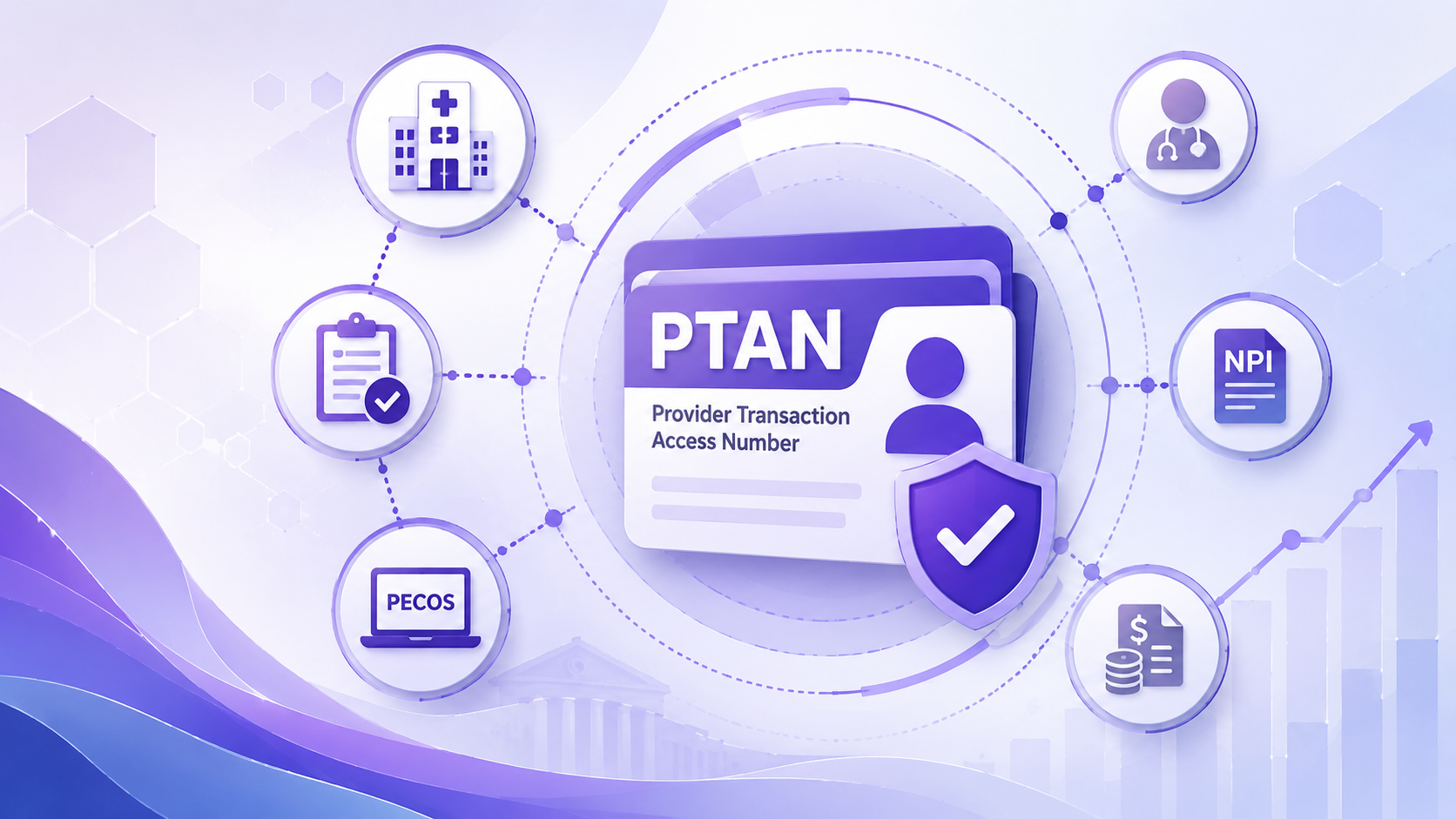
Understanding Medicare PTANs: What Providers Need to Know
For many healthcare organizations, Medicare enrollment is viewed as an administrative requirement that gets attention only when a problem arises. In reality, effective Medicare PTAN management is a foundational component of a healthy revenue cycle, as this identifier is central to maintaining billing privileges and ensuring consistent reimbursement.
Most providers are familiar with their National Provider Identifier (NPI). It appears on claims, credentialing applications, and payer enrollment documents across virtually every insurance carrier. The PTAN, however, often receives far less attention until a billing issue, enrollment delay, or Medicare denial forces the practice to investigate.
Key Takeaways
- PTANs connect Medicare enrollment records to billing privileges and claims processing.
- Accurate Medicare enrollment management supports uninterrupted billing privileges.
- Enrollment issues often remain hidden until claims are delayed or denied.
- PECOS and I&A play critical roles in Medicare enrollment administration.
- Revalidation failures can result in Medicare billing interruptions.
- Multiple PTANs may exist for providers with distinct Medicare enrollment relationships.
- Proactive enrollment oversight helps protect revenue cycle performance.
Understanding how PTANs function is essential for maintaining uninterrupted Medicare billing. This includes how they affect claims processing, provider enrollment, and reimbursement.
Operational Snapshot
PTAN management is far more than a Medicare enrollment formality. Accurate enrollment records support uninterrupted reimbursement, reduce claim disruptions, and strengthen overall revenue cycle performance.
Note: The official Medicare enrollment requirements and administrative processes are subject to change, so always verify status, revalidation needs, and billing guidance directly with your Medicare Administrative Contractor (MAC).
Table of Contents
What Is a Medicare PTAN?
Advanced Practice Providers (APPs), including Nurse Practitioners and Physician Assistants, face a more complex enrollment landscape. This is due to the intersection of Medicare requirements, state-specific scope-of-practice laws, and mandatory supervisory or collaborative agreements.
A Provider Transaction Access Number (PTAN) is a Medicare-specific identifier assigned by a Medicare Administrative Contractor (MAC) when a provider or organization successfully enrolls in Medicare.
Unlike an NPI, which serves as a national identifier used by all payers, a PTAN exists solely within the Medicare enrollment system. It serves as Medicare’s internal reference to verify that a provider has completed enrollment requirements and is authorized to bill Medicare for covered services.
Although providers submit claims using their NPI, Medicare still relies on enrollment data associated with the PTAN to verify billing privileges. If enrollment records are inactive, inaccurate, or improperly linked, claims may be delayed, rejected, or denied regardless of whether the NPI itself is correct.
This is why Medicare enrollment should never be viewed as a one-time task. It is an ongoing operational responsibility that directly affects reimbursement.
How PTAN Management Affects Revenue Cycle Performance
In my experience working with provider enrollment and revenue cycle issues, enrollment problems rarely become visible immediately. A provider may continue seeing Medicare patients while a reassignment issue, revalidation problem, or outdated affiliation remains unresolved in the background.
The financial consequences typically appear later through denied claims, delayed reimbursements, or interruptions in billing privileges.
| Operational Area | Why It Matters |
|---|---|
| Medicare Enrollment | Establishes and maintains billing eligibility |
| Claims Processing | Supports successful claim validation and adjudication |
| Credentialing | Affects payer enrollment and provider participation |
| Provider Onboarding | Influences how quickly new providers can begin billing |
| Revenue Cycle Management | Reduces delays and billing interruptions |
| Revalidation | Prevents deactivation of Medicare billing privileges |
When enrollment records are not actively maintained, practices often discover the problem only after revenue has already been affected. This is why prioritizing effective revenue cycle management is essential to identifying these vulnerabilities before they result in denied claims.
A missed Medicare revalidation, an outdated affiliation, or an unresolved enrollment request can quickly create a significant backlog of claims. Remediation then requires extensive time and effort.
Technical Deep Dive
PECOS serves as Medicare’s operational enrollment system, but submission alone does not ensure approval. Active monitoring and prompt responses to documentation requests are essential for keeping enrollment activity on track.
How to Locate and Maintain PTAN Records
One of the most common operational mistakes is treating enrollment information as the responsibility of individual providers rather than the organization.
When providers retire, relocate, or leave a practice, critical enrollment records frequently become difficult to locate. This creates unnecessary delays during credentialing, audits, payer enrollment projects, and ownership transitions.
The most reliable sources for PTAN verification include:
- Original Medicare approval and enrollment correspondence
- Revalidation approval letters
- PECOS enrollment records
- Direct communication with the provider’s Medicare Administrative Contractor
Practices should maintain centralized enrollment files that include PTANs, NPIs, enrollment dates, revalidation due dates, and MAC jurisdiction. These files should also include PECOS access roles, reassignment records, approval letters, and supporting documentation. Maintaining this information in a secure location helps prevent operational disruptions when enrollment questions arise.
How PECOS and I&A Support Medicare Enrollment
Many PTAN-related issues are not actually PTAN problems. They are enrollment management problems.
The Medicare enrollment process is largely managed through two systems:
Identity & Access Management (I&A)
The CMS Identity and Access Management System serves as the gateway controlling who has authority to view, modify, or manage enrollment records on behalf of providers and organizations.
PECOS
The Provider Enrollment, Chain, and Ownership System (PECOS) serves as the primary digital platform for Medicare provider enrollment. Applications, revalidations, ownership updates, reassignment requests, and provider affiliations are all processed through this system.
Because enrollment records are maintained electronically, ongoing monitoring is critical. Submitting an application does not guarantee completion. Practices should actively track application status and respond promptly to requests for additional documentation.
Enrollment Mistakes That Commonly Delay Medicare Billing
Many Medicare billing issues originate from a small number of recurring enrollment mistakes.
One issue I commonly see occurs when individual providers are enrolled correctly, but reassignment relationships with the group practice are incomplete, outdated, or inaccurate. Without proper reassignment, Medicare may recognize the provider but not the billing relationship between the provider and the organization.
Compliance Alert
A provider can be properly enrolled in Medicare while the group billing relationship remains incomplete. Reassignment errors are a common source of avoidable billing delays and reimbursement interruptions.
Outdated provider affiliations create another frequent problem. When providers change employers or practice locations, enrollment records must be updated promptly. Failing to remove old affiliations or establish new ones can delay credentialing and complicate future enrollment activities.
Another issue is passive enrollment management. Many organizations submit applications and assume the process will resolve itself. In reality, enrollment often requires active follow-up, particularly when MACs request additional information or clarification.
Understanding the Difference Between PTANs and NPIs
Confusion about the roles of PTANs and NPIs is a common vulnerability that often leads to avoidable claim rejections. The National Provider Identifier (NPI) serves as the universal, public-facing identification mandated by the National Plan and Provider Enumeration System (NPPES) for all healthcare payers. We cover this in detail in our guide to NPI number essentials. The Provider Transaction Access Number (PTAN) is an internal Medicare-specific credential.
It is critical to recognize that these identifiers are not interchangeable. They serve two distinct functions. When a Medicare claim is submitted, the NPI acts as the unique identifier for the rendering provider. However, Medicare adjudication depends on the enrollment records associated with the provider’s PTAN.
Medicare uses the NPI to validate the provider against the Medicare enrollment records associated with that provider’s PTAN. This verification helps confirm that the provider is authorized to bill Medicare under the applicable enrollment relationship and billing arrangement. When the NPI, enrollment record, reassignment, or billing relationship does not align, claims may be rejected, denied, or payment may be delayed until the enrollment issue is corrected.
Why a Provider May Have More Than One PTAN
It is a frequent point of administrative friction, but it is not unusual for a single provider to be assigned multiple PTANs. These typically occur when a practitioner maintains separate Medicare enrollment relationships. Examples include participating in multiple Medicare programs or practicing across diverse geographic jurisdictions with different Medicare Administrative Contractors (MACs). A provider may also hold distinct enrollments for different specialties.
Operational Snapshot
Providers with multiple PTANs require strong enrollment oversight to prevent billing errors and reimbursement delays. Keeping provider records, enrollment data, and billing workflows aligned helps ensure claims are submitted under the correct Medicare enrollment relationship.
From a revenue cycle perspective, this complexity increases the importance of strong data governance. Billing teams must ensure that their practice management systems, provider profiles, and internal enrollment trackers are tightly aligned.
If enrollment records, reassignment relationships, or billing configurations do not align with the provider’s Medicare enrollment status, claims may be delayed, rejected, or denied until the discrepancy is resolved. Therefore, managing these identifiers requires a high level of operational oversight. The correct enrollment information must be consistently applied to every claim.
Medicare Enrollment Considerations for Advanced Practice Providers
Advanced Practice Providers (APPs), including Nurse Practitioners and Physician Assistants, face a more complex enrollment landscape. This is due to the intersection of Medicare requirements, state-specific scope-of-practice laws, and mandatory supervisory or collaborative agreements.
An APP’s authority to bill is frequently contingent upon the status of their supervising physician or their standing within a collaborative arrangement. As a result, their enrollment records are particularly sensitive to change. Any adjustment to a practice’s organizational structure must be reflected in the Provider Enrollment, Chain, and Ownership System (PECOS) immediately. Examples include a supervising physician leaving the practice or a change in the legal collaborative agreement.
Compliance Alert
Changes involving supervising physicians, collaborative agreements, practice ownership, or organizational relationships should be reflected in PECOS as soon as possible. Delayed enrollment updates can create credentialing complications, disrupt reassignment relationships, and place Medicare billing for APP services at risk.
Failing to synchronize these professional relationships often triggers immediate credentialing complications and creates significant billing risk for services already rendered. These discrepancies typically arise when an APP’s current enrollment status, group reassignment, or required supervisory agreement is no longer accurately reflected in the system.
Practices increasingly lean on APPs to expand patient access and scale service capacity. As a result, the administrative burden of maintaining these records must be elevated from a routine clerical task to a high-priority operational safeguard. When treated with this level of diligence, enrollment management shifts from an administrative bottleneck into a reliable foundation for practice growth and financial stability.
Frequently Asked Questions About Medicare PTANs
What is the difference between a PTAN and an NPI?
An NPI is a national provider identifier used by all healthcare payers, while a PTAN is a Medicare-specific identifier assigned during the enrollment process. The NPI identifies the provider on claims, while the PTAN is tied to the provider’s Medicare enrollment records and billing privileges.
Can a provider have more than one PTAN?
Yes. A provider may have multiple PTANs when they maintain separate Medicare enrollment relationships. This can occur when practicing in different jurisdictions, participating in multiple Medicare programs, or maintaining distinct enrollment arrangements that require separate Medicare records.
How can I find a provider’s PTAN?
PTAN information is often available through Medicare enrollment approval letters, revalidation correspondence, PECOS records, or direct communication with the appropriate Medicare Administrative Contractor (MAC). Practices should maintain centralized records to avoid delays when enrollment information is needed.
What happens if Medicare enrollment records are not updated?
Outdated enrollment information can create billing delays, claim denials, credentialing complications, and interruptions in Medicare billing privileges. Changes involving practice ownership, provider affiliations, reassignment relationships, and supervisory arrangements should be updated promptly.
What is Medicare revalidation?
Medicare revalidation is the process of periodically updating and confirming enrollment information with Medicare. Providers and organizations that fail to complete required revalidation activities risk deactivation of their Medicare billing privileges and related reimbursement disruptions.
What role does PECOS play in PTAN management?
PECOS serves as Medicare’s primary enrollment platform. Providers use it to submit applications, complete revalidations, update ownership information, establish reassignment relationships, and manage enrollment changes that affect Medicare billing privileges.
Why are reassignment relationships important in Medicare enrollment?
Reassignment relationships allow a provider’s Medicare billing rights to be linked appropriately to a group practice or organization. When reassignment records are incomplete or inaccurate, claims may be delayed even when the provider’s enrollment is otherwise active and valid.
How often should practices review PTAN and enrollment records?
Practices should review enrollment records regularly throughout the year rather than waiting for a problem to occur. Periodic audits of PTAN records, provider affiliations, reassignment relationships, PECOS access, and upcoming revalidation deadlines help reduce operational and reimbursement risks.
Building an Effective PTAN Management Process
The practices that experience the fewest enrollment-related revenue disruptions are rarely the ones that react fastest to problems. They are the organizations that build enrollment oversight into their routine operations.
Enrollment management should function as an ongoing revenue-cycle responsibility rather than an occasional administrative task. Practices should maintain centralized records, monitor revalidation schedules, audit provider affiliations, and track enrollment activity throughout the year. These activities help prevent issues before claims are affected.
Many Medicare billing disruptions linked to PTANs are preventable when practices review enrollment records before filing claims. The challenge is that enrollment issues often go unnoticed until reimbursement stops.
When practices treat Medicare enrollment as a core operational function instead of a periodic compliance requirement, they reduce risk and improve billing continuity. They also create a more stable revenue cycle overall.
About the Author
Jennifer Blevens-Smith is the founder of Integral Clinic Solutions and has more than 20 years of experience in healthcare operations, provider enrollment, credentialing, revenue cycle management, and practice administration. She works directly with independent healthcare organizations to navigate payer enrollment, contracting, compliance, and operational challenges.
Need Help Strengthening Your Medical Practice Operations?
Integral Clinic Solutions provides practical support for medical practices navigating credentialing, contracting, revenue cycle operations, compliance workflows, front-office systems, and practice management challenges.
Explore more operational guidance, compliance insights, and healthcare business resources on the Integral Clinic Solutions blog. New articles and updates are added regularly for practice owners, administrators, and healthcare teams.
Disclaimer: This content is for informational and educational purposes only and does not constitute legal, coding, billing, compliance, financial, or medical advice. Healthcare practices must verify all operational requirements with applicable payers, regulators, and qualified professionals. Read our full Legal & Compliance Disclaimer.