Prior Authorization: A Guide for Efficient Medical Practices
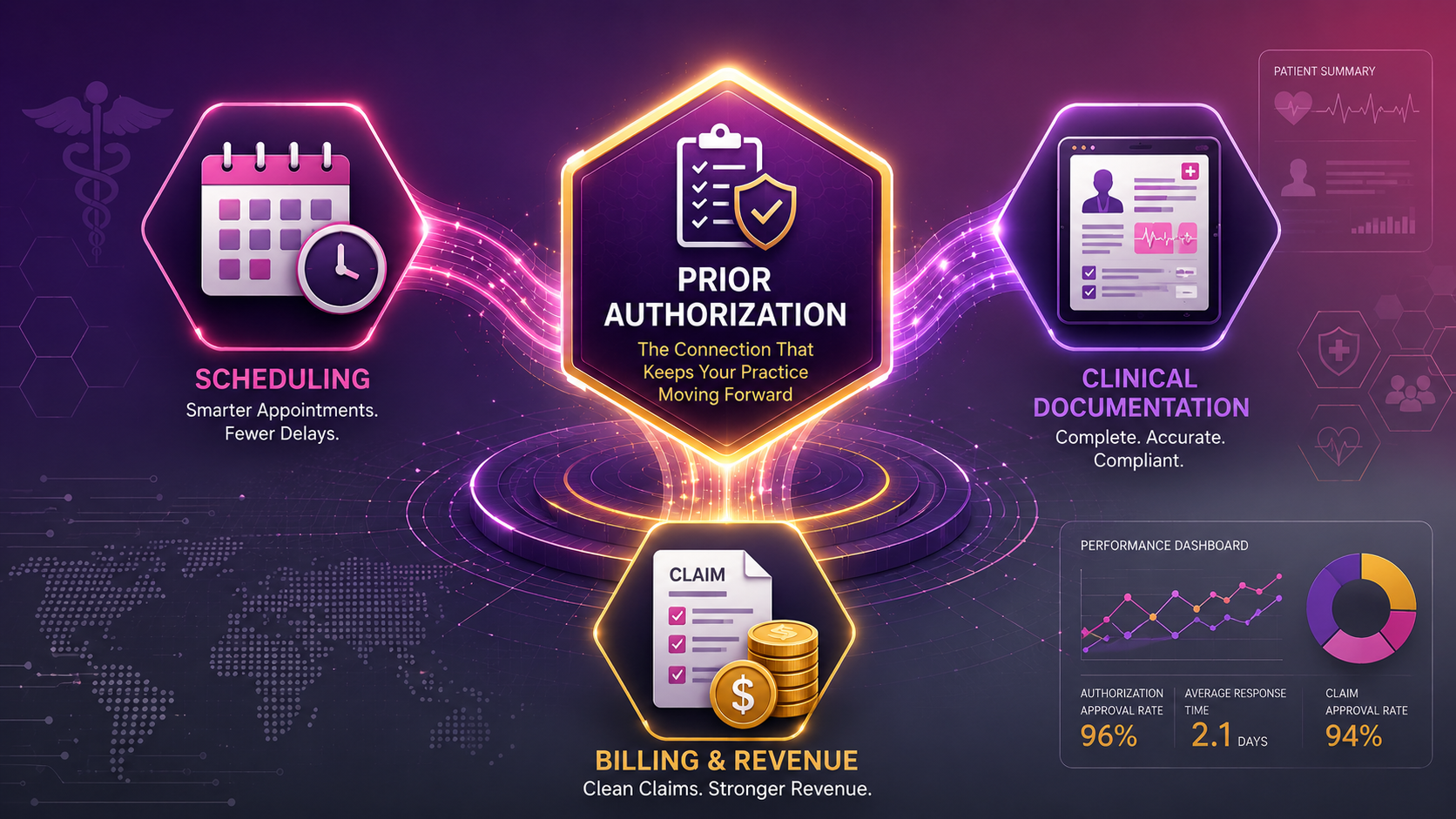
Prior authorizations are among the few administrative processes that affect nearly every department in a medical practice. They influence scheduling, clinical documentation, patient communication, billing, and reimbursement. While they’re often viewed as an unavoidable administrative burden, the way a practice manages prior authorizations can have a measurable impact on operational efficiency and financial performance.
Operational Snapshot
Prior authorizations influence far more than billing—they affect scheduling, documentation, patient communication, reimbursement, and overall practice efficiency. Treating them as an organization-wide workflow helps reduce avoidable delays and operational friction.
A delayed authorization can reschedule appointments, increase communication with payers, postpone treatment, and contribute to preventable claim denials. When these issues occur repeatedly, they consume valuable staff time and place unnecessary pressure on the revenue cycle.
Prior authorizations are an established part of modern healthcare. The challenge is managing them efficiently. The goal is building a structured process that allows your team to manage them consistently before they become operational problems.
Key Takeaways
- Prior authorizations affect nearly every department in a medical practice.
- Standardized workflows reduce delays and administrative burden.
- Accurate documentation supports medical necessity and reimbursement.
- Clear ownership improves accountability.
- Tracking requests through the full authorization lifecycle reduces denials.
- Technology supports—but does not replace—good operational processes.
- Performance metrics help identify workflow bottlenecks.
This article is based on practical medical practice operations experience and is intended for educational purposes only. Prior authorization requirements vary by payer, plan, provider type, specialty, service, and state. Practices should always verify current requirements directly with the applicable payer before services are rendered.
Table of Contents
Prior Authorizations Are More Than a Billing Requirement
It is a common error to silo prior authorization within the billing department. However, my experience with practice audits shows that the process must begin at the point of scheduling and clinical intake. When authorization is treated solely as a back-end billing requirement, you lose the opportunity to catch missing diagnosis codes or insufficient clinical documentation before the patient is ever seen.
To protect your revenue, your clinical staff must be as involved in validating medical necessity as your billing team is in submitting the claim.
Insurance verification determines whether an authorization is required. Providers must document the patient’s condition clearly enough to establish medical necessity. Clinical staff gather supporting information, while administrative teams communicate with payers and track approval status. Scheduling often depends on when authorization is received, and billing ultimately relies on attaching the correct authorization information to the claim.
Because multiple departments contribute to the process, even a small breakdown can affect multiple workflows. A missing diagnosis code, incomplete documentation, or delayed submission can create a chain reaction that extends well beyond the original request.
Rather than viewing prior authorizations as isolated administrative tasks, successful practices treat them as an integrated operational workflow that supports both patient care and revenue protection.
Industry Reform May Help, but Internal Operations Still Matter
Recent CMS Interoperability and Prior Authorization Final Rule initiatives, along with broader industry efforts, are pushing prior authorization toward electronic standards, increased transparency, faster response times, and more consistent payer-provider communication.
Developments such as electronic prior authorization, standardized data exchange, gold carding programs, and broader administrative automation, as measured by the CAQH Index, may help reduce administrative burden over time.
However, practice owners should not expect technology or legislation to replace internal operational discipline. Electronic prior authorization systems still depend on complete documentation, accurate eligibility verification, clear staff ownership, and consistent follow-up.
Operational discipline remains the foundation of successful authorization management, regardless of how automated the industry becomes.
Where Prior Authorization Workflows Commonly Break Down
Many authorization delays don’t result from insurance companies denying requests outright. They happen because practices submit incomplete information, assign responsibility inconsistently, or lose visibility into requests after submission.
Some of the most common operational challenges include:
- Requests submitted without sufficient clinical documentation to support medical necessity.
- Authorization responsibilities spread across multiple staff members without clear ownership.
- Missed expiration dates that require the authorization process to begin again.
- Authorization numbers that are never attached to claims.
- Delayed follow-up on pending requests, resulting in postponed appointments.
Individually, these issues may seem minor. Together, they create additional work for providers, administrative staff, and billing teams, delay reimbursement, and frustrate patients waiting for care.
The EHR Should Support the Entire Authorization Process
An electronic health record should function as more than a place to document patient encounters. It should also provide visibility into the authorization workflow.
Technical Deep Dive
An effective EHR should track pending requests, authorization numbers, approval dates, and expirations in one centralized location. Visibility across the workflow reduces duplicate work and helps prevent avoidable claim denials.
Practices benefit when their EHR allows staff to monitor pending requests, record authorization numbers, track approval and expiration dates, and associate approvals directly with scheduled services. This reduces dependence on spreadsheets, handwritten notes, or individual memory.
Without centralized tracking, staff often spend valuable time searching for approval information, repeating work already completed, or discovering missing authorizations only after claims have been denied.
The more visibility your team has throughout the authorization process, the easier it becomes to identify delays before they affect patient care or reimbursement.
Technology Can Improve Efficiency—But It Cannot Replace Good Processes
Technology continues to play an important role in authorization management. Electronic submissions, EHR integration, real-time authorization capabilities, and payer automation may reduce manual work and improve turnaround times when the underlying information is accurate.
Automation can improve efficiency for routine cases, but it should function as a workflow support tool, not an autopilot. I frequently see practices over-rely on their EHR to manage authorizations automatically, even when documentation, eligibility verification, or internal ownership remains inconsistent.
The greatest operational improvements occur when technology reinforces clearly defined processes, accurate documentation, and appropriate clinical oversight.
Build a Standardized Authorization Workflow
The most effective practices don’t rely on individual experience or memory. They establish standardized workflows that every team member follows consistently.
A structured process typically begins with insurance verification to determine whether authorization is required. Clinical documentation is then reviewed to confirm that medical necessity is adequately supported before the request is submitted through the appropriate payer portal.
Once submitted, staff monitor the request until a final determination is received. They communicate the outcome to scheduling as necessary and record the authorization information in the patient’s chart before services are rendered and claims are submitted.
Each step supports the next. When one stage is skipped or delayed, the entire process becomes less predictable.
Operational Snapshot
Standardized authorization workflows reduce variability by ensuring every request follows the same sequence from insurance verification through final documentation. Consistent execution creates a more predictable process while reducing avoidable delays caused by skipped or inconsistent steps.
Authorization Requirements Vary by Service
Not every authorization request follows the same process. Requirements differ depending on the service being performed and the payer reviewing the request.
| Service Type | Common Documentation Requirements |
|---|---|
| Advanced imaging | CPT and diagnosis codes, symptoms, prior conservative treatment, medical necessity, imaging facility information |
| Prescription medications | Previous medications, failed therapies, laboratory results when appropriate, provider documentation supporting medical necessity |
| Additional therapy or specialist visits | Progress notes, updated treatment plans, continued medical necessity, functional improvement documentation |
Understanding these differences helps staff prepare complete requests the first time. Complete submissions reduce follow-up requests from payers and improve the likelihood of receiving timely approvals.
Assign Prior Authorizations to the Right Team Members
One of the most important operational decisions is determining who manages prior authorizations.
Operational Snapshot
Assigning prior authorizations to trained clinical staff or dedicated coordinators creates greater consistency and fewer interruptions than distributing responsibilities across multiple departments. Clear ownership improves both efficiency and accountability.
Front office employees already balance patient scheduling, registration, insurance verification, and communication with patients. Adding complex authorization responsibilities often creates competing priorities while requiring clinical knowledge that may fall outside their primary role.
Medical assistants, nurses, or dedicated authorization coordinators are typically better suited for this work because they understand provider documentation, diagnosis coding, treatment plans, and medical necessity requirements. When additional information is needed, they can communicate effectively with providers before the request is submitted. This helps prevent situations where clarification occurs only after a denial has already occurred.
As patient volume grows, many practices find that dedicated authorization staff improves efficiency by creating consistent processes and reducing interruptions across clinical and administrative departments.
Assigning prior authorization responsibilities to the appropriate team members improves authorization outcomes while also strengthening coding accuracy, supporting compliance, and reducing audit risk.
Build a Tracking System That Doesn’t Depend on Memory
Submitting a prior authorization is only one part of the process. Once the request has been sent to the payer, practices need a reliable method for monitoring its progress until a final determination is received.
Without a defined tracking system, pending requests can easily be overlooked during busy clinic days. Staff may assume someone else has already followed up, or they may not realize an authorization is still pending until the patient arrives for treatment or the service must be rescheduled.
The objective is to create a process that makes every pending authorization visible until it reaches a final outcome. Whether a request is approved, denied, withdrawn, or requires additional information, its status should always be easy to identify.
Establish Follow-Up Intervals Instead of Waiting
One of the most persistent operational traps I encounter is the ‘reactive follow-up’ mentality—waiting for a status notification from the payer. That approach can delay care. In practice consulting, I recommend a proactive follow-up schedule based on each payer’s expected turnaround times.
Instead of waiting for an update, your team should treat the authorization follow-up as a scheduled clinical task. When you shift from reactive waiting to proactive monitoring, you reduce the ‘authorization gap’ that leads to last-minute appointment cancellations and patient friction.
Many insurance carriers publish estimated turnaround times for authorization requests, allowing practices to establish internal follow-up schedules rather than relying on incoming notifications. Instead of checking every request at random, staff can schedule follow-ups based on the expected processing timeline for that payer and service.
This creates a more predictable workload while helping identify delayed requests before they begin affecting patient scheduling.
Operational Snapshot
Using payer turnaround times to schedule follow-ups creates a proactive workflow instead of waiting for insurer updates. Routine follow-up intervals help identify delays before they disrupt scheduling or patient care.
Centralize Status Information
Regardless of the technology available, authorization status should be maintained in one consistent location.
Some organizations use dedicated authorization software, while others rely on shared work queues or internal tracking tools. The specific platform is less important than ensuring every team member references the same source of information.
A centralized tracking process should allow staff to quickly identify:
| Tracking Element | Operational Purpose |
|---|---|
| Submission date | Measures expected turnaround time |
| Current status | Identifies pending, approved, denied, or additional information requests |
| Next follow-up date | Prevents missed payer communication |
| Assigned staff member | Creates accountability for ongoing management |
Keeping these elements together reduces unnecessary searching, supports continuity when staff members are unavailable, and helps prevent pending requests from being overlooked.
Monitor the Entire Authorization Lifecycle
Tracking should continue beyond the initial approval.
Practices often focus heavily on obtaining authorization but pay less attention to what happens afterward. Depending on the service, approvals may have utilization limits, expiration dates, or restrictions tied to specific providers or treatment periods.
Maintaining visibility throughout the entire authorization lifecycle helps reduce situations where services are scheduled using expired approvals or where additional visits require new authorization before treatment continues.
Viewing authorization management as an ongoing process rather than a single event helps reduce avoidable interruptions later in the patient’s course of care.
Operational Snapshot
Authorization management should continue after approval by monitoring expiration dates, visit limits, and payer restrictions. Ongoing visibility helps prevent avoidable service interruptions and unexpected claim denials.
Prior Authorizations Are Part of Revenue Cycle Management
It’s easy to think of prior authorizations as purely administrative, but they play a direct role in financial performance.
Missing approvals, expired authorizations, incomplete documentation, and delayed submissions frequently result in denied claims or postponed services. Staff then spend additional time appealing denials, contacting payers, rescheduling patients, and correcting preventable errors.
Those activities increase labor costs while slowing reimbursement and extending accounts receivable. In many cases, the cost of reworking denied claims exceeds the effort required to complete the authorization correctly the first time.
Practices that consistently manage prior authorizations well typically experience cleaner claims, more predictable scheduling, improved cash flow, and fewer unnecessary disruptions throughout the revenue cycle.
Continue Learning: Prior authorizations are only one component of an effective revenue cycle. To understand how scheduling, eligibility verification, coding, claims management, payment posting, and accounts receivable work together to protect financial performance, check out our post on Revenue Cycle Management.
Measuring Performance Creates Better Decisions
Leadership often relies on anecdotes to measure authorization efficiency, but operational decisions should be based on performance data rather than perception. I advise practice owners to track average turnaround time by payer. They should also monitor denial rates by provider or service type, appeal success rates, staff hours spent on follow-up, and approval rates by payer.
These metrics help leadership identify recurring bottlenecks and evaluate staffing needs. They also support workflow improvements, technology decisions, and discussions with insurance carriers using objective data.
Without meaningful metrics, authorization problems are often managed only after they have already affected scheduling, patient care, or reimbursement.
Operational Snapshot
Operational metrics reveal where authorization bottlenecks actually occur instead of relying on assumptions. Measuring turnaround times, denial rates, and staff effort supports better decisions about workflow improvements and resource allocation.
Consistency Creates Reliability
The effectiveness of any tracking system depends less on the software being used and more on how consistently the process is followed.
Practices with reliable authorization management typically establish routine review schedules and maintain current status information. They also ensure pending requests remain visible until they are fully resolved. That consistency allows teams to identify problems early instead of discovering them only after appointments are affected or additional administrative work becomes necessary.
A structured tracking process does more than organize authorizations—it creates operational predictability across the practice, allowing staff to manage growing authorization volumes without relying on memory or informal communication.
Because prior authorization rules change frequently, practices should maintain up-to-date payer-specific references, review authorization requirements regularly, and document the source of the authorization information used for each request.
Prior Authorization Questions Medical Practices Often Ask
Who is responsible for obtaining prior authorizations in a medical practice?
Responsibility varies by practice size and specialty. Many organizations assign prior authorizations to medical assistants, nurses, or dedicated authorization coordinators because they can review clinical documentation and communicate with providers about medical necessity. Smaller practices may share responsibilities among clinical and administrative staff, but clear ownership is essential to prevent delays.
How long does a prior authorization usually take?
Processing times differ by payer, service, and whether additional clinical information is required. Some requests are reviewed within a few business days, while others may take longer. Many insurance companies publish expected turnaround times that practices can use when scheduling follow-up activities.
Can a patient receive treatment before prior authorization is approved?
That depends on the payer’s policy and the specific service. Some services require authorization before they are performed, while others may qualify for exceptions such as emergency care. Providing services without a required authorization can increase the risk of claim denial and patient billing issues.
What happens if a prior authorization request is denied?
A denial does not always mean the requested service cannot be performed. Depending on the payer’s policies, providers may be able to submit additional documentation, request reconsideration, or file an appeal. Understanding the reason for the denial is the first step in determining the appropriate next action.
Do prior authorizations expire?
Yes. Many authorizations are approved for a specific date range, number of visits, or treatment period. Practices should monitor expiration dates and utilization limits to avoid scheduling services after an authorization is no longer valid.
Are prior authorization requirements the same for every insurance company?
No. Authorization requirements vary among commercial insurers, Medicare Advantage plans, Medicaid managed care organizations, and other payers. Even plans offered by the same insurance company may have different authorization policies, documentation requirements, and submission methods.
Does Original Medicare require prior authorizations?
Original Medicare generally requires fewer prior authorizations than many commercial insurance plans, but CMS prior authorization and pre-claim review initiatives still apply to certain services, durable medical equipment, and specific review programs. Medicare Advantage plans often have different authorization requirements than Original Medicare.
Should prior authorization status be checked before every scheduled service?
For services that require authorization, status should be confirmed before the patient is seen. Staff should verify that the authorization is approved, active for the service date, tied to the correct provider or location when required, and not limited by visit counts or expiration dates.
What information is typically needed for a prior authorization request?
Requirements vary by payer and service, but requests commonly include patient demographics, insurance information, diagnosis codes, procedure or medication details, provider documentation supporting medical necessity, and any required clinical records or test results.
What should practices do when a payer requests more information?
When a payer requests additional information, the practice should review the request carefully, identify exactly what documentation is missing, involve the provider when clinical clarification is needed, and respond within the payer’s stated deadline. The request should remain visible in the tracking system until a final decision is received.
Building a More Reliable Authorization Process
Prior authorizations are unlikely to become less complex, but they can become more manageable through structured workflows, clear ownership, and consistent documentation.
Practices that view authorizations as an integrated operational process—not simply an administrative requirement—are better positioned to reduce delays, improve coordination between departments, and protect revenue without compromising patient care.
Success isn’t measured by obtaining approval alone. It’s creating a reliable system that supports providers, reduces staff frustration, improves the patient experience, and keeps the revenue cycle moving efficiently.
About the Author
Jennifer Blevens-Smith is the founder of Integral Clinic Solutions and has more than 20 years of experience helping independent healthcare providers and medical practices navigate provider credentialing, payer enrollment, contracting, healthcare operations, compliance administration, and revenue cycle management.
Throughout her career, she has worked with practices on payer enrollment, network participation, operational transitions, reimbursement challenges, provider onboarding, prior authorization workflows, and sustainable practice growth.
Her work focuses on helping providers build efficient healthcare businesses while maintaining high standards of patient care, operational accountability, and regulatory awareness.
Need Help Strengthening Your Medical Practice Operations?
Integral Clinic Solutions provides practical support for medical practices navigating credentialing, contracting, provider enrollment, and revenue cycle operations. The company also supports compliance workflows, front-office systems, and practice management challenges.
Explore more operational guidance, compliance insights, and healthcare business resources on the Integral Clinic Solutions blog. New articles and updates are added regularly for practice owners, administrators, and healthcare teams.
Disclaimer: This content is provided for informational and educational purposes only. Credentialing, enrollment, contracting, reimbursement, licensing, and compliance requirements vary by payer, provider type, specialty, location, and regulatory authority. Providers and healthcare organizations should verify current requirements directly with applicable payers and regulatory agencies. Read our full Legal & Compliance Disclaimer.