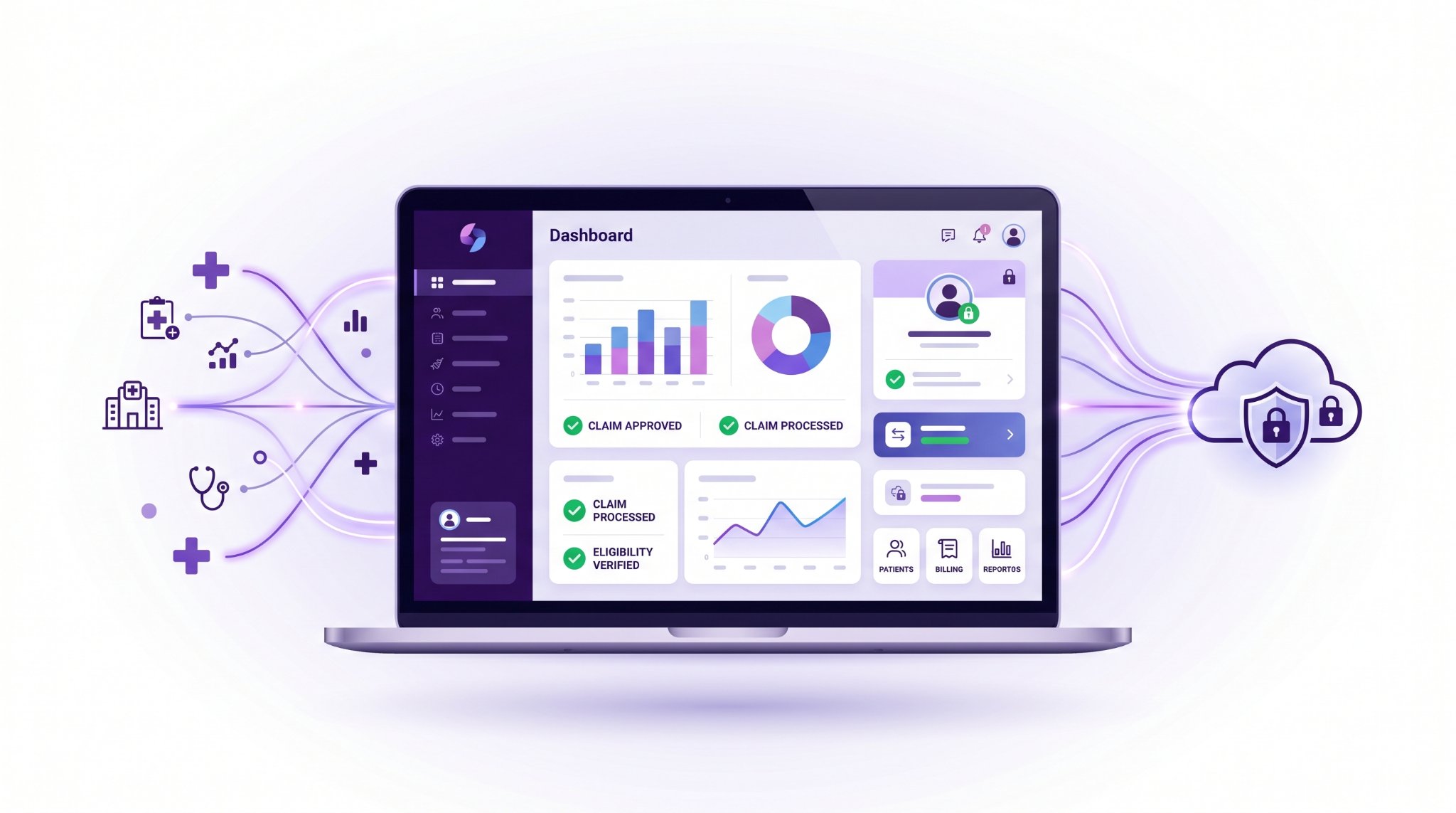
Payer Portals Simplified: Save Time, Cut Costs, Stay Compliant
Payer portals are often treated as basic lookup tools, but they play a much larger role in daily practice operations. Developing a structured approach to payer portal management helps stabilize clinical and administrative operations. It improves back-office workflows, reduces unnecessary staff time, and helps prevent avoidable tracking errors.
Operational Snapshot
Well-managed payer portals reduce dependency on phone queues and fragmented workflows. Centralizing eligibility, claims, and payment activity improves administrative efficiency while helping teams resolve issues before they impact cash flow.
From front-end eligibility verification to late-stage claim adjudication analysis, these platforms provide a primary source of administrative visibility. Shifting away from manual workflows and telephone queues establishes a highly efficient, centralized transaction hub that protects back-office labor capacity while stabilizing your broader medical practice revenue cycle management and operations.
Key Practice Takeaways
- Payer portals support eligibility, claims, prior authorization, and payment workflows.
- Portal data is often more detailed than clearinghouse responses.
- Every staff member should have unique credentials.
- Role-based access controls improve compliance and data security.
- Portal training should be included in onboarding and workflow education.
- Medicare and regional payers may require separate portal access strategies.
Table of Contents
What Are Payer Portals and Why Do You Need Them?
Payer portals are secure online systems that allow medical practices to communicate directly with insurance companies. They function as a real-time window into the insurer’s adjudication framework. They provide immediate answers that standard batch files cannot deliver. When used consistently, these portals support four critical parts of the practice’s revenue cycle.
Real-Time Eligibility Verification: Front-office teams use the portal to instantly confirm active plan coverage parameters, deductible structures, and coordination-of-benefits rules prior to the clinical encounter, preventing revenue leakage at the point of service.
Granular Benefit Tracking: Instead of relying on broad summaries, portals pinpoint precise service exclusions, maximum caps, and explicit patient out-of-pocket structural responsibilities before care is rendered.
Claim Adjudication Auditing: Back-office personnel can seamlessly review pending, paid, or formally blocked claims without introducing phone hold times or administrative delays, reducing overall days in accounts receivable (A/R).
Reimbursement Reconciliations: Billing desks utilize portals to download direct Electronic Remittance Advice (ERA) logs, allowing them to monitor payment posting status and track contract fee schedule accuracy in real time.
Operational Field Mapping: Portal Data vs. Clearinghouse Batches
Practices often lose time and revenue when staff assume that clearinghouse responses contain the same level of detail available through payer portals. To protect your workflows from hidden data decay, staff must recognize when a manual portal query is required to pull missing data variables that standard automated medical billing clearinghouse networks omit.
Technical Deep Dive
Payer portals expose claim-level details that frequently never appear in clearinghouse responses. Access to carrier-native data helps billing teams identify root causes faster and reduce unnecessary accounts receivable delays.
| Administrative Workflow Element | Clearinghouse Batch Response Limitations | Native Payer Portal Fields Available |
|---|---|---|
| Eligibility & Deductibles | Returns broad “Active/Inactive” status strings; often omits localized service limits. | Displays real-time met individual/family deductibles, specific plan type variables, and active HRA/HSA funds. |
| Coordination of Benefits (COB) | Flags a generic rejection code without identifying the primary or secondary hierarchy. | Provides explicit carrier records pointing to the primary insurer, policy status dates, and update history. |
| Late-Stage Claim Status | Shows standard “Received” or “Pending” updates while a claim rests inside the adjudication engine. | Unveils granular line-item edits, pending medical documentation flags, or non-covered service codes. |
| Payment & ERA Reconciliations | Delivers basic remittance summaries; bulk payment checks are frequently unlinked from local files. | Supplies printable check/EFT transaction logs, explicit processing dates, and full overpayment recovery history. |
Understanding these data boundaries eliminates guesswork at the billing desk. When an automated clearinghouse response lacks the specificity to fix a claim, billing personnel can instantly pivot to the carrier’s native data loops to retrieve the missing information. This keeps the accounts receivable lifecycle moving forward without unnecessary delays.
For example, a clearinghouse may return an “active coverage” response, but the payer portal may show that the patient’s plan requires a referral, has exhausted visit limits, or lists another carrier as primary. Without checking the portal, staff may assume the claim is clean when the payer already has information that could trigger a denial.
Navigating Payer Architecture: Multi-Payer Hubs vs. Standalone Portals
The initial step toward optimizing portal utilization is to align your digital configuration with your active provider credentialing footprint. A medical practice requires only access to specialized networks that match its current payer contracting mix.
Fortunately, modern insurance networks frequently consolidate multi-payer access under a single digital umbrella. Web-based platforms such as Availity Essentials and OneHealthPort allow administrative personnel to evaluate multiple commercial insurance plans through a unified database.
| Portal Architecture | Core Operational Focus | Workflow and Access Impact |
|---|---|---|
| Enterprise Multi-Payer Hubs (e.g., Availity, TriZetto) | Aggregates major commercial lines (BCBS, Aetna, UnitedHealthcare) into a single dashboard. | Dramatically maximizes staff velocity and simplifies user access provisioning and credential management. |
| Standalone Individual Portals (e.g., specialized regional plans) | Manages niche local networks, workers’ compensation, or managed Medicaid panels. | Requires independent login records, introduces administrative friction, but preserves tracking data. |
However, enterprise hubs rarely maintain 100% market penetration. Niche local networks, specialized workers’ compensation boards, or smaller regional commercial plans routinely require isolated portal environments. While less convenient, mastering these standalone portals is necessary to maintain clean data tracking across your entire patient demographic mix.
This regional complexity is highly evident when billing government programs. The federal government does not provide direct, end-to-end access to provider portals through centralized CMS platforms for daily transactional tracking. Instead, practices must route setups through their regionally designated Medicare Administrative Contractor (MAC) website.
For example, medical groups operating within the Pacific Northwest must route transaction profiles through the Noridian Healthcare Solutions portal, while MAC portals require greater technical oversight and stricter verification steps; maintaining active access is mandatory to safeguard both Part A and Part B cash flow lines.
Developing a Corporate Access and Governance System
From a compliance and vendor governance perspective, one operational mandate overrides all others: every individual staff member must retain unique, unshared user credentials. Sharing administrative profiles among multiple team members poses a serious HIPAA compliance risk by weakening user accountability, disrupting audit trails, and making it difficult to determine who accessed or changed protected information.
Compliance Alert
Shared portal accounts weaken audit trails and create avoidable compliance exposure. Individual credentials combined with role-based access controls provide accountability, improve security, and support defensible access management practices.
In the event of a network data exposure or security audit, a practice that uses shared logins faces severe liability and compounding civil monetary penalties due to a complete lack of internal file tracking and user audit logs.
To mitigate this exposure, practices must appoint a dedicated master portal administrator to control user provisioning, suspensions, and role-based access modifications. This admin ensures the team uses Role-Based Access Control (RBAC) to segment features by job duties.
Front-office staff can access eligibility tools, while sensitive financial fields, fee schedules, and ERA data remain restricted to the billing desk. Furthermore, deploying enterprise-grade encryption applications (such as 1Password or Dashlane) completely eliminates password tracking friction and account lockouts across the clinic footprint.
Finally, this administrative governance structure must encompass a formalized training curriculum. Assuming personnel will organically master these non-standardized frameworks without structured instruction is a costly mistake. Without training, staff may unintentionally change claim details, resubmit information incorrectly, or rely on unverified portal responses. These habits can create compliance concerns, especially when inaccurate information is used to obtain payment.
Transitioning your workforce from loose management habits to an objective, supportive layout requires clear standard operating procedures. Managers must learn to balance production metrics with continuous training. They should embed clear parameters for monitoring clinical staff without disrupting care right into the onboarding phase.
To support this, the portal admin should maintain a centralized digital directory. The directory should list all contracted insurance carriers, along with direct URLs to their technical portals, to optimize back-office speed.
Prior Authorizations and Technical Troubleshooting
Managing prior authorizations (PAs) remains a complex operational challenge within healthcare administration. However, deploying web-based portal modules completely transforms this pain point. Teams can upload clinical documentation directly, eliminate slow legacy fax networks, and bypass manual phone hold times.
Operational Snapshot
Digital prior authorization workflows create a documented chain of activity that is difficult to achieve through fax-based processes. Real-time tracking improves visibility and strengthens administrative accountability.
This structural migration secures rapid turnaround, tracks the review lifecycle in real time, and logs a secure timestamp that protects the practice against untracked transmission arguments during post-payment reviews.
Submitting prior authorizations through a payer portal is only one step in the overall process. Long-term success depends on standardized workflows, consistent follow-up, and effective tracking. Learn how to build an efficient prior authorization process in our complete guide.
Because these web interfaces rely on complex external databases, technical disruptions are inevitable. Login validation loops, sudden credential expirations, and unexpected system drops can quickly stall back-office workflows. Minimizing the financial impact requires administrators to deploy a clear, systematic roadmap. The roadmap should follow four phases:
Phase 1: Practice Registration: Access the primary platform registry (e.g., availity.com) to initialize your organization’s security profile, keeping corporate Tax IDs, group NPIs, and core business registrations ready for validation.
Phase 2: Carrier Mapping: Select and link the commercial insurance plans that align with your active contracting mix, including major commercial networks and localized affiliates.
Phase 3: User Provisioning: Once the corporate profile has cleared verification, configure separate sub-accounts for each workforce member, applying tailored security parameters aligned with their job descriptions.
Phase 4: Workflow Training & Troubleshooting Support: Implement structured workflow training to ensure your team can efficiently navigate dashboards, run real-time coverage checks, interpret complex transaction updates, and follow documented backup-downtime protocols during interface disruptions.
FAQ: Payer Portals and Practice Access Management
Are payer portals replacing traditional medical billing clearinghouses?
No. Payer portals and clearinghouses serve completely complementary roles within healthcare revenue operations. A clearinghouse handles the high-volume, automated batch scrubbing and transmission of electronic claim files across hundreds of distinct insurance companies simultaneously.
In contrast, a native payer portal is used for targeted, real-time investigative tasks. It provides deep clinical visibility, exact patient out-of-pocket benefit structures, and line-item adjudication details that standard batch responses cannot deliver.
Should practices share login credentials for commercial insurance portals?
No. Sharing administrative login profiles across multiple workforce members creates a serious security vulnerability and may increase HIPAA compliance risk.
To protect your organization from liability, every single team member must operate with unique, unshared user accounts.
This baseline provisioning ensures your practice maintains precise user audit trails and secures individual operational accountability. It also prevents catastrophic account lockouts across entire departments.
How often should medical practices audit payer portal access?
Medical practices should routinely review payer portal access, especially when employees change roles, leave the organization, or no longer need certain permissions.
A quarterly access review is a practical starting point for many practices. The goal is to confirm that each user has the correct access level and that inactive accounts are removed promptly.
Who is responsible for managing user access and security settings across portals?
Every medical practice must appoint a dedicated master portal administrator to oversee organizational access controls. This individual holds sole operational ownership of provisioning new employee sub-accounts and managing role-based access control (RBAC).
They are also responsible for executing routine credential audits and deactivating profiles immediately upon staff termination. Securing centralized governance over this infrastructure layer is a management necessity. It helps mitigate data breach risks and ensures uninterrupted system access.
Unlock the Power of Payer Portals in Your Practice
Strong payer portal integration is increasingly important for medical groups seeking improved process efficiency, stronger compliance safeguards, and more consistent operating margins. By provisioning your workforce with role-based credentials and enforcing rigorous training guidelines, you insulate your financial infrastructure from avoidable operational leaks. From front-end check-in procedures to late-stage claim troubleshooting, these digital networks streamline processes. Without them, those same processes can exhaust team capacity.
Organizational control remains your primary defense against administrative friction—whether your practice utilizes enterprise multi-payer platforms like Availity to consolidate major carrier streams or carefully tracks standalone endpoints for regional plans. Appoint a master portal administrator, protect logins with encrypted corporate password managers, and ensure your workforce is equipped to navigate these systems systematically.
The more proficient your administrative team becomes at utilizing these specialized portals, the more operational capacity your practice retains to dedicate to its core mission: exceptional patient care and sustainable organizational growth. Invest the resources to secure your portal infrastructure. It remains a vital safeguard for your revenue cycle. When an interface disruption strikes, utilize your documented backup downtime protocols. Rely on direct carrier telephone queues only as a final operational fallback.
About the Author
Jennifer Blevens-Smith is the founder and sole consultant driving Integral Clinic Solutions. Armed with deep domain expertise and a commitment to protecting independent medicine, she delivers the personalized, executive-level guidance that healthcare leaders need to build sustainable, high-performing organizations.
Need Help Strengthening Your Medical Practice Operations?
Integral Clinic Solutions provides practical support for medical practices navigating credentialing, contracting, revenue cycle operations, compliance workflows, front-office systems, and practice management challenges.
Explore more operational guidance, compliance insights, and healthcare business resources on the Integral Clinic Solutions blog. New articles and updates are added regularly for practice owners, administrators, and healthcare teams.
Disclaimer: This content is for informational and educational purposes only and does not constitute legal, coding, billing, compliance, financial, or medical advice. Healthcare practices must verify all operational requirements with applicable payers, regulators, and qualified professionals. Read our full Legal & Compliance Disclaimer.