How Individual and Group Payer Contracts Affect Billing and Provider Enrollment
How a medical practice contracts with insurance payers affects much more than credentialing paperwork. The structure determines which identifiers appear on claims, how providers are connected to payer agreements, where reimbursement is directed, and how easily the practice can add clinicians as it grows.
For a solo provider, an individual payer contract may appear to be the simplest option. In other situations, establishing a group structure from the beginning provides more flexibility, even when there is initially only one rendering provider.
Neither structure eliminates the need for credentialing or payer enrollment. The important distinction is understanding who holds the contract, which provider is authorized to render services under it, and which identifiers must appear on the claim.
Those details become particularly important when a practice begins hiring providers. Having a group contract does not automatically make every clinician employed by the practice in network.
Key Takeaways
- Individual and group payer contracts establish different relationships between the payer, practice, and rendering provider.
- A group payer agreement does not automatically make every clinician working for the practice in network.
- NPI Type 1 and NPI Type 2, tax information, legal business information, and payer enrollment records need to reflect the intended contracting and billing structure.
- Provider enrollment and credentialing should be incorporated into hiring and onboarding rather than beginning on the clinician’s first day.
- Employment start dates and payer participation effective dates are separate operational milestones.
- Practices anticipating additional clinicians should consider how their payer contracting structure will support future growth.
Table of Contents
Understand Individual and Group Payer Contracts
Individual Contracts Keep the Payer Relationship With the Provider
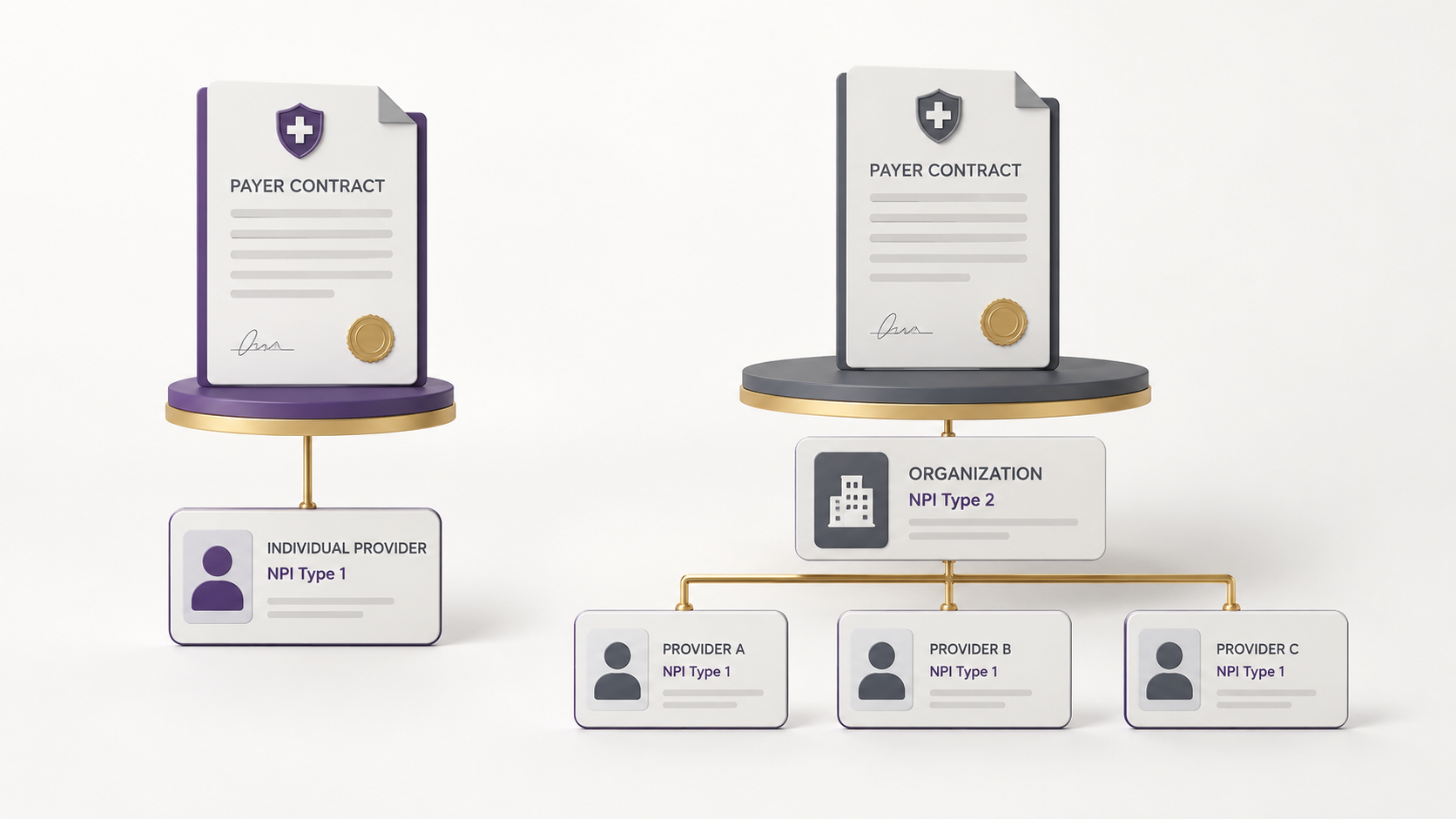
Under an individual contracting structure, the payer relationship is established with the individual provider rather than a group practice.
Under an individual contracting arrangement, the provider’s NPI Type 1 identifies the individual clinician. The applicable tax and billing information depends on the business structure and the payer’s enrollment requirements.
Depending on how the practice is established, the taxpayer identification number associated with the arrangement may be an Employer Identification Number (EIN) rather than the provider’s Social Security number.
Operationally, this structure can make sense when the provider intends to practice independently and does not expect other clinicians to bill under the same entity.
It can also be used when two providers share office expenses but maintain separate businesses and separate payer relationships. They may occupy the same location and divide overhead according to an arrangement developed with their accounting professionals. Each provider separately bills and receives reimbursement for their own services.
The limitation becomes more apparent when the practice grows.
If an individually contracted provider later decides to hire another clinician and wants services billed through a group entity, the payer enrollment and contracting structure may need to change. That can be done, but it requires additional administrative work and should not be treated as an immediate transition.
Operational Snapshot
Contract structure is an infrastructure decision, not just an enrollment choice. A practice that anticipates adding clinicians should evaluate whether today’s arrangement can support future billing relationships without requiring a structural transition at the same time the organization is trying to grow.
Group Contracts Create a Structure for Multiple Providers
A group structure adds another layer to the payer relationship.
In a group contracting structure, the practice generally has an organizational NPI Type 2 and applicable taxpayer identification information associated with the business. The payer relationship is established with the group. Individual rendering providers are then enrolled, affiliated, or otherwise associated with the organization according to the payer’s requirements.
A useful way to think about the structure is as an umbrella. The business sits at the top, while the individual providers authorized to render services under the agreement sit underneath it.
That distinction is reflected in billing.
When the claim requires both billing and rendering provider information, it identifies the billing organization and the individual clinician who rendered the service. The group may therefore be represented through its organizational information, including the NPI Type 2, while the rendering provider is identified using their individual NPI Type 1.
This allows the payer to answer two separate questions: Which organization is billing for the service, and which provider actually performed it?
Both matter for claim adjudication.
Technical Deep Dive
Group billing depends on two relationships being represented correctly: the organization submitting the claim and the clinician who performed the service. Claim configuration should preserve that distinction rather than treating the organizational and individual NPIs as interchangeable identifiers.
Group Participation Does Not Automatically Include Every Provider
This is one of the most important operational points for practices adding clinicians.
Having a valid group agreement with a payer does not necessarily mean a newly hired provider can begin seeing that payer’s members under the group’s in-network status immediately.
The payer still needs to recognize the individual rendering provider as participating under the group.
If the NPI Type 1 submitted for the rendering provider is not appropriately connected to the group’s payer arrangement, the claim may process as out-of-network or be denied, depending on the payer and the patient’s benefits.
That creates both a reimbursement problem and a patient experience problem.
A practice may believe it is providing an in-network service because the organization participates with the payer. The patient may reasonably believe the same thing. But if the rendering provider has not reached the appropriate effective date, the claim can produce unexpected out-of-network responsibility or fail to pay as anticipated.
The operational lesson is straightforward: group participation and individual provider participation need to be managed together.
Provider Onboarding Has to Start Before the First Patient Visit
This is where contracting and credentialing become closely connected to hiring.
A practice should not wait until a new provider’s first day to begin notifying payers.
Commercial payers and managed-care plans may require time to credential the clinician, associate the provider with the group, and establish an effective date. That process may take longer when the clinician requires full credentialing or recredentialing.
Practices should therefore build provider enrollment into the provider onboarding timeline.
Ideally, payer enrollment and credentialing work begins as soon as the provider’s anticipated start date is reasonably certain. Because processing timelines vary considerably by payer, provider type, market, and enrollment circumstances, practices should determine applicable requirements early enough to incorporate them into the hiring and onboarding timeline.
The practice also needs to understand whether a payer will recognize an earlier effective date. Retroactive participation should never be assumed.
Compliance Alert
A provider’s employment start date and payer participation effective date are separate operational milestones. Scheduling in-network patients before both are reconciled can expose the practice to denied claims and unexpected patient liability. It can also result in reimbursement that cannot be recovered simply by assuming participation will be applied retroactively.
If the provider begins seeing patients before participation is effective, leadership needs a defined plan for how those visits will be scheduled and billed. Otherwise, the practice can accumulate claims that cannot be reimbursed as expected.
Keep Payer, Tax, and NPI Information Aligned
Another common source of confusion is treating tax identification and NPI information as though they serve the same function.
They do not.
The W-9 communicates the legal name and taxpayer identification information associated with the person or business receiving payment. That information needs to align with how the entity is established for tax purposes.
The National Provider Identifier (NPI) identifies healthcare providers for HIPAA standard administrative and financial transactions.
An individual healthcare provider is identified by an NPI Type 1, while an eligible healthcare organization can obtain an NPI Type 2. The organizational NPI does not replace the rendering provider’s individual NPI when the claim requires identification of the clinician who performed the service.
Keeping those identifiers aligned across payer records is important because inconsistencies can create enrollment and billing problems.
A practice may have the correct contract but still experience claim issues when payer records do not match the structure under which the claim is being submitted. This includes the legal business name, tax ID, organizational NPI, rendering provider information, or payer enrollment records.
Technical Deep Dive
Identifier accuracy should be evaluated as a complete configuration rather than field by field. A correct NPI or tax ID can still produce billing problems when the payer has associated it with a different legal entity or provider relationship. It can also produce problems when the payer has associated it with a different enrollment structure than the one represented on the claim.
Individual and Group Payer Contracts at a Glance
| Organizational identifier | Individual Contract | Depends on the provider’s business and enrollment structure |
|---|---|---|
| Contracting structure | Individual provider | Practice or group entity |
| Individual provider identifier | NPI Type 1 | NPI Type 1 for each rendering provider |
| Organizational identifier | Generally not part of an individual-only structure | NPI Type 2 |
| Growth | Additional restructuring may be required | Designed to accommodate additional providers |
| New provider enrollment | Separate individual payer arrangement | Provider must meet the payer’s requirements for participation under the group |
| Best operational fit | Provider expecting to remain independent | Practice that has or may add providers |
The important consideration is not simply which option involves less paperwork today. Practice owners should think about how they expect the organization to operate several years from now.
Planning the Contract Structure for Practice Growth
Even when a practice starts with one provider, establishing an organizational structure may be worth considering if there is a reasonable possibility of adding clinicians later. Having that framework in place can make the payer relationship easier to expand, although each new clinician must still meet the applicable payer’s enrollment and participation requirements.
It can also create a clearer operational separation between the provider as an individual and the practice as a business. That distinction can be useful as the organization develops its accounting, banking, payroll, contracting, and revenue cycle processes.
Qualified legal and accounting professionals should still determine the appropriate legal and tax structure. Payer contracting decisions need to align with that underlying business structure rather than being made independently of it.
Frequently Asked Questions About Individual and Group Payer Contracts
What is the difference between an individual and group payer contract?
An individual payer contract establishes the payer relationship with an individual provider. A group contract establishes the relationship with the practice or group entity, while individual rendering providers must meet the payer’s requirements for participation under that group.
Does a group payer contract automatically make a new provider in network?
No. Having a group agreement does not necessarily mean every clinician working for the practice is automatically in network. A new provider may need to complete credentialing, enrollment, affiliation, or other payer requirements and reach the applicable participation effective date before services are treated as in network.
Can a solo provider have a group payer contract?
A solo provider may establish an organizational structure even when they are initially the only rendering provider. Whether that structure is appropriate depends on the practice’s business structure, payer requirements, and future plans, including whether the practice expects to add clinicians.
What is the difference between an NPI Type 1 and NPI Type 2?
An NPI Type 1 identifies an individual healthcare provider. An eligible healthcare organization can obtain an NPI Type 2. In a group billing arrangement, the organizational and individual NPIs serve different purposes and should align with the practice’s payer enrollment and billing structure.
When should payer enrollment begin for a newly hired provider?
Payer enrollment and credentialing should begin as soon as the provider’s anticipated start date is reasonably certain. Processing times vary considerably, so practices should incorporate payer requirements into the hiring timeline rather than waiting until the clinician’s first day to begin the process.
Can a new provider see patients before payer enrollment is complete?
A provider’s employment start date does not necessarily equal their payer participation effective date. If a clinician begins seeing patients before participation is effective, the practice should understand how those services will be scheduled and billed. Practices should not assume that a payer will grant retroactive participation.
Payer Contract Structure Should Support How the Practice Operates
Choosing between individual and group payer contracts is not simply a credentialing decision. It affects billing configuration, provider onboarding, and reimbursement. It also affects accounting and future growth.
An individual arrangement can work well for a provider who intends to remain independent. A group structure provides a framework for practices that employ or may eventually employ additional clinicians.
Whichever structure a practice chooses, the details need to remain aligned. The payer must have the correct tax and business information. The billing identifiers must reflect the contracted entity. Every rendering provider must also be appropriately connected to the payer arrangement before the practice assumes their services will process as in-network.
That last point becomes increasingly important as a practice grows. Hiring a provider is not complete when the employment agreement is signed, or the clinician arrives for their first day. From a revenue cycle perspective, onboarding also includes confirming that the provider can bill the practice’s payers under the intended contract structure.
Operational Snapshot
Payer readiness can function as a launch dependency for a new clinician, much like system access, scheduling setup, or clinical privileges. Tracking enrollment status against the planned patient schedule gives leadership an earlier signal when a hiring timeline is moving faster than the revenue cycle can support.
Building that work into the hiring process prevents a common and expensive problem: having a provider ready to see patients while the payer relationships needed to bill those visits are still catching up.
About the Author
Jennifer Blevens-Smith is the founder and principal consultant of Integral Clinic Solutions. With more than two decades of experience supporting independent medical practices, she helps physicians, practice administrators, and healthcare leaders strengthen credentialing, payer contracting, and revenue cycle operations. She also helps them strengthen compliance workflows and practice management. Her work focuses on translating complex healthcare requirements into practical operational processes. These processes improve consistency and reduce administrative burden. They also support long-term practice success.
Need Help Strengthening Your Medical Practice Operations?
Integral Clinic Solutions provides practical support for medical practices navigating credentialing, contracting, revenue cycle operations, compliance workflows, front-office systems, and practice management challenges.
Explore more operational guidance, compliance insights, and healthcare business resources on the Integral Clinic Solutions blog. New articles and updates are added regularly for practice owners, administrators, and healthcare teams.
Disclaimer: This content is for informational and educational purposes only and does not constitute legal, coding, billing, compliance, financial, or medical advice. Healthcare practices must verify all operational requirements with applicable payers, regulators, and qualified professionals. Read our full Legal & Compliance Disclaimer.