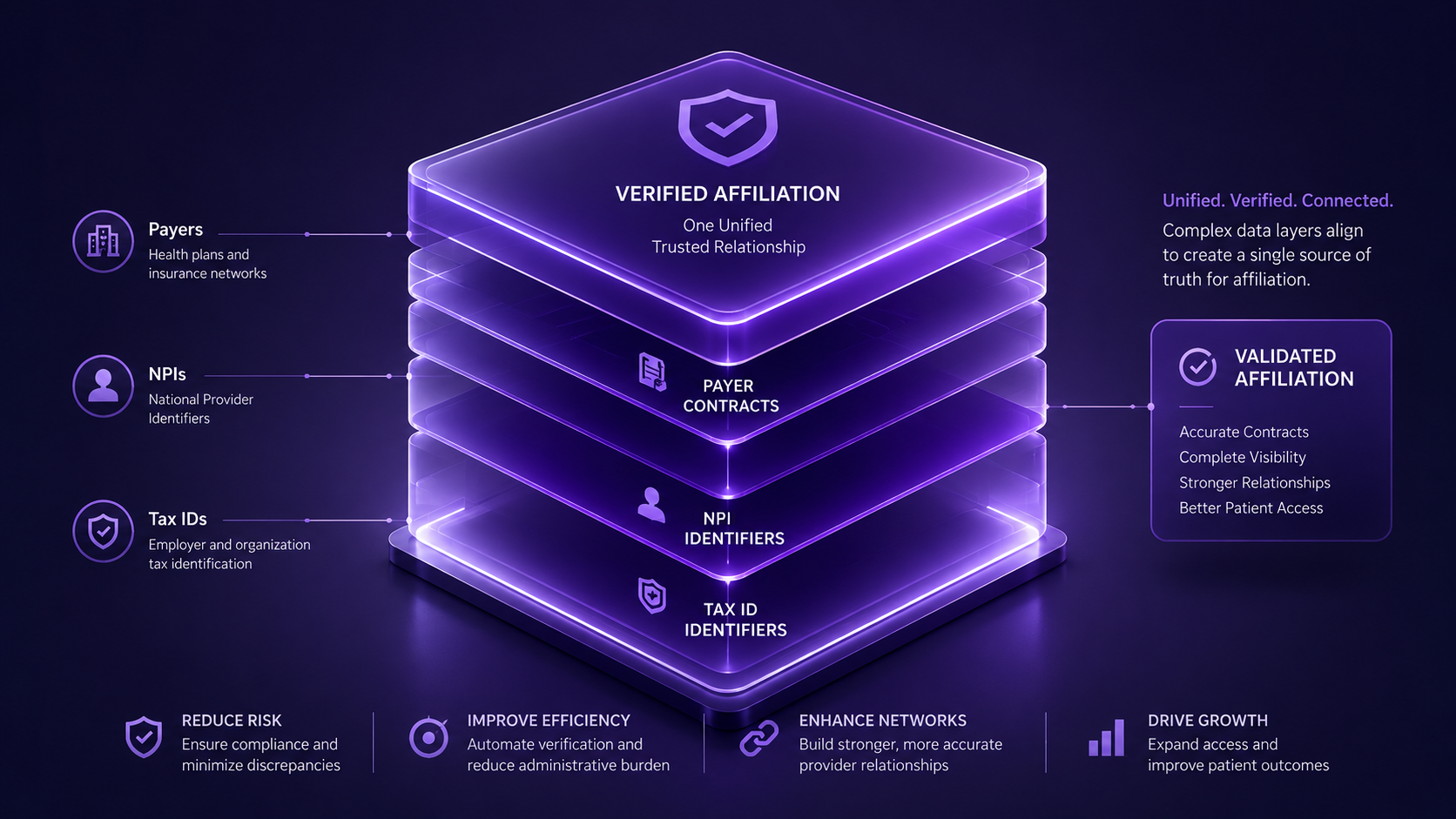
Provider Affiliation Management: Why Accurate Payer Relationships Matter
Healthcare providers can legally work for multiple medical practices, hospitals, or healthcare organizations simultaneously. A physician may split time between two practices, a nurse practitioner may work part-time for multiple employers, or a therapist may maintain employment with one organization while operating a separate practice.
From an operational standpoint, this arrangement is completely acceptable. Insurance companies, Medicare, and other payers have established processes that allow providers to be affiliated with multiple organizations. However, effective provider affiliation management is required to ensure these relationships are configured correctly within payer systems so that claims are processed accurately, and reimbursement reaches the correct organization.
When those relationships are managed properly, claims flow normally. When they are not, practices can experience denials, payment delays, reimbursement errors, and administrative headaches that are often difficult to identify until revenue is already being affected. For example, if a provider leaves one practice and joins another, outdated payer affiliation records may cause claims, payments, or remittance information to continue to be routed through the former organization.
In our experience supporting provider enrollment, payer credentialing, and revenue cycle operations, affiliation issues are often discovered only after claims are denied or reimbursements fail to match expected contract rates.
Operational Snapshot
Providers can legally maintain multiple employment relationships, but payer systems must accurately reflect every organizational affiliation. Even when credentialing is complete, incorrect payer mapping can trigger denials, payment delays, and reimbursement discrepancies.
In many cases, the provider was credentialed correctly, but the payer did not correctly link the provider to the billing organization. Without active monitoring of enrollment records, remittance data, and payer participation status, these issues can remain hidden for weeks or months.
Key Takeaways
- Healthcare providers may legally work for multiple organizations simultaneously.
- Credentialing approval does not automatically establish payer contract participation.
- Provider affiliations must be accurately reflected within payer enrollment systems.
- Incorrect affiliation records can lead to denials, reimbursement discrepancies, and payment delays.
- Medicare and commercial payers both rely on provider-to-organization relationships for proper claim processing.
- Provider transitions create elevated enrollment and payment-routing risks.
- Routine monitoring of ERAs, reimbursement rates, and participation records can help identify affiliation issues early.
Table of Contents
How Payers Track Provider Affiliations
Provider affiliation tracking often begins with the National Provider Identifier (NPI).
Healthcare professionals have their own NPI, commonly referred to as an NPI Type 1. Organizations, practices, and billing entities maintain their own group NPI, commonly referred to as an NPI Type 2.
A single provider can be linked to multiple organizations at the same time. Each organization maintains its own tax identification number, contracts, and payer relationships. The provider’s individual NPI is then associated with each participating organization through credentialing and enrollment processes.
Think of the organization as the umbrella and the providers as the individuals operating under it. The payer’s system must recognize both the provider and the organizational relationship in order to determine how a claim should be processed.
Technical Deep Dive: NPI & Adjudication
Payers do not evaluate a provider’s NPI in isolation. Claim adjudication depends on how the rendering provider, group NPI, tax ID, service location, and contract affiliation are connected within the payer’s enrollment system.
To master these interactions, read our comprehensive guide: NPI Number Essentials for Healthcare Providers.
Without that affiliation in place, the payer may recognize the provider but fail to recognize their participation under a specific group contract.
That distinction becomes important because reimbursement is not determined solely by the individual provider. It is determined by the relationship between the provider, the billing entity, the tax identification number, and the applicable payer contract.
Why Provider Affiliation Management Is Essential
Many organizations focus heavily on credentialing when a provider joins the practice. While credentialing is critical, it is only part of the process. Providers must also be properly affiliated with the group’s payer contracts.
A provider may appear fully credentialed within a payer’s system, but if the payer has not correctly linked that provider to the organization’s contract, claims can still be denied. Credentialing approval alone does not guarantee billing readiness.
Before submitting claims, organizations should verify group contract participation, affiliation status, and applicable effective dates to reduce the risk of preventable denials and payment delays.
This is one of the reasons why new provider onboarding frequently requires coordination among the credentialing, contracting, enrollment, and billing departments. Each area helps ensure the provider is correctly recognized within the payer’s system.
When a claim is submitted, payers review multiple pieces of information simultaneously, including:
| Claim Component | Purpose |
|---|---|
| Service Location | Identifies where services were performed |
| Group NPI | Identifies the billing organization |
| Tax Identification Number | Identifies the legal billing entity |
| Rendering Provider NPI | Identifies the individual who provided care |
| Contract Affiliation | Determines reimbursement eligibility and rates |
The payer evaluates all of these elements together before determining how the claim should be adjudicated.
Group Contract Participation Must Be Verified
Many organizations assume credentialing approval automatically means the provider can begin billing under the group’s contract. In reality, payer participation and group affiliation are often separate processes. Before submitting claims, organizations should verify that the provider appears under the correct group contract.
They should also verify that affiliation records are active and that effective dates have been established when applicable. This verification step is often what determines whether a newly credentialed provider is truly ready to bill under the organization’s payer agreements.
Affiliation Verification Should Be Documented
Practices should maintain documentation confirming payer affiliation approvals and effective dates. They should also maintain documentation of reassignment approvals, when applicable, and of provider participation under the organization’s contract.
Written confirmation should be retained whenever possible because it can help resolve enrollment disputes, reimbursement challenges, and participation discrepancies that may arise later. Relying solely on verbal confirmation can create unnecessary risk if enrollment issues affect reimbursement or trigger claim denials.
Medicare Uses a Similar Structure
The same general concept exists within Medicare enrollment. Through Medicare enrollment and reassignment processes, providers establish relationships with organizations that bill Medicare for services rendered. These relationships are maintained through enrollment records. The records are managed within PECOS and associated Medicare contractor systems.
Accurate enrollment and reassignment records help ensure claims are linked to the correct provider and billing organization. These affiliations are linked to Medicare participation records and provider identification assignments, which enable Medicare to determine where services were rendered and which organization should receive reimbursement.
As providers move between organizations or maintain multiple employment relationships, those affiliations must be accurately maintained to ensure proper claim processing. From Medicare’s perspective, the objective is the same as commercial payers: connect the provider to the correct organization and route reimbursement appropriately.
Revenue Cycle Risks When Providers Work for Multiple Practices
Where Problems Begin to Surface
Most providers who work for multiple organizations never experience significant billing issues. However, when problems do occur, they often originate from incorrect payer mapping, outdated enrollment information, or affiliation errors. One common issue involves reimbursement being processed under the wrong organizational relationship. These payment routing errors are not just isolated administrative headaches; they are critical breakdowns in your organization’s broader financial chain that warrant a comprehensive approach to Revenue Cycle Operations.
If payer systems incorrectly apply another organization’s contract terms, reimbursement may not match the contracted rate. Practices may find themselves receiving less than expected. In some situations, they may receive overpayments that later trigger audits, recoupments, or payment corrections.
Operational Snapshot
When providers participate with multiple organizations, reimbursement monitoring becomes a critical revenue cycle control. Unexpected payment variances may indicate that the payer applied the wrong contract relationship or affiliation record.
Neither outcome benefits the organization. Routine contract monitoring and payment validation become even more important when providers maintain affiliations with multiple entities.
Watch for Payment Routing Errors
Another area that deserves attention is payment routing. Electronic Remittance Advices (ERAs), Explanations of Benefits (EOBs), correspondence, and payments should consistently reflect the correct organizational information.
When reviewing payer communications, practices should verify:
- Provider information matches the rendering provider.
- Tax identification numbers match the billing entity.
- Addresses correspond to the correct organization.
- Payment information is being routed appropriately.
- Patient information belongs to the practice receiving the remittance.
If provider information appears correct but addresses, tax IDs, or organizational identifiers do not, it may indicate a payer configuration problem that requires immediate investigation. These issues may appear administrative on the surface. However, they can create significant downstream disruption in the revenue cycle if left unresolved.
The Red Flag Many Practices Miss
One of the clearest warning signs occurs when a practice receives information for patients it does not recognize. For example, an ERA may arrive listing one of your providers, but the patient is not in your system, and there is no matching date of service. That should immediately prompt further investigation.
Compliance Alert
Receiving remittance data for unfamiliar patients is a significant warning sign. The issue may indicate a payer affiliation or routing error that requires immediate review to prevent operational and compliance exposure.
In some situations, payer systems have mistakenly routed claim information, remittances, or correspondence to the wrong organization because provider affiliations were not configured correctly. Although uncommon, these situations require prompt attention because they can create both operational and compliance concerns if not addressed quickly.
For example, a provider may leave Practice A and begin working for Practice B while maintaining active participation with the same payer. If payer affiliation records are not updated correctly, claims may continue to be processed under outdated organizational relationships.
Revenue cycle teams may first discover the issue when payments fail to appear. They may also discover it when remittance information references unfamiliar patient accounts or reimbursement amounts do not align with the current contract.
Provider Transitions Create Additional Risk
Risk often increases when providers leave one organization and join another. If payers fail to update affiliation records properly, payments and communications may continue being directed to the former employer even after the provider has moved.
Revenue cycle teams may first notice the issue through aging accounts receivable. Claims begin reaching 45, 60, or even 90 days without payment activity. Staff may initially assume the payer is simply delayed. In reality, the payment may have been sent elsewhere, or the affiliation may never have been updated correctly.
Compliance Alert
Provider departures and onboarding events create elevated enrollment risk. Delayed payments after a transition should trigger immediate verification of affiliations, payment routing instructions, and payer contract participation records.
When reimbursement delays occur following a provider transition, practices should verify the following items:
| Verification Area | Why It Matters |
|---|---|
| Provider Affiliation Status | Confirms the provider is properly linked to the current organization within the payer’s system. |
| Tax Identification Associations | Ensures claims are connected to the correct legal billing entity. |
| ERA Delivery Information | Verifies remittance files are being sent to the correct organization. |
| Payment Routing Instructions | Confirms reimbursement is being directed to the appropriate bank account or payment destination. |
| Group Contract Participation Records | Validates that the provider is attached to the correct payer contract and reimbursement schedule. |
The sooner affiliation issues are identified, the easier they are to correct. Early investigation can prevent prolonged payment delays, unnecessary follow-up work, and avoidable revenue cycle disruption.
How Practices Often Discover Affiliation Problems
Affiliation problems are not always obvious at the point of billing. In many cases, practices first discover them through revenue cycle patterns that do not match normal payer behavior.
Common warning signs include unexpected payment variances and claims aging without clear denial activity. They also include ERA files routed to the wrong organization, unfamiliar patient information appearing on remittances, or a provider not appearing correctly in payer portals after onboarding.
When these warning signs appear, the issue should be investigated as an enrollment and affiliation problem rather than treated solely as a routine claims follow-up.
Affiliation Verification Checklist for New Providers
Before billing services under a new provider affiliation, organizations should verify:
- Credentialing approval has been finalized.
- Enrollment records reflect the correct service locations.
- Group affiliations have been established with each payer.
- Contract participation is visible within payer portals when available.
- Effective dates have been confirmed.
- ERA enrollment reflects the correct organization.
- Payment routing information is accurate.
- Tax identification numbers are linked correctly.
- Medicare reassignment records are active when applicable.
Completing these verification steps before submitting claims can help reduce avoidable denials, payment delays, and reimbursement discrepancies.
Frequently Asked Questions
Can a provider be in-network with the same payer at multiple organizations?
Yes. A provider may be affiliated with multiple participating organizations that contract with the same payer. However, each affiliation typically requires proper enrollment, credentialing, and payer recognition. Participation at one organization does not automatically establish participation at another.
How long should practices monitor claims after a provider joins the organization?
Monitoring should continue well beyond the provider’s first day of seeing patients. Many organizations perform enhanced review of claim status, remittances, participation records, and reimbursement rates during the first 60 to 90 days after onboarding to identify enrollment or affiliation issues before they create significant accounts receivable problems.
Are affiliation issues more common with commercial payers or government payers?
Affiliation-related issues can occur with either. The underlying problem is usually not the payer type itself but whether enrollment records, reassignment information, service locations, contract participation records, and billing relationships were updated correctly. Every payer maintains its own systems and processes, which is why verification remains important regardless of payer category.
What departments should be involved when investigating an affiliation problem?
Affiliation issues are rarely isolated to a single department. Credentialing, enrollment, contracting, billing, revenue cycle, and compliance teams may all need to participate in the investigation. Many reimbursement problems persist longer than necessary because organizations assume the issue belongs exclusively to one operational area.
What is the first thing to check when reimbursement suddenly changes for a provider?
While multiple factors can affect reimbursement, practices should confirm that the provider remains linked to the correct organizational affiliation and contract. Unexpected payment variances sometimes result from configuration changes, enrollment updates, service location changes, or contract mapping issues that are not immediately visible during routine claim review.
Preventing Affiliation Errors Before They Impact Revenue
Providers working for multiple organizations is not unusual, and it is not inherently problematic.
What matters is understanding how payer systems manage those relationships and ensuring internal teams know what to monitor.
Operational Snapshot
Affiliation management is not solely a credentialing responsibility. Revenue cycle, billing, enrollment, and contracting teams all play a role in identifying issues before they escalate into reimbursement delays or take-backs.
Credentialing departments should understand provider affiliations. Billing teams should validate reimbursements and payment routing. Revenue cycle leaders should monitor aging claims and investigate unusual trends quickly.
Most affiliation-related issues are manageable when identified early. The larger problems occur when organizations assume everything is functioning correctly and fail to recognize warning signs until reimbursement delays, take-backs, or contract discrepancies have already accumulated.
Ultimately, the goal is not to prevent providers from working for multiple organizations. The goal is to implement robust provider affiliation management to ensure that payer systems accurately recognize those relationships, so that claims are processed correctly. Payments must reach the right entity, and revenue must remain protected. A little operational awareness upfront can prevent a significant amount of cleanup later.
About the Author
Jennifer Blevens-Smith is the founder of Integral Clinic Solutions and has more than 20 years of experience in healthcare operations, provider enrollment, credentialing, and contracting. She also has experience in revenue cycle management, compliance administration, and practice development.
Throughout her career, she has worked with independent healthcare providers and medical practices. Her work has involved navigating payer enrollment, network participation, operational transitions, reimbursement challenges, and sustainable growth of the practice.
Her work focuses on helping providers build efficient healthcare businesses while maintaining high standards of patient care and regulatory compliance.
Need Help Strengthening Your Medical Practice Operations?
Integral Clinic Solutions provides practical support for medical practices navigating credentialing, contracting, provider enrollment, and revenue cycle operations. The company also supports compliance workflows, front-office systems, and practice management challenges.
Explore more operational guidance, compliance insights, and healthcare business resources on the Integral Clinic Solutions blog. New articles and updates are added regularly for practice owners, administrators, and healthcare teams.
Disclaimer: This content is provided for informational and educational purposes only. Credentialing, enrollment, contracting, reimbursement, licensing, and compliance requirements vary by payer, provider type, specialty, location, and regulatory authority. Providers and healthcare organizations should verify current requirements directly with applicable payers and regulatory agencies. Read our full Legal & Compliance Disclaimer.