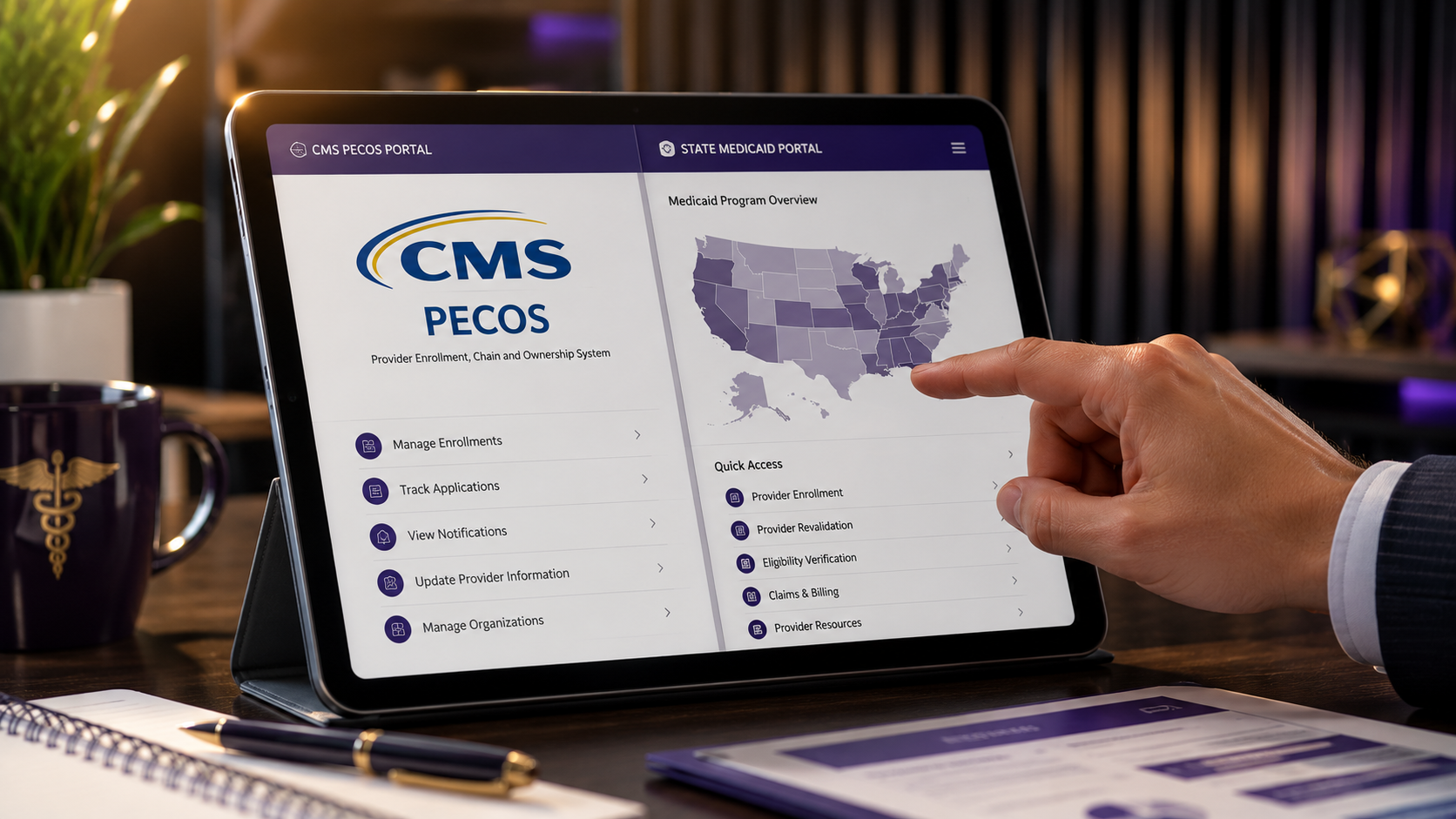
Medicare vs. Medicaid Credentialing: Understanding the Enrollment Differences
Medicare and Medicaid are both government healthcare programs, but provider enrollment follows different administrative pathways. Understanding those differences is important because practices must use different systems, agencies, and processes depending on the program.
For medical practices, the distinction matters because providers must understand the applicable enrollment and billing requirements before seeing patients and submitting claims. If enrollment is not completed correctly, the practice may not be able to bill, payments may be delayed, or claims may be denied altogether.
Understanding where to apply, what system to use, and who administers the program locally helps prevent unnecessary credentialing delays.
Operational Snapshot
Although both programs fall under CMS, Medicare and Medicaid follow different enrollment pathways. Understanding which agency, system, or contractor manages approval helps practices avoid preventable credentialing delays and reimbursement issues.
Key Takeaways
- Medicare and Medicaid use different provider enrollment pathways.
- Medicare enrollment generally uses PECOS, with applications processed by the applicable Medicare enrollment contractor.
- Medicaid provider enrollment requirements and processes vary by state.
- Medicaid participation may require state enrollment plus separate managed care credentialing or contracting.
- Practices should verify individual, group, location, specialty, and managed care requirements before beginning enrollment.
- Enrollment or participation problems can contribute to claim denials, reimbursement delays, and other billing complications.
Table of Contents
Medicare and Medicaid Are Not Managed the Same Way
Medicare generally serves people who are 65 and older, as well as certain younger individuals with disabilities and people with end-stage renal disease (ESRD). Medicaid serves lower-income individuals and families, but eligibility and program structure vary by state.
Both programs are connected to CMS, the Centers for Medicare & Medicaid Services, but they are administered differently.
| Program | Who It Generally Serves | How Enrollment Is Managed |
|---|---|---|
| Medicare | Adults 65+ and certain disabled individuals | Through PECOS and Medicare Administrative Contractors |
| Medicaid | Lower-income individuals and families | Through each state’s Medicaid program |
| Medicare groups | Clinics, practices, and organizations billing Medicare | Enrolled through PECOS |
| Medicaid groups | Clinics and organizations billing Medicaid | Enrolled or contracted through the state Medicaid program |
Medicare is divided into jurisdictions managed by Medicare Administrative Contractors (MACs), which oversee enrollment and claims administration for specific regions. Medicaid, on the other hand, is administered by each individual state. That means Oregon Medicaid, Florida Medicaid, Washington Medicaid, and other state programs may all have different enrollment processes.
How the Medicare Enrollment Pathway Differs
Unlike the state-specific enrollment pathways used by Medicaid programs, Medicare enrollment is generally completed through the Provider Enrollment, Chain, and Ownership System (PECOS), where individual providers and groups enroll to bill Medicare.
Original Medicare does not use the same negotiated-rate contracting process commonly associated with commercial health plans. Medicare Fee-for-Service reimbursement is generally based on Medicare-established payment methodologies and fee schedules rather than rates negotiated between an individual practice and Medicare.
Providers who need a deeper understanding of the Medicare-specific identifier associated with approved enrollment can also review our guide to Medicare PTAN management.
Technical Deep Dive
Medicare enrollment follows a more centralized administrative pathway than Medicaid enrollment. Applications are generally submitted through PECOS and reviewed by the appropriate Medicare Administrative Contractor (MAC). Medicaid enrollment, by contrast, follows the requirements established by each state program and may involve additional managed care participation requirements.
Practices should make sure they understand which Medicare Administrative Contractor applies to their state and provider type. Some MACs handle Part A and Part B, while others may be involved with DME, home health, or hospice services. The correct pathway matters because enrollment requirements can vary by provider type and service category. Submitting through the wrong process can delay approval.
Medicaid Credentialing Is State-Specific
Medicaid is different because each state manages its own program. Even though Medicaid receives federal support, enrollment is handled through the individual state Medicaid agency or its designated managed care organizations.
Providers must complete the enrollment requirements established by the state Medicaid program before billing for covered services. In some states, that may involve a Medicaid provider enrollment portal. In others, the process may include paper applications. It may also include managed care organization credentialing or additional state-specific documentation.
Because each state administers its program differently, enrollment procedures and documentation requirements can vary significantly. Approval timelines, provider screening standards, and managed care relationships can also vary.
Managed Care Adds Another Layer
Many states deliver Medicaid benefits through managed care organizations (MCOs), which administer coverage on behalf of the state program. State enrollment may establish provider eligibility, but providers may also need to complete separate credentialing, contracting, or other participation requirements with the Medicaid MCOs serving that patient population.
Many states deliver Medicaid benefits through managed care organizations (MCOs), which administer coverage on behalf of the state program. State enrollment may establish provider eligibility, but providers may also need to complete separate credentialing, contracting, or other participation requirements with the Medicaid MCOs serving that patient population.
The provider may also need to be credentialed or contracted with the Medicaid MCOs serving that patient population.
Practices expanding services or adding non-physician providers should also verify how those providers must be enrolled, credentialed, and linked to the group.
In our experience, one of the most common enrollment mistakes occurs when practices complete state Medicaid enrollment but overlook separate managed care credentialing requirements, leading to avoidable reimbursement delays.
Compliance Alert
State Medicaid approval does not always guarantee participation with Medicaid managed care plans. Many providers must complete separate MCO credentialing or contracting before claims can be reimbursed correctly.
Verifying participation requirements with each Medicaid managed care plan helps prevent unexpected claim denials and network access limitations.
The MCO may review the provider’s specialty, service area, and network needs before approval. It may also review malpractice history, licensing status, and other risk factors. In some cases, a plan may determine that its network is already full for a specific specialty or region.
In this video, I provide an operational deep dive into the practical differences between Medicare and Medicaid enrollment, including how each program is administered and where providers must complete enrollment. If you are preparing to credential providers or expand your practice, understanding these separate pathways can help prevent enrollment delays.
What to Verify Before Medicare or Medicaid Enrollment
Enrollment requirements can vary based on provider type, organizational structure, location, and services offered. Early verification is essential. Practices unfamiliar with government enrollment workflows may benefit from reviewing the credentialing process before beginning Medicare or Medicaid enrollment. This helps avoid wasted time and incomplete applications.
Key items to verify include:
- Whether the provider needs individual enrollment, group enrollment, or both
- Which Medicare Administrative Contractor applies to the provider’s location and service type
- Whether Medicaid enrollment is handled by the state, an MCO, or both
- Whether the application is completed through PECOS, a state portal, CAQH, or paper forms
- Whether the group needs separate enrollment before providers can be linked
- Whether specialty, location, or network limitations may affect approval
Many commercial and managed care plans continue to rely on CAQH data during credentialing reviews. Practices that participate with Medicaid managed care organizations may benefit from understanding how to properly manage a CAQH ProView profile to help avoid application delays.
Practices should confirm the applicable enrollment, effective-date, and billing requirements before providing services to Medicare or Medicaid patients. Providing services before the applicable enrollment or participation requirements are satisfied may result in claim denials, reimbursement delays, or billing issues that cannot always be corrected retroactively.
Compliance Alert
Practices should verify enrollment status before treating Medicare or Medicaid patients. Providing services before approval can create claim denials, reimbursement delays, and billing issues that may be difficult to correct retroactively.
Credentialing vs. Enrollment for Medicare and Medicaid
Healthcare organizations often use the terms credentialing, enrollment, and contracting interchangeably, creating confusion about which process applies to a specific payer or government program.
This matters because government programs do not always use the term “credentialing” the same way commercial payers do. Medicare, in particular, typically refers to this process as enrollment rather than credentialing or contracting.
Using the correct terminology helps practices find the right instructions faster.
Medicare and Medicaid Credentialing FAQs
What is the difference between Medicare enrollment and Medicaid enrollment?
Medicare enrollment is completed through PECOS and reviewed by the appropriate Medicare Administrative Contractor (MAC). Medicaid enrollment is managed by individual state Medicaid programs and may include additional requirements such as managed care organization (MCO) credentialing or contracting. The enrollment process, documentation requirements, and timelines can differ significantly between the two programs.
Do providers need to enroll separately in Medicare and Medicaid?
Yes. Medicare and Medicaid are separate programs with different enrollment processes. Approval in one program does not automatically grant participation in the other. Providers who plan to treat both Medicare and Medicaid beneficiaries must complete the applicable enrollment requirements for each program.
Is Medicaid enrollment the same in every state?
No. Each state administers its own Medicaid program and establishes its own enrollment procedures, documentation requirements, and participation rules. Providers should verify requirements directly with the state Medicaid agency or applicable managed care organizations before beginning the enrollment process.
Does Medicaid enrollment automatically include participation with Medicaid managed care plans?
Not always. Many states require providers to complete separate credentialing, contracting, or network participation requirements with Medicaid managed care organizations. State Medicaid enrollment alone may not guarantee reimbursement from every Medicaid managed care plan operating in the state.
What is a Medicare Administrative Contractor (MAC)?
A Medicare Administrative Contractor (MAC) is a private organization that processes Medicare enrollment applications and claims for a specific geographic region. MACs also provide provider education, enrollment support, and claims administration services on behalf of Medicare.
Can a provider see Medicare or Medicaid patients before enrollment is approved?
Requirements vary depending on the program, payer policies, and applicable regulations. Providers should verify enrollment and billing requirements before treating Medicare or Medicaid patients. Providing services before approval may result in claim denials, reimbursement delays, or other billing complications.
Does a group practice need separate enrollment from individual providers?
In many cases, yes. Group practices may need their own enrollment approval before individual providers can be linked to the organization for billing purposes. Requirements vary by program, payer, and organizational structure, so practices should confirm enrollment requirements before submitting applications.
What information should practices verify before starting enrollment?
Practices should verify whether individual enrollment, group enrollment, or both are required. They should also confirm the appropriate Medicare Administrative Contractor, state Medicaid requirements, managed care participation requirements, application methods, and any specialty-specific or network participation restrictions that could affect approval.
Choosing the Right Medicare or Medicaid Enrollment Pathway
Medicare and Medicaid are both government-supported programs, but their enrollment processes are not the same. Medicare enrollment generally follows a centralized pathway through PECOS and the applicable Medicare Administrative Contractor, while Medicaid enrollment follows state-specific processes that may include additional managed care participation requirements.
For practices, the most important step is knowing where the provider or group needs to enroll before patients are seen and claims are submitted. Medicare is primarily an enrollment process. Medicaid may involve state enrollment, managed care credentialing, managed care contracting, and group participation requirements, depending on the program structure.
When practices understand the difference early, they can avoid delays, protect reimbursement, and make sure providers are properly approved before billing begins.
About the Author
Jennifer Blevens-Smith is the founder and sole consultant driving Integral Clinic Solutions. Armed with deep domain expertise and a commitment to protecting independent medicine, she delivers the personalized, executive-level guidance that healthcare leaders need to build sustainable, high-performing organizations.
Need Help Strengthening Your Medical Practice Operations?
Integral Clinic Solutions provides practical support for medical practices navigating credentialing, contracting, revenue cycle operations, compliance workflows, front-office systems, and practice management challenges.
Explore more operational guidance, compliance insights, and healthcare business resources on the Integral Clinic Solutions blog. New articles and updates are added regularly for practice owners, administrators, and healthcare teams.
Disclaimer: This content is for informational and educational purposes only and does not constitute legal, coding, billing, compliance, financial, or medical advice. Healthcare practices must verify all operational requirements with applicable payers, regulators, and qualified professionals. Read our full Legal & Compliance Disclaimer.