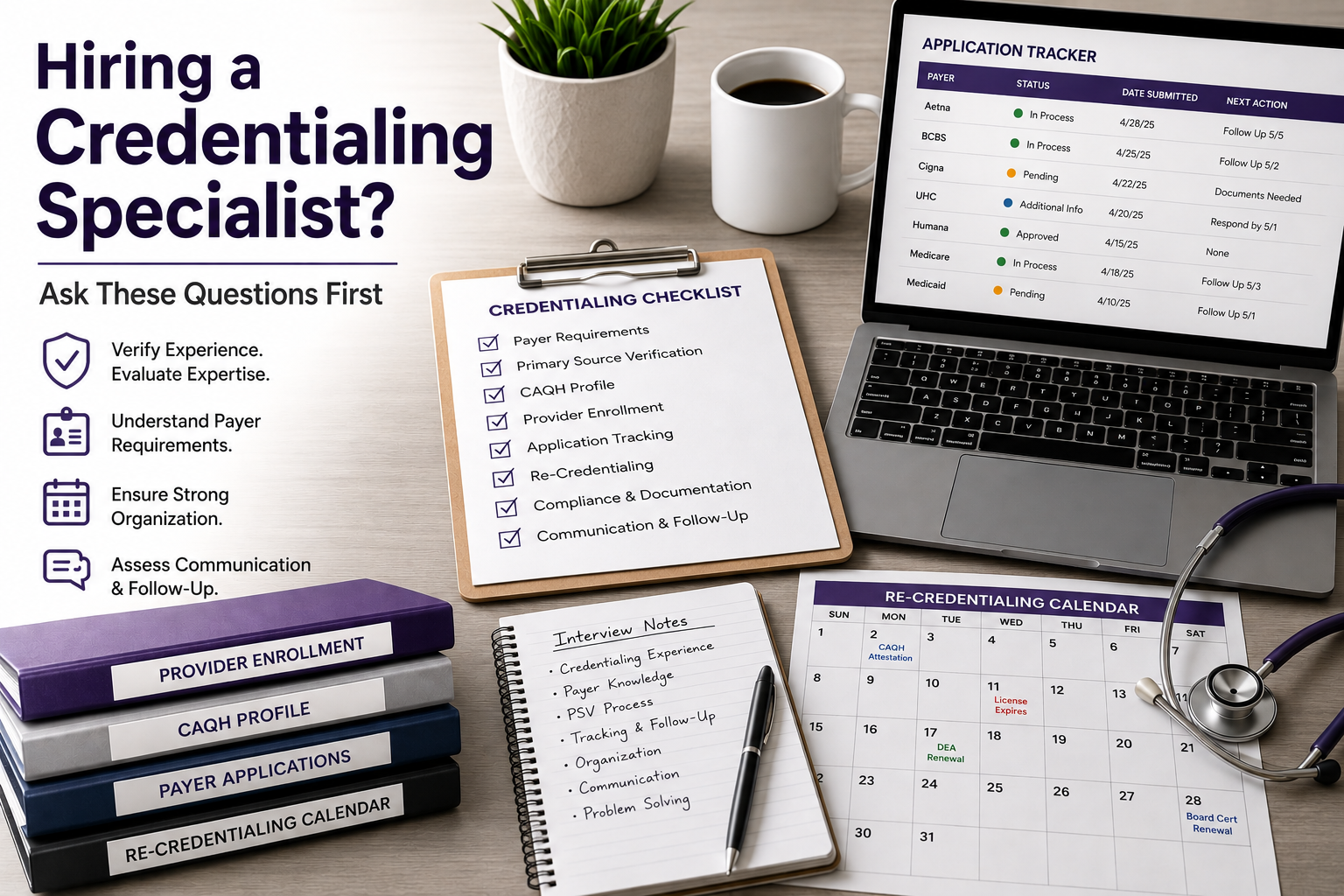
How to Interview a Credentialing Specialist Before You Hire
Hiring a credentialing specialist can protect your practice from delayed enrollments, missed payer deadlines, and revenue interruptions. But hiring the wrong person can create the same problems you were trying to avoid.
Key Takeaways
- Credentialing directly affects provider onboarding, payer participation, and reimbursement.
- Experience with real-world payer enrollment challenges is often more valuable than certifications alone.
- Strong credentialing specialists maintain structured tracking systems and documented follow-up processes.
- Re-credentialing management is critical to maintaining uninterrupted payer participation.
- Communication, accountability, and escalation procedures should be discussed before engagement begins.
- Poor credentialing processes frequently create downstream revenue cycle problems.
Credentialing is often viewed as an administrative task. After more than 20 years working in healthcare operations, administration, and provider enrollment, I have seen credentialing mistakes create significant financial consequences for medical practices. Delayed enrollments, missed re-credentialing deadlines, incomplete applications, and inaccurate provider records can prevent claims from being paid. They can also delay a provider’s ability to see patients as an in-network participant.
Operational Snapshot
Credentialing errors often surface as reimbursement problems rather than administrative issues. Delayed enrollments, incomplete applications, and inaccurate provider records can directly affect claim payments and provider onboarding timelines.
Start With Their Actual Credentialing Experience
Credentialing is not simply paperwork. It is the process that determines whether providers can participate with insurance networks, bill under contracted agreements, and maintain active payer status over time. If you are unfamiliar with the enrollment lifecycle, our guide to the essential steps in the credentialing process provides a detailed overview of how provider enrollment moves from application through approval.
That is why the interview process matters. You are not simply hiring someone to complete forms. You are hiring someone whose work directly affects provider onboarding and payer participation. Their work also affects reimbursement timelines and revenue cycle performance. The right credentialing specialist should understand both the administrative requirements and the operational impact of credentialing decisions.
A practice may hire a provider expecting patient appointments to begin within a few months. If credentialing applications are delayed or incomplete, enrollment timelines can be significantly extended, affecting scheduling, staffing plans, and projected revenue. These situations are common enough that credentialing should be viewed as a business-critical function rather than a purely administrative task.
This is why credentialing experience should be evaluated as part of provider readiness, not just application processing. Hospitalogy recently described credentialing and enrollment as a major operational bottleneck because a hired provider may be present in the organization but still unable to generate billable revenue until credentialing, enrollment, and payer participation are complete.
That same issue applies to smaller practices. A provider is not truly ready to see insured patients until the payer side is operationally complete. For additional industry perspective, see Hospitalogy’s article on the credentialing and enrollment bottleneck.
The first question should be simple:
How much credentialing experience do they actually have?
Credentialing is often learned through hands-on work. A certification can be helpful, but it does not replace real experience dealing with payer applications, provider data, missing documents, rework, and slow approvals. A strong candidate should be able to explain the types of providers they have credentialed. They should also be able to discuss the payer groups they have worked with and the volume of applications they have managed.
The goal is not just to hear that they have “done credentialing before.” You want to understand whether they have handled situations similar to yours. Credentialing a solo provider is different from adding multiple providers to a group contract. Starting a new practice is different from maintaining an established payer roster. Managing Medicare enrollment is different from working through commercial payer portals and state Medicaid requirements.
A good follow-up question is:
What credentialing challenges have you handled with payers in our state?
That answer will usually tell you much more than a resume.
Evaluate Their Knowledge of Payer Requirements
Credentialing is not the same across every payer. Each insurance company may have different forms, portals, timelines, documentation requirements, and follow-up expectations. Some payers move quickly. Others routinely take months or request additional information midway through the process.
Credentialing requirements can also vary significantly between commercial plans, Medicare Advantage organizations, Medicaid managed care plans, and other payer types. Network participation criteria, verification requirements, re-credentialing standards, and enrollment workflows are not always consistent across plans.
A credentialing specialist should be able to explain how they identify payer requirements before submitting applications. They should also know how to track what has been submitted, what is still pending, and what needs follow-up.
A knowledgeable credentialing specialist should also understand primary source verification (PSV), which is the process of validating provider credentials directly with the original issuing source. Credentialing depends on accurate verification of licenses, education, training, certifications, and other qualifications before enrollment decisions are made.
During the interview process, consider asking:
Can you explain your process for primary source verification and credential validation?
Experienced credentialing specialists understand that provider information should not be accepted at face value. Licenses, board certifications, malpractice coverage, and sanctions information must be verified through authoritative sources rather than relying solely on provider-supplied documents. Their answer can provide valuable insight into their understanding of credentialing standards, data accuracy, compliance requirements, and risk management.
For additional background on why primary source verification is an essential component of credentialing, see this overview from DataSpring.
| Interview Area | What You Want to Hear |
|---|---|
| Payer knowledge | Familiarity with Medicare, Medicaid, and major commercial payers in your state |
| Timeline expectations | Realistic estimates, not promises that everything will be completed quickly |
| Documentation process | A clear list of what they need before applications begin |
| Follow-up system | A tracker, spreadsheet, software, or other organized method |
| Escalation process | A plan for delayed, denied, or stalled applications |
If someone gives vague answers or says payer timelines are usually predictable, that is a concern. Credentialing rarely moves perfectly. The stronger candidate is usually the one who is honest about delays and can explain how they prevent those delays from becoming revenue problems.
Evaluate Their Credentialing Process
Review Their Tracking and Organization System
Credentialing depends heavily on the organization. There are provider licenses, DEA registrations, malpractice documents, CAQH profiles, NPI information, tax IDs, group NPIs, W-9s, payer applications, effective dates, and re-credentialing deadlines.
If these details are not tracked properly, things get missed.
Ask directly:
How do you track credentialing progress?
A strong answer should include more than “I keep notes.” They should be able to describe how they track each payer and application status. They should also explain how they monitor submission dates, follow-up dates, missing items, approval status, and effective dates. For an established practice, they should be able to track re-credentialing deadlines so payer participation does not lapse.
Technical Deep Dive
Effective credentialing management requires structured tracking of submissions, payer responses, missing documents, follow-up dates, approvals, and renewal deadlines. Informal note-taking is rarely sufficient for multi-payer enrollment environments.
This matters operationally because credentialing delays do not stay isolated. From an operational perspective, credentialing issues often create downstream revenue cycle problems. When I audit provider enrollment and reimbursement workflows, I frequently find that denied claims, delayed payments, and participation disputes can be traced back to incomplete enrollment records.
They can also result from missed follow-up activities or inaccurate provider information. A strong credentialing specialist understands that their work affects far more than application processing. It affects whether the organization gets paid correctly.
For a broader look at how enrollment, billing, claim submission, and payment workflows work together, read our guide on Revenue Cycle Management in Healthcare.
If a provider cannot bill in-network on time, scheduling may need to be adjusted, revenue projections may change, and billing staff may have to manage claims differently. If re-credentialing is missed, claims may be denied even though the provider has been seeing patients for years.
Ask About Communication Expectations Upfront
Credentialing requires consistent communication between the specialist, the provider, the practice, and the payer. A credentialing specialist who does not communicate well can leave leadership unsure of where things stand.
Before hiring, ask how often they provide updates and what those updates include. Weekly updates are often appropriate during active credentialing, especially if multiple payers are involved. Those updates should identify what has been submitted and what is pending. They should also identify what is delayed and what the practice needs to provide.
You should also ask how quickly they respond to questions and what method of communication they prefer. Email is usually best for documentation, but urgent issues may require phone follow-up. What matters most is that expectations are clear before the work begins.
Poor communication creates unnecessary friction. Practice owners should not have to chase someone repeatedly to find out whether an application was submitted or whether a payer responded.
Assess Their Ability to Manage Credentialing Challenges
Confirm What They Need From You
A qualified credentialing specialist should be able to tell you exactly what they need before starting. If they cannot clearly outline required documents, that may signal inexperience or disorganization.
Most credentialing work requires provider licenses, certifications, malpractice coverage, NPI information, and CAQH access. It also requires DEA registration when applicable, tax ID information, a group NPI, a W-9, practice demographics, service locations, and payer lists. If you are unfamiliar with the differences between individual and organizational NPIs, see our guide on NPI Number Essentials.
This question also helps clarify responsibilities. Credentialing is a partnership. The specialist can manage the process, but the practice still has to provide accurate information quickly. If the provider delays documents or CAQH updates, the credentialing timeline can stall.
Clear expectations prevent both sides from blaming each other later.
Ask How They Handle Delays and Denials
Delays happen. Applications get lost. Payer portals malfunction. Documents are rejected, and representatives provide conflicting information. The question is not whether a credentialing specialist has experienced delays. The question is how they respond when delays occur.
Ask:
What is your process when an application is delayed, denied, or stuck with a payer?
You want to hear that they follow up consistently and document payer communication. They should escalate when needed and notify the practice early. You do not want someone who waits until the expected completion date passes before checking the status.
Compliance Alert
Enrollment delays should trigger immediate follow-up and escalation efforts. Waiting until expected completion dates pass can create avoidable disruptions to hiring plans, provider scheduling, and cash flow.
A delayed credentialing application can affect hiring plans, provider schedules, and cash flow. A strong specialist understands that and treats follow-up as part of the job, not an afterthought.
Do Not Ignore Re-Credentialing
Credentialing is not a one-time event. Payers periodically require providers to re-credential to maintain participation. If that process is missed, the provider may lose active status with the payer, and claims may be denied.
Ask whether the specialist manages re-credentialing and how they track renewal deadlines. If you are hiring someone for ongoing support, this is especially important. A good credentialing specialist should understand that maintaining payer participation is just as important as initial approval.
Credentialing Specialist Interview Red Flags
Just as important as identifying positive qualifications is recognizing warning signs during the interview process. Experienced credentialing specialists understand that payer enrollment can be complex, timelines can change unexpectedly, and successful outcomes depend on organization, communication, and consistent follow-up. If a candidate struggles to explain their process or makes unrealistic promises, proceed carefully.
The following red flags may indicate a lack of experience, weak operational processes, or unrealistic expectations about credentialing management.
| Red Flag | Why It Matters |
|---|---|
| Guarantees specific payer approval timelines | Payer processing times are influenced by factors outside the specialist’s control. Experienced professionals discuss estimated timelines and potential delays rather than making guarantees. |
| No documented tracking system | Credentialing requires ongoing monitoring of submissions, follow-up dates, approvals, effective dates, and renewal deadlines. Relying solely on memory or informal notes increases the risk of missed tasks. |
| Cannot explain escalation procedures | Applications occasionally become delayed, denied, or stalled. A qualified specialist should have a clear process for follow-up, escalation, and issue resolution. |
| Limited knowledge of CAQH management | CAQH is a foundational component of commercial payer credentialing. Inexperience with profile maintenance, attestations, and document management can create enrollment delays. |
| No process for managing re-credentialing | Initial enrollment is only one part of credentialing. Failure to monitor renewal deadlines can result in participation issues and denied claims. |
| Provides vague answers about prior experience | Strong candidates can describe provider types, payer experience, enrollment volume, and specific challenges they have successfully managed. |
One of the most common mistakes organizations make is focusing exclusively on whether applications can be submitted. Submission is only the beginning of the process. The more important question is whether the specialist has the systems, experience, and accountability measures necessary to move applications from submission through approval. They must also be able to minimize enrollment delays and participation risks.
Limited familiarity with CAQH is often a warning sign because many commercial payer credentialing workflows depend on accurate profile management, document maintenance, and timely attestations. For a deeper understanding, see our guide to the CAQH ProView platform.
Discuss Fees, Scope, and Accountability
Discuss Fees and Scope Clearly
Credentialing can be expensive because it is time-consuming. The cost may be structured per provider, per payer, hourly, monthly, or by project. Before signing an agreement, clarify exactly what is included.
Does the fee include application submission only, or does it include follow-up until approval? Are payer corrections included? Is CAQH maintenance included? Are re-credentialing services included? Are additional fees charged for Medicare, Medicaid, or commercial payers?
This needs to be clear upfront. A lower price does not help if the service only covers partial submission and leaves your team responsible for follow-up. At the same time, a higher price should be accompanied by clear deliverables, organized reporting, and accountability.
Verify References and Previous Results
Before hiring a credentialing specialist, consider asking for professional references or examples of previous credentialing projects. While payer information and provider data should remain confidential, an experienced specialist should be able to discuss prior work, describe credentialing workflows they have managed, and explain how they tracked progress and resolved challenges.
You may also ask about average credentialing volumes, provider types supported, and software platforms used. Ask about their experience with Medicare, Medicaid, and commercial payer enrollment as well. The goal is not to test memorization. The goal is to verify that the candidate has successfully managed credentialing processes similar to those used within your organization.
Frequently Asked Questions
What qualifications should a credentialing specialist have?
Experience is often more important than certifications alone. A strong credentialing specialist should understand Medicare, Medicaid, commercial payer enrollment, CAQH management, provider documentation requirements, and payer follow-up processes. They should also have experience managing credentialing projects similar to your practice’s needs.
How long does provider credentialing usually take?
Credentialing timelines vary by payer, provider type, and state requirements. Some enrollments may be completed within a few weeks, while others can take several months. Experienced credentialing specialists provide realistic estimates and maintain follow-up procedures rather than guaranteeing approval dates.
Should a credentialing specialist manage CAQH profiles?
In many cases, yes. Commercial payers frequently rely on CAQH information during credentialing and re-credentialing reviews. A qualified credentialing specialist should understand profile maintenance, document updates, attestations, and how CAQH information is shared with participating organizations.
What are the biggest warning signs when interviewing a credentialing specialist?
Common warning signs include unrealistic promises about payer timelines, lack of a documented tracking system, inability to explain escalation procedures, limited knowledge of CAQH, and no process for managing re-credentialing deadlines. Strong candidates should be able to clearly explain how they handle enrollment challenges.
Can credentialing mistakes affect reimbursement?
Yes. Credentialing errors can delay provider participation, prevent claims from processing correctly, create reimbursement delays, and lead to denied claims. In many organizations, revenue cycle issues can be traced back to enrollment problems, incomplete provider records, or missed follow-up activities.
Should a credentialing specialist handle re-credentialing?
If the specialist provides ongoing support, re-credentialing management should be part of the discussion. Payers periodically require providers to re-credential to maintain participation status. Missing these deadlines can result in participation issues and claim denials.
Making the Right Credentialing Hire
Hiring a credentialing specialist should not be rushed. This role directly affects payer participation, provider onboarding, claim payment, and long-term revenue stability.
The right person should be organized, payer-aware, realistic about timelines, and consistent with follow-up. They should be able to explain their process clearly and provide proof of progress without being chased.
Credentialing problems are often preventable when the right systems are in place. Asking better interview questions helps you identify whether a specialist has the experience and structure needed to protect your practice from avoidable delays and missed deadlines. It also helps protect the practice from revenue disruption.
About the Author
Jennifer Blevens-Smith is the founder and sole consultant driving Integral Clinic Solutions. Armed with deep domain expertise and a commitment to protecting independent medicine, she delivers the personalized, executive-level guidance that healthcare leaders need to build sustainable, high-performing organizations.
Need Help Strengthening Your Medical Practice Operations?
Integral Clinic Solutions provides practical support for medical practices navigating credentialing, contracting, revenue cycle operations, compliance workflows, front-office systems, and practice management challenges.
Explore more operational guidance, compliance insights, and healthcare business resources on the Integral Clinic Solutions blog. New articles and updates are added regularly for practice owners, administrators, and healthcare teams.
Disclaimer: This content is for informational and educational purposes only and does not constitute legal, coding, billing, compliance, financial, or medical advice. Healthcare practices must verify all operational requirements with applicable payers, regulators, and qualified professionals. Read our full Legal & Compliance Disclaimer.