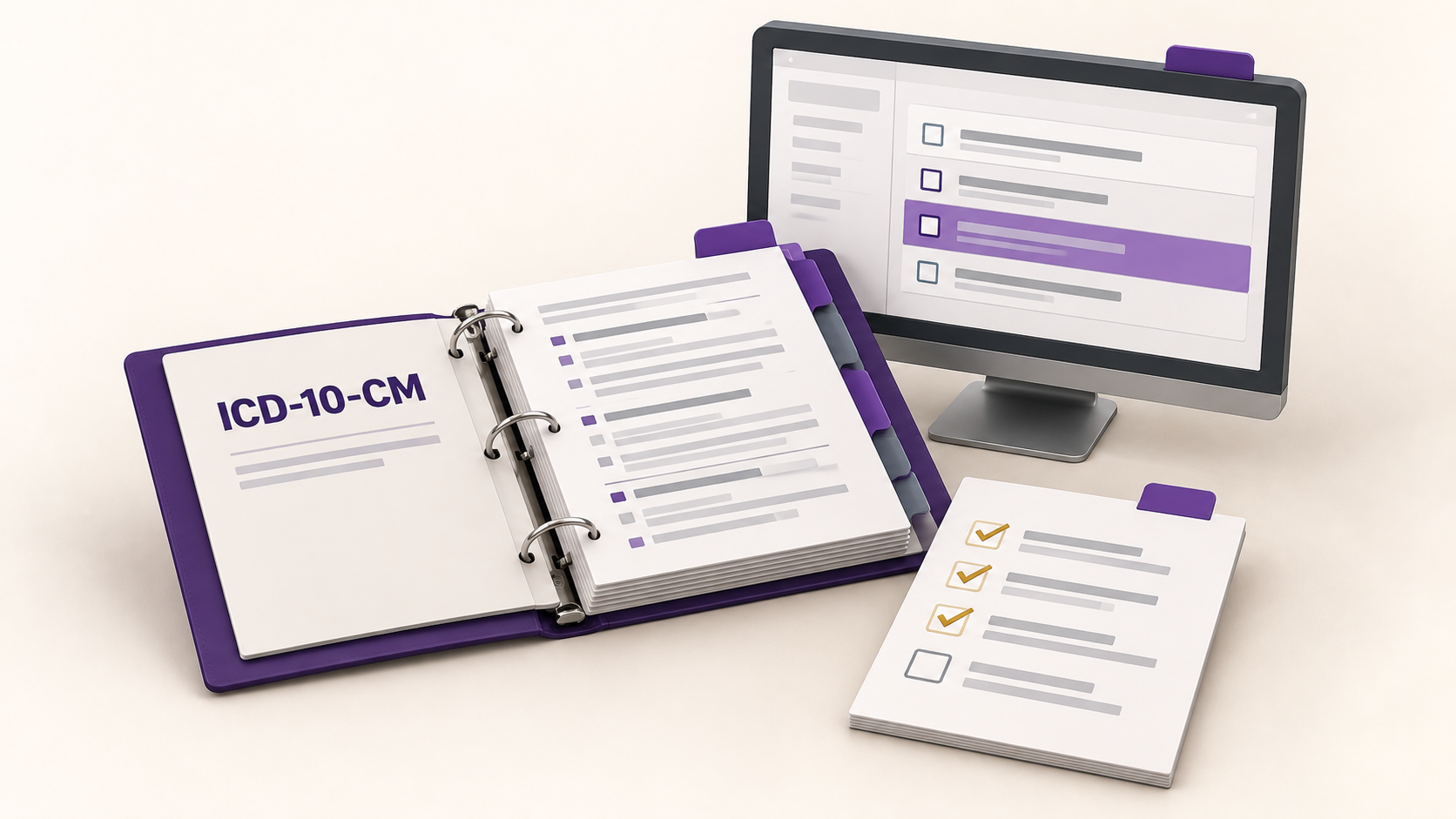
From Code Release to Claim Review: Preparing Your Practice for ICD-10-CM Updates
ICD-10-CM updates can affect a medical practice long before anyone notices a claim problem. A revised instruction may change how staff review documentation. A deleted code may remain on a favorite list. An updated EHR may pass a diagnosis to a billing system that still uses an older release. Each situation calls for a different response.
The practice needs a repeatable process that connects the official release to the work people perform. That process includes reviewing relevant changes, deciding what needs action, assigning responsibilities, testing the affected path, and checking results after implementation. A vendor installation is one milestone within that work.
This article focuses on managing recurring diagnosis-code updates in independent practices and small groups. It does not teach individual diagnosis coding or catalog a single year’s additions. Coding decisions still require the applicable official instructions, clinical documentation, and qualified review.
For a broader explanation of how diagnosis coding connects with documentation, staff responsibilities, and claim workflows, see our article on ICD-10 diagnosis coding in medical practice operations. This article focuses on preparing for and implementing recurring ICD-10-CM updates.
Key Takeaways
- Monitor official releases and verify their effective periods.
- Review relevant instructional and guideline changes alongside code additions, deletions, and revisions.
- Identify every affected system, template, workflow, and reference.
- Assign practice and vendor responsibilities, then educate affected staff.
- Test the connected workflow and preserve access to applicable historical releases.
- Monitor results, correct underlying problems, and verify the corrections.
Table of Contents
Monitor Official ICD-10-CM Updates and Confirm Effective Dates
Keep Diagnosis and Procedure Updates Separate
ICD-10-CM is the United States diagnosis classification used across healthcare settings. ICD-10-PCS classifies procedures for inpatient hospital reporting. An office practice should not treat a PCS release as its professional procedure-code update. CPT and HCPCS have their own maintenance processes and are outside this article’s implementation scope.
CDC’s National Center for Health Statistics publishes official ICD-10-CM materials. CMS also provides diagnosis-code files and maintains ICD-10-PCS materials. Start with official release pages, rather than an annual summary copied from an educational website. A commercial reference or specialty summary may help explain changes, but it should not replace the applicable official files.
Assign one person to monitor releases and a backup who can cover absences. For a small practice, the owner may be a coding lead, billing supervisor, or administrator. The important issue is that someone can identify a release, start the review, and follow unresolved work through completion. Outsourcing billing does not eliminate the need for an internal contact.
Confirm Which Release Applies
Build the monitoring calendar around the October 1 fiscal-year release and check for applicable April 1 updates. Also watch for corrected files, errata, and revised guidance. Do not assume that every release changes every specialty or that every file has the same effective period.
Record the release name, official source, date reviewed, and effective dates. The fiscal-year label refers to the year in which the federal fiscal year ends. Avoid choosing a file solely because its year looks current. Read the stated period and determine whether later materials replace it.
For routine office encounters, the service date is central to identifying the applicable diagnosis-code version. Hospital inpatient reporting uses the discharge-date framework. Staff who handle different claim types need to verify the rules applicable to each setting. The date a biller opens or submits a claim does not, by itself, determine the code version.
Keep prior versions available for work involving older services. A correction submitted after a release takes effect may still concern an encounter before that effective date. Staff need access to the version that applies to the encounter, even when the system’s default search displays the newest release.
Compliance Alert
A claim submitted after an update takes effect may still concern an earlier encounter. Applying the newest code version to every claim can create a second error while staff try to correct the first. Verify the applicable service-date or discharge-date rules before changing the diagnosis coding.
Identify Which ICD-10-CM Updates Affect Your Practice
Start the review with the practice’s actual specialties, services, patient conditions, and commonly reported diagnosis families. Recent utilization reports can identify frequent codes. However, frequency alone is not enough. Include less common diagnoses used for important services and changes to instructions that may affect a broader group of codes.
Review the addenda, updated Alphabetic Index and Tabular List, code descriptions, and official guidelines as applicable. A list of additions is useful, but it does not describe the entire implementation task. An unchanged code may still sit beneath a revised instruction.
| Change Type | Question to Investigate | Possible Practice Action |
|---|---|---|
| Addition | Does the practice document encounters this code describes? | Review applicability, documentation, and system availability. |
| Deletion or expansion | Where is the old code still available for new work? | Review favorites and local references; determine supported selections. |
| Description revision | Does the wording affect how staff interpret the code? | Review reference text and relevant training. |
| Instructional change | Has an applicable Tabular or Index instruction changed? | Review coding steps and documentation requirements. |
| Guideline change | Does the revised guidance change the review process? | Update affected procedures and staff education. |
Review Changes Beyond New Codes
Separate additions, deletions, descriptor revisions, instructional changes, and guideline changes. Each category raises a different question. An addition may create a relevant option. A deletion may require a review of stored favorites. A revised instruction may require a change in the documentation or review process even when the code number remains unchanged.
When a code is deleted or expanded, do not automatically replace it with the nearest description in a spreadsheet. The appropriate selection depends on the documented encounter and applicable coding instructions. A conversion table can help identify an area to investigate; it does not replace coding judgment.
Document the conclusion for each relevant change. Record what changed, why it matters to the practice, where it appears in the workflow, and what action is needed. Some changes may require no action after review. Recording that conclusion helps distinguish an intentional decision from an overlooked item.
A practical change log connects the coding review to implementation. For example, an entry might identify a deleted diagnosis favorite, the templates that reference it, the person responsible for review, and the evidence needed to close the task. This is an illustrative workflow example, not a recommendation for a particular replacement code.
Map Relevant Changes Across Systems and Workflows
A relevant update can appear in more than one location. The central diagnosis library may change while a clinician’s personal favorite list remains untouched. A printed reference can outlast an electronic update. An interface may transmit a diagnosis correctly but expose a different description in the receiving system.
Trace the Diagnosis Through Connected Systems
Use workflow mapping to trace the affected diagnosis through the practice’s own workflow. Consider where staff document the encounter, select the code, transfer it, review the claim, and correct a problem. Identify the actual systems and local materials involved. Avoid assuming that one product update covers every connected application.
Review diagnosis favorites, order sets, documentation prompts, encounter templates, billing rules, claim-edit settings, and interface mappings where applicable. Examine locally maintained reference sheets and procedures too. Each item belongs in the review only when the identified change affects it.
| Affected Component | Responsible Reviewer | Evidence of Completion |
|---|---|---|
| Diagnosis library and activation dates | System vendor and practice coding lead | Applicable release and date handling verified. |
| Favorites and encounter templates | Clinical lead and authorized EHR administrator | Affected items reviewed and tested. |
| Billing interface and claim edits | Billing lead and relevant vendors | Representative information transfers correctly. |
| Local references and procedures | Assigned document owner | Current materials available; old working copies retired. |
| Staff readiness | Department lead | Relevant instruction delivered and questions resolved. |
Templates deserve particular attention when a change introduces a relevant documentation distinction. The purpose is to help clinicians capture accurate clinical documentation for the encounter. Do not add a default diagnosis or a forced clinical answer merely because a more detailed code exists.
Jennifer Blevens-Smith explains how overused patient-note templates can weaken documentation accuracy. This supports reviewing prompts carefully when coding updates affect the information clinicians need to document.
Preserve the distinction between a historical record and a tool used for new work. Updating a current favorite list does not justify rewriting older diagnoses across the chart. Staff should follow appropriate documentation and correction procedures when an older record requires review.
The impact map should identify who can change each item and who will confirm the result. A coder may identify the change but lack permission to alter an EHR template. An administrator may coordinate the work but need clinical approval for a documentation prompt. These dependencies affect the implementation schedule.
Technical Deep Dive
A vendor can update the central diagnosis library while locally maintained favorites, templates, or connected systems still reflect older information. Treat code availability and workflow readiness as separate checks. Confirm which components the vendor maintains and test the diagnosis through the affected systems.
Coordinate ICD-10-CM Updates With Staff and Outside Partners
Define What Each Party Will Deliver
Ask the EHR and practice-management vendors which release they will load, when installation will occur, and whether activation follows the effective date. Confirm whether the update includes code descriptions and rules or only the central code library. Confirm vendor responsibility boundaries, including which local items the practice must maintain.
When different vendors support the EHR, billing platform, and interface, identify the responsible contact for each system. A support ticket should describe the relevant release, affected function, expected behavior, and unresolved question. An assurance that the software is updated may leave important details unanswered.
Include the clearinghouse or outsourced billing team when the change affects their edits, data handling, or workflows. Contact an affected payer when a specific coverage policy, edit, or implementation question needs clarification. Practices do not need to obtain separate approval from every payer before applying official diagnosis-code updates.
A valid code does not establish coverage or guarantee payment. Code-set validity, documentation support, coverage criteria, and payer edits are separate issues. If a payer system appears to reject an applicable code, investigate the stated reason rather than changing the diagnosis to obtain payment.
Set deadlines that reflect dependencies. Template review may need clinical input before training can occur. An interface check may depend on two vendor installations. Assign a backup or escalation contact for work that could delay implementation.
Educate Staff on the Tasks That Change
Training should explain relevant changes in terms of the person’s work. Clinicians may need to understand a new documentation distinction. Coding staff may need to review changed instructions. Billing staff may need to recognize an implementation-related edit and route it correctly.
Use the practice’s actual workflow for education. Explain what staff will see, what action they should take, and who handles uncertainty. Include how to report a missing code, an outdated favorite, or a mismatch between systems.
Keep training focused on relevant changes rather than asking everyone to learn the entire release. Save the approved materials in an accessible location and retire obsolete working copies. Staff returning from leave or joining later need the same operational instructions.
Test ICD-10-CM Updates Before Implementation
Testing should follow the path affected by the update. Seeing a new diagnosis in an EHR search confirms only that one function can display it. It does not establish that documentation templates, billing interfaces, and downstream edits behave as intended.
Test Effective Dates and the Connected Workflow
Use a supported test environment or another approved validation method. Coordinate with vendors when codes cannot be activated before their effective date. If preimplementation testing is limited, document the limitation and identify the checks to perform when the release becomes active.
Select scenarios tied to the relevant changes. Confirm that applicable codes are available, deleted options are handled correctly for new services, descriptions match the release, and local references support the intended workflow. Include an older-service scenario to check that historical code versions remain accessible where needed.
| Test Scenario | Expected Result | What the Check Does Not Prove |
|---|---|---|
| A relevant newly available code | Available for an applicable encounter date. | The service is covered or payable. |
| A code deleted for the new release | New-encounter tools follow applicable validity rules. | A replacement is correct without documentation review. |
| An encounter before the effective date | The applicable earlier version remains usable. | All historical records should be recoded. |
| A diagnosis moving between systems | Code and intended meaning remain intact. | The payer will adjudicate or pay the claim. |
| An affected documentation template | Prompts support accurate encounter documentation. | A clinical diagnosis can be assumed from a template. |
Follow representative information from the EHR to the billing system and, when supported, through clearinghouse validation. Check whether codes are transmitted intact and whether messages reach the staff member responsible for action. An interface failure can make a correct upstream selection appear to be a coding error.
Do not assume that a payer or clearinghouse accepts test claims. Ask about supported testing, approved test data, and the limitations of the result. Never submit fabricated services as payable claims to test a release. A test acceptance does not guarantee payment for future patient claims.
Record the expected behavior, observed result, tester, unresolved issue, and resolution. A task is ready to close when the practice can show that the affected function works as intended. The specific evidence may be a documented scenario result, vendor confirmation, or another appropriate verification.
Decide how unresolved problems will be handled. An approved workaround should preserve accurate documentation and coding, identify its owner, and include a recheck date. Avoid undocumented substitutes that create another problem downstream.
Monitor Results and Correct Problems After Implementation
Start monitoring with the earliest real encounters affected by the release. Include later claim and payment outcomes as they become available. The practice should not consider implementation complete simply because the installation finished and no one reported a problem that day.
Separate the Symptom From Its Source
Review claim rejections, payer denials, edit messages, documentation questions, and staff reports related to the changes. Rejections before adjudication and denials after payer review are different events. Their messages may point to different systems and require different follow-up.
Jennifer Blevens-Smith explains how a claim rejection differs from a payer denial. Recognizing where processing stopped helps staff investigate problems appearing after an ICD-10-CM update.
Compare affected claims with a reasonable preimplementation baseline when the data allow it. Look at the codes, services, systems, and payers involved. A practice-wide denial total may hide a small cluster linked to a newly revised workflow.
Timing alone does not prove that an update caused a problem. Check whether the issue involves code validity, the applicable release, documentation, a local template, an interface, or payer policy. General denial management belongs in the practice’s broader revenue cycle process; this review focuses on the transition.
Route the finding to the person who can resolve it. A missing diagnosis option may require vendor support. An outdated reference may require a local document change. A clinical documentation question needs the appropriate clinical review. Define medical biller responsibilities so problems reach the staff member who can correct their source.
Verify the Correction Before Closing the Issue
Correct affected claims through the applicable process, but also address the tool or workflow that produced the error. If staff continue selecting an outdated favorite, correcting individual claims leaves the next encounter exposed to the same problem.
Retest the affected path after a correction. Record what changed, who verified it, and whether additional claims or records need review. Share the outcome with affected staff and update the reference material when needed.
Monitoring frequency should reflect claim volume, affected services, and unresolved issues. Continue through enough of the claim cycle to evaluate meaningful results. An internal review period is an operational choice, not a universal regulatory deadline.
Operational Snapshot
An implementation problem can first appear in a biller’s work queue even when its source is an EHR favorite or interface. Correcting the claim may recover that encounter, but it leaves the next one exposed. Assign the underlying correction to someone who can change and retest the affected component.
A useful implementation record connects each relevant change to its owner, completed actions, testing evidence, and follow-up findings. At the next release, the practice can use that record to improve its process and identify recurring dependencies. The goal is a repeatable method that turns a published coding change into verified practice readiness.
Frequently Asked Questions About ICD-10-CM Updates
When should a practice check for ICD-10-CM updates?
Monitor official materials before the October 1 fiscal-year release and check for applicable April 1 updates. Also watch for corrections or revised guidance. Assign an owner and backup, and record each release’s effective period. The review should begin early enough to coordinate relevant system, workflow, and staff changes.
Does an EHR update cover everything the practice needs to change?
An EHR update may load the diagnosis library without updating locally maintained favorites, templates, printed references, billing rules, or connected systems. Confirm what the vendor maintains and what remains the practice’s responsibility. Test the affected workflow rather than treating the installation notice as proof that every component is ready.
Can a practice automatically replace deleted diagnosis codes?
A deleted or expanded code requires review of the documented encounter and applicable coding instructions. A conversion table or similar description can identify an area to investigate, but it does not establish the correct replacement for every patient. Review affected favorites and references without automatically rewriting older diagnoses or clinical records.
Which code version applies to a claim submitted after an update?
The submission date alone does not determine the diagnosis-code version. Routine office encounters generally follow the applicable service date, while hospital inpatient reporting follows the discharge-date framework. Verify the rules for the setting and claim type, and preserve access to earlier releases for corrections involving services before the update.
Can the practice test new codes before their effective date?
Testing depends on the systems and trading partners involved. Use a supported test environment or approved validation method, and confirm whether future codes can be tested before activation. Document limitations and plan checks when the release becomes active. Do not submit fabricated services as payable claims or assume test acceptance guarantees payment.
What should staff investigate when claim problems appear after an update?
Identify where the claim stopped and examine the specific response. Check the applicable release, code validity, documentation, local templates, interfaces, and relevant payer policies. Timing alone does not prove the update caused the problem. Assign the underlying correction to the responsible owner, then retest the affected path and review related claims.
About the Author
Jennifer Blevens-Smith is the founder and sole consultant driving Integral Clinic Solutions. Armed with deep domain expertise and a commitment to protecting independent medicine, she delivers the personalized, executive-level guidance that healthcare leaders need to build sustainable, high-performing organizations.
Need Help Strengthening Your Medical Practice Operations?
Integral Clinic Solutions provides practical support for medical practices navigating credentialing, contracting, revenue cycle operations, compliance workflows, front-office systems, and practice management challenges.
Explore more operational guidance, compliance insights, and healthcare business resources on the Integral Clinic Solutions blog. New articles and updates are added regularly for practice owners, administrators, and healthcare teams.
Disclaimer: This content is for informational and educational purposes only and does not constitute legal, coding, billing, compliance, financial, or medical advice. Healthcare practices must verify all operational requirements with applicable payers, regulators, and qualified professionals. Read our full Legal & Compliance Disclaimer.