Patient Reviews: Is Your Medical Practice Responding the Right Way?
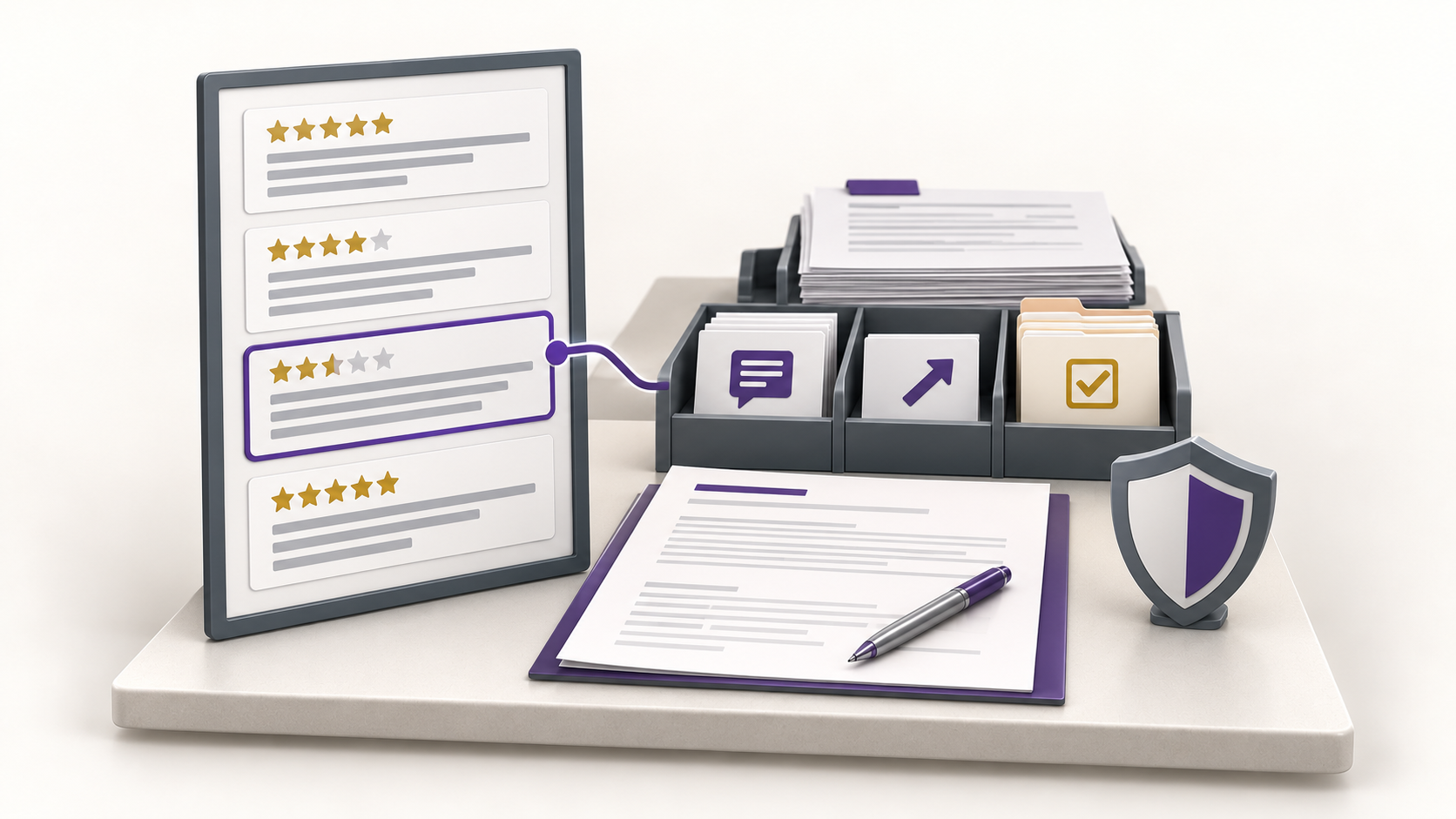
Patient reviews can give an independent medical practice useful information about how patients experience its operations. They can also create privacy, compliance, and workflow problems when nobody has clearly decided who should monitor them, who may respond, or when a concern needs to move beyond a public reply.
That is why managing patient reviews should not be treated primarily as a marketing activity. A review may mention a long wait, an unexpected bill, difficulty reaching the office, a staff interaction, or a problem scheduling follow-up care. Sometimes that feedback points to an operational problem. Sometimes it reflects a misunderstanding or an isolated experience. The practice still needs a consistent way to handle it.
The goal is not to win every public disagreement or turn every review into a promotional opportunity. It is to monitor the appropriate platforms, respond within clear privacy boundaries, escalate significant concerns, and use recurring themes as one source of information about how the practice is operating.
Key Takeaways
- Assign responsibility for monitoring public reviews, responding when appropriate, and escalating concerns that require additional attention.
- Protect patient privacy in every public response, including responses to positive reviews.
- Do not assume a negative or disputed review violates a platform’s rules. Reporting and responding are separate decisions.
- Use neutral review-request practices and distinguish platform policies from legal and regulatory requirements.
- Treat recurring review themes as operational signals that may warrant investigation, not automatic proof that a workflow is failing.
- Keep public reviews separate from structured patient surveys, private feedback, and formal complaint processes.
Table of Contents
Patient Reviews Need an Assigned Practice Workflow
Someone in the practice should know who is responsible for monitoring public patient reviews. That sounds simple, but review management often becomes an informal task. An owner checks Google occasionally. A manager sees a notification. A staff member notices a negative comment. Someone responds because they think a quick answer will help.
That approach creates unnecessary risk because the person who sees a review should not automatically be the person authorized to answer it. A quick response written without considering privacy, platform rules, or the nature of the complaint can create a second problem while trying to solve the first one.
A practice should decide which platforms it monitors, who performs that monitoring, how frequently reviews are checked, and who has authority to post a public response. Staff also need to know which situations they can handle through the normal review process and which ones require management, privacy, compliance, clinical, or legal review.
Operational Snapshot: Assign Review Ownership Before a Problem Appears
A front-desk employee notices a detailed one-star review and responds before telling the manager. The response unintentionally confirms information the practice should not have discussed publicly. A defined workflow changes the sequence: staff identify the review, route it to the designated owner, classify the concern, and determine whether a public response, private follow-up, platform report, or internal escalation is appropriate.
This does not require a complicated committee. In a small practice, one manager may own most of the process. What matters is that responsibility is deliberate rather than assumed. The workflow should also identify a backup so reviews are not ignored when the primary person is unavailable.
The practice should define a few basic decision points. Can the designated person respond without additional review? Does the post describe a clinical or billing concern that needs to be routed internally? Does it raise a possible privacy or safety issue? Does it appear to violate the review platform’s policies? Those questions help staff decide what happens next instead of treating every review the same way.
| Workflow question | What the practice should define | Why it matters |
|---|---|---|
| Who monitors reviews? | Primary owner and backup | Prevents reviews from being missed or handled informally |
| Who may respond? | Authorized roles and response boundaries | Reduces impulsive or inappropriate public replies |
| What requires escalation? | Privacy, safety, clinical, billing, legal, threatening, or other significant concerns | Routes higher-risk issues to the appropriate person |
| What should be documented? | Significant reviews, reports, escalations, and follow-up actions | Creates continuity when an issue requires additional work |
| Who reviews patterns? | Manager, owner, or operational lead | Connects recurring feedback to process improvement |
The same principle applies to HIPAA compliance in everyday practice operations. A policy is more useful when employees understand who owns the work, what they are allowed to do, and when they need help. Review management should fit into those existing operational responsibilities rather than sit outside them as a separate marketing task.
How Should Your Practice Respond to Public Patient Reviews?
A public review may contain information about an appointment, diagnosis, treatment, bill, staff interaction, or another detail the reviewer chose to disclose. That does not mean the practice should confirm those details in its response.
This is where a natural instinct to explain what happened can create trouble. Staff may know that a reviewer left out important information. They may want to correct an inaccurate statement, explain a billing decision, or defend an employee. The public review page is generally not the place to work through those individual details.
Positive Reviews Still Require Privacy Discipline
Privacy concerns are not limited to complaints. A positive review may mention a procedure, diagnosis, appointment, or long relationship with a clinician. Even a friendly response can disclose information if the practice confirms or expands on what the reviewer wrote.
A brief, neutral acknowledgment can thank someone for sharing feedback without confirming a treatment relationship. The response does not need to repeat the person’s experience or add information about their care.
Compliance Alert: A Reviewer’s Disclosure Does Not Remove the Practice’s Privacy Obligations
A person can choose to discuss their own healthcare publicly, but that does not give the practice permission to disclose protected information in return. HHS OCR has taken enforcement action involving providers disclosing protected health information when responding to online reviews. Keep public responses general and move individual matters to an appropriate private process.
Move Individual Concerns Out of the Public Conversation
If a review raises a concern that deserves follow-up, the public response does not need to resolve the issue. Its purpose is much narrower. The practice can acknowledge that feedback was received, explain that individual matters are not discussed publicly, and provide an appropriate route for private contact.
Once the issue moves into a private channel, the practice can verify identity, review the relevant information, and determine what follow-up is appropriate. That separation is important. Public response management and internal complaint resolution are related processes, but they are not the same process.
Templates can help staff maintain that boundary. However, a template should not become an automatic reply pasted under every review. Someone still needs to read the review and determine whether responding publicly is appropriate at all.
| Public review situation | Public response | Internal action | Possible escalation |
|---|---|---|---|
| General positive review | Optional brief, neutral acknowledgment | Usually none beyond routine monitoring | Usually unnecessary |
| Ordinary negative service feedback | General response when appropriate; do not discuss individual details | Review the concern if it identifies a possible workflow problem | Manager if follow-up is warranted |
| Detailed clinical or billing complaint | Do not debate the facts publicly | Route through the appropriate private process | Clinical, billing, compliance, or management personnel as appropriate |
| Suspected fake or spam review | Avoid a public argument over authenticity | Preserve relevant information and review platform policy | Platform reporting process |
| Threatening or harassing content | Avoid an improvised response | Preserve the content and follow the practice’s applicable procedures | Leadership, security, legal counsel, or others as circumstances require |
| Potential privacy or patient-safety concern | Keep any public response limited | Promptly route the underlying issue for review | Appropriate privacy, compliance, clinical, or leadership personnel |
What Should You Do With a Negative, False, or Questionable Review?
Not every negative review violates a platform’s rules. A patient may describe an experience very differently from how the practice sees it. The review may be incomplete, frustrating, or based on a misunderstanding. Disagreement alone does not make the content fraudulent or removable.
The first question should therefore be what type of issue the practice is dealing with, not how quickly it can get the review removed.
A Negative Opinion Is Not Automatically a Policy Violation
If a reviewer complains about wait times, staff communication, office policies, or another aspect of the experience, the practice may disagree with the characterization. That does not necessarily create a basis for platform removal. Trying to litigate every disputed point in the response can also draw more attention to the disagreement and increase privacy risk.
Instead, separate the public-review decision from the internal fact-finding decision. Internally, the practice can determine what happened and whether any corrective action is warranted. Publicly, the response should remain within the boundaries already established for review management.
Know When to Report, Document, or Escalate a Review
A different process applies when content appears to involve spam, impersonation, conflicts of interest, harassment, prohibited content, or another potential violation of the platform’s rules. In that situation, review the applicable policy and use the platform’s reporting process when appropriate.
For example, Google tells businesses to report a review that violates the platform’s policies. A report does not guarantee removal. The platform decides whether its rules were violated.
Technical Deep Dive: One Review Can Trigger Several Different Decisions
A questionable review can create three separate work paths. The practice may decide whether a public response is appropriate, whether the content should be reported under the platform’s rules, and whether the underlying allegation requires internal investigation. Those decisions do not have to produce the same result. A review can remain online while the practice investigates a legitimate operational concern, or a policy-violating review can be reported even when no internal process failure occurred.
Some reviews deserve internal attention regardless of whether they remain online. A complaint involving a possible privacy incident, patient-safety issue, discrimination allegation, significant billing concern, threatening behavior, or serious staff conduct issue may need to be routed to the person responsible for that area.
The review itself is not proof that the allegation is accurate. It is information that may justify examining records, communication, workflow, or other evidence through the practice’s normal internal process.
Request Patient Reviews Without Steering the Outcome
Practices often want a consistent way to invite patients to share feedback. That can be built into checkout, follow-up communication, or another appropriate workflow. The request, however, should not be designed to manufacture a particular rating.
A process that asks only patients believed to be happy to post publicly while directing dissatisfied patients somewhere else can create a distorted review system. The practice should also be cautious about scripts that tell patients what rating to leave or incentives that depend on whether the review is positive.
A more defensible operational approach is a neutral and consistent request. Make the review opportunity available without telling the person what to say. If the practice uses more than one review platform, staff should also understand that the platforms may not have identical solicitation rules.
Operational Snapshot: Audit the Automation, Not Just the Reviews
A practice may configure an automated review request once and then leave it running for years. The operational control is a periodic check of what the system actually sends, which patients receive it, where the link goes, whether negative feedback is being filtered differently, and whether the process still fits current platform rules. Automation can perform the task, but the practice still owns the workflow.
This is also an area where legal requirements and platform policies need to remain distinct. Google prohibits incentives for reviews and prohibits merchants from discouraging negative reviews or selectively soliciting positive reviews. A practice using that platform should follow Google’s rules on incentivized and manipulated reviews.
Federal consumer-protection requirements are a separate layer. The Federal Trade Commission’s rules governing consumer reviews and testimonials address fake and false reviews, certain insider reviews and testimonials, review suppression, and incentives conditioned on a particular positive or negative sentiment.
That distinction matters. It would be inaccurate to say that every incentive connected with a review is categorically prohibited under federal law. A platform can impose stricter rules on reviews submitted to that platform. Practices therefore need to identify which requirement they are following instead of collapsing legal requirements, platform policies, and internal procedures into one rule.
| Rule or process | What it governs | What the practice needs to do |
|---|---|---|
| HIPAA and applicable privacy requirements | What protected information the practice may disclose | Keep public responses within the practice’s privacy obligations |
| Review-platform rules | Solicitation, incentives, prohibited content, reporting, and removal | Check the current rules for each platform being used |
| FTC requirements | Fake or deceptive reviews and testimonials, certain incentives, disclosures, and suppression practices | Make sure review and testimonial practices comply with applicable consumer-protection requirements |
| Practice procedure | Monitoring, response authority, documentation, investigation, and escalation | Translate outside requirements into a repeatable staff workflow |
Use Recurring Review Themes as an Operational Signal
Public reviews can be useful even when the practice is not focused on its star rating. Repeated comments may expose friction that deserves a closer look.
Patients may repeatedly mention difficulty reaching the office, long waits, confusing bills, inconsistent scheduling instructions, unclear follow-up, or different experiences depending on which staff member handles an interaction. None of those comments should automatically be accepted as a complete account of what happened. They should not automatically be dismissed either.
One Review Is a Data Point, Not Proof of a Practice Problem
A single review should not automatically drive a policy change. The situation may be unusual. The reviewer may not have all the information. The complaint may not accurately describe the underlying workflow.
Compare the feedback with what the practice can verify. Depending on the concern, that could include call logs, schedules, message queues, billing questions, wait-time information, staff observations, complaint records, or other relevant operational evidence.
This prevents two opposite mistakes. The first is changing a process every time someone posts a negative comment. The second is assuming negative feedback has no value because the practice can explain why an individual event occurred.
Repeated Themes Should Trigger a Closer Look
When the same type of concern appears repeatedly, the practice has a stronger reason to investigate. Multiple comments about unanswered calls may point toward phone coverage or message-routing problems. Repeated complaints about billing confusion may indicate that explanations are inconsistent or that patients are receiving information too late. Recurring comments about delays may reveal a scheduling, staffing, or handoff problem.
The useful question is not simply, “Are these reviews bad?” It is, “What would we need to check to determine whether there is a repeatable operational problem behind them?”
Operational Snapshot: Trace the Pattern Back to the Workflow
Suppose several reviews mention that patients could not get a return call. Do not stop at reminding staff to call patients back. Check how calls enter the practice, who owns each message queue, how work is reassigned when someone is absent, what happens when a message remains open, and whether completion can be verified. The review theme identifies where to look; the workflow review identifies what needs to change.
This is where recurring patient-experience problems can become useful operational information. A repeated complaint may expose unclear ownership, inconsistent instructions, weak handoffs, staffing pressure, or a process that works differently in practice than it does on paper.
Jennifer Blevens-Smith discusses the broader relationship between practice operations and patient experience in the video below. The focus is not public-review compliance specifically. It is how practices can examine the operational conditions that affect patient satisfaction without treating satisfaction as a substitute for appropriate care.
Once a recurring issue is verified, the response belongs in the underlying process. That may mean clarifying responsibility, changing a handoff, revising patient communication, retraining staff, or adding a control that helps the practice detect the problem sooner. Improving the rating is not the operational objective. Improving the process is.
Keep Public Reviews in Their Proper Role
Public reviews are only one source of patient feedback. They should not replace a structured survey process, private feedback, direct patient communication, a formal complaint pathway, or the practice’s quality and compliance processes.
Those channels answer different questions. A public review tells the practice what one person chose to share publicly. A structured survey can ask consistent questions across a broader group. A private complaint process can collect details and support individual follow-up. Internal quality and compliance processes address issues that may require formal investigation or corrective action.
| Feedback channel | Best use | Important limitation |
|---|---|---|
| Public online reviews | Monitoring publicly shared experiences and recurring themes | Unstructured, public, and not representative of every patient |
| Patient satisfaction surveys | Collecting consistent feedback across defined questions | Results depend on survey design, participation, and follow-up |
| Private feedback | Giving patients a nonpublic way to raise concerns or suggestions | Needs clear ownership and a response process |
| Formal complaints or grievances | Handling concerns that require documented review or resolution | Must follow the practice’s applicable policies and requirements |
| Operational monitoring | Testing whether a reported problem is occurring in the actual workflow | Requires reliable data and someone responsible for acting on findings |
A public review platform also gives the practice limited control over who responds, what questions are asked, and what information is provided. That makes it different from a structured patient satisfaction survey process designed to collect and analyze feedback more consistently.
Keeping those channels separate also helps the practice avoid overreacting to its online reputation. A one-star review may warrant no operational change after investigation. A pattern that appears across reviews, surveys, complaints, and staff observations may deserve considerably more attention.
The strongest review-management process therefore does not revolve around chasing five-star ratings. It makes public reviews visible to the practice, protects patient privacy, gives staff clear response boundaries, provides a route for escalation, and makes recurring concerns available to the people responsible for improving operations.
Frequently Asked Questions About Patient Reviews
Can a medical practice respond to a negative patient review?
Yes, but the response should protect patient privacy. Avoid confirming that the reviewer is a patient or discussing appointments, treatment, billing, diagnoses, or other individual details. A general response can acknowledge feedback and direct the person to an appropriate private contact method.
Can a practice say publicly that the reviewer was never a patient?
Publicly confirming or denying a treatment relationship can create unnecessary privacy risk. If the practice believes a review is fake or violates platform rules, it can use the platform’s reporting process while keeping any public response general and avoiding discussion of individual records.
Can a medical practice ask patients to leave Google reviews?
The answer depends on the applicable rules. Google prohibits incentivized reviews on its platform. FTC requirements separately address incentives conditioned on positive or negative sentiment and other deceptive review practices. Practices should check both applicable law and the current rules of each platform they use.
What should a practice do if it believes a patient review is fake?
Document the concern and compare the review with the platform’s current policies. If it appears to violate those policies, use the platform’s reporting process. Avoid publicly arguing about whether the reviewer is a patient, and remember that reporting a review does not guarantee its removal.
How often should a medical practice monitor online reviews?
There is no single monitoring interval that fits every practice. Choose a frequency appropriate to review volume and staffing, assign a responsible person and backup, and make sure significant concerns can be escalated promptly rather than waiting for an occasional reputation check.
About the Author
Jennifer Blevens-Smith is the founder and principal consultant of Integral Clinic Solutions. With more than two decades of experience supporting independent medical practices, she helps physicians, practice administrators, and healthcare leaders strengthen credentialing, payer contracting, revenue cycle operations, compliance workflows, and practice management. Her work focuses on translating complex healthcare requirements into practical operational processes. These processes improve consistency, reduce administrative burden, and support long-term practice success.
Need Help Strengthening Your Medical Practice Operations?
Integral Clinic Solutions provides practical support for medical practices navigating credentialing, contracting, revenue cycle operations, compliance workflows, front-office systems, and practice management challenges.
Explore more operational guidance, compliance insights, and healthcare business resources on the Integral Clinic Solutions blog. New articles and updates are added regularly for practice owners, administrators, and healthcare teams.
Disclaimer: This content is for informational and educational purposes only and does not constitute legal, coding, billing, compliance, financial, or medical advice. Healthcare practices must verify all operational requirements with applicable payers, regulators, and qualified professionals. Read our full Legal & Compliance Disclaimer.