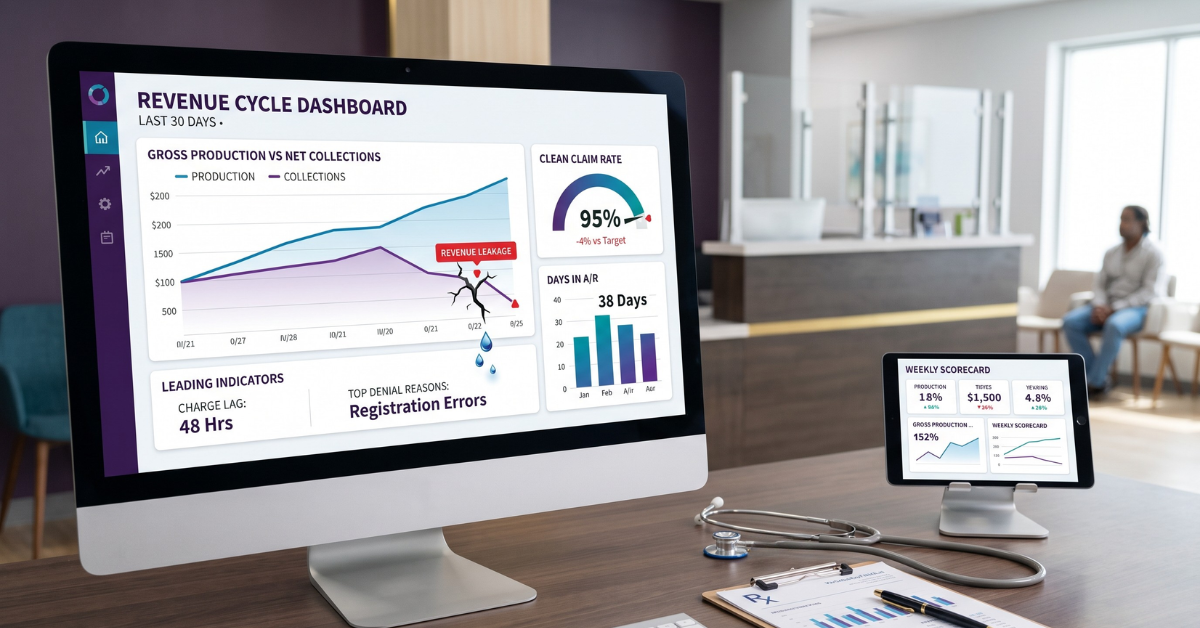
Why a Busy Medical Practice Can Still Struggle Financially: Understanding Production, Collections, and Profit
When evaluating production vs collections, many independent practice owners discover that a busy practice does not automatically translate into financial success. Schedules are full, providers are maxed out, staff are operating at capacity, and patient volume is strong. Yet the bank account tells a different story.
Cash flow feels permanently tight. Payroll becomes a source of monthly executive anxiety. Vendor balances creep upward past 60 days. Leadership is left asking a frustrating, high-stakes question: Why are we working harder than ever, but seeing zero financial improvement or bottom-line sustainability?
A common root cause of this operational paradox is a misunderstanding of the relationship between production, net collections, and net profit margin. These three financial pillars are interconnected but not interchangeable. According to historical benchmarking data from the Medical Group Management Association (MGMA), a medical group can increase gross production while still losing revenue through preventable revenue-cycle leakage.
Operational Snapshot
A busy schedule reflects clinical demand, but financial stability depends on how effectively production converts into collections and profit. Practices that actively monitor core revenue cycle performance metrics are better positioned to protect cash flow and long-term viability.
Key Takeaways
- Gross production volume alone is a vanity metric that does not indicate true financial health.
- Net collections determine available operating cash flow and working capital.
- Revenue leakage typically originates in front-end administrative workflows long before claims reach billing.
- Clean Claim Rate (CCR), First-Pass Denial Rate, Charge Lag, and Days in A/R are critical leading performance indicators.
- Net profit margin remains the ultimate metric for long-term practice sustainability and valuation.
- Cross-functional alignment between front-desk, clinical, and billing teams is essential to safeguard revenue.
The Illusion of Activity: Production vs. Financial Performance
Healthcare organizations often focus too heavily on volume-based metrics. Provider schedules, Work Relative Value Units (wRVUs), daily patient counts, and gross monthly charges are easy to extract from an Electronic Health Record (EHR) system, creating the appearance of financial progress.
The problem is that clinical activity alone does not determine financial viability. Gross production represents the total dollar amount billed out based on your practice’s Master Chargemaster Fee Schedule. It reflects the sheer volume of clinical effort, including office visits, surgeries, imaging, and ancillary services. This occurs before any industry realities, contractual obligations, or compliance write-offs are applied.
In professional practice management, gross production is merely the starting point of a complex, multi-step Revenue Cycle Management (RCM) lifecycle. A practice can generate $300,000 in gross charges this month. Those charges must survive payer contract discounts, front-end clearinghouse edits, complex National Correct Coding Initiative (NCCI) edits, and patient collection friction before turning into liquid capital.
Why High Production Fails to Materialize as Revenue
To diagnose where cash flow is breaking down, healthcare executives must distinguish between what is performed and what is realized. Production measures clinical work performed; net collections measure actual cash received. This distinction is critical for maintaining GAAP (Generally Accepted Accounting Principles) compliance and avoiding balance sheet inflation. It also helps ensure accurate forecasting.
Every medical practice experiences a reduction in expected revenue due to contractual adjustments. You may bill your standard fee, but commercial payers (like Blue Cross, UnitedHealthcare, Aetna) and government entities (CMS) dictate the actual allowed amount based on fee schedules. However, the true financial danger lies in the unexpected, preventable revenue leakage that happens after those contractual adjustments are applied.
| Financial Metric | What It Represents | Impact on Practice Health |
|---|---|---|
| Gross Production | Total clinical services rendered based on standard chargemaster rates. | Measures physical capacity and clinical demand, not actual liquidity. |
| Net Collections | Actual cash recovered from payers and patients after contractual write-offs. | Determines available cash flow and the practice’s ability to meet financial obligations. |
| Net Profit Margin | The net capital remaining after every operational expense and overhead cost is paid. | Determines long-term sustainability, practice valuation, and partner distributions. |
Compliance Alert
Revenue leakage often begins long before a claim reaches billing. Registration errors, missing authorizations, and documentation gaps can quietly erode expected reimbursement and create avoidable cash-flow disruptions.
If your leadership team reviews gross production reports but neglects granular revenue-cycle analytics, such as tracking clean claim rates or denial trends, critical process failures remain invisible until they trigger a severe cash crunch.
Example: When Production and Collections Tell Different Stories
A primary care practice generates $300,000 in gross charges during a busy month. After contractual adjustments, expected reimbursement falls to $135,000. However, registration errors, prior authorization failures, delayed claim submission, and patient collection issues reduce actual collections to $118,000.
From an operational perspective, production appears strong. Providers are busy, schedules are full, and clinical demand remains high. Financially, however, the practice failed to convert a meaningful portion of its expected revenue into cash. Without monitoring collection performance and operational workflows, leadership may incorrectly assume the issue is insufficient patient volume rather than preventable revenue leakage.
The RCM Dashboard: Lagging Indicators vs. Leading Indicators
Most practice owners pull financial reports at the end of the month, looking purely at trailing, lagging data. To truly bridge the gap between production and financial performance, leadership must differentiate between lagging indicators (what happened) and leading indicators (what is about to happen to your cash flow).
Incorporate these four critical metrics into your weekly management scorecard to catch systemic leakage before it impacts your bank account. Benchmark targets can vary by specialty, payer mix, geographic region, and practice model. The following ranges are commonly used as operational performance indicators.
- Clean Claim Rate (CCR): Many high-performing practices target 95% or higher. This measures the percentage of claims that pass through your clearinghouse and are accepted by the payer on the first submission without edits or rejections. A dropping CCR is the earliest warning sign of front-end registration failures.
- First-Pass Denial Rate: Many organizations strive to maintain a rate below 4%, although acceptable ranges may vary by specialty and payer mix. This tracks the percentage of claims denied by payers upon initial adjudication. If this number creeps upward, it indicates specific coding misalignment (ICD-10-CM/CPT codes) or missing prior authorizations.
- Bad Debt Percentage: Many practices target less than 3%, though patient demographics and collection policies can significantly influence results. This represents the write-offs associated with uncollectible patient balances, highlighting inefficiencies in your point-of-service (POS) collection protocols.
- Lag Time (Charge Lag): Many organizations aim to submit charges within 48 hours to accelerate reimbursement and improve cash flow. This measures the exact time elapsed between the patient encounter and final claim submission. Excessive charge lag directly compresses your cash flow velocity.
Operational Snapshot
Revenue leakage frequently originates in front-end registration, eligibility verification, prior authorization workflows, documentation quality, and accounts receivable management.
The Silent Leaks: Where Net Collections Break Down
Production represents potential energy; collections represent reality. Net collections are the actual dollars required to fund payroll, commercial lease obligations, medical supplies, enterprise technology stacks, and malpractice insurance premiums.
When a practice is exceptionally busy but cash is tight, front-end administrative workflows typically fail the back-end billing team. In many practices, revenue cycle problems begin before a claim reaches the billing department. They often originate in patient registration, eligibility verification, prior authorization workflows, or clinical documentation.
Core Drivers of Collection Leakage
1. Front-End Registration Failures: Inaccurate insurance data entry, failure to identify coordination of benefits (COB), missing secondary policies, or neglecting Real-Time Eligibility (RTE) checks prior to or at the time of the encounter.
2. Prior Authorization Gaps: Proceeding with scheduled procedures, infusions, or advanced imaging before obtaining a finalized, documented prior authorization number from the payer, leading to hard, unappealable denials.
3. Unmonitored Payer Reimbursement Variance: A lack of contract auditing tools allows insurance payers to underpay contracted rates or apply incorrect fee schedules without being systematically identified and appealed.
4. Escalating Patient Responsibility: Inadequate point-of-service (POS) collection protocols for copays, deductibles, and co-insurance associated with High-Deductible Health Plans (HDHPs), allowing bad debt to accumulate.
5. Accounts Receivable (A/R) Velocity Problems: Delayed claim submissions due to sluggish charting or incomplete provider signatures, extending your Net Days in A/R and trapping working capital in a perpetual state of “pending.”
An influx of new patient volume will temporarily mask these inefficiencies by providing a baseline of incoming cash flow. Eventually, however, the operational debt must be paid, and cash flow constraints will expose what productivity reports concealed.
Watch: The Dangerous Growth Trap in Private Practice
Many healthcare organizations assume that a busy schedule automatically translates into financial success. In this video, I discuss one of the most common operational challenges facing independent practices: the disconnect between production, collections, and profitability.
You’ll learn why increasing patient volume does not always improve cash flow and how revenue leakage can silently erode collections. You’ll also learn which operational metrics practice leaders should monitor to identify financial problems before they become crises. The discussion covers revenue cycle performance, front-office workflows, denial management, and overhead growth. It also explores the importance of understanding production vs collections when evaluating the financial health of a medical practice.
If your providers are busy, your staff is working at full capacity, and your schedule is consistently full, profitability may still remain disappointing. This video will help you identify where financial performance may be breaking down.
Profit Margin: The Ultimate Metric of Sustainability
While optimizing net collections is vital, a practice cannot achieve true financial stability without mastering its net profit margin. Margin represents the net capital remaining after deducting all operating expenses (OPEX). As a practice grows busier, operational complexity increases exponentially. Overhead expenses frequently scale faster than revenue.
Where Margin Erosion Usually Occurs
Labor Inefficiencies & Overtime: Adding administrative or clinical headcount to handle increased volume without first optimizing workflows, leading to costly overtime and increased payroll tax burdens.
Technology Stack Bloat: Accumulating siloed, unintegrated software platforms, patient engagement tools, and auto-renewing software-as-a-service (SaaS) subscriptions that accumulate unnoticed month after month.
Operational Waste & Supply Chain Creep: Underutilized clinical square footage, poor medical inventory controls leading to expired supplies, and unnegotiated vendor group purchasing organization (GPO) contracts.
The Danger of Volume-Based Provider Incentives: Many independent practices utilize legacy compensation models that bonus providers purely on gross charges generated or Work Relative Value Units (wRVUs) produced. While this incentivizes clinical activity, it detaches the provider from the economic reality of the collections cycle.
If a provider receives a volume bonus for performing a high-complexity service that is ultimately denied due to lack of medical necessity documentation, the practice incurs multiple financial losses. These include the clinical cost of the service, the administrative cost of the appealed claim, and the out-of-pocket bonus paid to the provider for revenue that was never actually realized.
Actionable Framework: Securing Your Financial Foundation
To reverse margin erosion, practice executives should execute a targeted, multi-step operational audit:
Audit Your Net Collection Rate (NCR): Calculate your NCR monthly using the standard industry formula: [Net Payments ÷ (Gross Charges - Contractual Adjustments)] x 100. Many practices target a Net Collection Rate (NCR) between 95% and 98%. Performance expectations may vary based on payer mix and specialty. Anything lower indicates systemic billing leakage or unappealed claim denials.
Technical Deep Dive
Net Collection Rate is one of the clearest indicators of revenue-cycle effectiveness. Consistent underperformance typically signals denial management failures, uncollected balances, payer underpayments, or unresolved workflow breakdowns.
Benchmark Net Days in A/R: Measure the exact velocity of your revenue cycle. Many high-performing practices strive to maintain Net Days in A/R below 35 days, though realistic targets may vary depending on specialty, payer mix, and claim complexity.
Conduct a Comprehensive Line-Item Overhead Audit: Review every vendor contract, EHR user license, clinical supplier agreement, and utility line item annually. This helps eliminate cost creep and optimize your operational expense ratio.
Align Compensation with Performance: Modern practices must protect operating cash flow by restructuring provider incentives away from gross charges. Tie a percentage of provider bonuses directly to net cash realized or clean claim performance metrics.
Operational Alignment: Breaking Down Silos Between Front-Desk, Clinical, and Billing Teams
The operational paradox of high clinical volume and low cash reserves is rarely a failure of a single department. Instead, it is a failure of coordination between departments. In many independent practices, front-desk staff, clinical providers, and back-end billing teams operate in siloed environments, unaware of how their daily actions impact downstream revenue collection.
To eliminate the silent leaks in your revenue cycle, practice management consulting strategies focus on establishing clear workflow transitions and standardized feedback loops:
1. Standardize Front-Desk Accountability
Front-office teams must be trained to realize that they are the true gatekeepers of the revenue cycle. Implement real-time eligibility (RTE) batch checking 72 hours before every scheduled appointment rather than during the check-in window. This gives staff adequate runway to contact patients regarding coordination of benefits (COB) issues or terminated policies before clinical resources are utilized.
2. Implement a Denials Feedback Loop
When the back-end billing team receives a denial due to an avoidable front-end or clinical error, such as a missing modifier or unauthorized procedure, that data cannot simply be worked and archived. Create a monthly “Denials Root-Cause Matrix” shared transparently across departments. When clinical and administrative teams see the direct financial impact of minor data entry or documentation omissions, behavioral alignment follows.
Transitioning from Volume to Value
An exceptionally busy clinical schedule reflects strong demand for your services, but long-term success depends on how effectively that activity converts into collections and profit. Sustainable growth requires continuous oversight of revenue cycle performance, operational efficiency, and expense management.
By routinely monitoring collections, controlling expenses, and strengthening accountability across departments, practice leaders can create a more predictable financial foundation. Consistent operational oversight helps ensure that clinical effort translates into sustainable cash flow and long-term organizational stability.
Operational Snapshot
Gross production measures activity. Net collections measure realized revenue. Profit margin measures sustainability. Practices should monitor all three to understand true financial performance.
Production vs Collections: Common Questions for Medical Practice Owners
What is the difference between production, collections, and profit in a medical practice?
Production represents the total value of services billed based on the practice’s fee schedule. Collections represent the actual payments received from insurance companies and patients after contractual adjustments. Profit is the amount remaining after all operating expenses are paid. Understanding the difference between these metrics is essential for evaluating true financial performance.
Why is my medical practice busy but not profitable?
A busy schedule does not guarantee financial success. Claim denials, delayed claim submission, poor patient collections, payer underpayments, and rising overhead expenses can all prevent strong production from translating into healthy cash flow and profitability.
What is gross production in healthcare?
Gross production is the total dollar value of services billed before contractual adjustments, write-offs, and payment reductions are applied. It reflects clinical activity and patient demand but does not represent actual revenue collected by the practice.
What causes revenue leakage in a medical practice?
Revenue leakage commonly results from registration errors, eligibility verification failures, missing prior authorizations, coding mistakes, documentation deficiencies, delayed claim submission, payer underpayments, and weak patient collection processes. These issues reduce collections and negatively impact cash flow.
Why is the net collection rate important?
The net collection rate measures how effectively a practice converts expected reimbursement into actual payments. Monitoring this metric helps identify billing inefficiencies, denial trends, underpayments, and other revenue cycle problems that may be reducing collections.
How does charge lag affect cash flow?
Charge lag measures the time between a patient encounter and claim submission. Delays in documentation, coding, or provider sign-off can postpone reimbursement and slow cash flow. Reducing charge lag helps improve revenue cycle efficiency and financial stability.
What financial metrics should practice owners monitor regularly?
Practice owners should routinely monitor net collection rate, clean claim rate, denial rate, charge lag, days in accounts receivable (A/R), bad debt percentage, net profit margin, and overall collections performance. These metrics provide insight into both operational and financial health.
How can a medical practice improve profitability?
Improving profitability requires more than increasing patient volume. Practices should focus on reducing revenue leakage, improving collections, controlling overhead expenses, strengthening front-end workflows, monitoring payer performance, and creating accountability throughout the revenue cycle.
About the Author
Jennifer Blevens-Smith is the founder and sole consultant driving Integral Clinic Solutions. Armed with deep domain expertise and a commitment to protecting independent medicine, she delivers the personalized, executive-level guidance that healthcare leaders need to build sustainable, high-performing organizations.
Need Help Strengthening Your Medical Practice Operations?
Integral Clinic Solutions provides practical support for medical practices navigating credentialing, contracting, revenue cycle operations, compliance workflows, front-office systems, and practice management challenges.
Explore more operational guidance, compliance insights, and healthcare business resources on the Integral Clinic Solutions blog. New articles and updates are added regularly for practice owners, administrators, and healthcare teams.
Disclaimer: This content is for informational and educational purposes only and does not constitute legal, coding, billing, compliance, financial, or medical advice. Healthcare practices must verify all operational requirements with applicable payers, regulators, and qualified professionals. Read our full Legal & Compliance Disclaimer.