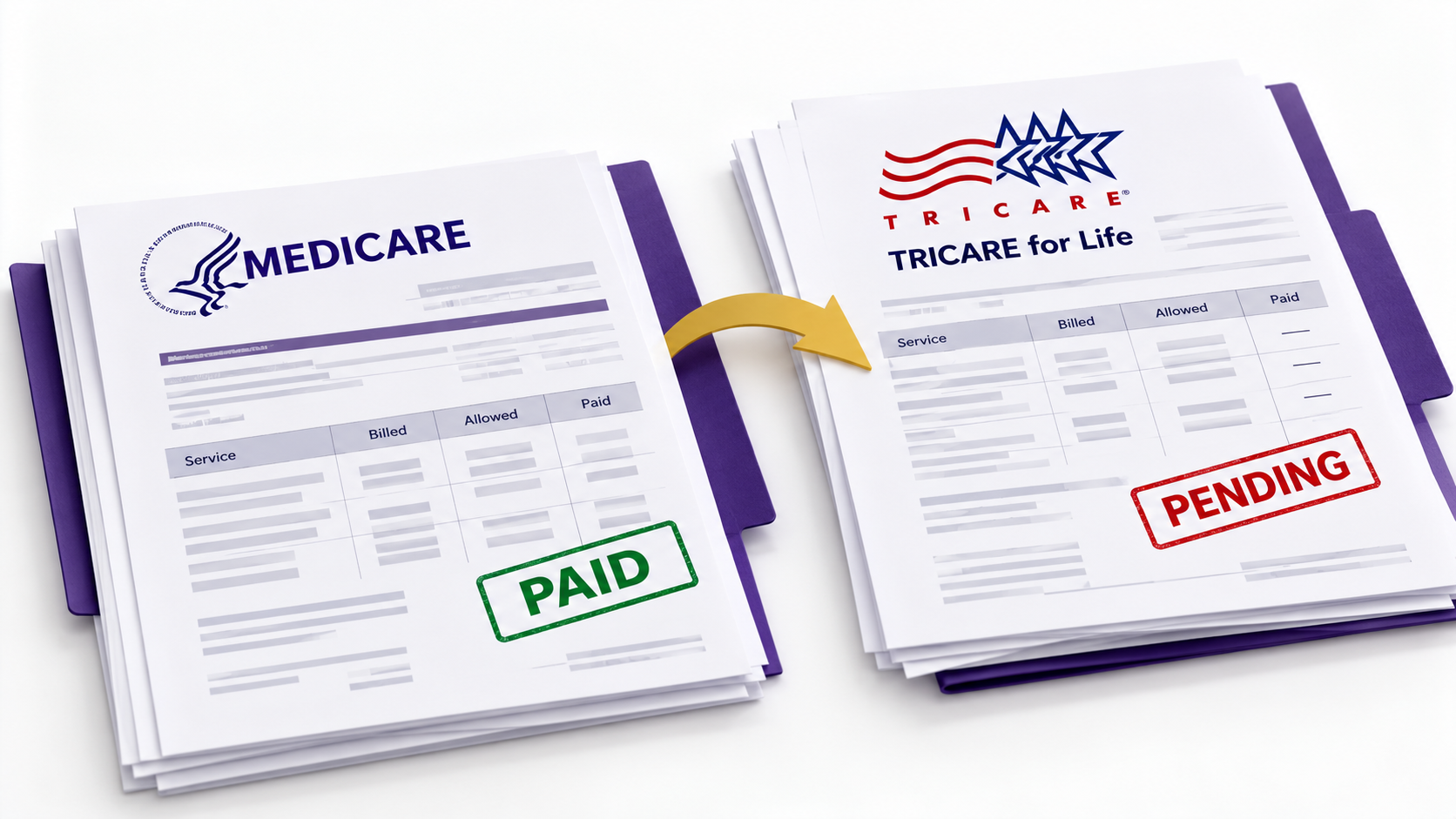
Medicare Paid the Claim. So Where Is the TRICARE for Life Payment?
TRICARE for Life billing requires medical practices to understand how Medicare and TRICARE work together, where to submit claims, and what to do when payment does not arrive as expected.
For many patients, the process is straightforward. The practice submits a claim to Medicare, Medicare processes it, and the claim automatically crosses over to the TRICARE for Life contractor for additional processing. However, that process does not apply to every claim.
Other health insurance, provider participation status, Medicare coverage decisions, and missing crossover transactions can change what the billing team needs to do. When staff assume every claim follows the same path, unpaid balances may sit unresolved or move to patient collections before the practice has confirmed the correct payment responsibility.
Independent medical practices need a process that begins with accurate registration and continues through payment reconciliation. The goal is not simply to submit the claim. It is to know which payer should process it, verify that each required step occurred, and resolve exceptions before they create avoidable delays.
Key Takeaways
- Medicare generally processes covered services first for TRICARE for Life beneficiaries using Original Medicare in the United States.
- Automatic crossover handles many secondary claims, but billing teams must identify exceptions and confirm missing payments.
- Other health insurance can change the payer sequence and documentation requirements.
- Medicare and TRICARE coverage decisions determine whether a patient balance is appropriate.
- Registration, billing, and payment-posting staff need clear responsibilities for resolving incomplete claims.
- A claim should remain in active follow-up until the practice confirms its final payment outcome.
Table of Contents
How TRICARE for Life Billing Works With Medicare
TRICARE for Life (TFL) is Medicare-wraparound coverage for eligible TRICARE beneficiaries who have Medicare Part A and Part B. For most covered medical services received in the United States, Original Medicare processes the claim first. TFL then considers its payment responsibility under TRICARE rules.
That relationship is important because TFL is not simply another commercial secondary insurance plan. Its payment depends on Medicare’s processing decision, whether TRICARE covers the service, and any other applicable insurance.
When both Medicare and TRICARE cover a service, TFL generally pays the remaining Medicare deductible and coinsurance amounts, leaving the patient with no out-of-pocket cost for that covered service. Different results can apply when only one program covers the service or when other insurance is involved.
Practices can review the official TRICARE for Life coverage and cost-sharing rules when determining how the two programs coordinate.
Understand the Normal Claim Path
For a typical domestic claim involving Original Medicare and TFL, the process follows five stages:
- The practice submits the claim to Medicare.
- Medicare determines coverage and processes its payment responsibility.
- Medicare sends eligible claim information through the automatic crossover process.
- Wisconsin Physicians Service (WPS), the TFL claims contractor, processes the secondary claim.
- The practice posts both payment decisions and reconciles any remaining balance.
Each stage has a different purpose. Medicare’s payment does not establish that WPS has received the claim. Likewise, the absence of a TFL payment does not automatically mean the patient owes the balance.
Practices that also work with other military health insurance programs should distinguish TFL from standard TRICARE plans and VA Community Care. The administrative processes are not interchangeable.
Technical Deep Dive
Automatic crossover is the electronic transfer of eligible Medicare-processed claim information to the TFL contractor. It reduces the need for separate secondary claims, but it is not a guarantee that every claim reaches WPS. When the expected TFL payment is missing, staff should check the Medicare remittance and confirm whether WPS has a claim on file before taking further action.
Verify Medicare and TRICARE for Life Coverage Before the Visit
Many TRICARE for Life billing problems begin before a claim is created. Registration staff may correctly record Medicare and TFL but overlook another active health plan. The claim then moves through billing with an incomplete picture of the patient’s coverage.
Staff should verify Medicare eligibility, confirm the patient’s TFL eligibility, and ask whether any additional insurance applies. The patient may present a Medicare card and a Uniformed Services identification card; there is no separate TFL insurance card.
The practical control is to make the additional-insurance question part of patient registration and insurance verification and to update the insurance record whenever coverage changes.
Confirm the Complete Insurance Picture
Staff should not assume that a Medicare card and TFL eligibility establish the complete payer order. Patients may also have a Medicare supplement, employer-sponsored coverage, retiree coverage, Medicaid, or another health plan.
Medicare Advantage requires particular attention. A patient enrolled in a Medicare Advantage plan does not follow the same routine Original Medicare crossover process. The practice must confirm the plan’s claim-submission requirements and how TFL coordinates with that coverage.
If a patient reports conflicting insurance information, registration staff should document the discrepancy rather than guessing which payer is primary. For example, a patient may report that an employer plan ended, while the eligibility response still shows active coverage.
In that situation, the registration team should record the information provided, identify what remains unverified, and send the issue to the designated billing or insurance-verification employee. The handoff should identify the specific question, the available documentation, and who is responsible for resolving it.
This matters because an unresolved payer-order question can affect both claim routing and the timing of patient billing. A clean demographic record alone does not establish that the practice has the correct coordination-of-benefits information.
Operational Snapshot
A patient provides Medicare and military identification but does not mention an additional insurance plan. The practice submits the claim based on the information in registration. Later, the billing team discovers that another payer should have been considered. The claim requires additional investigation and possibly a different submission path. A routine question about other health insurance, followed by a documented verification process, can prevent this avoidable rework.
Submit TRICARE for Life Claims Through the Correct Billing Path
For most services covered by Original Medicare and TFL in the United States, the practice submits the claim to Medicare and allows the automatic crossover process to handle secondary submission.
However, the correct path changes when other health insurance applies, Medicare does not process the claim, or the claim does not cross over. Staff should establish the payer sequence before submitting a separate claim to WPS.
Check the Payer Sequence Before Submitting
The following table summarizes common arrangements. Actual payment order depends on the patient’s coverage and applicable Medicare Secondary Payer rules.
| Coverage arrangement | General processing approach | What staff should verify |
|---|---|---|
| Original Medicare and TFL | Medicare generally processes first, followed by TFL. | Medicare adjudication and automatic crossover. |
| Medicare, other non-employment health insurance, and TFL | Medicare, then other health insurance, then TFL in common arrangements. | Applicable coordination rules and required payment documentation. |
| Current-employment-based group coverage | Medicare may be primary or secondary depending on Medicare Secondary Payer rules. | Employment status, group-plan details, and the correct primary payer. |
| Medicare, TFL, and Medicaid | Medicaid generally pays last. | State Medicaid requirements and prior payer decisions. |
These distinctions should be part of the billing team’s decision process rather than handled only after a denial or missing payment. TRICARE’s coordination requirements for other health insurance provide additional direction for these situations.
Do Not Overlook Supporting Documents
When separate submission is necessary, staff should determine what supporting information WPS requires. Depending on the claim, this may include Medicare processing information, other payer explanations of benefits, or documentation supporting the billed service.
TRICARE generally applies a one-year filing deadline to claims for services received in the United States, subject to applicable exceptions. Staff should verify the deadline for the specific claim rather than assuming that Medicare’s original submission protects every later filing requirement.
Staff should review the TRICARE for Life claim-filing requirements before deciding whether separate submission and supporting documentation are necessary.
Understand Medicare and TRICARE for Life Payment Responsibilities
One of the most important TRICARE for Life billing distinctions is whether Medicare, TRICARE, both programs, or neither program covers the service. Those coverage decisions affect the remaining balance and whether the patient may owe anything.
Compare the Coverage Outcomes
| Coverage outcome | General payment result | Patient balance consideration |
|---|---|---|
| Both Medicare and TRICARE cover the service | Medicare pays first; TFL generally covers eligible remaining Medicare cost-sharing. | Usually no patient out-of-pocket amount for the covered service. |
| Medicare covers the service, but TRICARE does not | Medicare processes under its rules; TFL does not pay for the noncovered service. | Applicable Medicare cost-sharing may remain. |
| TRICARE covers the service, but Medicare does not | TFL may process under TRICARE rules. | TRICARE deductibles and cost-sharing may apply. |
| Neither program covers the service | Neither program provides payment. | The patient may be responsible, subject to applicable billing restrictions and agreements. |
This table is a starting point, not a substitute for reviewing the actual payer decisions. Provider status, service-specific rules, other insurance, and applicable billing protections can affect the final result.
Separate Payer Processing From Patient Billing
Consider a claim where Medicare pays its portion but the expected TFL payment has not arrived. The remaining amount may appear as Medicare coinsurance in the practice management system. That does not establish that the patient should receive a statement.
The billing team should understand how to use EOBs and ERAs to reconcile Medicare and TFL payments before moving a balance to patient statements.
Where a claim remains under secondary-payer review, the practice should distinguish an unresolved insurance balance from a confirmed patient balance. This protects patients from premature collection activity and gives staff a more accurate view of outstanding receivables.
Resolve Common TRICARE for Life Billing Problems
When a TFL payment is missing, the first question should be where the claim stopped. Staff need to distinguish a Medicare processing issue, a missing crossover, a WPS processing problem, and a valid coverage determination.
Medicare Processed the Claim, but WPS Has No Record
Start with the Medicare remittance. Confirm that Medicare processed the claim, review the available crossover information, and then check whether WPS has received the claim.
If WPS has no record, staff should investigate whether the claim was eligible for crossover and whether a separate submission is appropriate. Repeatedly submitting a secondary claim without checking the original transaction can create duplicate work and complicate follow-up.
The account note should identify the Medicare processing date, the WPS status-check date, the information received, and the next action. A vague note such as “insurance pending” does not tell the next employee what has already been investigated.
WPS Received the Claim but Did Not Pay
This is a different problem. Staff should review the WPS processing result rather than treating the claim as missing. The next step may involve correcting insurance information, supplying another payer’s payment details, clarifying eligibility, or reviewing a coverage decision.
For example, WPS may have a claim on file but need information about other health insurance. In that situation, resending the same claim without addressing the missing information is unlikely to resolve the issue.
Billing notes should identify the actual reason for the unresolved claim, the required correction or documentation, and the employee responsible for completing it.
The Practice Cannot Explain the Remaining Balance
When both payers have processed the claim but a balance remains, staff should compare the Medicare and TFL remittances with the original charge and posted adjustments.
The review should determine whether the remaining amount reflects a valid patient obligation, an unapplied payment, an incorrect contractual adjustment, or a payer decision that needs further investigation.
Understanding where a claim stopped in the billing process can help staff choose the correct next action. In this video, Jennifer Blevens-Smith explains the difference between a claim rejection and a payer denial.
Operational Snapshot
Medicare pays a claim, but no TFL payment appears. Instead of transferring the remaining coinsurance to patient collections, the assigned billing employee checks the Medicare remittance and WPS claim status. If WPS has not received the claim, staff investigate crossover or separate-submission requirements. If WPS has processed it, they review the actual payment decision. The account stays in active follow-up until the remaining balance is explained.
Build a Reliable TRICARE for Life Claim Follow-Up Process
TRICARE for Life billing should not end when Medicare accepts the claim. A reliable process follows the account through both payer decisions, payment posting, and final reconciliation.
Establish a Claim Review Sequence
Billing teams can use the following checklist when a TFL claim remains unresolved:
- Confirm Medicare and TFL eligibility for the date of service.
- Review Medicare’s claim-processing decision and remittance.
- Determine whether automatic crossover was expected.
- Verify whether WPS received or processed the claim.
- Review other health insurance and the applicable payer sequence.
- Identify any missing documentation or correction required.
- Reconcile all payments, adjustments, and remaining amounts.
- Confirm whether any balance is valid patient responsibility.
- Assign an employee and a documented next review date.
- Record the final resolution before closing follow-up.
Using payer portals to track claims can help billing staff verify processing status while maintaining a documented follow-up record. Additional guidance on using payer portals to track claims can support a consistent approach across payers.
Assign Responsibility Across Departments
Registration staff are responsible for collecting and verifying insurance information. Billing staff must establish the correct claim path, investigate processing problems, and follow unresolved balances. Payment-posting staff need to recognize when a secondary payment or adjustment is missing.
These responsibilities should connect through a defined handoff. For example, when billing discovers that an additional insurance plan was omitted, the issue should return to registration with clear instructions for correcting the record. The corrected information must then reach the employee handling the claim.
Without that feedback loop, staff may resolve one account while the same registration problem continues to affect other patients.
Keep Unresolved Secondary Balances Visible
Consider a practice with several Medicare claims awaiting TFL payments. One employee checks the accounts and discovers that two claims crossed over successfully, one never reached WPS, and another requires information about other insurance.
Those four claims should not receive the same generic follow-up note. Each needs its own status, assigned action, responsible employee, and review date. The practice should also distinguish these accounts from balances ready for patient billing.
A supervisor can then review the unresolved secondary-payer queue to identify overdue actions. This creates accountability without requiring the same employee to rediscover the claim history at every follow-up.
Review Patterns, Not Just Individual Claims
Repeated crossover problems, missing other-insurance information, or delayed payment posting may indicate a larger workflow issue. Reviewing those patterns can help the practice decide whether it needs registration training, billing-system changes, or clearer follow-up procedures.
The useful management question is not simply how many TFL claims remain unpaid. It is: What is preventing each claim from reaching its correct payment outcome, and who is responsible for the next step?
TRICARE for Life Billing FAQs
Does TRICARE for Life automatically receive Medicare claims?
Most claims processed by Original Medicare automatically cross over for TRICARE for Life processing. However, crossover does not occur for every claim. If the expected secondary payment is missing, the billing team should verify Medicare’s processing information and WPS claim status before submitting another claim.
Can a practice bill the patient when Medicare pays but TRICARE for Life does not?
Not automatically. Staff should first determine whether WPS received and processed the claim, whether the service is covered, and whether other insurance affects payment. The practice should reconcile the payer remittances and confirm that the remaining amount is valid patient responsibility before sending a statement.
What happens when a TRICARE for Life patient has other health insurance?
The practice must establish the correct payer order before submitting claims. Medicare Secondary Payer rules may affect employer-sponsored coverage, while Medicaid generally pays after TRICARE for Life. Additional insurance may also require separate claim submission and supporting payment documentation.
Should a practice submit a separate claim to WPS after Medicare pays?
Usually not when automatic crossover works correctly. A separate submission may be necessary when the claim does not cross over or when other insurance is involved. Staff should verify the claim status and follow the applicable WPS instructions rather than routinely submitting duplicate claims.
Reliable TRICARE for Life billing depends on accurate insurance information, the correct payer sequence, and consistent follow-up after Medicare processes a claim. When each department understands its responsibilities, practices are better positioned to resolve payment exceptions and avoid sending patients balances that still require insurance review.
About the Author
Jennifer Blevens-Smith is the founder and principal consultant of Integral Clinic Solutions. With more than two decades of experience supporting independent medical practices, she helps physicians, practice administrators, and healthcare leaders strengthen credentialing, payer contracting, revenue cycle operations, compliance workflows, and practice management. Her work focuses on translating complex healthcare requirements into practical operational processes. These processes improve consistency, reduce administrative burden, and support long-term practice success.
Need Help Strengthening Your Medical Practice Operations?
Integral Clinic Solutions provides practical support for medical practices navigating credentialing, contracting, revenue cycle operations, compliance workflows, front-office systems, and practice management challenges.
Explore more operational guidance, compliance insights, and healthcare business resources on the Integral Clinic Solutions blog. New articles and updates are added regularly for practice owners, administrators, and healthcare teams.
Disclaimer: This content is for informational and educational purposes only and does not constitute legal, coding, billing, compliance, financial, or medical advice. Healthcare practices must verify all operational requirements with applicable payers, regulators, and qualified professionals. Read our full Legal & Compliance Disclaimer.